Real-Time Voice AI Architecture: STT + LLM + TTS + Telephony

Real-time voice AI architecture, explained: STT, LLM, TTS, and telephony, plus latency budgets, streaming pipelines, and production design tradeoffs.
Voice AI architecture is the wiring diagram for a system that can listen, understand, speak back, and do it fast enough to pass as a normal conversation. Speech recognition, language reasoning, speech synthesis, and telephony each do a specific kind of translation, but the handoffs between them decide whether the experience feels snappy or painfully delayed.
Humans have a tight tolerance for dead air. A system has to hear a user, interpret intent, decide what to say, and start talking back inside a window that feels conversational. Miss that window and users talk over it, repeat themselves, or abandon the interaction. Land it and the technology fades into the background.
The Four Pillars of Voice AI Architecture
Real-time voice systems tend to converge on the same four-layer stack. You can swap vendors and models, but you cannot wish away the layers: each one comes with its own latency budget, its own ways to fail, and its own knobs to tune. If you want to debug why a voice agent feels “slow” or “off,” you start by understanding what each layer is responsible for.
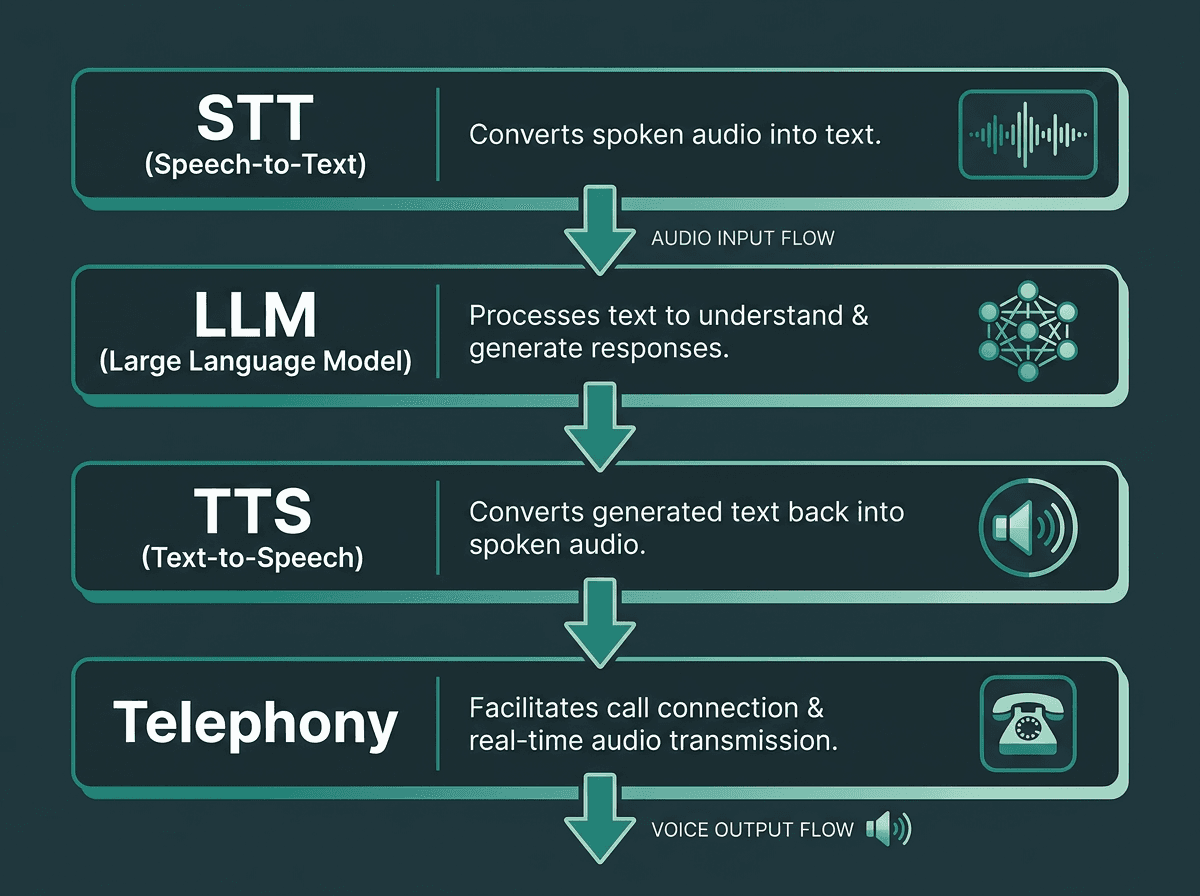
Each layer of the voice AI stack handles a distinct transformation of data.
Speech-to-Text (STT): Turning Sound into Meaning
Speech-to-text (STT), often referred to as Automatic Speech Recognition (ASR), takes raw audio and turns it into a transcript the rest of the stack can work with. In real time, the STT engine cannot sit around waiting for a full sentence. It streams partial hypotheses as the person speaks (streaming transcription), which lets downstream components start early instead of idling. The downside is that mistakes propagate: one wrong word near the beginning of an utterance can steer the LLM toward the wrong intent and produce an answer that sounds confident and is still incorrect.
One piece that quietly dominates perceived speed is Voice Activity Detection (VAD), the logic that decides when speech starts and when it ends. If VAD is tuned conservatively, it will hesitate before declaring end-of-speech, and that hesitation shows up as a pause users interpret as “the bot is thinking.” In production, a lot of “latency” complaints are really endpointer behavior.
Large Language Models (LLM): The Reasoning Core
Large language models generate text responses from text prompts, using patterns learned from large training corpora. In a voice pipeline, the LLM sits between the transcript and the reply: it receives the STT output and produces the words the system will say back. The catch is performance. LLM inference is typically the biggest single source of delay, often representing the largest share of latency in the pipeline. Two tactics matter most when you are chasing milliseconds: pick smaller, task-focused models for structured workflows, and stream the LLM output token-by-token so TTS can start speaking before the model has finished composing the entire response.
Text-to-Speech (TTS): Giving the AI a Voice
Text-to-speech turns the LLM’s text into audio a user can actually hear. Neural TTS has reached the point where it can sound convincingly human, but you still pay for quality with compute time. For interactive systems, the non-negotiable requirement is streaming: the TTS engine needs to emit audio chunks as text arrives, not after the full sentence is available. The metric teams watch is when the first audio chunk hits the user’s device, often tracked as Time to First Audio Byte (TTFAB), because that is the moment the conversation stops feeling stalled.
Telephony: The Delivery Layer
Telephony is the transport layer that carries audio between your system and the person on the other end, whether that is the public phone network, VoIP, or a browser session over WebRTC. Most modern deployments rely on SIP trunking or WebRTC media servers, and neither is “free” from an engineering perspective. Codecs introduce compression artifacts, networks introduce jitter, and both can nudge STT accuracy and add delay in ways that only show up under real traffic.
How the Pipeline Actually Flows
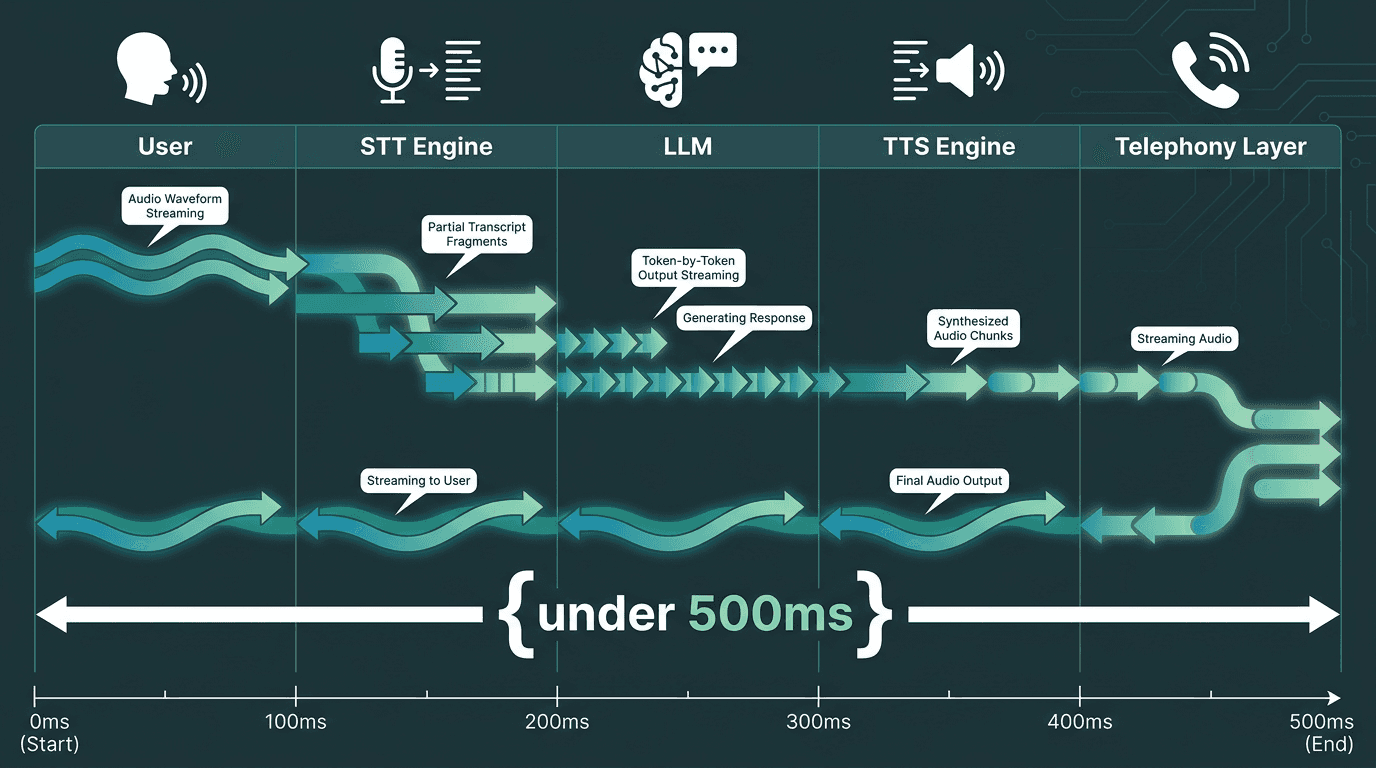
Parallel streaming across every stage is what keeps voice-to-voice latency under 500ms.
A real-time voice stack is not a baton pass where one component finishes and hands off to the next. The systems that feel responsive run the stages in parallel, with streaming and overlap everywhere they can get it. STT starts emitting partial text almost immediately after the user begins speaking. The LLM begins producing tokens once it has enough context to commit. TTS can start synthesizing from the first fragment it receives. Done well, the user reaches the end of their sentence while the system is already partway into preparing the reply.
That overlap is what helps keep voice interactions responsive. For a closer look at why the overlap is an architectural requirement, the article on streaming architecture for real-time voice walks through the concrete design choices that make it work.
Latency Budget: Where the Time Actually Goes
Component | Typical Latency Contribution | Primary Optimization Lever |
|---|---|---|
STT (Streaming ASR) | 50-100ms | Streaming transcription + VAD tuning |
LLM Inference | 150-300ms | Smaller models, token streaming, caching |
TTS Synthesis | 50-150ms (to first audio chunk) | Streaming TTS, low-latency neural models |
Telephony / Network | 20-80ms | Edge deployment, codec selection, WebRTC |
The budget makes the problem obvious: the LLM is where most pipelines spend their time. If you replace a large general-purpose model with a smaller model tuned for a narrow domain, you can often cut inference time by more than half while keeping response quality intact for structured flows like customer support or appointment scheduling. That is a big reason “conversational” models optimized for voice have emerged as products in their own right, not just a checkbox on top of a giant general model.
Real-World Deployment: What This Looks Like in Practice
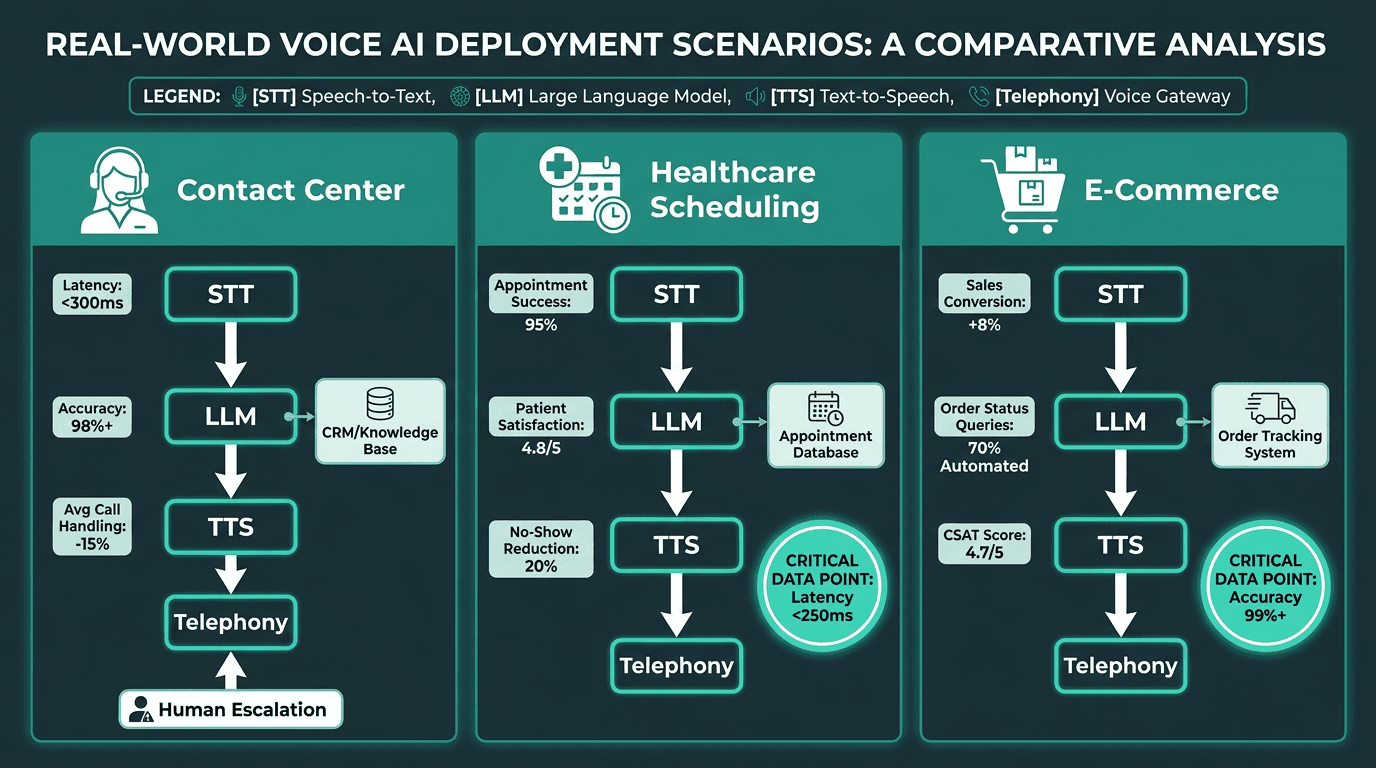
The same four-component voice AI architecture adapts across industries with varying latency and accuracy requirements.
In a typical contact center rollout, telephony connects over SIP into an existing PBX or cloud phone system. STT transcribes the caller as audio arrives, the LLM pulls in the right facts by consulting a knowledge base or CRM via function calling, and TTS speaks back in a consistent brand voice. A human agent stays out of the loop until the system flags a need to escalate. For teams implementing this end to end, a look into voice bot architecture shows how these pieces are connected inside a production SDK.
Common Misconceptions About Voice AI Architecture

Separating fact from fiction across three critical voice AI architecture assumptions.
Misconception 1: Better accuracy always means lower latency. Accuracy and latency usually pull in opposite directions. A larger ASR model can be more accurate, but it often takes longer per audio chunk. In real-time conversations, a slightly less accurate model that responds quickly can deliver the better experience because the user is not left waiting. The trade depends on the job: medical dictation can accept extra delay to reduce errors; a customer service bot generally cannot.
Misconception 2: The LLM is the voice AI. The LLM is the most visible component, but it is still just one part of a four-layer system. Teams that obsess over model choice while neglecting STT quality, TTS prosody, or telephony constraints end up with something that can “reason” but still sounds unnatural or replies too slowly. Users judge the stack as a whole, seams and all.
Misconception 3: Speech-to-speech models eliminate the need for this architecture. Speech-to-speech (S2S) models that take audio in and produce audio out are real, and the category is growing. The trade today is control. Many production deployments still need predictable behavior, auditability, and clear places to inject business logic, all of which are easier when you keep explicit STT, LLM, and TTS stages. In that light, S2S is better treated as a complementary option for specific low-latency scenarios, not a blanket replacement for the STT + LLM + TTS pipeline.
Designing for Production: Key Architectural Decisions
Picking an STT model, an LLM, and a TTS voice is the easy part. The hard part is making the system behave under real traffic, with interruptions, noisy audio, and messy user intent. The article on designing AI voice agents digs into safety guardrails and use-case patterns that sit on top of the basic pipeline.
Critical architectural decisions for production voice AI systems:
Interruption handling: Users interrupt AI responses mid-sentence. The system needs to detect barge-in via VAD, cancel the active TTS stream, and restart the LLM with updated context. If it cannot do that, it immediately feels like a bot that talks over people.
Context window management: The LLM receives conversation history on every turn. As that history grows, inference time climbs. Summarization or sliding-window strategies keep context bounded without dropping important state.
Fallback and escalation logic: Production systems need defined behavior for low-confidence STT, out-of-scope requests, and emotional escalation signals. Treat these as first-class components, not “nice to have” behavior you tack on later.
Edge vs. cloud deployment: Shipping audio to a cloud endpoint adds network delay. A common hybrid pattern is to run STT and TTS at the edge while keeping LLM inference in the cloud for flexibility.
Codec and audio quality: Telephony compresses audio with codecs like G.711 or Opus. Codec choice affects TTS output fidelity and STT input accuracy. Ignore this layer and you will end up chasing “mystery” accuracy regressions in production.
Key Takeaways
What to remember about real-time voice AI architecture:
Voice AI architecture links four stages: STT turns speech into text, the LLM generates a reply, TTS turns that reply into audio, and telephony delivers it to the user.
To feel conversational, total voice-to-voice latency needs to stay within a range that supports natural turn-taking.
LLM inference is usually the largest contributor to total pipeline delay.
Responsive voice systems rely on streaming and overlap across all four layers rather than sequential execution.
VAD tuning in the STT layer is an easy-to-miss lever that can materially change perceived responsiveness.
Real deployments need explicit designs for barge-in, context management, fallbacks, escalation, and codec choices.
Speech-to-speech models can be useful, but they do not replace the STT + LLM + TTS pipeline for most production requirements.
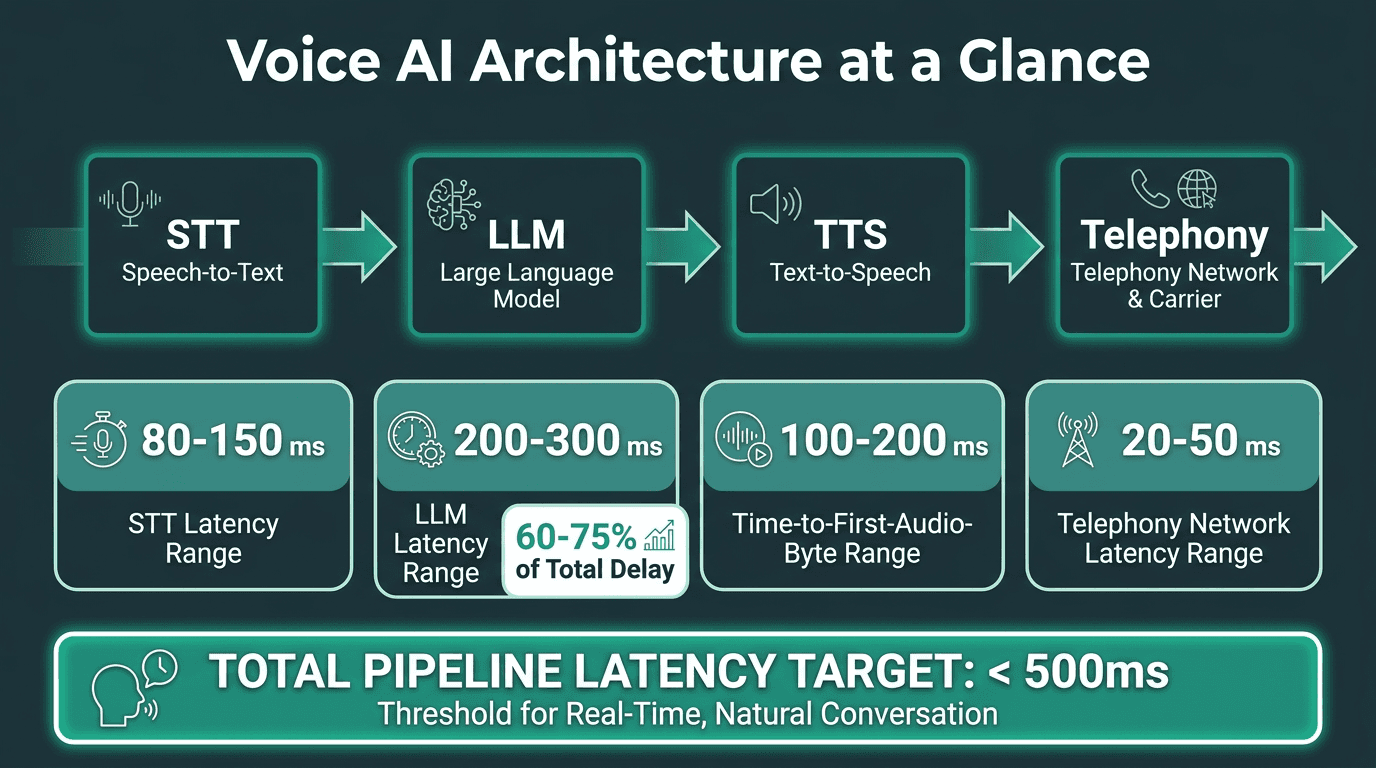
A quick-reference summary of the four-component voice AI pipeline and its latency benchmarks.
Bringing It Together with Smallest.ai
The failure mode in real-time voice AI is rarely “STT broke” or “TTS broke” in isolation. It is the compounded effect of small delays, inconsistent behavior, and integration friction across the entire chain. When teams assemble the stack from multiple vendors, they inherit a coordination problem: each provider optimizes their own layer, and the seams between layers get left behind. Smallest.ai is designed to reduce the integration complexity between those layers.
It offers purpose-built products for key layers of the voice stack, including Pulse for streaming speech-to-text, Lightning for low-latency neural text-to-speech, and Atoms for assembling those components into a complete voice agent without managing the integration yourself. For teams who want to build low-latency voice conversations without stitching together multiple voice infrastructure components, the integrated stack removes a large chunk of the engineering overhead. The pipeline described above reflects the same architectural principles used in production voice AI systems.
Frequently asked questions
What is voice AI architecture?
How much latency should a real-time voice AI system target?
Which component causes the most latency in a voice AI pipeline?
Can a voice AI system handle interruptions from the user?
What is the difference between a speech-to-speech model and the STT + LLM + TTS pipeline?