AI Phone Agents: How They Work for Support and Sales

AI phone agents explained: the STT/LLM/TTS stack, real-world deployments, and the production details (latency, escalation, integration) that make them work.
You have probably talked to an AI phone agent and never realized it. That steady, unhurried voice that confirmed a delivery window, moved an appointment, or guided you through a refund was not a person. These systems now handle millions of customer calls every month, and the slice handled by AI keeps rising. In many cases, callers are unable to differentiate between human agents and their AI counterparts.
What follows is a practical, systems-level explanation of what an AI phone agent is, how the underlying pipeline works, where it’s already deployed at scale, and why a slick demo often collapses in production. If you’re evaluating vendors, building internally, or simply trying to understand what you’re hearing as a caller, the mechanics will help you separate real capability from theater.
What Is an AI Phone Agent?
An AI phone agent is software that can carry a real-time voice conversation over a phone line using speech recognition, language understanding, and voice synthesis. In practice, that means it can run customer support flows, book appointments, qualify leads, and handle other routine calls without a human sitting on the line. It listens, maps what you said to intent, chooses the next action or response, and speaks back fast enough to keep the conversation moving. For a fuller breakdown of what AI phone agents are and how they differ from earlier automation, that resource lays out the foundational concepts clearly.
The difference from older IVR (interactive voice response) systems isn’t cosmetic; it changes the entire interaction. IVR pushes callers through menu trees: press 1 for billing, press 2 for support. It falls apart when someone speaks normally: “I was charged twice last week and I need to fix it.” An AI phone agent is built for that kind of open-ended language, can hold context across multiple turns, and answers in a voice that feels conversational rather than like a stitched-together prompt library. This isn’t a small upgrade. It’s a different category of interface.
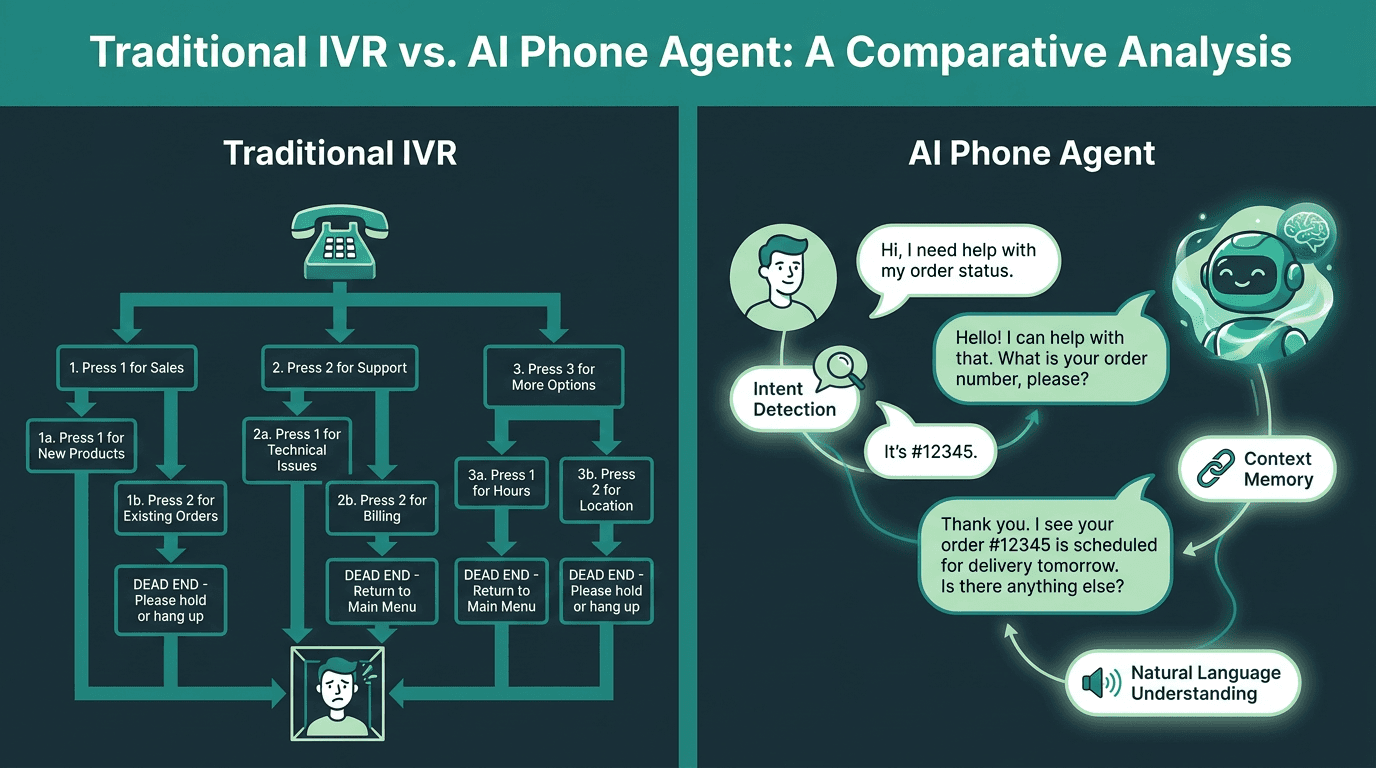
Traditional IVR relies on rigid menu trees. AI phone agents handle open-ended natural language in real time.
The Technology Stack Behind Every Call
No serious AI phone agent is “one model that does it all.” It’s a pipeline of specialized components, and any lag in the chain shows up as awkward silence on the line. A typical stack has four parts: speech-to-text (STT) to transcribe audio, a language model layer to decide what to do, text-to-speech (TTS) to speak back, and an orchestration layer that keeps the whole exchange real-time (AssemblyAI, 2026). Each layer can fail in its own way, which is why the strongest deployments are engineered as a single system, not a pile of swap-in vendors.
Listening: Speech-to-Text in Real Time
Automatic speech recognition (ASR) turns the caller’s audio into text the rest of the system can work with. The practical dividing line is streaming ASR versus batch ASR. Batch waits for the speaker to finish, then transcribes. Streaming transcribes as the caller talks, which is essential for phone calls where even a small delay reads as “the system is stuck”. Real-world accuracy is where things get painful: regional accents, road noise, a speakerphone in a kitchen, and domain vocabulary in medical, legal, or retail settings all expose weaknesses that polished demos rarely surface.
Understanding and Deciding: The Language Model Layer
Once the words are in text form, the language model layer interprets intent, keeps track of dialogue state, and chooses what to say or do next. This is where the agent earns the label “intelligent.” Large general-purpose models buy you breadth, but they also bring latency and cost that get ugly when you’re running at contact-center scale. Smaller, task-specific language models built around a defined set of intents are often faster and cheaper per call, while staying accurate for the workflows they’re meant to handle. Multi-turn context is the real exam: the agent has to remember that the caller gave an order number two turns ago while still answering the question they’re asking right now.
Speaking: Text-to-Speech and Voice Quality
Text-to-speech (TTS) turns the agent’s response into audio. It’s also the layer callers judge most harshly: a stiff, synthetic voice can drain trust even if the underlying reasoning is correct. For conversations that feel natural instead of laggy, teams typically target sub-300ms end-to-end response time. Stretch that to a full second and the whole exchange starts to feel broken. If you want the mechanics behind that timing budget, how to build faster AI voice agents breaks down where latency accumulates and how teams shave it down.
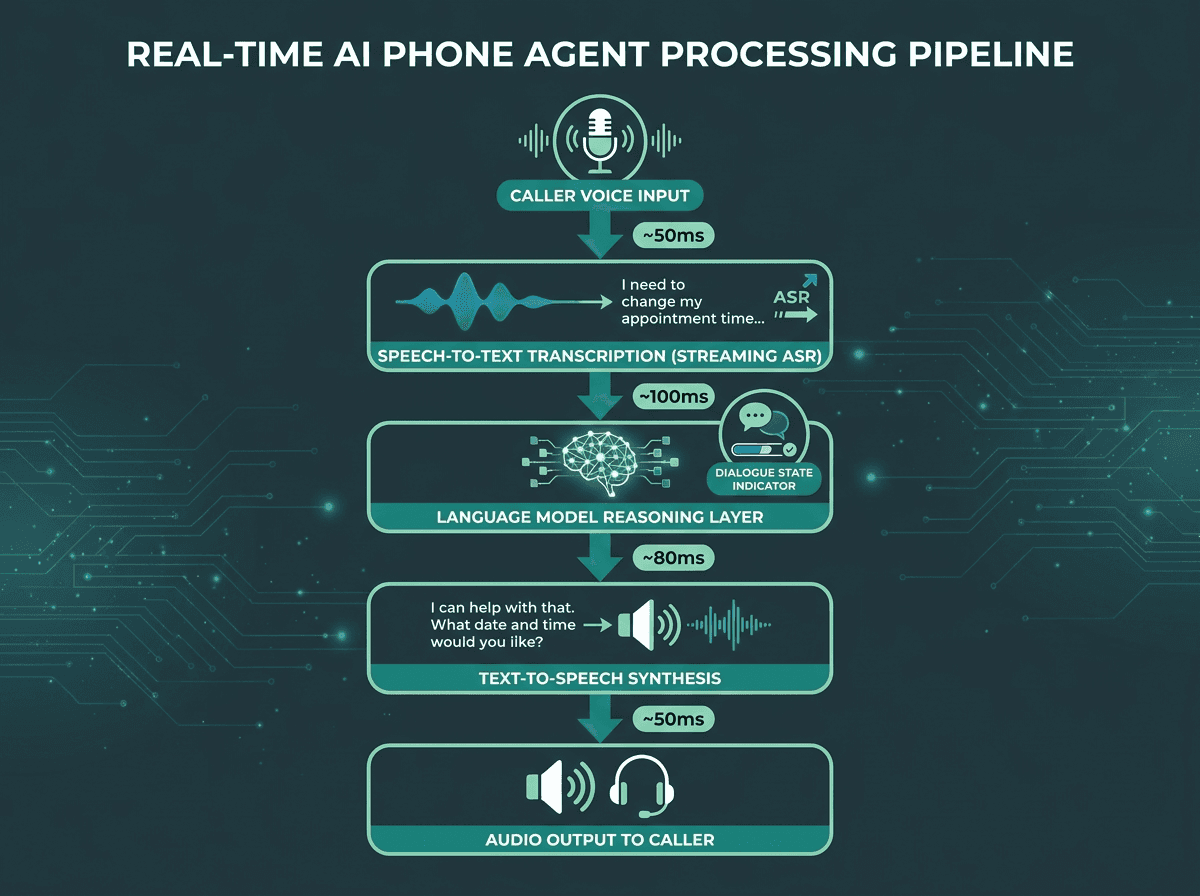
Every AI phone call passes through this four-stage pipeline. Latency at any stage degrades the caller experience.
Support vs. Sales: Two Different Jobs, One Architecture
A return request and a sales qualification call can run on the same underlying stack, but they’re not the same job. The divergence is in conversation design and in what “success” means. A support agent is judged on resolution speed, accuracy, and deflection rate. It has to understand the issue, pull the right information or trigger the right action, and wrap the call cleanly. A sales agent is measured on qualification, objection handling, and knowing when to hand off to a human rep. It needs discovery questions, a light touch of rapport, and a reliable read on buying signals.
Mix those goals and you get the kind of automation customers complain about. A support agent that starts trying to upsell feels pushy and off-brand. A sales-tuned agent dropped into a billing dispute feels slippery and infuriating. The architecture can support both, but the prompt engineering, dialogue flows, escalation logic, and KPIs should be designed as separate systems. For teams building on the sales side, building an AI agent for sales calls walks through the design process. For the support side, set up AI agents for better customer support focuses on the practical setup.
Where These Systems Are Actually Being Deployed
The scaled use cases are already well-established, and they’re mostly the kinds of calls people don’t want to wait on hold for. Healthcare organizations use AI phone agents for appointment scheduling and prescription refill reminders, with some health systems reporting call deflection rates after deployment. Financial services firms run fraud alert callbacks and account verification flows where consistency and structure play to AI’s strengths. E-commerce and retail teams use agents for order status, returns initiation, and post-purchase upsell calls at volumes that would be hard to staff cost-effectively with humans alone.
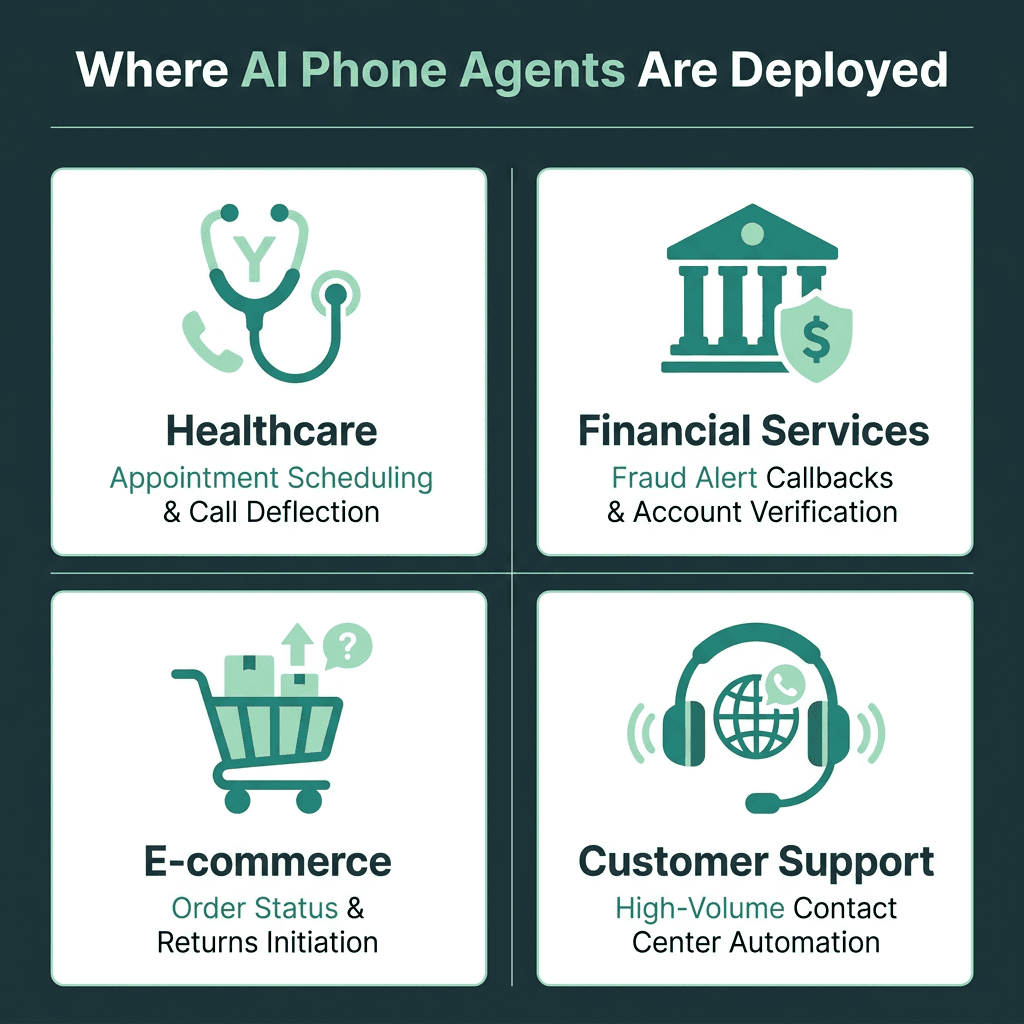
AI phone agents are now embedded across healthcare, financial services, retail, and contact center operations.
Three Things People Get Wrong About AI Phone Agents
These misconceptions tend to drive bad deployment choices and unrealistic expectations:
"It is just a smarter IVR." IVR routes callers through predefined menus using keypad input or simple keyword matching. An AI phone agent handles open-ended natural language, carries context across multiple turns, and can take action in backend systems. That’s not “smarter routing”; it’s a different class of system.
"AI agents will replace all human agents." Most rollouts look like augmentation plus escalation, not a clean replacement. Edge cases, emotionally charged calls, and high-stakes decisions still belong with humans. The balance between AI and human agents is something you design for, not a switch you flip.
"Latency does not matter if the voice sounds good." A one-second pause is enough to make a conversation feel busted. Speed and voice quality are both table stakes. A beautiful voice that hesitates for two seconds fails the caller just as reliably as a robotic voice that answers immediately.
What Makes or Breaks an AI Phone Agent in Production
Most projects don’t fail because the demo was impossible; they fail because production is unforgiving. Four factors tend to decide whether an AI phone agent survives real call volume.
End-to-end latency is the floor. Add delay at every hop and you end up with a conversation that feels like talking to someone on a bad satellite connection: you speak, you wait, you wonder if you were heard. Then there’s voice naturalness, which functions as the trust layer. Callers form an opinion in the first couple of seconds, and that initial impression largely determines how much patience they’ll give the system for the rest of the call.
Fallback and escalation logic is where “good” deployments separate from the ones people rage-quit. When the agent can’t parse the request or the call drifts outside its scope, it needs a clean handoff to a human. Dead ends create the harshest feedback loops for AI phone systems. Backend integration is the other make-or-break piece: CRM, ticketing, scheduling, order management. Without those connections, the agent can only acknowledge problems, not resolve them. A voice that sounds helpful but can’t look up an account or update a record doesn’t move the call forward.
Voice cloning has also become a real lever for acceptance. When brands keep a consistent, recognizable voice across AI calls, callers tend to accept the automation more readily than when they hear a generic synthesized voice. Consistency helps the automated touchpoint feel like part of the same brand, not a bolt-on.
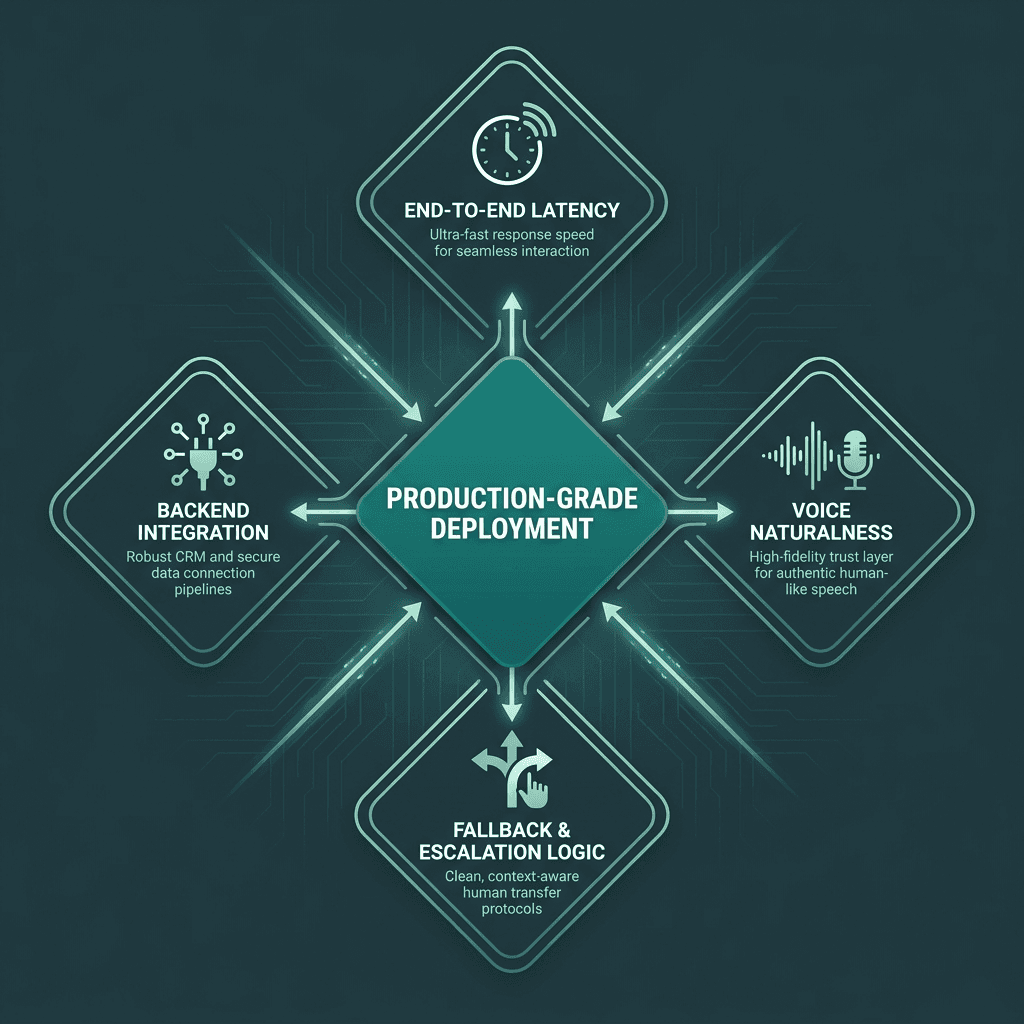
These four factors determine whether an AI phone agent succeeds in production or fails under real call volume.
AI Phone Agent Capability Comparison
Platform | End-to-End Latency | TTS Voice Quality | STT Accuracy | Built-In Language Model | Customization Depth | Platform Type |
|---|---|---|---|---|---|---|
Smallest.ai (Atoms + Lightning + Pulse + Hydra + Electron) | Targets sub-300ms across the end-to-end stack | Ultra-low-latency neural TTS via Lightning; supports voice cloning | Streaming STT via Pulse; tuned for real-time phone audio | Electron: a conversational small language model built for voice agents | High: configurable full stack; API-first agent platform | Full agent platform + API access via Waves |
Enterprise Hosted Platform | Varies; commonly 500ms to 1s+ depending on setup | High quality, but voice customization is often constrained | Strong on clean audio; performance drops with noise | General-purpose LLM integration; not optimized for voice | Moderate: template-driven with limited configuration | Managed platform with limited API depth |
Open-Source Self-Hosted | Depends on how much you invest in infrastructure | Variable; depends on the models you select | Can be strong if tuned well; operational overhead is high | Bring-your-own LLM; maximum flexibility, few defaults | Very high: full control, with high engineering cost | Self-hosted, developer-assembled stack |
Point-Solution TTS/STT API | Low latency per component, but no orchestration layer | High quality per component | High accuracy per component | None; requires separate LLM integration | Low: single-function tool rather than a full agent | API only; no agent orchestration |
Key Takeaways
The essential points on AI phone agents:
An AI phone agent is a real-time voice system that listens, understands natural language, reasons about intent, and responds in a synthesized voice without a human on the line.
The stack typically has three core AI layers: speech-to-text (ASR), a language model for reasoning and dialogue management, and text-to-speech (TTS) for voice output.
Support and sales agents run on the same architecture, but they need different conversation design, success metrics, and escalation logic.
Sub-300ms end-to-end latency is the bar for conversations that feel natural. Latency and voice quality aren’t a tradeoff; you need both.
Production deployments most often fail on fallback logic and backend integration, not on the models in isolation.
The conversational AI market is experiencing rapid growth, with a projected compound annual growth rate of over 20%.
Voice cloning and a consistent brand voice can improve caller acceptance rates in production deployments.
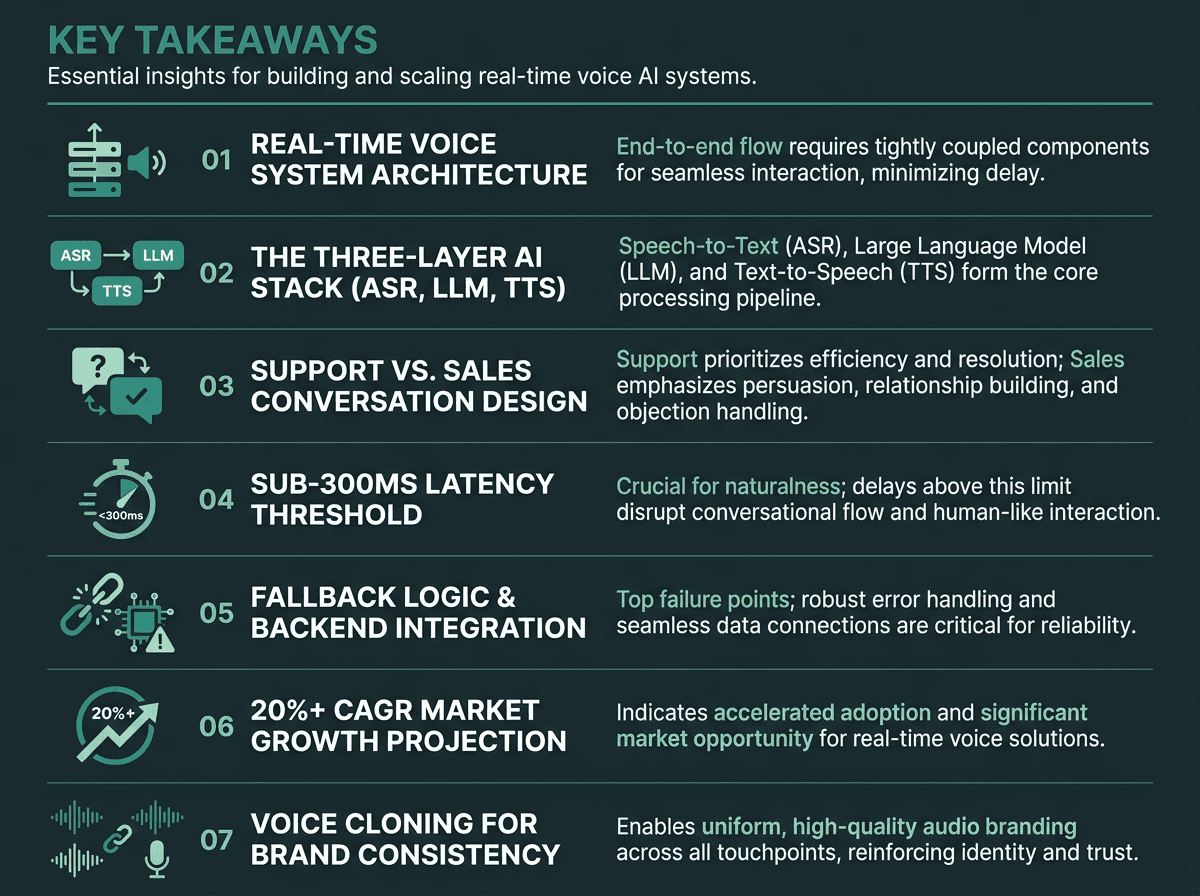
Seven things worth remembering about how AI phone agents work and what makes them succeed.
The Infrastructure Problem No One Talks About
The hard part of building an AI phone agent isn’t the concept; it’s the voice pipeline. Getting low latency and consistent quality is difficult even before you add real call volume. Many teams start by stitching together separate ASR, LLM, and TTS providers, then spend months chasing latency spikes, inconsistent voices, and integration issues that only appear at scale. Each component looks fine on its own. The trouble shows up in the handoffs.
That integration tax is what derails a lot of projects before they ever feel production-ready. When components weren’t designed to cooperate, every boundary adds delay, new error surfaces, and more operational work. You end up juggling multiple vendor relationships, multiple SDKs, and multiple failure modes just to complete one phone call.
Smallest.ai's Voice Agents platform, Atoms, is built to reduce that seam work. Lightning handles ultra-low-latency TTS with voice cloning support. Pulse provides streaming STT tuned for real-time phone audio. Hydra manages speech-to-speech processing. Electron is a conversational small language model designed for voice agent workloads rather than adapted from a general-purpose model. Because these components are designed as a single stack, latency, quality, and reliability are engineered characteristics, not surprises that appear in production. If you’re moving from concept to a real rollout, the complete guide on AI phone agents lays out the broader deployment picture, and pricing for AI phone agents on the Smallest.ai platform is available directly.
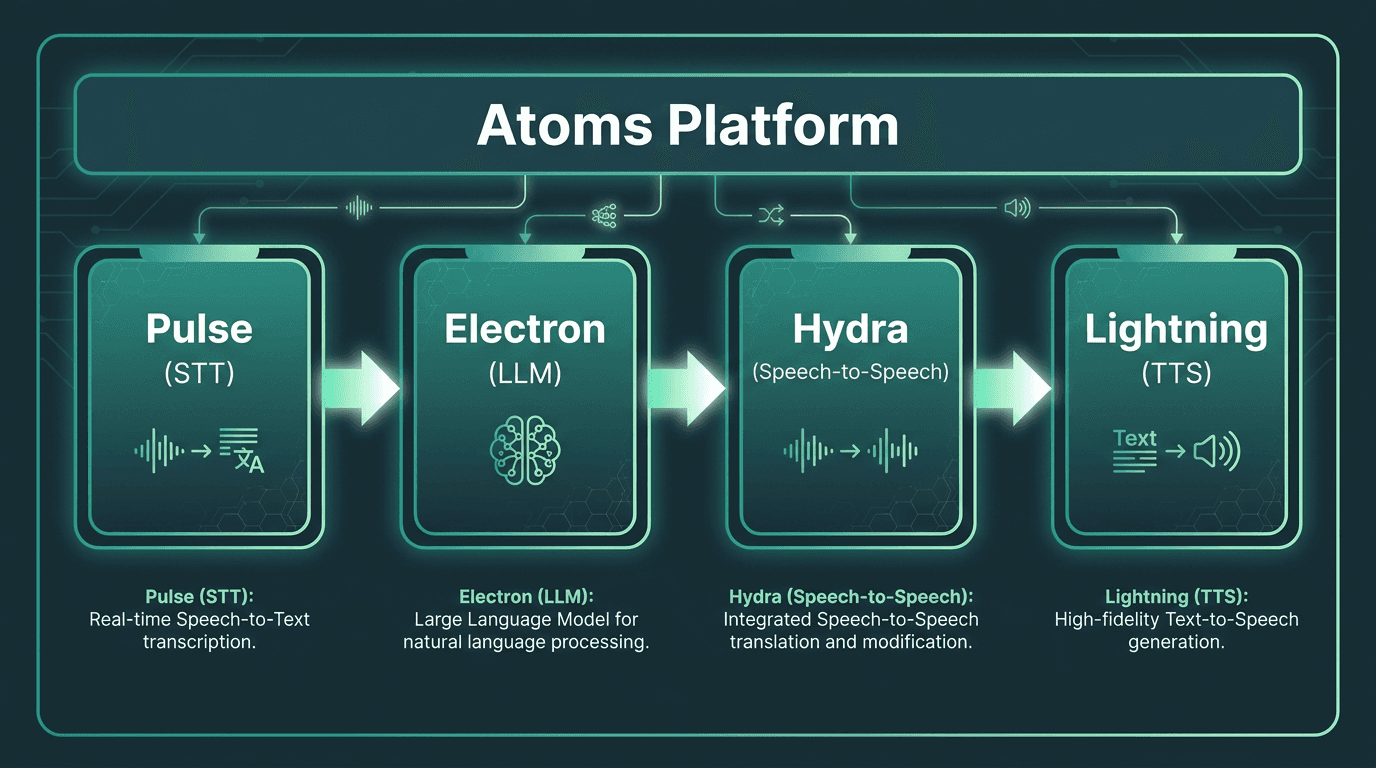
Smallest.ai's Atoms platform integrates Lightning, Pulse, Hydra, and Electron as a single coherent voice agent stack.
Frequently asked questions
How does an AI phone agent differ from a traditional IVR system?
What latency does an AI phone agent need to feel natural on a real call?
Can an AI phone agent handle multi-turn conversations, or is it limited to simple queries?
Do support and sales require separate AI phone agents, or can one agent do both?
What infrastructure do you need to deploy an AI phone agent at scale?