Long-Form TTS: How to Generate Consistent Speech at Scale

A production guide to long-form TTS: semantic chunking, stable pronunciation, streaming modes, audio assembly, retry logic, and scalable orchestration.
Long-form TTS turns document synthesis into a systems problem. A voice that sounds convincing for twenty seconds can drift over a chapter as pacing, pronunciation, energy, pauses, loudness, or encoding shifts between requests.
The workflow below proceeds from document preparation through synthesis, audio assembly, recovery, and scale. It targets developers building audiobooks, accessibility products, educational narration, publishing systems, and other long-form text-to-speech applications. By the end, you should be able to design a pipeline that preserves linguistic context while keeping every segment independently reproducible.
Table of contents:
Why Long-Form TTS Is a Different Engineering Problem: Context, drift, and request boundaries.
Step 1: Normalize and Segment the Document: Deterministic text preparation and semantic TTS chunking.
Step 2: Lock Voice and Pronunciation State: Stable synthesis settings and vocabulary control.
Step 3: Choose an Execution and Delivery Mode: Sequential, parallel, synchronous, SSE, and WebSocket synthesis.
Step 4: Assemble and Validate Continuous Audio: Seam handling, encoding, retries, and scalable architecture.
Production Checklist and Summary: Deployment checks and operating principles.
Recommended URL slug: long-form-tts-consistent-speech-at-scale
Why Long-Form TTS Is a Different Engineering Problem
Short synthesis is judged locally: is the sentence intelligible and natural? Long-form speech is judged across time. Listeners notice whether a narrator maintains identity, whether paragraph openings carry appropriate emphasis, and whether a recurring term sounds the same an hour into playback.
Research published in the ISCA Archive found that evaluating synthesized speech sentence by sentence does not fully capture long-form quality, because surrounding context can change how listeners rate the same material.
Why a few sentences and a complete document behave differently
Concern | Short request | Long-form pipeline |
|---|---|---|
Context | Contained within one passage | Must survive request boundaries |
Pronunciation | Few repeated entities | Names and acronyms recur across chapters |
Audio | One encoded result | Many segments require compatible assembly |
Recovery | Retry the request | Retry only the failed or rejected segment |
Quality control | Manual listening is practical | Automated checks and targeted review are required |
What most implementations get wrong: They treat document synthesis as repeated sentence synthesis. The resulting audio can be individually clean but globally incoherent.
Step 1: Normalize and Segment the Document
Build a deterministic normalization layer
Do not send extracted document text directly to a speech synthesis API. Normalize Unicode, collapse accidental whitespace, remove nonspoken markup, resolve typographic punctuation, and classify headings, lists, quotations, footnotes, and code. Preserve both the original text and a versioned normalized representation so generated audio stays auditable.
Normalization decisions should be explicit:
Expand numbers according to context. The string 1205 could mean a year, a quantity, an identifier, or twelve-oh-five.
Define how dates, currencies, units, URLs, email addresses, and mathematical notation are spoken.
Resolve abbreviations before synthesis when their expansion is unambiguous.
Keep language tags and speaker changes as metadata rather than flattening them into prose.
Record character offsets that map normalized text back to the source document.
Chunk by meaning, not character count
TTS chunking should start from sentence and paragraph boundaries. Accumulate complete sentences until a configurable target is reached, but prefer ending at a paragraph, heading, scene change, or dialogue boundary. Never split inside a number, abbreviation, quoted phrase, or pronunciation token.
Practical algorithm: parse structure, detect sentences, estimate each candidate's synthesis cost, append while under the configured target, then select the strongest nearby semantic boundary. Store chunk ID, source range, preceding context, following context, and a hash of normalized text.
There is no universally optimal chunk size. The right range depends on model behavior, API constraints, latency goals, language, paragraph structure, and whether the application needs progressive playback. Test several ranges using complete documents, not isolated samples. Sending an extremely large block as one request increases timeout exposure, complicates retries, reduces observability, and can exceed practical service limits.
Step 2: Lock Voice and Pronunciation State
Create an immutable synthesis profile for each production. It should cover the voice or clone identifier, model version, language, speed, sample rate, output format, channel layout, pronunciation resource version, and every relevant generation control exposed by the provider. Hash the profile and attach that hash to each request.
A consistent AI voice requires a persistent voice identity. Do not recreate or reclone the voice per chunk. When using Smallest.ai's Waves API with a Lightning model, keep the selected voice and supported synthesis parameters fixed across the document. Consult the current official documentation when constructing requests, because available fields vary by endpoint and model.
Treat pronunciation as production data
Extract named entities, abbreviations, acronyms, product names, measurements, and domain vocabulary before synthesis.
Create canonical spoken forms, including language-specific variants and case-sensitive exceptions.
Use pronunciation dictionaries or lexicons where the selected text-to-speech API supports them.
Otherwise, apply controlled text substitutions and test that they do not alter visible alignment or captions.
Version the dictionary. Regenerate only chunks affected by a changed entry.
Context still matters. NASA is normally spoken as a word; API is usually spelled out. A surname can differ by person, and an abbreviation can expand differently by domain. Run an entity review before expensive AI voice generation, especially for medical, legal, scientific, and multilingual material. Teams managing voice identity across products can also use a documented process to keep voice identity consistent.
Step 3: Choose an Execution and Delivery Mode
Execution mode selection
Mode | Use when | Operational concern |
|---|---|---|
Synchronous | A bounded chunk is ready and the caller can wait | Timeouts and response size |
SSE | Complete text is already available but audio should arrive progressively | Reconnect and partial-output handling |
WebSocket | Text arrives incrementally from an agent, model, or live source | Session state, ordering, and backpressure |
Synchronous requests are straightforward for offline document jobs. Smallest.ai documents SSE streaming for cases where the complete text is already known and WebSocket streaming when text arrives incrementally. That distinction matters: streaming text-to-speech is not one transport pattern, and picking the wrong one introduces buffering or session complexity without improving narration quality.
Sequential versus parallel synthesis
Sequential synthesis simplifies ordering and can preserve state when an API explicitly supports contextual continuity, but total job time grows linearly with chunk count. Parallel synthesis improves throughput and isolates slow requests, yet it raises rate-control pressure and can make cross-chunk prosody differences more noticeable because chunks are synthesized independently.
Recommended production compromise: use bounded parallelism within a document, preserve strict output ordering, and pass supported context consistently. Start conservatively, compare adjacent-boundary quality, then increase concurrency only when listening tests and waveform metrics remain stable.
For any TTS API targeting developers, concurrency controls belong in the orchestration layer. Use a queue, a per-provider limiter, exponential backoff with jitter, and idempotency keyed on document ID, chunk hash, and synthesis-profile hash.
Step 4: Assemble and Validate Continuous Audio
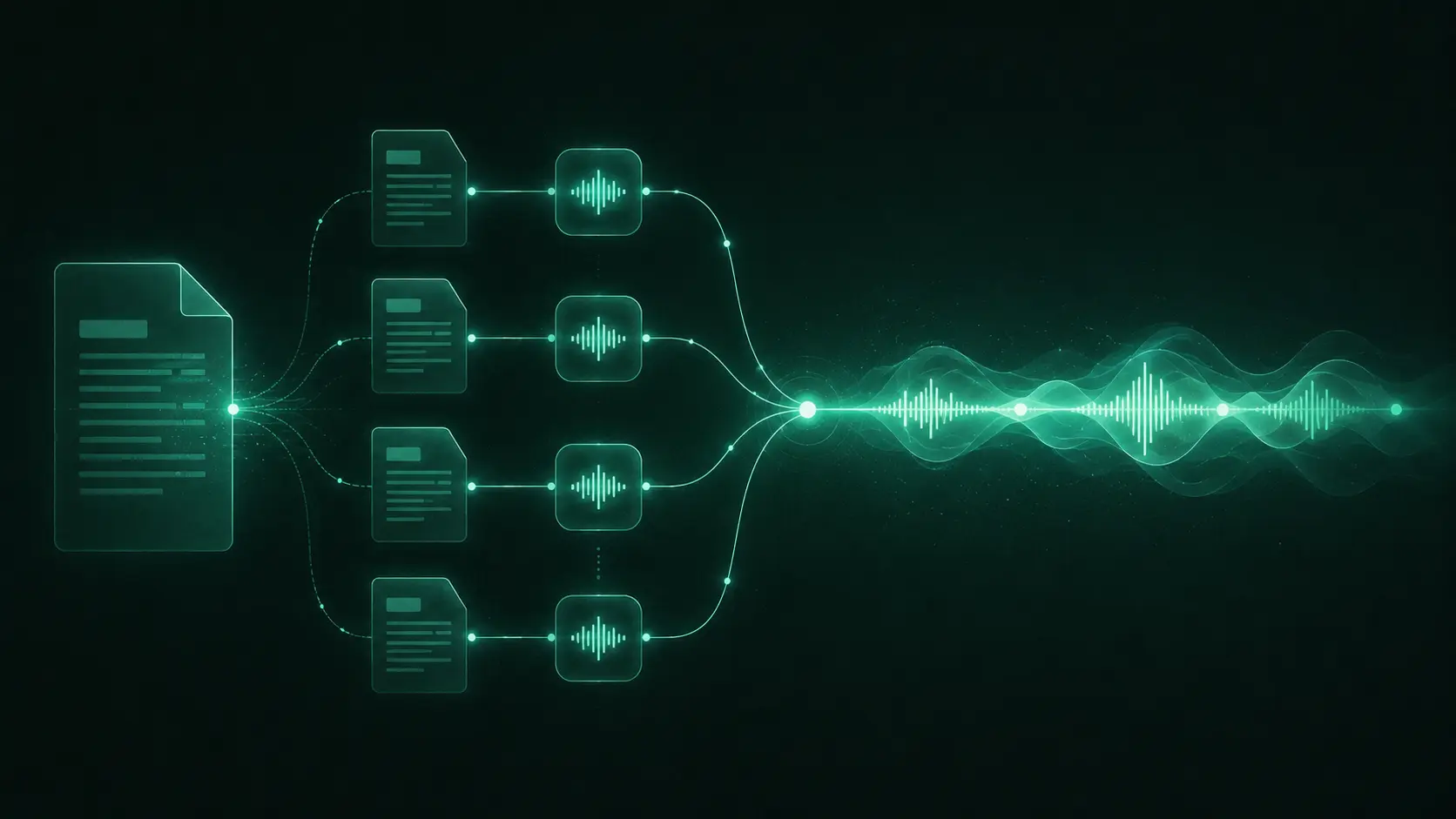
Join compatible PCM first, validate transitions, then encode the final deliverable.
Join audio without creating seams
Decode every response to a common PCM representation before concatenation. Verify sample rate, bit depth, channel count, and frame alignment. Do not assume that byte-concatenating independently encoded MP3 or container files will produce a clean, standards-compliant result. Decode segments to a common PCM format, assemble them, and encode the final program once.
At each boundary:
Measure leading and trailing silence, but do not remove intentional rhetorical pauses.
Insert pause duration from document structure, such as sentence, paragraph, heading, or scene break.
Apply very short fades only when they prevent clicks. Broad crossfades can smear consonants or duplicate room tone.
Check peak level, DC offset, loudness, and discontinuity against neighboring segments.
Encode once after assembly using one codec configuration.
Normalization does not mean forcing every chunk to identical loudness independently. Per-chunk gain changes make noise and vocal energy pump at boundaries. Measure chunks, flag outliers, assemble the program, then apply controlled program-level normalization. Retain archival PCM or a lossless intermediate so future exports do not accumulate codec damage.
Use a manifest for recovery and scale
A scalable text-to-speech system stores one manifest per document. Each chunk record contains source offsets, normalized text hash, synthesis profile, pronunciation version, request ID, attempt count, provider response metadata, audio checksum, duration, validation results, and object-storage location.
Workers claim queued chunks, call the speech synthesis API, upload immutable outputs, and update status transactionally. The assembler runs only when required chunks pass validation. A failed chunk is retried independently; a changed paragraph invalidates only its dependent chunks. Keep request IDs and provider error bodies for incident analysis.
Reference architecture: ingestion service to normalizer to semantic segmenter to durable queue to bounded synthesis workers to object storage to audio assembler to automated QC to publishing. A control database stores manifests and state transitions, while metrics track attempts, latency, output duration, validation failures, and queue age.
Scale by separating document-level orchestration from chunk-level execution. Partition queues by tenant or priority, enforce quotas, cache identical chunk outputs only when all synthesis inputs match, and use dead-letter handling for permanent failures. For publishing workflows, see how teams turn written content into long-form audio at scale.
Production Checklist and Summary
Developer checklist:
Normalize text deterministically and preserve source mappings.
Split on linguistic boundaries, not arbitrary character offsets.
Version voice, model, language, speed, pronunciation, sample rate, and format settings.
Use bounded concurrency with idempotent retries and request tracking.
Assemble common PCM, manage pauses deliberately, and encode once.
Validate seams, duration, loudness, clipping, missing audio, and pronunciation-sensitive chunks.
Store manifests so individual chunks can be regenerated safely.
Choose synchronous, SSE, or WebSocket delivery based on text availability and playback requirements.
Reliable long-form TTS comes from preserving state across many controlled synthesis operations. Semantic segmentation protects language context, immutable profiles protect voice identity, pronunciation data protects recurring vocabulary, and manifests make failure recovery economical.
Developers can implement this workflow with Smallest.ai's text-to-speech solution and its documented synchronous, SSE, and WebSocket TTS APIs. Keep the orchestration, validation, and audio assembly layers provider-aware but independently testable.
Frequently asked questions
Should I send an entire book in one TTS request?
What chunk size should I use for long-form TTS?
Can I synthesize all chunks in parallel?
How do I keep technical terms pronounced consistently?
When should I use streaming instead of synchronous TTS?


