Fastest TTS APIs for low-latency voice agents

Fastest TTS APIs for voice agents in 2026, compared by TTFA, streaming, voice quality, pricing, and dev experience across five providers.
When someone talks to a voice agent and the reply takes more than a second to arrive, the exchange stops sounding like a conversation and starts feeling like a slow web form. The low-latency TTS API you pick is the final choke point before sound hits the user's ear, and in a full STT + LLM + TTS pipeline, small delays stack up fast. Streaming architectures generally reduce perceived response time by allowing audio playback to begin before synthesis fully completes.
As voice agents show up in customer support, healthcare, and fintech, the bar for TTS infrastructure keeps climbing. This comparison looks at five major TTS APIs using the measures that matter in real-time systems: Time to First Audio (TTFA), streaming support, voice quality, pricing, and developer experience.
What Makes a TTS API Fast Enough for Voice Agents
Before you line up providers, you need a shared definition of "fast." The headline number is Time to First Audio (TTFA), sometimes described as Time to First Byte (TTFB) when you're dealing with audio streams. TTFB needs to land under 300 ms if you want the interaction to feel responsive. For a full voice agent round-trip to feel responsive, the combined STT + LLM + TTS budget should stay under 800 ms. If you're trying to pinpoint where your delays actually come from, how to build faster AI voice agents is a solid starting point.
Criterion | Why It Matters | Target for Voice Agents |
|---|---|---|
Time to First Audio (TTFA) | Sets the user's perception of responsiveness | < 300 ms |
Streaming Support | Lets audio start playing before synthesis fully finishes | Chunked / WebSocket |
Voice Quality & Naturalness | Directly affects trust and willingness to keep talking | Neural, human-like |
Pricing Model | Determines unit economics once you scale | Per-character or per-minute |
Developer Experience | Controls how quickly teams can integrate and ship | REST + WebSocket SDKs |
Scalability & Concurrency | Keeps latency stable under spikes and many sessions | Auto-scaling infra |
Smallest.ai Lightning: Built From the Ground Up for Real-Time
Smallest.ai's Lightning API was built around a blunt requirement: voice agents cannot sit around waiting for audio. It streams output in chunks from the earliest usable fragment and is designed for low-latency speech generation in real-time applications. That performance isn't framed around perfect lab conditions. Lightning pipelines text normalization, phoneme prediction, and waveform synthesis so the first audio can ship while the rest of the input is still being processed.
Lightning is delivered through the Waves API, with both REST and WebSocket options. For voice agents, WebSocket is the path that counts: a persistent connection avoids repeated TCP handshakes, and it supports mid-stream interruption so the agent can stop talking when the user cuts in. Voice cloning is available through the same API, which keeps a production agent on one provider and one integration even when you need a consistent branded voice. The platform also includes a real-time speech-to-text API called Pulse.
Where Lightning stands out:
Sub-100 ms TTFA on the WebSocket streaming path.
Interruption handling built into the streaming protocol.
Voice cloning integrated directly into the TTS endpoint.
Clear Smallest.ai pricing, plus a free tier for prototyping.
Lightning is designed primarily around real-time conversational use cases, where latency, streaming behavior, voice consistency, and operational simplicity are often more important than maintaining a large catalog of voices.
ElevenLabs Flash: TTS for Customization and Content Workflows
ElevenLabs is widely used in text-to-speech applications, and Flash v2.5 is its attempt to close the latency gap. Flash v2.5 is positioned as a lower-latency option within ElevenLabs' TTS lineup, but latency varies based on workload and deployment conditions. For real-time applications, latency consistency can be just as important as average response time.
ElevenLabs is commonly evaluated in projects that prioritize voice customization, multilingual support, and content-generation workflows. Pricing is character-based, and deployment requirements vary depending on workload and latency expectations.
Cartesia Sonic: The Latency Specialist
Cartesia Sonic is another provider commonly evaluated for low-latency TTS. It leans on a state-space model (SSM) architecture rather than a transformer, which keeps memory use fixed instead of growing with sequence length. In practice, that shows up as steadier latency even when the agent swings between quick confirmations and longer, more detailed answers.
The provider is designed for low-latency streaming workloads.
Deepgram Aura: Pragmatic Speed for Production Pipelines
Deepgram Aura is often evaluated in the context of a unified STT and TTS pipeline. The argument is that latency is a systems problem, not a single-component scoreboard. If you're already on Deepgram Nova for STT, keeping the pipeline inside one vendor can cut a network hop and shave off handoff overhead. In a tightly integrated deployment, keeping STT and TTS within the same vendor ecosystem can reduce integration complexity and network handoffs.
The API supports low-latency streaming use cases. Aura includes a range of voices intended for production speech applications. Pricing is usage-based and tied to character volume. Aura is often evaluated alongside Deepgram's broader speech platform offerings.
OpenAI TTS: Familiar but Not Built for Real-Time
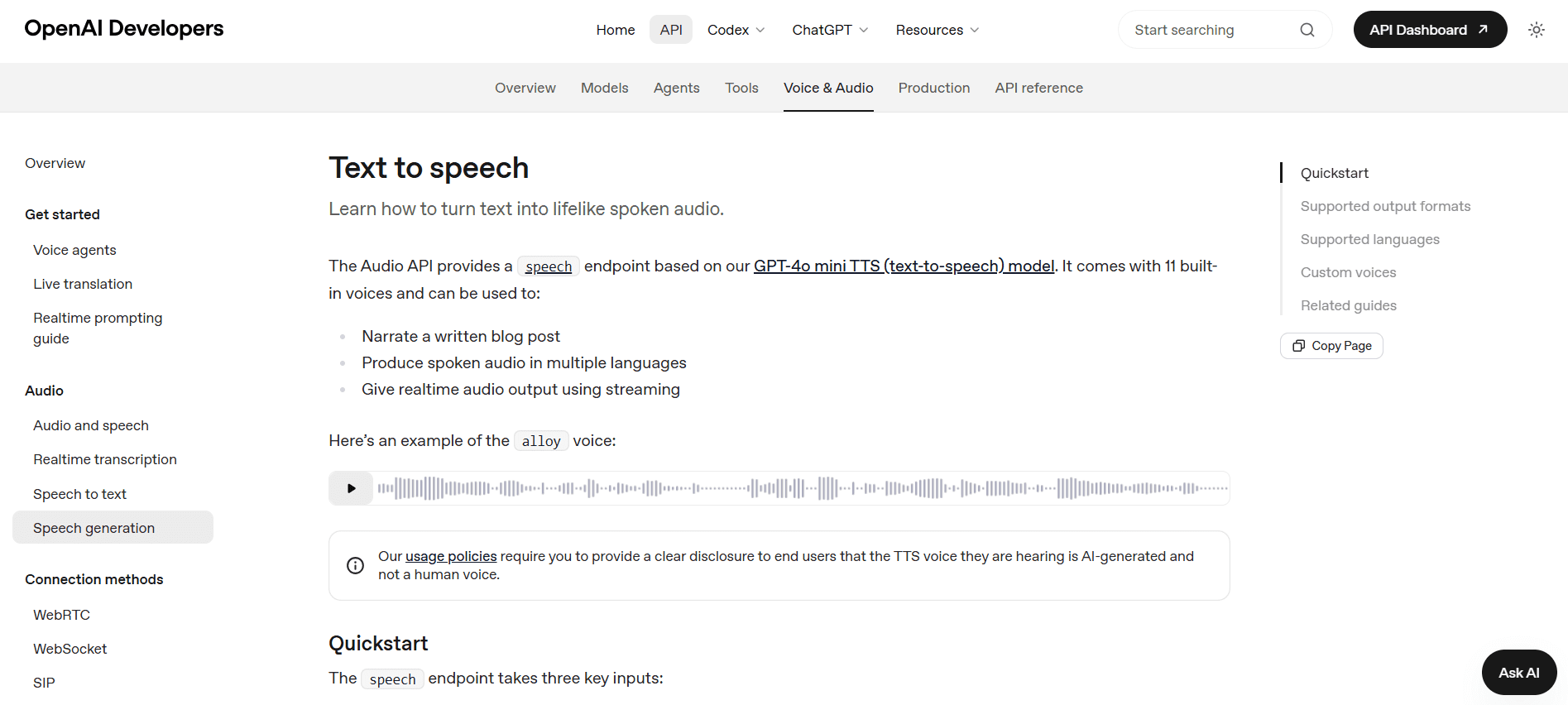
OpenAI's TTS API is convenient if you're already building around GPT. The issue is how it's put together. The standard endpoint returns a fully rendered audio file instead of a stream, so TTFA effectively becomes total synthesis time. For conversational workloads, total synthesis time can become a meaningful part of overall response latency. Streaming support is available, but it is generally evaluated differently from streaming-first voice systems.
If you're generating narration for video, producing podcast audio, or running batch text-to-audio jobs, OpenAI TTS can fit just fine. For interactive agents, the latency profile may be less suitable for real-time conversational applications. If you're weighing the trade-offs between free neural TTS vs. production APIs, OpenAI is commonly evaluated for content generation workflows rather than real-time conversational applications.
Head-to-Head: Low-Latency TTS API Comparison Table
Provider | Latency Profile | Streaming | Voice Cloning | Common Use Case |
|---|---|---|---|---|
Smallest.ai Lightning | Very low latency streaming | WebSocket + REST | Yes, via API | Real-time voice agents, low latency at scale |
Cartesia Sonic | Very low latency streaming | WebSocket | Limited | Latency-critical agents, uniform response times |
Deepgram Aura | Low latency streaming | REST streaming | No | Teams using Deepgram STT in a unified pipeline |
ElevenLabs Flash | Streaming support available | REST streaming | Yes | Expressive, multilingual content and agents |
OpenAI TTS | Streaming support available | Partial streaming | No | Content narration, batch audio generation |
Verdict: How to Choose a Low-Latency TTS API
The choice of a low-latency TTS API depends on specific project requirements and existing technical stacks. Teams should evaluate providers based on their required latency thresholds, need for features like voice cloning, and any existing vendor relationships. For applications where speed is the primary driver, latency requirements should be evaluated alongside streaming behavior, operational requirements, and overall platform capabilities.
For teams already using a specific vendor for STT, evaluating that vendor's TTS offering can be a practical step, as a unified pipeline can sometimes reduce overall system complexity and network overhead. In use cases where vocal expressiveness and broad language support are more critical than minimizing latency, other providers may be a better fit. Ultimately, the decision should align with the end-user experience goals. When designing voice assistants with a latency budget, TTS is one component of the overall conversational latency budget.
The Problem-Solution Bridge
Voice agent teams don't struggle to find a TTS API that produces audio. They struggle to find one that produces audio quickly enough that the synthesis step disappears from the user's perception. A 500 ms pause between a question and the agent's first word isn't a minor polish issue; it's where users decide whether the system feels alive or laggy. The APIs that hold up here treat streaming as the default, not a bolt-on. Smallest.ai Lightning is built around that constraint: sub-100 ms TTFA, WebSocket streaming with interruption support, voice cloning in the same endpoint, and usage-based pricing designed for production deployments. If responsiveness is the product, build low-latency voice conversations with Lightning as the TTS layer and the Atoms platform for the rest of the stack.
Frequently asked questions
What TTFA should a conversational voice agent aim for?
Can a general-purpose TTS API work for a real-time voice agent?
Does Smallest.ai support voice cloning for voice agents?
How should TTS latency fit into an overall voice agent latency budget?
What is the difference between streaming and non-streaming TTS?


