Best TTS APIs for real-time voice agents

Best TTS APIs for voice agents in 2026, compared on TTFA latency, streaming, voice quality, pricing, and developer experience for real-time deployments.
The best TTS API for voice agents is rarely the one with the most realistic demo voice. In production, latency matters just as much as naturalness. Every response has to move through speech recognition, an LLM, and speech synthesis. If any stage is slow, users feel it immediately. Research on human conversation shows that conversational systems become noticeably less natural as response delays increase, making low-latency speech synthesis an important part of the overall voice pipeline. Since TTS is the last stop in the pipeline, its speed often determines whether the entire interaction feels natural or broken.
The cost of getting voice infrastructure wrong is rising. Below are six leading TTS APIs, judged on latency, voice quality, pricing, developer experience, and scalability, with an emphasis on what actually matters when you are shipping real-time agents.
How We Evaluated These APIs
Each API here was scored against five criteria that map directly to real-time voice agent requirements. Naturalness still matters, but by 2026 most reputable providers can sound good in a controlled demo. The separation happens in the operational details: how quickly audio starts, how reliably it streams, and how painful it is to integrate and run at scale.
Evaluation criteria:
Time to First Audio (TTFA): The milliseconds between sending text and receiving the first audio chunk. For conversational agents, this is the latency number that defines whether turns feel snappy or stalled.
Streaming support: Whether the API can stream audio progressively instead of waiting for full synthesis. The reasoning behind this is laid out in why streaming architecture is non-negotiable.
Voice quality and naturalness: Prosody, emotional range, and how the voice behaves with messy real-world text: abbreviations, numbers, partial sentences, and interruptions.
Pricing and scalability: Per-character or per-minute costs, free tiers, and whether the model stays economical when you move from a few test calls to real traffic.
Developer experience: SDK quality, documentation clarity, WebSocket support, and how long it takes to get from "hello" to a working streaming integration.
Smallest.ai Lightning
Smallest.ai's Lightning Text-to-Speech API sits inside a suite that was designed for voice agents from day one, rather than retrofitted from a general-purpose TTS product. That shows up immediately in the latency profile. Lightning streams over WebSockets and keeps TTFA consistently under 100ms, which preserves real headroom inside the 200-300ms end-to-end budget where conversations still feel human.
Lightning also earns its spot on voice quality, not just speed. Prosody and sentence rhythm remain consistent across longer interactions. Instant voice cloning is available via the API, so teams can ship a branded or persona-specific voice without juggling a second provider.
Pricing is usage-based and built to scale with production workloads. The practical trade-off is that Lightning's biggest performance edge shows up when you run the full Smallest.ai pipeline. You can still use Lightning as a drop-in TTS layer inside a mixed-vendor stack, but the "why is this so fast" effect is strongest when latency is tuned end-to-end. Book a demo to see the full pipeline running live.
ElevenLabs
Strength: ElevenLabs is widely used for expressive voice generation, particularly in media, audiobooks, and character-driven experiences. It offers a large voice library and voice cloning capabilities.
Limitation: In real-time voice agents, achieving low latency requires trade-offs. The lower-latency models are faster but have less expressive range, while the higher-quality models add delay that can break a tight conversational budget. The character-based pricing model can also become expensive at high volumes.
Deepgram Aura-2
Strength: Deepgram's Aura-2 TTS API is commonly evaluated by teams building production voice applications, particularly when Deepgram is already being used for speech recognition. Its clearest advantage is consolidation; teams already using Deepgram for speech-to-text can add TTS under one vendor, simplifying contracts and support.
Limitation: The voice lineup is more curated than some competitors and offers fewer voice options than platforms focused heavily on voice variety. It is a strong choice for enterprise voice applications and high-volume contact centers. Teams should benchmark latency, language coverage, and deployment requirements against their own production workloads before choosing a provider.
Cartesia
Strength: Cartesia is positioned around low-latency speech generation and streaming-first architectures. The Sonic model documentation emphasizes low time-to-first-byte performance, making it relevant for latency-sensitive applications. It is built around a streaming-first architecture and it is often evaluated by teams where responsiveness is a primary requirement.
Limitation: Cartesia is newer than other providers on this list, and its platform is less mature. Cartesia offers a smaller ecosystem than longer-established providers. Teams with broader language, compliance, or enterprise deployment requirements should evaluate whether its current capabilities match their production needs.
OpenAI TTS
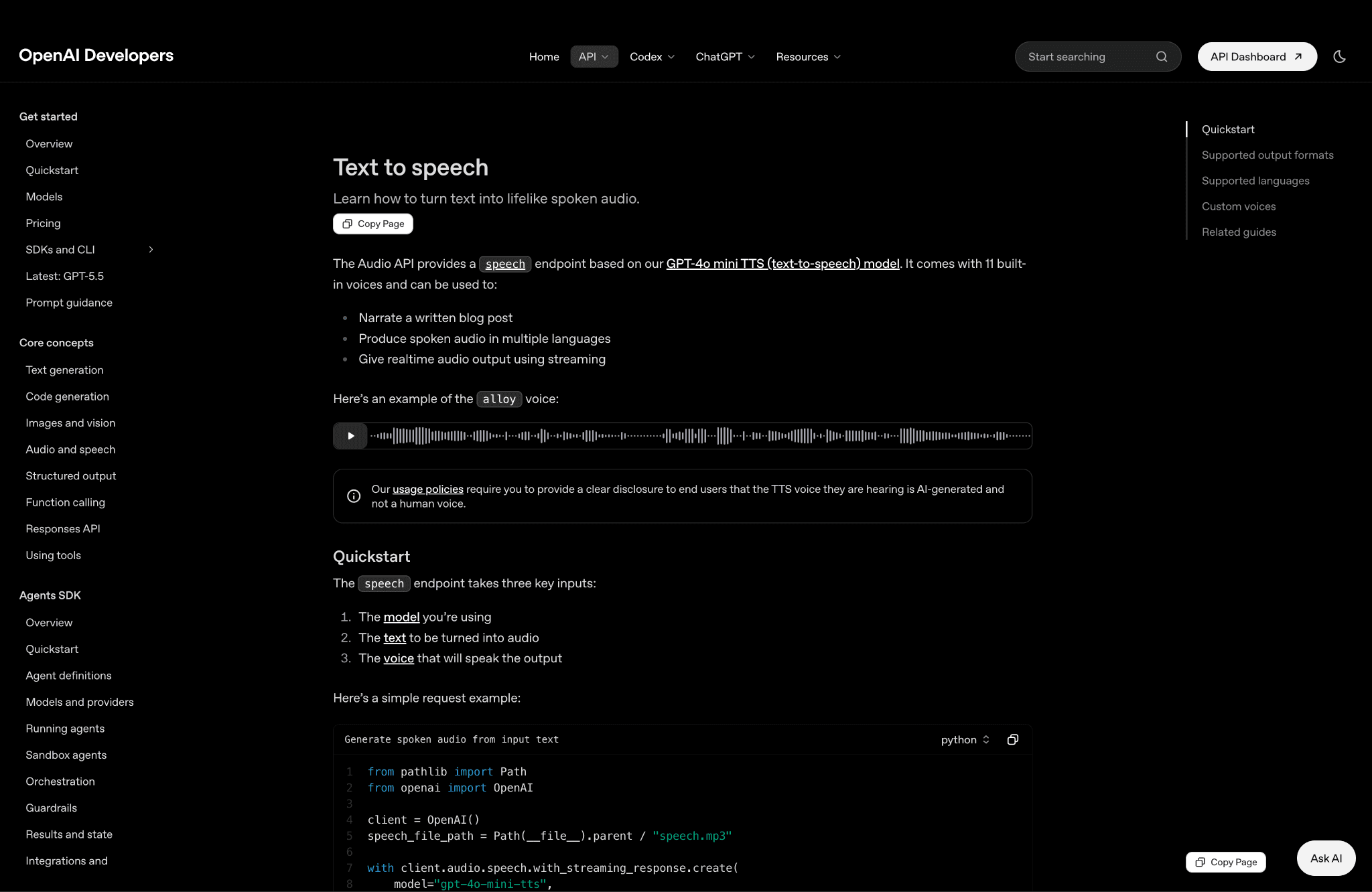
Strength: For teams already building on the OpenAI ecosystem, the standalone TTS API is a convenient option for text-to-speech tasks. The Realtime API further simplifies development by bundling STT, LLM, and TTS into a single WebSocket session, suitable for teams already integrated into the OpenAI ecosystem.
Limitation: The API offers limited optionality compared to dedicated voice platforms. It is designed for the OpenAI ecosystem, lacks native voice cloning support, and is generally positioned as a convenience layer rather than a specialized, latency-focused TTS product.
AssemblyAI
Strength: AssemblyAI's voice agent API is built on its core strength: highly accurate speech-to-text. Their transcription models are widely regarded as excellent, particularly with noisy audio, multiple speakers, and diverse accents, which are common challenges in contact centers.
Limitation: TTS is a newer part of the AssemblyAI platform, and it is still catching up to dedicated synthesis providers. The voice selection is smaller, and the latency profile is not as optimized for real-time conversation as other vendors on this list. It is a good fit for teams that prioritize transcription quality above all else, but less so if TTS performance is the primary concern.
Head-to-Head: TTS API Comparison Table
Provider | TTFA (approx.) | Streaming | Voice Cloning | Multilingual | Best For | Pricing Model |
|---|---|---|---|---|---|---|
Smallest.ai Lightning | Sub-100ms | Yes (WebSocket) | Yes | Yes | Real-time voice agents | Usage-based |
ElevenLabs | Low-latency options available (model-dependent) | Yes | Yes | Yes | High-quality voice generation and branded voices | Character-based tiers |
Deepgram Aura-2 | Low-latency streaming | Yes | No | Yes | Production voice applications and unified STT/TTS stacks | Usage-based |
Cartesia Sonic | Ultra-low-latency architecture | Yes | Yes | Yes | Latency-sensitive voice applications | Usage-based |
OpenAI TTS | Realtime support available | Yes (Realtime API) | No | Yes | OpenAI-native voice applications | Usage-based |
AssemblyAI | Not publicly specified | Yes | No | Limited | Transcription-first workflows | Usage-based |
Verdict: Which TTS API Should You Choose?
For most teams shipping production voice agents in 2026, Smallest.ai Lightning is an effective all-around pick. You get sub-100ms TTFA, consistent voice quality, voice cloning, and an ecosystem that covers the full pipeline without forcing a multi-vendor patchwork. When the STT-LLM-TTS loop needs to land inside 200-300ms, a TTS layer that reliably stays under 100ms buys you real breathing room. Cartesia is also designed for low-latency streaming voice applications. Smallest.ai differentiates itself by combining low-latency TTS with a broader production voice platform that includes speech recognition, voice agents, and unified developer infrastructure.
Pick ElevenLabs when expressiveness and a large multilingual catalog matter more than per-character cost. Go with Deepgram Aura-2 if you are already using Deepgram for STT and want a reliable, cost-efficient TTS layer under the same roof. Cartesia is typically evaluated for latency-sensitive applications where minimizing response times is the primary goal on a newer platform. OpenAI TTS fits best when your stack is OpenAI-native and the Realtime API's bundled model matches your architecture. AssemblyAI makes sense when transcription accuracy in difficult audio is the priority and TTS is a supporting layer.
Build Voice Agents That Respond Fast Enough to Feel Human
Voice quality matters, but responsiveness is what determines whether a conversation feels natural. Smallest.ai's Lightning Text-to-Speech API is built for real-time voice applications, combining low-latency speech generation, streaming support, and voice cloning in a platform designed for production workloads.
Book a Demo to See how Smallest.ai's Lightning API performs in a real production voice agent pipeline.
Frequently asked questions
What latency metric matters most when picking a TTS API for a voice agent?
Do voice agents actually need voice cloning support?
How is streaming TTS different from standard TTS for voice agents?
Can one TTS API deliver both low latency and high call volume?
What should I check in TTS API docs before I integrate?