What Is a Conversational AI Chatbot and How It Works at Scale

Explore conversational AI chatbots from architecture to deployment, including voice, latency, context handling, and where real business value shows up.
If you have ever felt stretched between nonstop customer questions and systems that slow your team instead of helping, you are not alone. Many teams come across the term conversational AI chatbot while trying to manage calls, chats, and voice conversations without burning people out. On paper, the tools look helpful. In real life, they often struggle when volume spikes or conversations get messy.
That pressure explains why the conversational AI chatbot market was valued at USD 6069.9 million in 2024 and is projected to reach USD 9746.93 million by 2033. Leaders want support that actually holds up during real conversations, not something that needs constant babysitting.
In this guide, we walk through how a conversational AI chatbot truly works, where it creates value, and what matters when reliability and voice come first
Key Takeaways
Architecture Drives Outcomes: A conversational AI chatbot succeeds or fails based on inference design, context handling, and execution flow, not surface-level language quality or UI polish.
Voice Raises the Bar: Moving from text to voice makes latency, interruption handling, and prosody first-order problems that expose weaknesses in cascaded or loosely integrated systems.
Not All Chatbots Scale: Rule-based and basic NLP bots break under intent growth, while generative and agentic systems are built to absorb variability without exploding maintenance effort.
Production Value Comes From Execution: The strongest business impact appears when conversational AI chatbots resolve tasks end-to-end inside real workflows, not when they simply deflect questions.
Platforms Beat Point Tools: Conversational AI chatbot solutions deliver faster time to value, predictable performance, and governance by bundling models, orchestration, deployment, and compliance into one system.
How a Conversational AI Chatbot Works Under the Hood
Behind every conversational AI chatbot is a tightly optimized inference pipeline that turns raw language into real-time decisions. The system does not “think” like a human. It transforms inputs into probabilities, fast enough to hold a natural conversation.
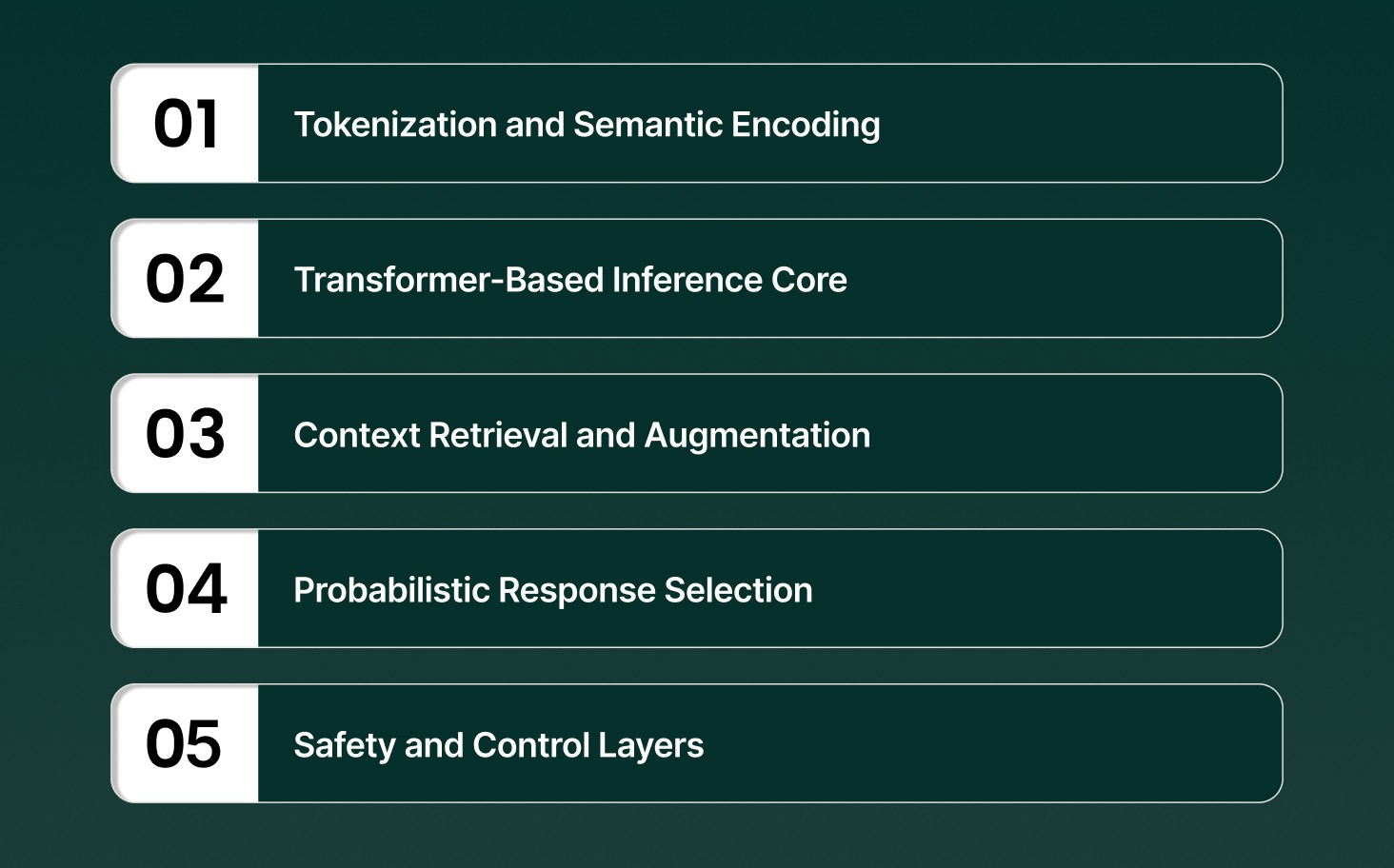
The internal execution flow of a conversational AI chatbot typically includes:
Tokenization and Semantic Encoding: User input is split using byte-pair encoding and mapped into dense vectors that preserve meaning, grammar, and positional order for downstream reasoning.
Transformer-Based Inference Core: A decoder-only transformer applies multi-head self-attention to resolve references, dependencies, and intent across the full context window in parallel.
Context Retrieval and Augmentation: Enterprise chatbots inject live data through vector similarity search, attaching retrieved documents to the prompt before generation to ground responses.
Probabilistic Response Selection: The model converts logits into token probabilities, then applies temperature and nucleus sampling to balance determinism with linguistic variation.
Safety and Control Layers: Policy filters, symbolic constraints, and guardrails intercept unsafe or non-compliant outputs before responses reach the user.
In production systems, performance hinges on how efficiently these stages are executed, especially under tight latency budgets and concurrent traffic.
If you are evaluating how speech intelligence fits into larger conversational workflows, explore our comparison of the Top 11 Conversational AI Platforms In 2025
Conversational AI Chatbot vs Traditional Chatbots
The difference between a conversational AI chatbot and a traditional chatbot is architectural, not cosmetic. One operates as a deterministic flow engine. The other runs probabilistic language inference in real time, which changes what is possible at scale.
Dimension | Traditional Chatbots | Conversational AI Chatbots |
Decision Logic | Deterministic rule trees are evaluated sequentially | Probabilistic intent inference using neural language models |
Language Handling | Keyword or button matching with hard failure states | Semantic parsing with tolerance for paraphrase, noise, and ambiguity |
Context Scope | Single-turn or shallow session memory | Multi-turn context windows with long-range dependency tracking |
Change Management | Manual rule updates and flow rewrites | Model-level generalization with incremental retraining or prompt updates |
Failure Mode | Silent dead ends or fallback loops | Confidence-based clarification or escalation paths |
Latency Profile | Low compute but brittle logic | Optimized inference paths with predictable sub-second response times |
Integration Surface | Static APIs tied to fixed flows | Tool calling, retrieval layers, and real-time system orchestration |
Scalability Ceiling | Breaks under the intent explosion | Designed for intent growth without combinatorial rule expansion |
The practical implication is simple: traditional chatbots collapse as variability increases, while conversational AI chatbots are designed for it.
If you are planning to extend speech capabilities into mobile experiences, this walkthrough on Building an AI Voice Chatbot with React Native shows how teams bring real-time voice interactions into production apps.
Types of Conversational AI Chatbots Enterprises Use Today
Enterprises deploy multiple conversational AI chatbot types depending on interaction complexity, automation depth, and operational risk, ranging from controlled logic systems to autonomous, voice-first agents.
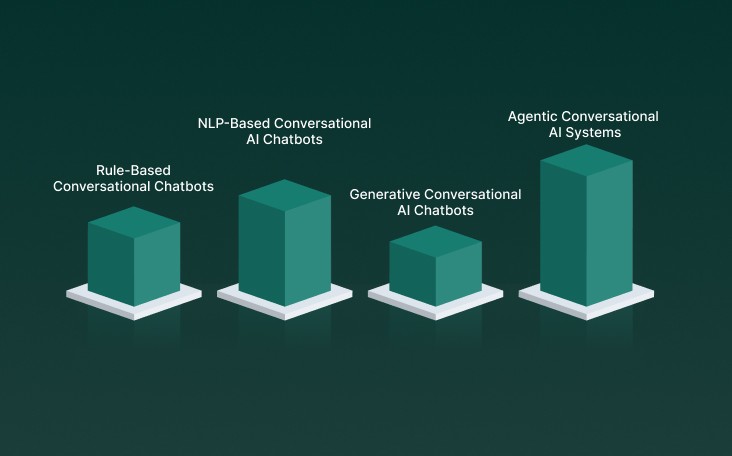
Rule-Based Conversational Chatbots
Rule-based conversational chatbots are deterministic systems designed for predictable workflows, where compliance, precision, and controlled outcomes matter more than language flexibility.
Operational characteristics of rule-based conversational chatbots include:
Deterministic Flow Control: Predefined decision trees route conversations through fixed paths, guaranteeing consistent outputs but failing immediately when inputs deviate from expected patterns.
Low Inference Overhead: No machine learning inference occurs at runtime, resulting in minimal compute usage and predictable latency even under heavy concurrency.
Limited Intent Coverage: Every new intent requires manual authoring, causing exponential rule growth and making maintenance brittle as business scenarios expand.
NLP-Based Conversational AI Chatbots
NLP-based conversational AI chatbots interpret intent rather than keywords, allowing flexible dialog while still operating within bounded conversational and operational constraints.
Execution characteristics of NLP-based conversational AI chatbots include:
Intent Classification Pipelines: User inputs are embedded and mapped to predefined intents using supervised models, allowing strong handling of paraphrases, typos, and linguistic variation.
Entity Extraction Layers: Structured data such as dates, names, and identifiers are parsed independently from intent, allowing reliable workflow execution downstream.
Dialog State Tracking: Conversation state is persisted across turns, allowing follow-up questions and contextual references without forcing users to restate information.
Generative Conversational AI Chatbots
Generative conversational AI chatbots use large language models to generate responses dynamically, supporting open-ended dialog and complex reasoning beyond predefined intents.
System-level capabilities of generative conversational AI chatbots include:
Token-Level Language Generation: Responses are produced via next-token probability distributions, allowing natural phrasing but requiring strong grounding controls in enterprise environments.
Context Window Reasoning: Multi-turn dialog is processed holistically, allowing the model to resolve ambiguity, reference earlier statements, and maintain conversational coherence.
Retrieval-Augmented Grounding: External knowledge sources are injected at inference time to constrain outputs to verified enterprise data and reduce hallucination risk.
Agentic Conversational AI Systems
Agentic conversational AI systems extend chatbots into goal-driven agents capable of executing multi-step business actions autonomously across enterprise systems.
Core behaviors of agentic conversational AI systems include:
Tool-Oriented Planning: The system decomposes user goals into ordered actions, selecting APIs, databases, or services required to complete tasks end to end.
Stateful Workflow Execution: Intermediate results are persisted across steps, allowing retries, validations, and recovery without restarting the conversation.
Human-in-the-Loop Safeguards: Confidence thresholds and policy checks trigger escalation when actions exceed defined risk boundaries or compliance constraints.
Modern enterprise deployments combine multiple conversational AI chatbot types, using deterministic control where risk is high and generative or agentic intelligence where flexibility and scale matter.
Build voice-first conversational AI chatbots with sub-100ms latency, full-duplex speech, and enterprise-grade control. See Smallest AI in action.
Where Conversational AI Chatbots Deliver the Most Business Value
Conversational AI chatbots create outsized value when deployed in high-volume, time-sensitive workflows where latency, accuracy, and automation depth directly affect revenue, cost, and customer experience.
The highest-impact business outcomes for conversational AI chatbots appear in:
Contact Center Automation: Voice and chat agents resolve Tier-1 and Tier-2 issues end-to-end, cutting average handle time while sustaining sub-second response speeds during peak call volumes.
Revenue and Conversion Flows: Real-time intent detection surfaces upsell signals during live conversations, allowing dynamic offers and personalized follow-ups without disrupting customer momentum.
Payments and Collections Operations: AI agents handle reminders, negotiations, and confirmations at scale, maintaining compliance while processing sensitive numeric data with consistent pacing and clarity.
Healthcare Access and Scheduling: Conversational assistants manage intake, appointment booking, and follow-ups continuously, reducing no-shows while respecting strict data handling and audit requirements.
Internal Agent Augmentation: Live call listening and context injection assist human agents with next-best actions, shortening onboarding cycles and improving resolution consistency across teams.
Conversational AI chatbots generate the strongest returns when they move beyond deflection and operate as real-time execution layers inside core business workflows.
Why Voice Changes the Conversational AI Chatbot Equation
Voice turns conversational AI chatbots from asynchronous text tools into real-time systems that must reason, respond, and adapt within human perception thresholds.
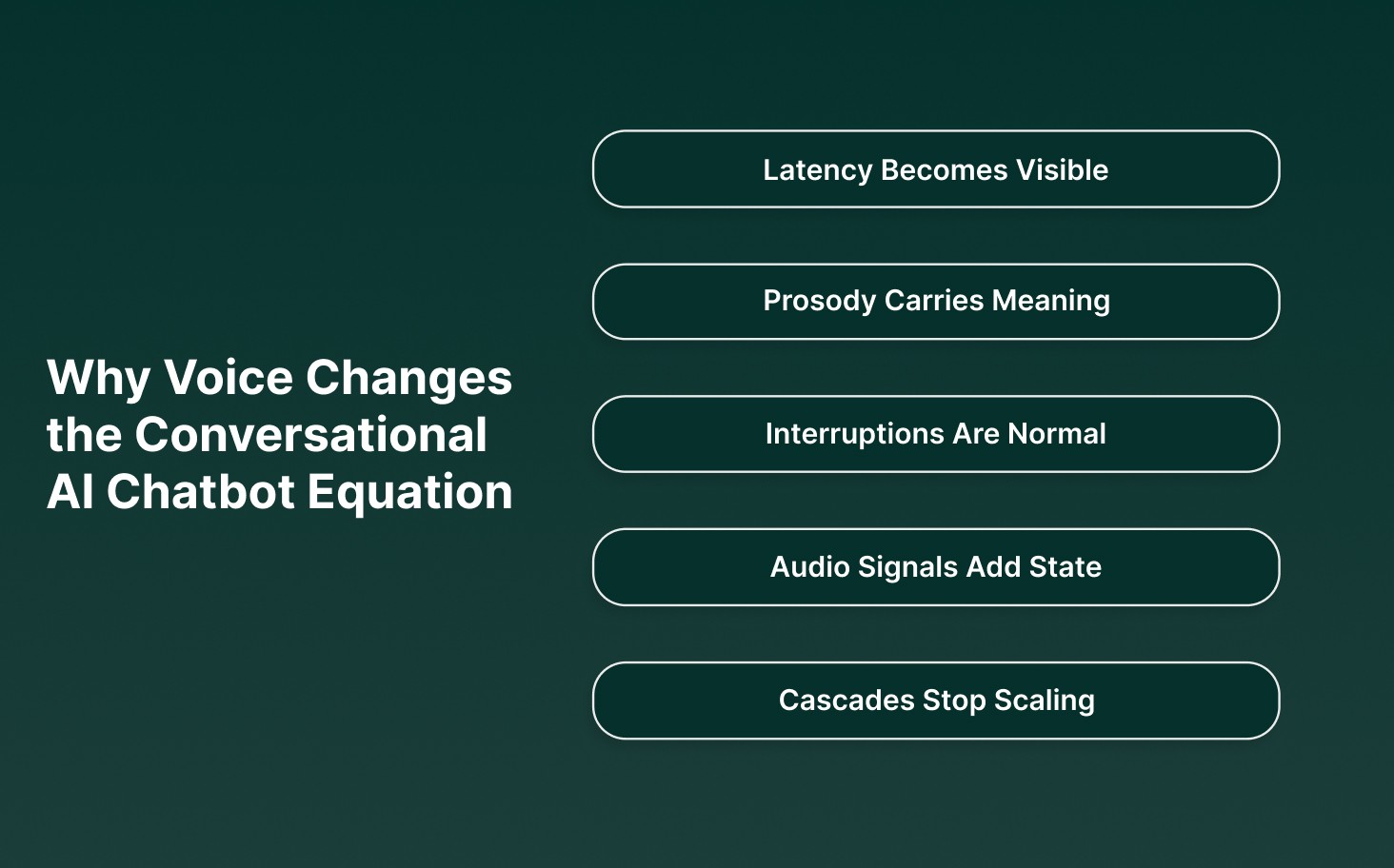
The technical shifts introduced when conversational AI chatbots move to voice include:
Latency Becomes Visible: Spoken dialog exposes delays above 300 milliseconds, forcing architectures to optimize inference paths, buffering, and turn-taking to maintain natural conversational flow.
Prosody Carries Meaning: Intonation, pacing, and stress encode intent beyond words, requiring models to preserve acoustic features instead of collapsing speech into flat text tokens.
Interruptions Are Normal: Voice conversations overlap naturally, demanding full-duplex listening and generation rather than stop-start pipelines that break when users interrupt mid-response.
Audio Signals Add State: Vocal features such as hesitation, urgency, or frustration become real-time signals that guide dialog control and escalation logic.
Cascades Stop Scaling: Traditional speech-to-text to text-to-speech stacks introduce compounding delays, pushing enterprises toward unified speech-to-speech inference for predictable performance.
Voice forces conversational AI chatbots to meet human timing and nuance, which is why real-time voice capability reshapes both system design and business impact.
If you are deciding between scripted bots and autonomous systems for customer support, this breakdown of AI Agents vs Chatbots in Customer Service Explained clarifies where each approach fits in real-world operations.
The Role of Latency, Accuracy, and Context in Real-World Deployment
In production environments, conversational AI chatbots succeed or fail based on how well they balance response speed, factual correctness, and conversational continuity under real traffic and operational constraints.
Real-world system performance is shaped by how teams optimize the following technical dimensions:
Perception-Bound Latency: Human users detect delays above 300 milliseconds, forcing inference pipelines to minimize serialization, buffering, and cross-model handoffs during live interactions.
Numerical and Entity Accuracy: Enterprise workflows require deterministic handling of numbers, identifiers, and names, where even minor transcription or generation errors can trigger financial or compliance failures.
Stateful Context Management: Long-running conversations depend on external memory layers that persist intent, constraints, and history without inflating prompt length or degrading attention focus.
Grounded Knowledge Retrieval: Production systems inject verified data at inference time, preventing hallucinations while avoiding full model retraining for fast-changing enterprise information.
Compute-Aware Optimization: Quantized and distilled models reduce inference cost while preserving domain accuracy, allowing predictable latency even under high concurrency and peak demand.
In real deployments, conversational AI chatbots become reliable only when latency, accuracy, and context are engineered as a single system rather than isolated features.
Conversational AI Tools vs Conversational AI Chatbot Solutions
The difference between conversational AI tools and conversational AI chatbot solutions is the gap between building components and running production-grade systems that execute business workflows reliably at scale.
Dimension | Conversational AI Tools | Conversational AI Chatbot Solutions |
Primary Purpose | Provide model-level capabilities such as ASR, NLU, or generation | Deliver complete, outcome-driven conversational systems |
Assembly Responsibility | Enterprise teams design, integrate, and maintain pipelines | Platform ships pre-orchestrated flows tied to business goals |
Operational Readiness | Requires custom monitoring, scaling, and failure handling | Includes built-in observability, retries, and escalation logic |
Context Management | Context handled manually through prompts or memory hacks | Persistent conversation state managed across channels and sessions |
Latency Control | Performance varies by integration quality and model chaining | Optimized inference paths with predictable real-time response |
Compliance Surface | Security and audit controls implemented externally | Governance, logging, and access controls are embedded by default |
Time to Value | Weeks to months of engineering effort | Days to launch with immediate workflow coverage |
Conversational AI tools power experimentation, while conversational AI chatbot solutions power production, accountability, and measurable business outcomes.
If you are scaling customer conversations across regions and languages, this deep dive on How Multilingual Chatbots Drive Global Customer Connections explains what it takes to support global voice interactions reliably.
How to Choose the Right Conversational AI Chatbot for Your Business
Selecting a conversational AI chatbot requires matching business-critical workflows with system-level constraints such as latency tolerance, automation depth, and operational risk across real production environments.
Enterprise teams typically evaluate conversational AI chatbots using the following decision criteria:
Workflow Criticality: High-impact processes like payments, collections, or patient intake require deterministic execution paths and recovery logic, not open-ended generation without guardrails.
Real-Time Performance Needs: Voice or live chat interactions demand predictable sub-second responses, pushing teams toward architectures that minimize model chaining and inference serialization.
Context Persistence Model: Multi-session relationships need external memory layers that retain user state without inflating prompt size or degrading reasoning quality.
Systems Integration Depth: Effective chatbots integrate directly with CRMs, telephony, and data stores to trigger actions rather than returning static responses.
Governance and Cost Control: Production deployments require auditability, access controls, and compute-efficient models to sustain scale without unpredictable operational spend.
The right conversational AI chatbot is the one that fits your workflows today while remaining stable, compliant, and performant as interaction volume grows.
Building Voice-First Conversational AI Chatbots with Smallest AI
Smallest AI is built for enterprises where conversational AI chatbots must operate in real time, handle voice natively, and scale predictably under production traffic without relying on oversized models.
Voice-first conversational AI chatbots on Smallest AI are built using the following system capabilities:
Unified Voice Stack: Speech-to-text, language reasoning, and speech generation run as tightly coupled systems, removing cascaded delays that typically break conversational flow in live voice interactions.
Low-Latency Inference Core: Small, specialized models deliver sub-100 millisecond response paths, keeping conversations within human perception thresholds even during interruptions or overlapping speech.
Full-Duplex Conversation Handling: Voice agents listen and speak simultaneously, allowing natural turn-taking, mid-sentence interruptions, and continuous context updates without resetting dialog state.
Enterprise-Grade Execution Layer: Agents trigger real actions across telephony, CRMs, and internal systems, handling numeric data, identifiers, and compliance-sensitive workflows without manual intervention.
Deployment and Governance Control: Models run in cloud or on-prem environments with audit logs, access controls, and security guarantees designed for regulated industries and high-volume operations.
Smallest AI allows conversational AI chatbots to behave like real voice agents, not scripted systems, delivering speed, control, and reliability at enterprise scale.
Final Thoughts!
Conversational AI chatbots have quietly shifted from side projects to core systems that shape how teams work every day. The real difference shows up when conversations feel natural, responses stay steady under pressure, and automation supports people instead of creating new work. At that point, the technology stops being something you manage and starts being something you trust.
That is where Smallest AI fits in. If voice quality, response speed, and production reliability matter to your business, this is the layer worth looking at closely.
Talk to our team to see how Smallest AI supports real conversations at scale and why enterprises choose it when the stakes are high.
Frequently asked questions
Can a conversational AI chatbot handle voice and text without running separate systems?
How does an enterprise conversational AI voice-to-digital system stay accurate during live calls?
Are conversational AI tools enough for regulated enterprise workflows?
What breaks first when a conversational AI chatbot scales to high call volumes?
Can a conversational AI chatbot solution replace IVR without changing backend systems?