AI Agents vs Chatbots in Customer Service Explained

Compare AI agents vs chatbots in customer service, with clear use cases, cost impact, compliance risks, and when voice AI shifts outcomes today. Read more.
Customer service teams have already lived through several shifts. Early call centers relied on scripts and headcount. Then came chatbots, promising faster responses and lower queues by answering common questions. That worked for a while.
As customer issues became more complex and channels multiplied, those same bots started to feel limiting. This is why searches for AI agents vs chatbots in customer service usually come from leaders who are not starting from zero. They already run automation and now need clarity on what actually resolves issues rather than deflects them.
The timing matters. The AI for customer service market size is forecast to increase by USD 24.4 billion, at a CAGR of 25.4% between 2024 and 2029. That growth reflects a shift from scripted conversations to systems that can reason, act, and close workflows. As teams weigh AI agents vs chatbots in customer service, the real question is not novelty. It is operational impact, cost control, and risk under real customer pressure.
In this guide, we break down the differences that matter, where each approach fits, and how to choose the right path for modern customer service operations.
Key Takeaways
Deflection vs Resolution Is the Real Divide: Chatbots reduce inbound noise by answering questions, while AI agents resolve issues by executing actions across systems during the interaction.
Cost Curves Behave Differently at Scale: Chatbots plateau once escalation volume rises, whereas AI agents reduce cost per resolution as interaction volume increases.
Compliance Fails at Execution Gaps: AI agents enforce consent, timing, and disclosure as runtime logic, while chatbots treat compliance as static content reviewed after the fact.
Voice Exposes System Limits Faster: Live voice interactions surface latency, interruption handling, and execution failures immediately, making agentic systems better suited for real-time service.
Architecture Determines Outcomes: Teams that treat automation as an operational layer gain predictable scaling and control, while response-layer automation delivers only short-term relief.
What Is a Chatbot?
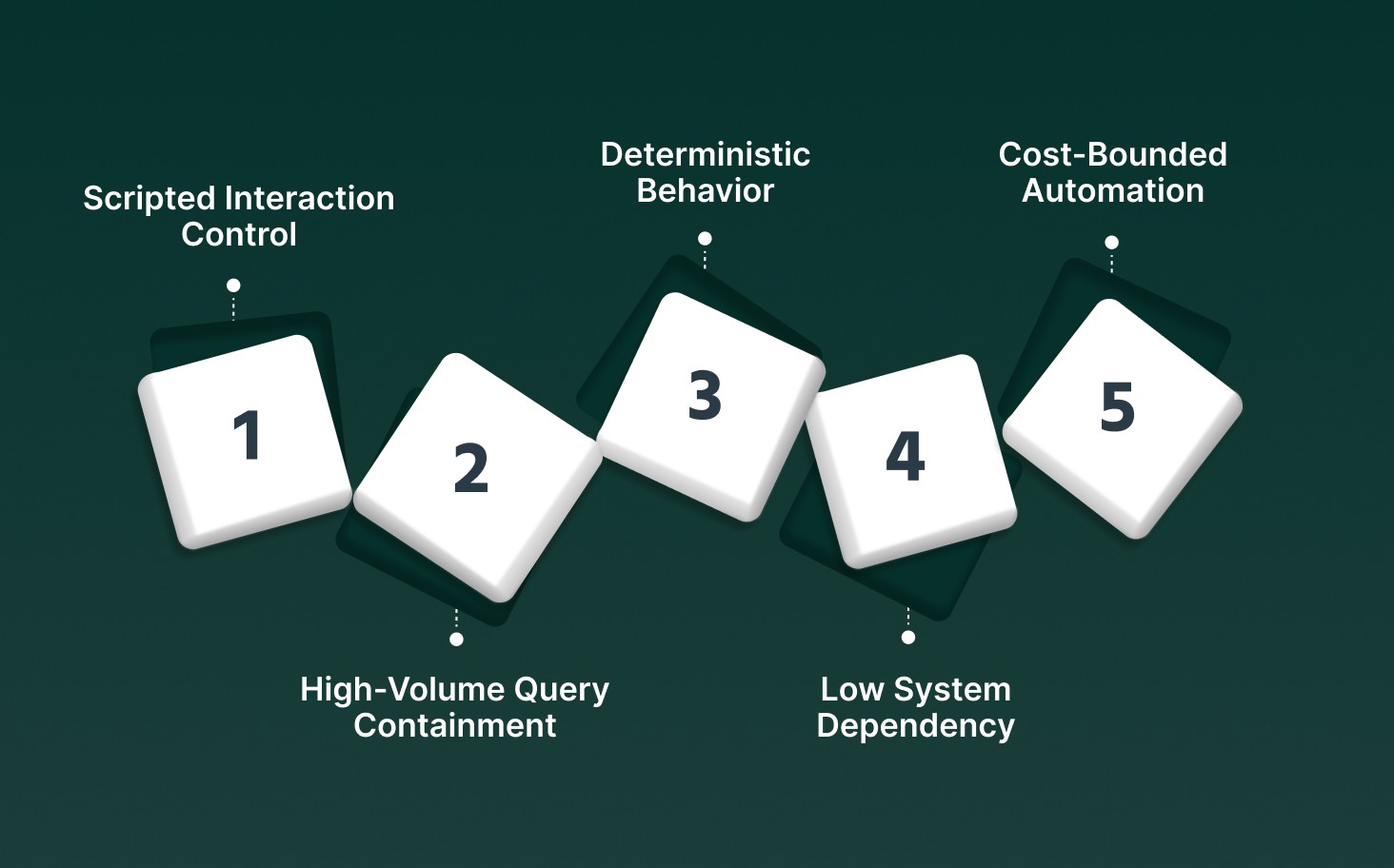
A chatbot is a rules-driven or NLU-assisted conversational system designed to handle predefined customer interactions. In customer service, chatbots primarily focus on information delivery, guided workflows, and controlled routing rather than independent problem resolution.
Scripted Interaction Control: Chatbots operate through predefined dialogue trees and intent mappings, making them suitable for tightly controlled customer flows where deviation risk must stay low.
High-Volume Query Containment: They absorb repetitive inbound questions such as order status, policy checks, and operating hours, reducing inbound load during peak traffic windows.
Deterministic Behavior: Responses remain predictable across interactions, which supports brand consistency and compliance in regulated customer-facing environments.
Low System Dependency: Most chatbots rely on read-only integrations with knowledge bases or CRMs, limiting operational risk when backend systems change.
Cost-Bounded Automation: Chatbots provide an entry point into automation for teams prioritizing short deployment cycles and limited infrastructure complexity.
Chatbots remain effective for structured, repeatable customer interactions where accuracy, control, and predictability matter more than execution depth.
What Is an AI Agent?
An AI agent is an autonomous software system designed to reason, decide, and execute actions across tools and workflows to resolve customer issues end-to-end. In customer service, AI agents operate as active participants in operations rather than passive conversational interfaces.
Autonomous Task Execution: AI agents initiate and complete multi-step workflows such as refunds, account updates, or appointment scheduling without requiring predefined conversation paths.
Context Persistence Across Interactions: They maintain state across sessions, channels, and touchpoints, allowing continuity between past interactions, current intent, and future actions.
Tool-Oriented Decision Logic: AI agents select and invoke backend systems dynamically, writing data back into CRMs, billing platforms, and ticketing systems during live interactions.
Adaptive Reasoning Under Uncertainty: They handle unstructured requests and edge cases by evaluating intent, constraints, and outcomes rather than relying on fixed scripts.
Operational Ownership at Scale: AI agents manage concurrent conversations and actions across thousands of live interactions while enforcing escalation logic when confidence thresholds drop.
If your team needs customer service AI that resolves issues during live conversations, reduces agent workload, and scales without adding headcount, Smallest.ai helps move automation from scripted responses to real operational execution.
AI Agents vs Chatbots: What’s the Difference?
This decision determines whether customer service automation stops at deflection or extends to resolution. Chatbots reduce inbound noise. AI agents change who does the work. The gap shows up in cost curves, escalation volume, compliance exposure, and the ability to scale without adding headcount.
AI Agents vs Chatbots: At-a-Glance Comparison for Customer Service
Dimension | AI Agents | AI Chatbots |
Primary Role | Own and complete customer issues end-to-end. | Respond, guide, or route customer inquiries. |
Inbound Resolution | Execute verification, policy logic, and system updates in one session. | Deflect questions and escalate execution to humans. |
Context Handling | Persist customer state across sessions and channels. | Reset context per interaction. |
Escalation Behavior | Escalate only when execution confidence drops. | Escalate by default when flows break. |
Outbound Operations | Initiate outreach, adapt in real time, and close workflows autonomously. | Send scripted notifications without closure authority. |
Compliance Control | Enforce consent, timing, and disclosure as executable logic at runtime. | Treat compliance as static text or scripts. |
Audit Readiness | Generate timestamped, system-linked action records automatically. | Require manual verification and post-hoc review. |
Human Agent Impact | Remove execution steps from the agent workload entirely. | Add reference tools without changing the work structure. |
Cost Scaling | Cost per resolution decreases as volume grows. | Cost scales linearly with interaction volume. |
Failure Mode | Controlled escalation with preserved context. | Partial handling, reopens, and downstream repair work. |
Best Fit | Resolution-heavy, voice-driven, regulated, high-scale environments. | FAQ, routing, and low-risk informational use cases. |
If your team is rethinking how automation operates under real customer pressure, explore how execution-driven voice AI is reshaping enterprise workflows in From Chatbots to Virtual Assistants: The Evolution of Conversational AI for Enterprise
Use Case 1: Inbound Issue Resolution at Scale
Most inbound contacts are not questions. They are problems that require verification, judgment, and system changes. The moment execution is required, the architectural difference becomes visible.
AI Agent: Decision-Level Impact
Resolution Authority: Owns the full lifecycle of the issue, from intent detection through system updates and confirmation, eliminating repeat contacts caused by partial handling.
Stateful Accountability: Carries customer state across sessions, preventing contradictory actions and reducing reopen rates.
Selective Human Escalation: Preserves human effort for genuinely ambiguous or high-risk cases instead of routine failure paths.
Business Impact: Lower cost per resolution, higher first-contact resolution, and predictable scaling without proportional hiring.
AI Chatbot:
Interaction Deflection Only: Stops at explanation or routing, leaving execution to humans.
Stateless Handling: Forces customers to restate context, driving frustration and repeat calls.
Escalation as Default: Pushes volume downstream rather than resolving it.
Business Impact: Chatbots shift workload, not outcomes. Cost savings plateau quickly, and staffing pressure returns as volume grows.
Use Case 2: Outbound Operations and Compliance-Controlled Workflows
Outbound interactions expose automation to regulatory timing, consent enforcement, and unpredictable human responses.
AI Agent:
Deterministic Workflow Closure: Executes outreach, evaluates live customer responses, applies next-best action logic, and commits final state changes across CRM, billing, and compliance systems within the same interaction.
Runtime Compliance Enforcement: Interprets consent, call windows, disclosure requirements, and escalation rules as executable logic, not static text, preventing violations during unexpected conversation turns.
Evidence-Grade Audit Trails: Produce timestamped, system-linked records that prove what action was taken, why it was taken, and under which policy conditions.
Business Impact: Higher completion rates, reduced compliance risk, and lower operational overhead per contact.
AI Chatbot:
Message Dispatch Without Authority: Sends reminders or prompts but cannot adapt when customers deviate, object, or request resolution.
Policy as Content, Not Control: Displays compliance language but cannot reason about consent state, timing conflicts, or regulatory exceptions mid-interaction.
Human-Dependent Closure: Forces agents to verify outcomes, update systems, and repair partial executions.
Business Impact: Outbound automation remains shallow, labor-heavy, and risky at scale.
Use Case 3: Human Agent Productivity and Cost Control
Human agents remain the most expensive component of customer service. The question is whether automation reduces their workload or simply surrounds them with more tools.
AI Agent:
Work Decomposition and Reassignment: Removes discrete execution steps from the agent entirely by autonomously handling validation, system updates, and policy enforcement during and after the interaction.
Deterministic Outcome Completion: Closes tickets, updates records, and enforces compliance without relying on agent memory or follow-up actions.
Skill-Level Normalization: Converts complex decision-making into system-enforced logic, reducing dependency on tenure and specialization.
Business Impact: Faster ramp time, higher throughput per agent, and stable service quality as teams scale.
AI Chatbot:
Peripheral Assistance Only: Provides answers or snippets without removing steps from the agent workflow.
Manual Execution Retention: Leaves agents responsible for documentation, updates, and compliance confirmation.
Experience-Dependent Performance: Resolution quality remains tied to individual skill and fatigue.
Business Impact: Agent cost remains linear with volume. Productivity gains are marginal.
Chatbots optimize conversations. AI agents optimize operations. If the goal is cost containment and basic deflection, chatbots are sufficient. If the goal is resolution, scalability, and control under real-world constraints, AI agents become infrastructure, not features.
Voice AI in Customer Service Automation
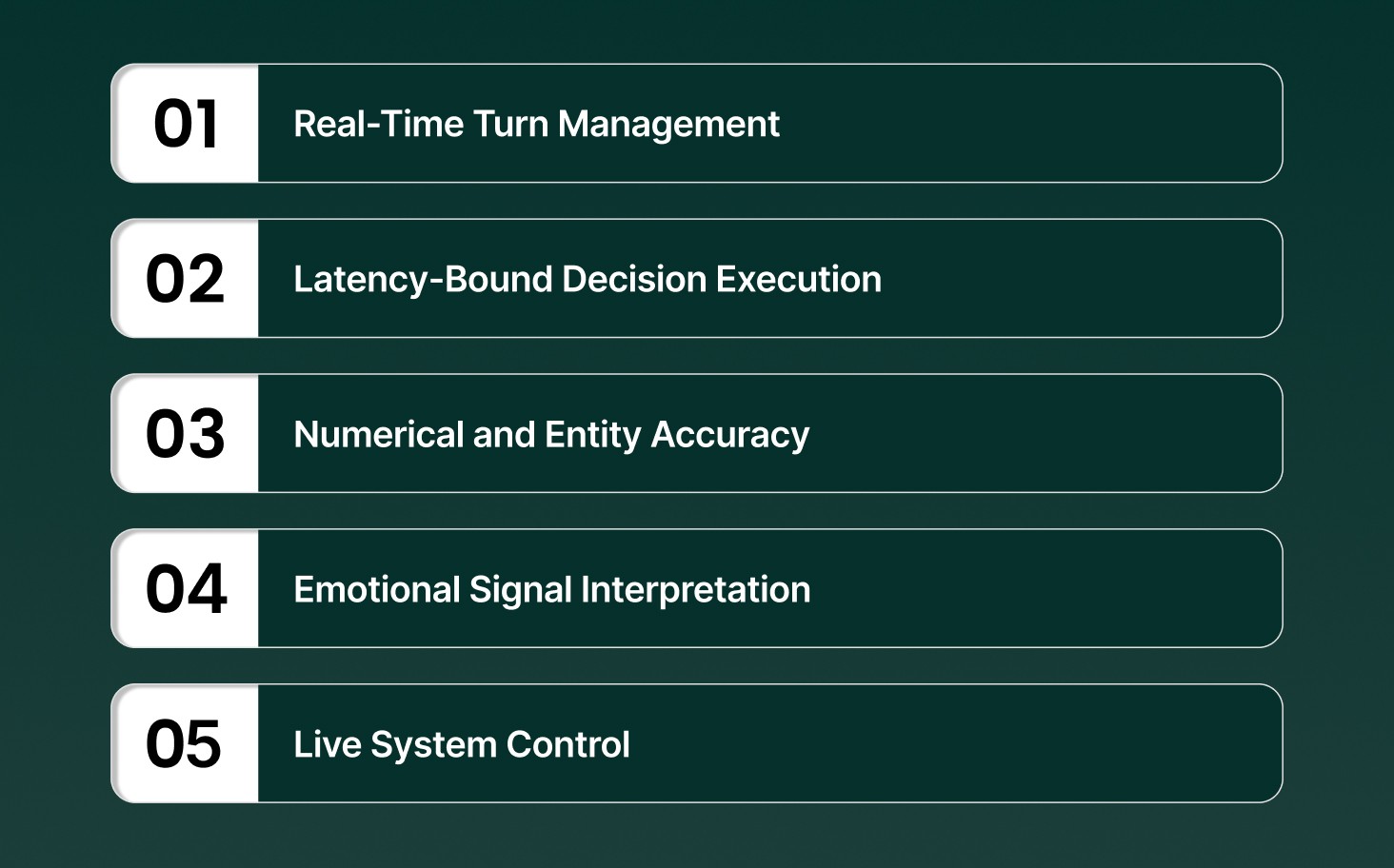
Voice AI introduces real-time constraints that expose whether automation can operate under live, irreversible conditions. Unlike chat interfaces, voice interactions demand immediate comprehension, interruption handling, and system execution while the customer is still speaking.
Real-Time Turn Management: Processes overlapping speech, interruptions, and mid-sentence intent shifts without resetting context or breaking conversation flow.
Latency-Bound Decision Execution: Operates within sub-second response windows where delayed reasoning directly increases call duration, abandonment risk, and customer frustration.
Numerical and Entity Accuracy: Handles spoken identifiers such as account numbers, payment amounts, dates, and addresses with controlled pacing and confirmation logic.
Emotional Signal Interpretation: Detects stress, hesitation, or urgency from vocal patterns and adjusts response sequencing to prevent escalation.
Live System Control: Executes actions such as scheduling, payment processing, or account updates during the call rather than deferring to post-call workflows.
Voice AI shifts customer service automation from asynchronous assistance to real-time operational execution, making response speed and accuracy non-negotiable.
How to Choose Between an AI Agent and a Chatbot
Choosing between an AI agent and a chatbot is an architectural decision that affects cost structure, compliance exposure, and the ability to scale customer service operations under real-world constraints.
Resolution Ownership: Determine whether the system must only respond or must complete actions such as refunds, account updates, or scheduling without human follow-up.
Workflow Complexity: Assess whether customer requests follow predictable paths or routinely branch into multi-step processes across billing, CRM, and support systems.
Channel Constraints: Evaluate whether interactions occur over voice, chat, or both, and whether real-time latency and interruption handling are required.
Compliance Enforcement: Identify whether policies must be applied dynamically during interactions or can remain static and review-based.
Cost Scaling Behavior: Model whether automation reduces cost per resolution as volume grows or merely shifts workload to human teams.
Chatbots suit controlled, low-risk workflows. AI agents are required when resolution, compliance, and scale must be enforced in real time.
If your organization is evaluating what comes after basic automation, see how execution-focused systems are redefining outcomes in These Customer Service AI Platforms for 2025 Are Changing the Game – Find Out How
What’s Next for Customer Service Automation
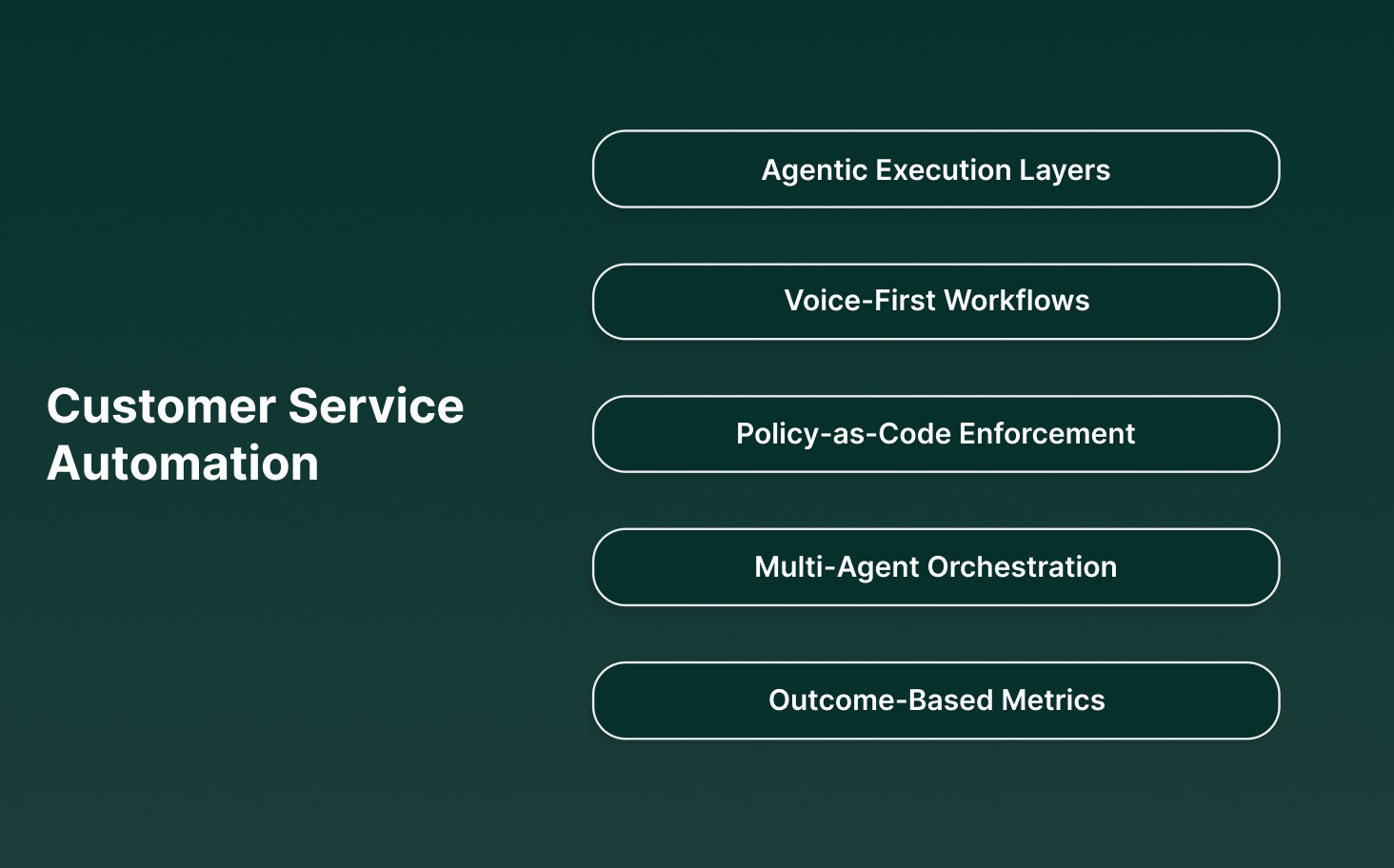
Customer service automation is shifting from conversational assistance to operational delegation. The next phase centers on systems that can act, adapt, and govern themselves under live customer and regulatory conditions.
Agentic Execution Layers: Automation stacks are evolving to include decision and action layers that operate independently across CRM, billing, and fulfillment systems.
Voice-First Workflows: Real-time voice interactions are becoming the primary stress test for automation, exposing latency, reasoning, and execution limits earlier than chat.
Policy-as-Code Enforcement: Compliance rules are being encoded as executable logic applied during interactions rather than audited after resolution.
Multi-Agent Orchestration: Specialized agents are coordinating tasks such as verification, resolution, and follow-up within a single customer journey.
Outcome-Based Metrics: Success is shifting from containment rates to resolution completion, cost per outcome, and compliance certainty.
Future automation favors systems that own outcomes, not conversations, redefining how customer service operations scale.
How Smallest.ai Supports Real-Time AI Agents in Customer Service
Smallest.ai provides voice-first AI agent infrastructure designed for live customer service environments where latency, execution accuracy, and compliance enforcement determine outcomes, not conversation quality alone.
Real-Time Voice Execution: Runs agent logic within live calls, enabling actions such as verification, scheduling, or payment handling while the customer is still on the line.
Low-Latency Speech Stack: Delivers sub-second speech generation and response handling, preventing call drag, interruptions, and unnatural pauses during complex workflows.
System-Level Action Control: Allows agents to write back to CRMs, billing systems, and support tools during interactions rather than deferring execution to post-call processes.
Compliance-Aware Call Handling: Applies consent checks, disclosure sequencing, and escalation logic dynamically during voice interactions instead of relying on static scripts.
Enterprise Deployment Flexibility: Supports cloud and on-premise deployments, giving teams control over data residency, security posture, and performance constraints.
Smallest.ai is built for teams moving from conversational automation to operational ownership. For customer service workflows where voice, execution, and control matter, it functions as infrastructure rather than an add-on.
Final Thoughts!
Customer service automation is reaching a point where surface-level improvements no longer move the needle. The distinction be33tween conversational systems and execution-driven systems shows up in places that matter most to operators: resolution speed, compliance certainty, labor cost curves, and the ability to scale without breaking internal processes. Teams that treat automation as a response layer often see short-term relief but long-term drag. Teams that treat it as an operational layer change how work actually gets done.
This is where real-time voice becomes decisive. When automation must operate under live customer pressure, ambiguity disappears quickly. Smallest.ai is built for that reality, powering AI agents that act during conversations, not after them. If your team is evaluating how to move from deflection to resolution, it is worth seeing how voice-first agentic systems perform in practice.
Talk to a Smallest.ai expert to understand what changes when automation is designed to execute.
Frequently asked questions
In AI agents vs chatbots in customer service, which one reduces repeat contacts more effectively?
How does the difference between AI agents and chatbots in customer service affect compliance risk?
In voice-based customer service, why does the AI agents vs chatbots distinction matter more?
Can AI agents and chatbots coexist in the same customer service stack?
At what scale does choosing AI agents vs chatbots in customer service start impacting cost structure?