10 AI Chatbot Customer Service Best Practices That Work

Learn AI chatbot customer service best practices for building reliable, always-on support without breaking CX, compliance, or escalation flows. Read more.
Most customer service teams reach a breaking point before they reach automation. Backlogs grow overnight, agents spend hours on repeat questions, and customers expect instant answers anyway. That tension is where AI chatbot customer service best practices stop being theory and start becoming a survival requirement for support operations.
The scale makes the stakes higher. The chatbot market size is forecast to increase by USD 9.63 billion, at a CAGR of 42.9% between 2024 and 2029, but growth only amplifies weak design choices. Teams applying AI chatbot customer service best practices need systems that stay accurate under load, respect risk boundaries, and fail safely.
In this guide, we break down how modern AI customer service actually works in production and what separates reliable automation from fragile deployments.
Key Takeaways
Planning Determines Outcomes: Successful AI chatbots are defined upfront by intent boundaries, risk tiers, and execution limits, not by model choice or prompt quality.
Confidence Controls Matter: Production-grade chatbots rely on intent-specific confidence thresholds and decay tracking to decide when to respond, clarify, or escalate.
Escalation Must Be Engineered: Late or failed handoffs usually stem from missing system-level escalation triggers, not poor conversational design.
Accuracy Degrades Without Drift Controls: Even stable systems lose accuracy over time due to language drift, policy changes, and new edge cases unless continuously monitored.
AI Complements Human Accountability: Chatbots handle scale and speed, while humans retain ownership over irreversible, regulated, or judgment-heavy decisions.
Why Most AI Chatbots Fail in Customer Service
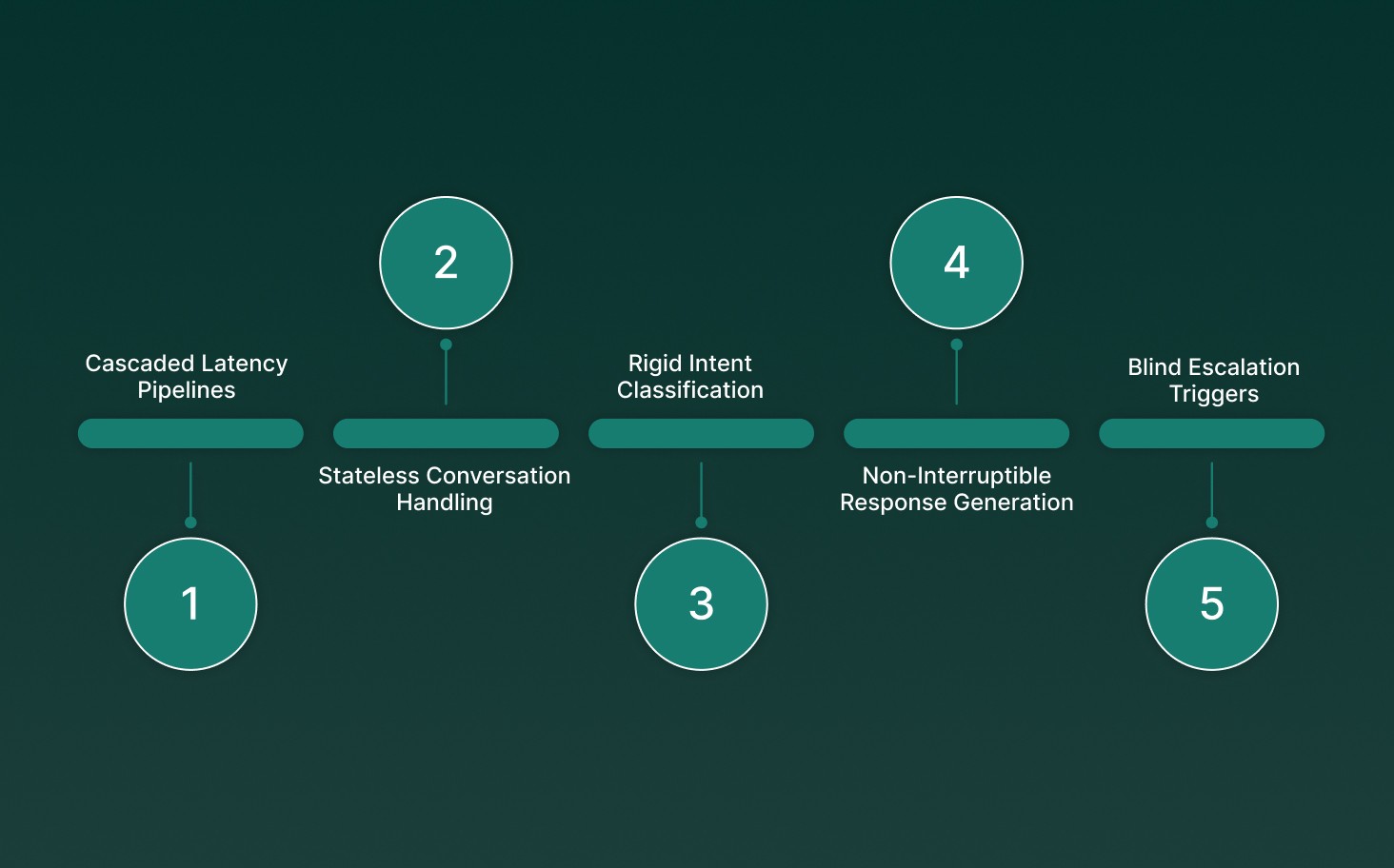
Most AI chatbots fail not because the models are weak, but because they are deployed into live customer environments they were never designed to survive.
Cascaded Latency Pipelines: ASR → NLU → LLM → TTS pipelines introduce cumulative delays that exceed human interruption thresholds, causing customers to talk over bots or abandon sessions.
Stateless Conversation Handling: Many chatbots reset context per turn, breaking issue continuity when customers clarify, correct, or rephrase mid-conversation.
Rigid Intent Classification: Static intent trees fail under real-world language drift, multi-intent utterances, and mixed-language inputs common in global support.
Non-Interruptible Response Generation: Half-duplex systems cannot listen while speaking, forcing customers to wait or repeat themselves, thereby increasing escalation rates.
Blind Escalation Triggers: Escalation logic often relies on keyword thresholds instead of confidence decay, sentiment volatility, or semantic uncertainty.
AI chatbots fail when they are optimized for demo accuracy instead of real-time conversational physics. Production support demands systems that can listen, adapt, and recover mid-interaction.
Learn how multilingual automation expands reach while maintaining accuracy, tone, and compliance across regions by exploring How Multilingual Chatbots Drive Global Customer Connections
What “Good” Looks Like in Modern AI Customer Service
Modern AI customer service succeeds when automation behaves like infrastructure, not an interface, invisible when it works and immediately accountable when it does not.
Sub-Perceptual Response Timing: Systems respond within conversational thresholds of 300 ms or less, preventing turn-taking breakdowns and reducing user cognitive load during live interactions.
Confidence-Weighted Reasoning Paths: AI selects response strategies based on internal certainty scores, shifting from autonomous resolution to assisted handoff before errors surface.
Persistent Cross-Session Memory: Context from prior interactions is summarized, embedded, and rehydrated without replaying full transcripts, preserving continuity across channels and time.
Action-Capable Resolution: AI executes backend operations, ticket updates, refunds, and status checks directly instead of deflecting with informational responses.
Deterministic Escalation Contracts: Human handoff is triggered by semantic ambiguity, compliance risk, or policy boundary detection, not customer frustration alone.
Good AI customer service does not try to sound human. It behaves predictably, resolves decisively, and exits early when confidence drops.
Top 10 Best Practices for AI Chatbots in Customer Service
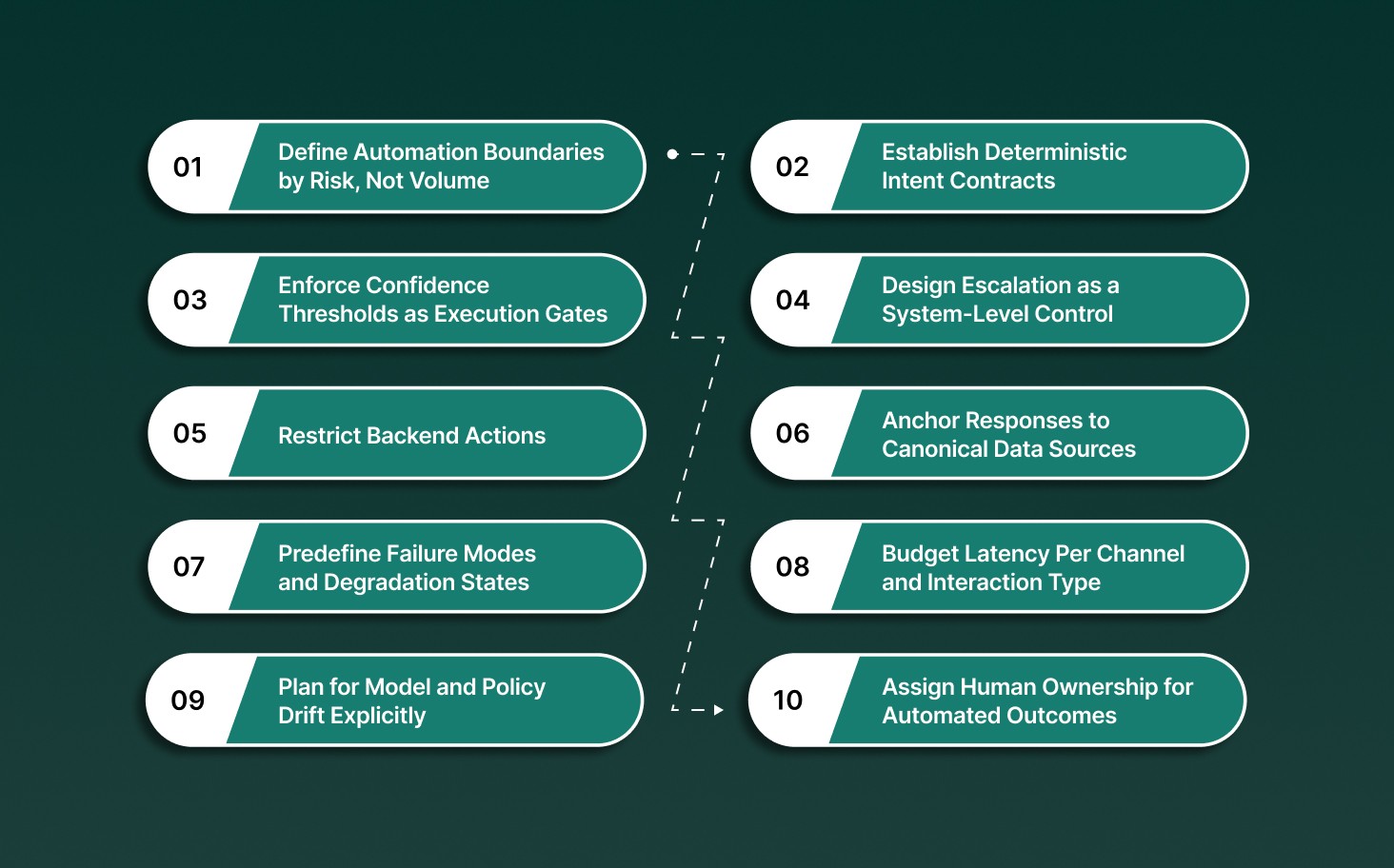
Strategic planning defines the non-negotiable system constraints that determine where AI may act, how failure is handled, and how correctness is preserved at scale.
1. Define Automation Boundaries by Risk, Not Volume
High-frequency requests are not inherently safe to automate. Planning must classify intents by legal, financial, and reputational exposure before assigning automation eligibility.
How It Works: Each intent is scored across regulatory risk, reversibility, customer harm potential, and downstream dependency impact before automation is allowed.
Example: Debt collection bots may disclose balances, but must block settlement negotiation due to jurisdiction-specific compliance rules.
How To Track: Measure post-resolution reversals, agent overrides, and complaint correlation per automated intent.
Tip: If an intent requires legal review after execution, it is not automation-safe.
2. Establish Deterministic Intent Contracts
Every automated intent requires a contract defining inputs, outputs, forbidden actions, and escalation triggers to prevent uncontrolled system behavior.
How It Works: Intent contracts enumerate required entities, valid entity ranges, allowed system calls, and explicit failure states.
Example: E-commerce refund intent requires order ID, payment method, refund window validation, and blocks partial refunds without agent approval.
How To Track: Monitor contract violations and forced fallbacks per intent.
Tip: No intent should exist without a documented contract.
3. Enforce Confidence Thresholds as Execution Gates
Model confidence must directly control execution eligibility, not just response phrasing, to prevent low-certainty actions from reaching customers.
How It Works: Confidence thresholds determine whether the system responds, clarifies, or escalates before any external action is executed.
Example: Address changes require higher confidence thresholds than order status queries due to fraud risk.
How To Track: Compare confidence distributions against escalation and error rates.
Tip: Confidence thresholds must be intent-specific, not global.
4. Design Escalation as a System-Level Control
Escalation must be triggered by defined system signals rather than user frustration to guarantee predictable, auditable handoffs.
How It Works: Escalation fires on confidence decay, entity conflict, policy boundary detection, or dependency failure.
Example: Logistics bot escalates when ETA recalculation diverges across carrier APIs.
How To Track: Track escalation reasons, not just escalation counts.
Tip: Agents must see the escalation cause, not only the transcript.
5. Restrict Backend Actions Through Explicit Capability Mapping
AI systems must operate under least-privilege access, with every backend action explicitly granted per intent and channel.
How It Works: A capability matrix maps intents to permitted API calls, data fields, and write permissions.
Example: Recruitment bots may schedule interviews, but cannot update compensation bands or offer status.
How To Track: Audit blocked action attempts and permission violations.
Tip: Never infer permissions from intent similarity.
6. Anchor Responses to Canonical Data Sources
AI responses must be grounded in authoritative systems at inference time to prevent confident delivery of outdated or conflicting information.
How It Works: Each response type is bound to a single system of record with defined freshness limits.
Example: Pricing answers are always resolved from billing APIs, never from CRM notes or cached summaries.
How To Track: Monitor data conflicts and response suppression events.
Tip: When sources disagree, block output instead of synthesizing.
7. Predefine Failure Modes and Degradation States
AI systems must enter predictable degraded modes during partial failures instead of silently continuing with reduced accuracy.
How It Works: Defined failure states disable specific capabilities while preserving safe read-only interactions.
Example: Voice agent disables write actions when ASR confidence drops mid-call.
How To Track: Log degraded-state entry frequency and recovery time.
Tip: Degradation must be visible to users.
8. Budget Latency Per Channel and Interaction Type
Latency tolerance varies by channel and determines architectural feasibility before deployment decisions are made.
How It Works: Voice interactions enforce sub-200 ms turn latency, while chat tolerates longer reasoning windows.
Example: Multi-step reasoning flows are excluded from voice automation but allowed in async chat.
How To Track: Monitor p95 and p99 latency by channel and intent.
Tip: Voice amplifies delay more than minor inaccuracies.
9. Plan for Model and Policy Drift Explicitly
Accuracy decay is inevitable and must be operationalized through continuous monitoring and retraining pipelines.
How It Works: Drift is detected via confidence shifts, fallback spikes, and agent correction frequency.
Example: Policy update triggers increased clarification prompts within 72 hours.
How To Track: Weekly drift reports tied to retraining cycles.
Tip: Drift detection must be automated.
10. Assign Human Ownership for Automated Outcomes
Every automated outcome must have a named owner accountable for correctness, remediation, and evolution.
How It Works: Ownership is assigned per intent to operational teams, not solely to engineering.
Example: Billing automation owned by finance operations, not product.
How To Track: Tie incident resolution time to the owning team.
Tip: Unowned automation degrades fastest.
Strategic planning determines whether AI chatbots become scalable infrastructure or operational liabilities. Precision in constraints, ownership, and failure design separates success from systemic failure.
If your support team needs AI that responds fast, knows when to step aside, and plays well with real systems, Smallest.ai is built for that. Talk to our team to see how it fits your customer workflows.
Where Voice AI Changes the Rules for Customer Support
Voice AI reshapes customer support by introducing real-time constraints that expose weaknesses hidden in text-first systems and force architectural rigor.
Turn-Taking Physics: Human speech tolerates sub-200 ms pauses; exceeding this threshold breaks conversational flow and increases barge-in, misrecognition, and abandonment.
Barge-In Aware Inference: Voice systems must cancel, replan, and regenerate responses mid-utterance when users interrupt, without resetting intent or losing semantic state.
Acoustic Error Propagation: Minor ASR mishears compound downstream, requiring confidence scoring and correction loops before synthesis to prevent the spread of authoritative misinformation.
Numeric and Entity Fidelity: Voice interactions demand exact handling of digits, names, and identifiers, where even a single-token error can lead to compliance and trust failures.
Prosody-Controlled Meaning: Intonation, pacing, and stress influence perceived intent and empathy, requiring TTS systems that modulate delivery in response to conversational state.
Voice AI turns customer support into a real-time system problem. Teams that ignore conversational physics end up with bots that sound fluent but fail fast.
Deploying AI for Always-On Customer Support Without Degrading Experience
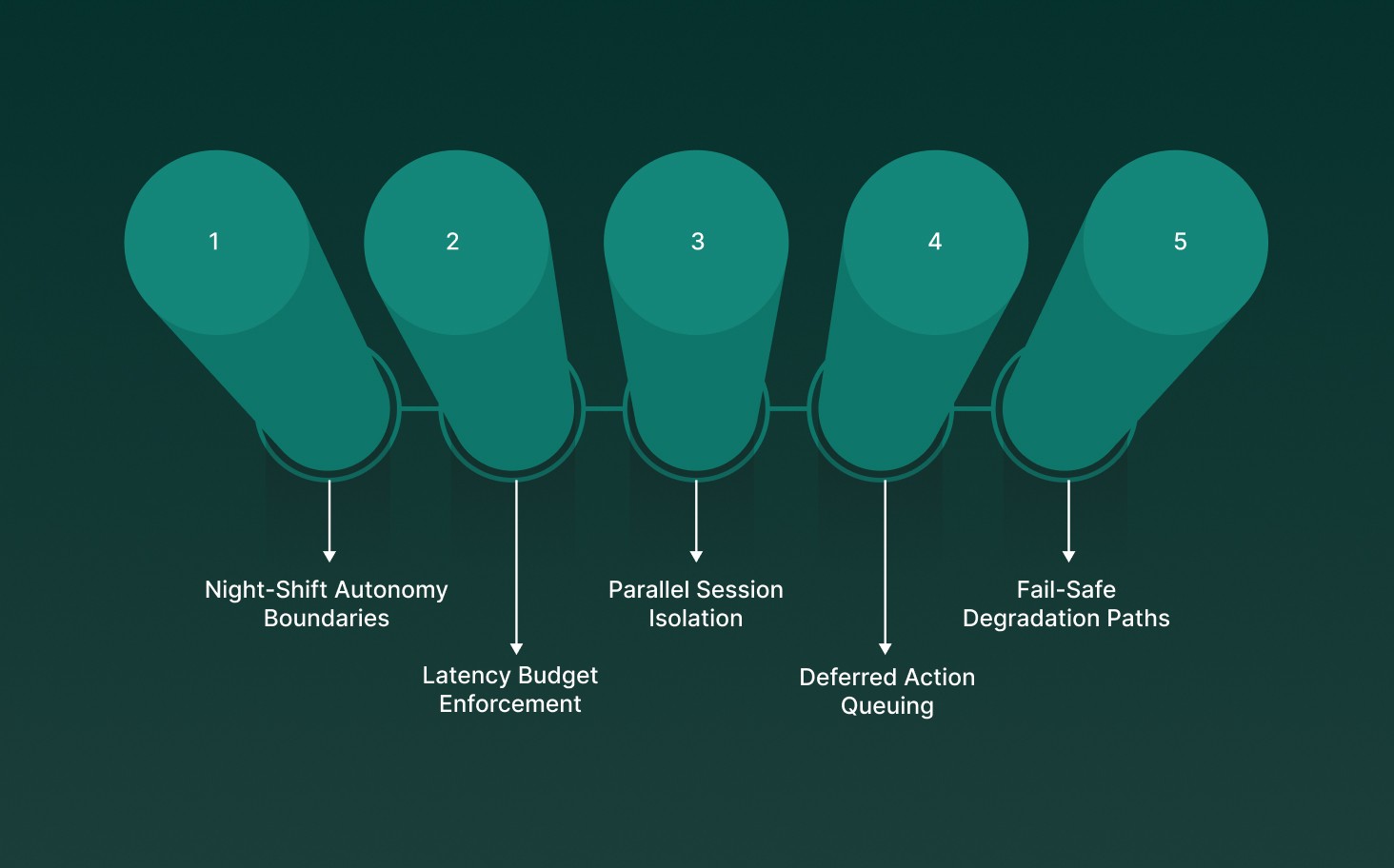
Always-on support fails when uptime is prioritized over correctness, latency predictability, and clean human recovery paths.
Night-Shift Autonomy Boundaries: AI must switch from resolution to intake mode after confidence drops, preserving context for human follow-up without attempting partial fixes.
Latency Budget Enforcement: Hard ceilings on end-to-end response time prevent performance decay during traffic spikes and protect conversational flow under load.
Parallel Session Isolation: Each call or chat maintains strict memory and state separation to avoid cross-user leakage during high-concurrency periods.
Deferred Action Queuing: Actions requiring human approval are logged with structured intent, entity extraction, and timestamps for deterministic morning execution.
Fail-Safe Degradation Paths: When models or dependencies fail, systems degrade gracefully to scripted flows or callbacks rather than silently timing out.
Always-on support is not about being available at all costs. It is about staying predictable, recoverable, and respectful of human follow-through.
Measuring, Monitoring, and Improving AI-Driven Support Over Time
AI support systems degrade silently without continuous measurement, especially when language, products, and customer behavior change faster than models can retrain.
Confidence Drift Tracking: Monitor model confidence decay per intent to detect when automation quality erodes before CSAT or escalation spikes appear.
Resolution Path Auditing: Log every decision branch taken during conversations to identify loops, dead ends, and overconfident completions.
Handoff Quality Scoring: Measure whether escalations include complete context, extracted entities, and accurate summaries, not just transfer counts.
Latency Variance Analysis: Track p95 and p99 response times per channel to catch infrastructure or model regressions invisible in averages.
Post-Interaction Model Correction: Feed corrected agent responses back into training pipelines with intent labels and failure reasons for targeted retraining.
AI support does not fail loudly. Teams that win treat monitoring as a control system, not a reporting dashboard.
How AI Chatbot Design Differs by Industry
AI chatbot design must adapt to industry-specific risk profiles, data sensitivity, and interaction cadence. Reusing a single architecture across sectors creates compliance gaps and operational failure.
Industry | Primary Constraint | Technical Design Requirement |
Debt Collection | Regulatory Exposure and Call Control | Script-bound dialogue enforcement, call-state logging, dispute flagging, confidence-based escalation, jurisdiction-aware compliance logic |
Ecommerce | Order State Volatility | Real-time OMS access, idempotent actions, SKU and address entity validation, burst-safe concurrency during peak traffic |
Logistics | Time-Critical Updates | Event-driven status ingestion, ETA recalculation, exception handling for delays, proactive outbound notifications |
Healthcare | Clinical Risk and PHI | Intent whitelisting, PHI redaction, symptom ambiguity detection, HIPAA-compliant storage and access control |
Small Business | Resource Constraints | Preconfigured workflows, low-maintenance retraining, unified inbox integration, predictable cost scaling |
Real Estate | Scheduling and Qualification | Calendar synchronization, lead scoring, entity extraction for budgets and locations, and human handoff before negotiation |
Recruitment | Fairness and Context | Bias-aware screening, structured intake, resume entity parsing, audit-ready decision logging |
Industry-aware design is not optional. Chatbots that ignore sector constraints fail audits, frustrate users, or create legal exposure.
See how enterprise support systems mature from basic automation to context-aware execution by reading From Chatbots to Virtual Assistants: The Evolution of Conversational AI for Enterprise
Common Mistakes to Avoid When Implementing AI Chatbots
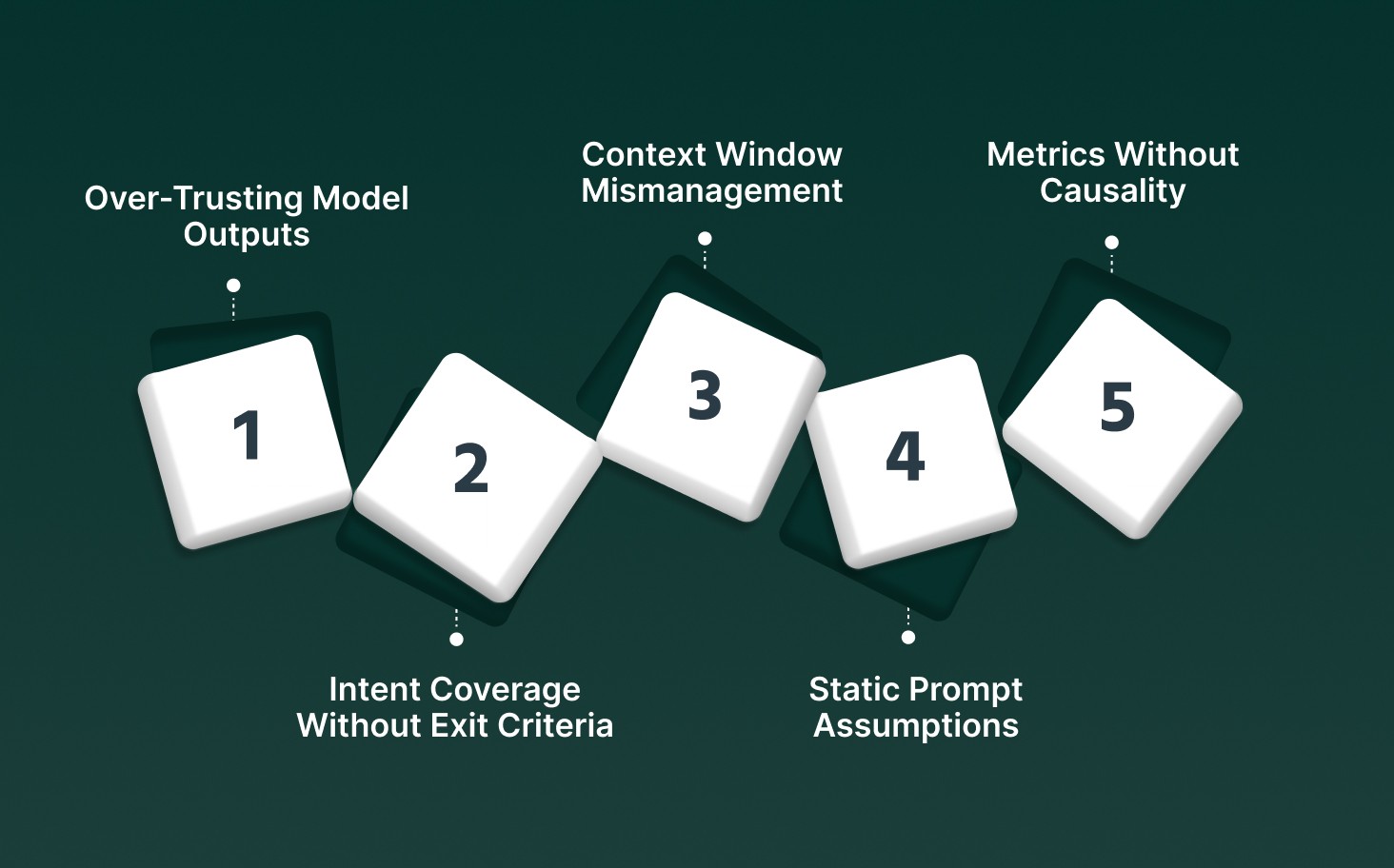
Most chatbot failures are self-inflicted. Teams optimize for launch speed and surface fluency while ignoring control systems, recovery paths, and real-world conversational entropy.
Over-Trusting Model Outputs: Treating probabilistic responses as deterministic truth without confidence thresholds leads to silent misinformation in billing, compliance, and account workflows.
Intent Coverage Without Exit Criteria: Expanding intent libraries without defining failure boundaries traps users in loops instead of triggering timely human intervention.
Context Window Mismanagement: Allowing uncontrolled context growth increases hallucination risk and degrades relevance during long, multi-turn conversations.
Static Prompt Assumptions: Freezing prompts at launch ignores language drift, product changes, and policy updates that invalidate responses within weeks.
Metrics Without Causality: Tracking deflection or volume alone hides whether AI resolved issues correctly or merely delayed human involvement.
Successful AI chatbots are engineered systems, not conversational experiments. The difference is disciplined constraints, not better phrasing.
Why Teams Use Smallest.ai for Production-Grade AI Support
Smallest.ai is built for teams running AI in live customer environments where latency, accuracy, escalation control, and auditability directly affect customer trust and operational risk.
Real-Time Voice Architecture: Sub-200 ms end-to-end latency enables interruption-aware voice interactions without turn clipping or delayed responses in live customer calls.
Deterministic Escalation Controls: Confidence decay, entity conflicts, and policy boundaries trigger system-driven handoffs instead of relying on user frustration signals.
Strict Action Guardrails: Intent-level permissioning prevents unauthorized writes to billing, CRM, or scheduling systems, reducing compliance and rollback risk.
Enterprise Deployment Flexibility: Supports cloud and on-premise inference to meet data residency, latency, and regulatory requirements across industries.
Audit-Ready Decision Logs: Captures intent classification, confidence scores, data sources, and blocked actions for post-incident reviews and regulatory audits.
Smallest.ai is designed for teams that need AI support systems to behave predictably under load, fail safely, and integrate cleanly with real operational workflows.
Conclusion
Strong AI customer service does not come from adding more intents or tuning prompts. It comes from treating automation like infrastructure, with clear limits, observable behavior, and recovery paths when things break. Teams that plan this way avoid silent failures and earn trust from both customers and agents over time.
If you are evaluating how to move from fragile chatbots to production-grade support systems, this is where platforms matter. Smallest.ai is built for real-world voice and chat automation with strict controls, low latency, and clean human handoffs.
See how teams design reliable customer support with Smallest.ai. Get in touch with us!
Frequently asked questions
How do AI chatbots handle policy changes without retraining the entire model?
What causes chatbot accuracy to drop even when no changes are made?
Why do some chatbots escalate too late instead of too often?
Can AI chatbots be audited after an incident?
What limits AI chatbots from fully replacing human agents?