AI Call Agent: Architecture, Use Cases, and Platform Options in 2026
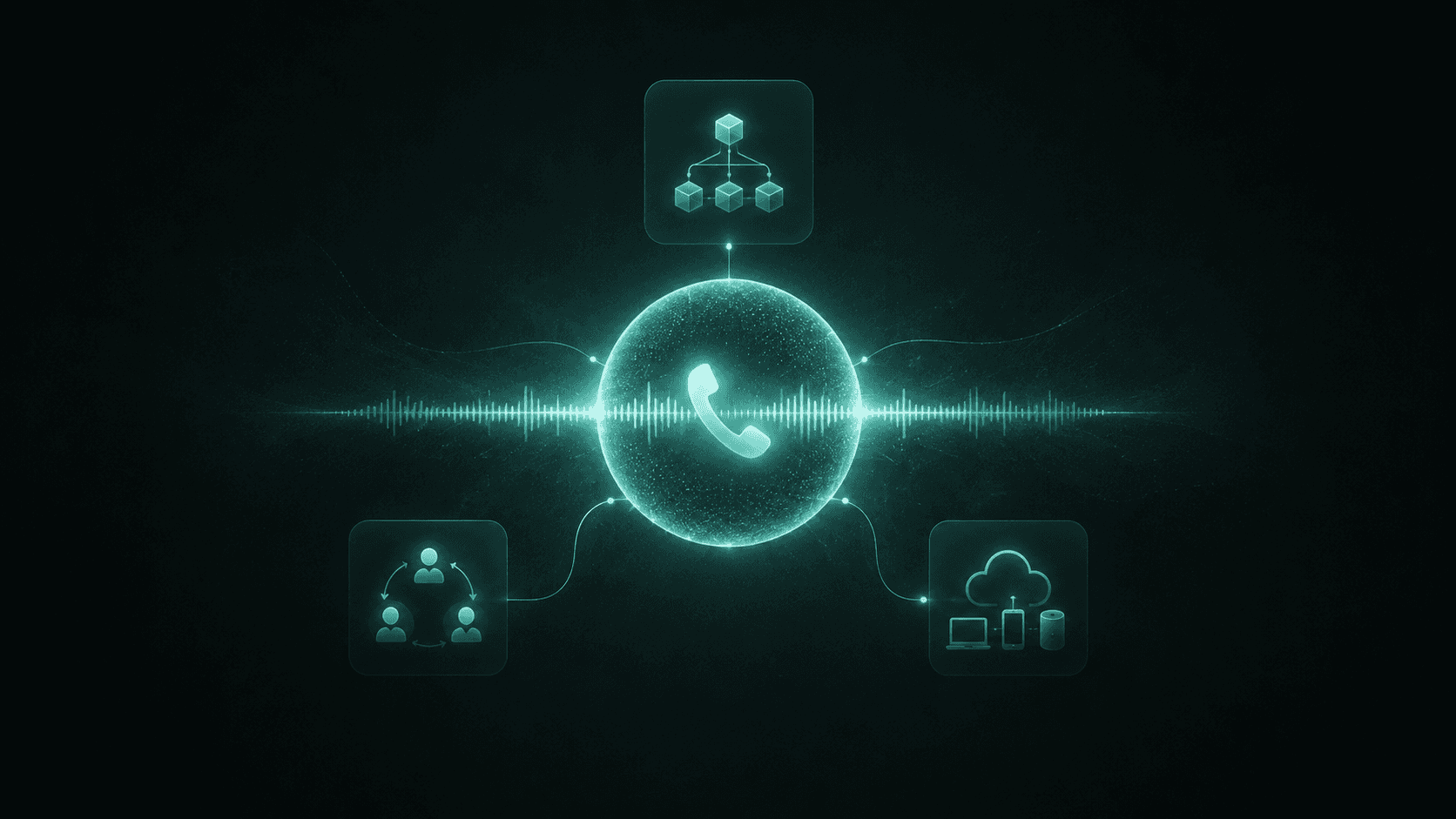
AI call agent platforms compared for 2026: Smallest.ai, ElevenLabs, Deepgram, OpenAI, and Cartesia on latency, pricing, integrations, and voice quality.
An AI call agent is software that can run a phone conversation end to end without a human on the line. It listens, infers intent, drafts a response, and speaks back in real time. What used to demand a full contact center stack can now be assembled with a handful of APIs and a voice pipeline that is tuned for live turn-taking.
The category has grown up quickly. By 2026, the conversation has shifted from whether AI call agents are viable to how different platforms approach deployment, orchestration, latency, and operational requirements. This comparison starts with how these systems work under the hood, then sizes up the leading options against the production realities that matter: latency, voice quality, pricing, integration flexibility, and compliance readiness.
How an AI Call Agent Actually Works
No matter the vendor, AI call agents tend to follow the same three-part flow. A speech-to-text (STT) engine transcribes the caller as they speak. A language model (LLM or SLM) reads that transcript, decides what to do next, and produces text. A text-to-speech (TTS) engine turns the text into audio and streams it back over the line. The gap between the caller finishing a thought and the agent starting to respond is measured in milliseconds. That end-to-end latency is the metric that decides whether the agent feels conversational or like a traditional automated system rather than a conversational agent.
Real deployments add a lot more than STT, an LLM, and TTS. You need interruption detection (so the agent stops talking when the caller cuts in), turn-taking logic, telephony integration (SIP, WebRTC, or carrier APIs), and session memory that stays coherent across a call. Some vendors ship this as a managed service; others expose each layer as an API so teams can assemble their own stack. If you want a clearer picture of the architectural trade-offs before picking a direction, the full-stack vs point solutions breakdown for call routing infrastructure is a useful primer.
[Image: A step-by-step infographic illustrating the three-stage AI call agent pipeline: Stage 1 shows a microphone icon feeding audio into a speech-to-text block, Stage 2 shows the transcript entering a language model block with a neural network icon, Stage 3 shows synthesized text flowing into a text-to-speech block and out through a speaker icon. Each stage has a latency label underneath.]
The three-stage pipeline every AI call agent runs on, with latency occurring at each handoff
Common AI Call Agent Use Cases
AI call agents are not a single-purpose tool. They are deployed across a wide range of functions, automating workflows that traditionally required significant human effort. From customer service to sales and collections, these agents handle high-volume, repetitive tasks, freeing up human teams to focus on more complex issues.
Here are five common use cases where AI call agents are making an impact:
Inbound Support: AI agents can serve as the first point of contact for customer service, functioning as an advanced AI answering service. They can handle common inquiries like order status, account information, and basic troubleshooting 24/7, reducing wait times and improving customer satisfaction. For more complex problems, the agent can gather initial information before seamlessly transferring the call to a human agent.
Lead Qualification: In both inbound and outbound sales, AI agents can automate the initial stages of lead qualification. They can engage prospects, ask structured questions about their needs, budget, and timeline, and score their responses. This ensures that human sales representatives spend their time on well-qualified leads, increasing efficiency and conversion rates.
Appointment Scheduling: Automating appointment booking, rescheduling, and cancellations is a primary use case for AI call agents. An AI agent can access calendar availability in real time, offer open slots to callers, and send confirmations and reminders, which helps to reduce no-shows.
Collections: AI agents are used in debt collection to automate outbound calls for payment reminders and to negotiate payment plans. These agents can handle a high volume of calls consistently and adhere strictly to compliance scripts, reducing the risk of human error and ensuring all interactions are logged for audit purposes.
Outbound Follow-up: Beyond initial sales calls, AI agents can be used for proactive outbound communication. This includes post-purchase follow-ups, customer satisfaction surveys, and re-engagement campaigns for dormant customers. Automating this outreach with an AI outbound calling system ensures consistent customer engagement without overburdening staff.
Evaluation Criteria for This Comparison
Every platform below is assessed against these six criteria:
End-to-end latency: How quickly does the agent respond after the caller stops speaking? Lower latency generally contributes to more natural conversational flow during live interactions.
Voice quality: Does the synthesized voice sound human? Naturalness, prosody, and emotional range all factor in.
Pricing model: Per-minute, per-character, or flat subscription? Hidden costs matter at scale.
Integration flexibility: Can it connect to your telephony stack, CRM, and custom logic without heavy engineering?
Compliance and security: HIPAA, GDPR, SOC 2, and data residency options for regulated industries.
Developer experience: Quality of documentation, SDKs, and the effort required to go from prototype to production.
Smallest.ai Atoms: Low-Latency Voice Agents
Smallest.ai is engineered around a single hard constraint: latency. Atoms is the voice and text agent layer, built on proprietary components for low-latency speech synthesis (Lightning TTS) and speech-to-text (Pulse STT). Atoms also provides conversational reasoning and orchestration capabilities. There is also Hydra, a speech-to-speech layer that can skip the reasoning step entirely for certain interaction patterns, shaving more time off the response. Smallest.ai publishes internal benchmarks showing Lightning is designed for low-latency speech synthesis workloads.
Atoms is designed with a modular architecture, allowing teams to use the full platform or individual components depending on deployment requirements. Each component is available on its own through the Waves API, so you can keep your existing STT provider and still use Lightning for TTS, or use its conversational reasoning layer without redoing telephony. Pricing is usage-based and posted publicly on the Smallest.ai pricing page, with tiers that scale from prototype workloads to larger deployments. This structure is useful for teams building production voice agents.
For regulated deployments, Smallest.ai has published compliance documentation that addresses HIPAA and GDPR considerations; the AI call agent compliance guide is the place to start. The platform also supports voice cloning via the Lightning API, which matters if you want a consistent, proprietary voice identity across automated calls rather than a generic assistant voice.
Where Atoms stands out:
Sub-100ms TTS time-to-first-byte via Lightning
Modular architecture: use the full stack or individual APIs
Conversational reasoning and orchestration capabilities designed for conversational tasks
Voice cloning included in the API surface
Transparent, usage-based pricing with no enterprise-only gating on core features
The trade-off is orientation: Atoms is built for developers, not drag-and-drop workflows. If your team lacks engineering bandwidth, you will likely need help to get a production agent live. For teams that expect to scale, that upfront work buys you the flexibility to tune the stack instead of living with a vendor's defaults. If you are weighing it against other popular voice agent frameworks, the Vapi alternatives comparison for 2026 maps out where Smallest.ai lands in the wider market.
ElevenLabs: Voice Generation and Cloning
ElevenLabs focuses on voice generation, voice cloning, and conversational AI capabilities. The platform is commonly evaluated for applications where voice quality and customization are important considerations, such as in audiobooks, branded IVR, or high-touch customer service.
For AI call agent deployments, ElevenLabs sells a Conversational AI product that bundles STT, an LLM layer, and its TTS into a managed pipeline. The platform's design priorities focus on voice quality and customization. TTS pricing is character-based and increases with usage, and Conversational AI has its own tiers; at high call volumes, spend can rise quickly compared to platforms optimized for usage efficiency. The platform provides a broad voice library and voice-cloning capabilities for teams that prioritize voice customization.
Deepgram: Speech Recognition and Transcription
Deepgram focuses on speech recognition, transcription, diarization, and related speech-processing workflows. It is commonly evaluated as part of broader voice AI systems where transcription quality is an important requirement, particularly for handling accented speech, noisy audio, or specialized domain vocabulary.
What you do not get is the rest of the stack: no TTS, no LLM layer, no telephony integration out of the box. You are buying a speech processing component, not a complete agent. Teams that pick Deepgram typically pair it with a separate TTS provider and an LLM, which adds integration work and more failure points. If you want the broader STT landscape through the lens of voice agent stacks, the best speech-to-text APIs for voice agents in 2026 compares Deepgram with other options.
OpenAI Realtime API: Unified Audio Processing
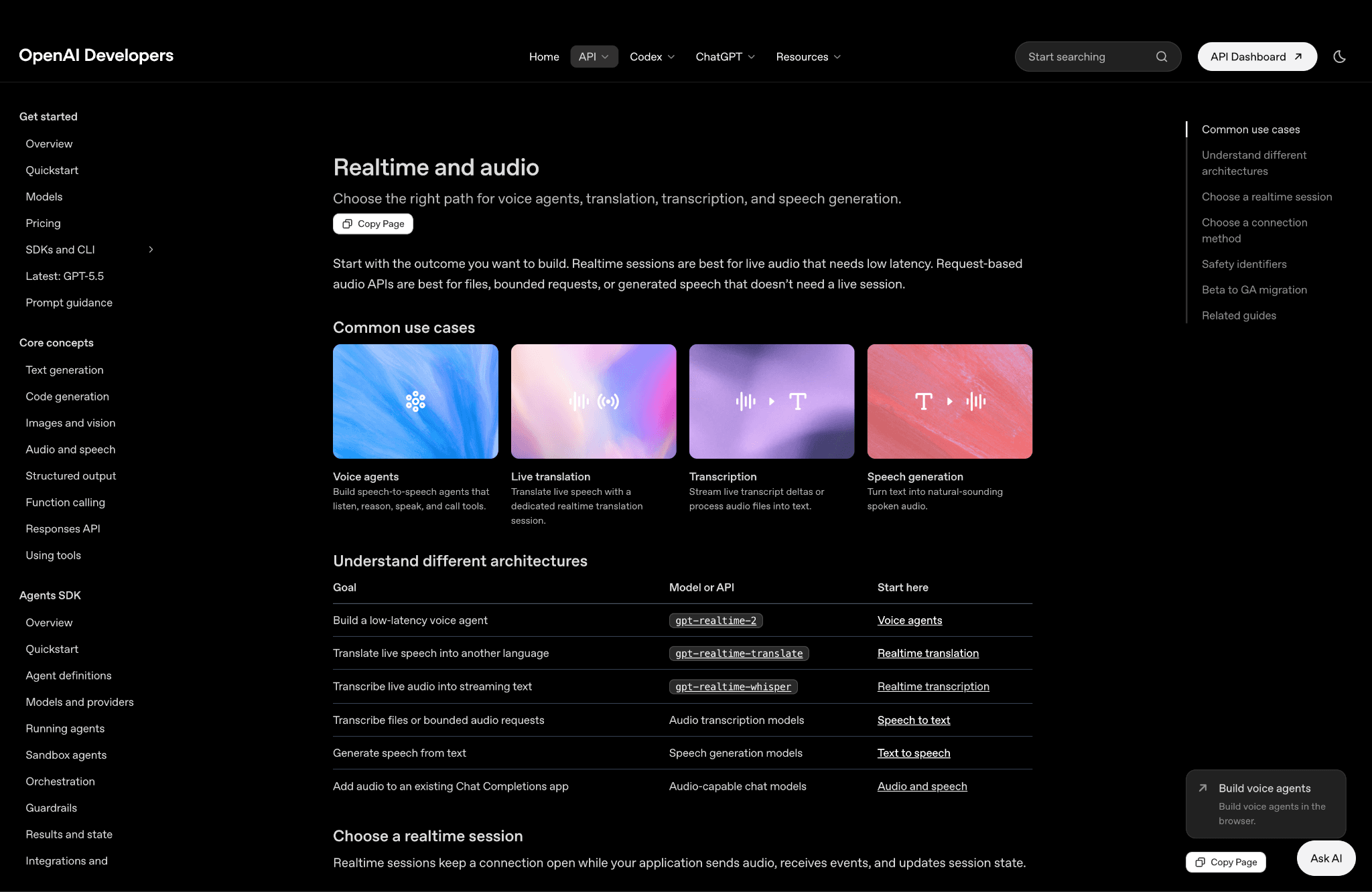
OpenAI's Realtime API, introduced in late 2024 and refined through 2025, takes a different path than the classic three-box pipeline. Instead of chaining STT, an LLM, and TTS, it pushes audio in and pulls audio out through a single GPT-4o model pass. This architecture integrates the components into a single inference step where the model processes audio input directly and generates audio output without requiring an intermediate text transcription stage.
The downsides are not subtle. Per-minute pricing is higher than most alternatives, which becomes a real budget line at call center scale. Voice customization is also narrower than what you get from dedicated TTS providers. And since the entire pipeline lives inside one proprietary model, you give up the ability to swap parts as requirements change. Organizations evaluating OpenAI should consider the tradeoffs between simplicity, customization, pricing, and deployment flexibility. The Smallest.ai vs Deepgram vs OpenAI TTS guide breaks down the cost and quality trade-offs.
Cartesia: Real-Time Speech Infrastructure
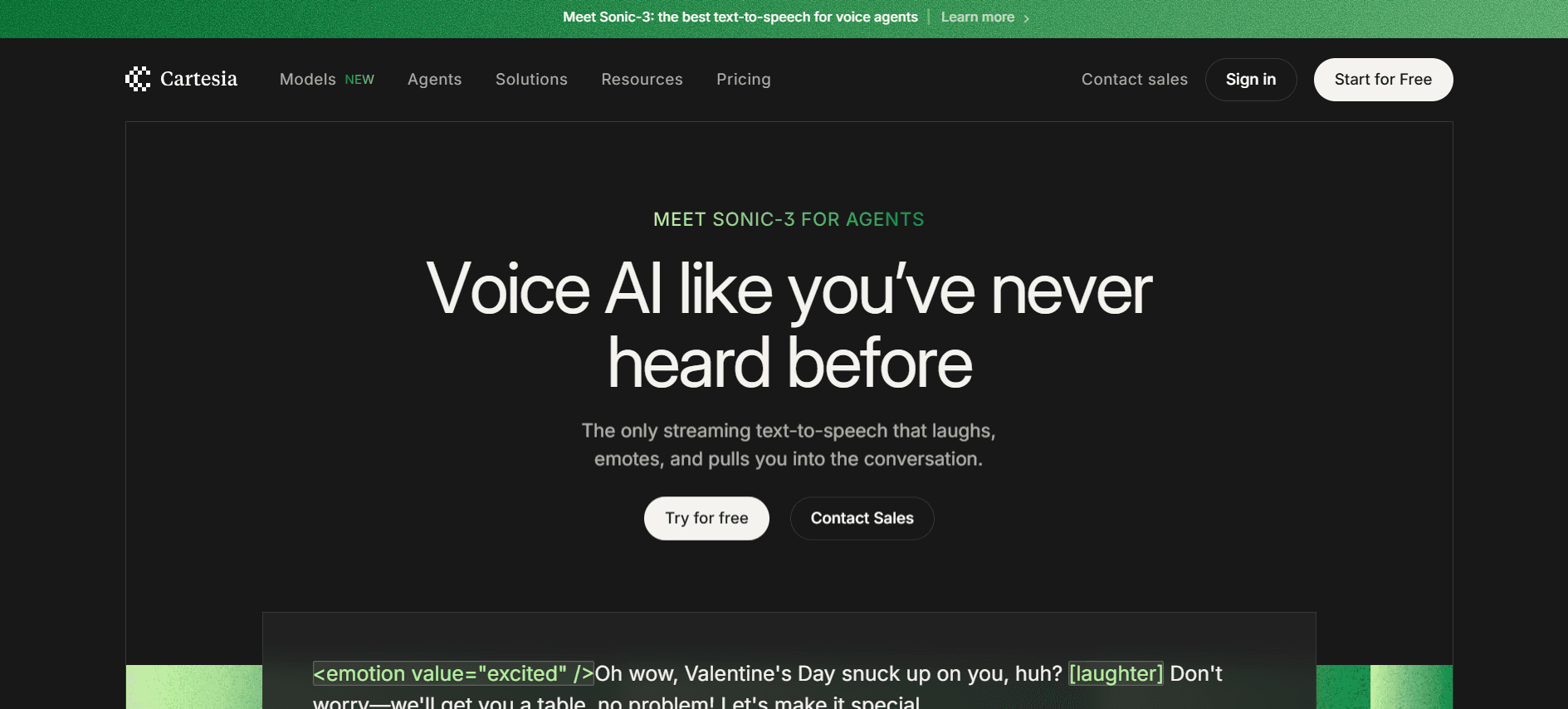
Cartesia focuses on real-time speech infrastructure, including speech synthesis and related voice capabilities. Its Sonic model is designed for real-time speech synthesis, with a distinct voice library. Pricing is character-based and friendly to developers, with a free tier for prototyping.
Cartesia provides building blocks rather than a complete agent platform. It makes sense in custom stacks where you already have an STT provider and an LLM and you just need fast, reliable speech output. If your decision is specifically Cartesia versus Smallest.ai's Lightning, the practical difference is scope: Lightning sits inside a broader platform (Atoms) that can expand with your stack, while Cartesia provides speech infrastructure components.
Common AI Call Agent Deployment Mistakes
Deploying an AI call agent involves more than choosing a platform; it requires careful planning to avoid common pitfalls that can undermine the user experience and operational goals. Many deployments fail not because of the technology itself, but due to strategic and architectural oversights. Understanding these mistakes is key to a successful implementation.
Here are five common mistakes to avoid:
Ignoring Latency Budgets: Natural conversation has a rhythm. When an AI agent takes too long to respond, the conversation feels awkward and broken. Teams often underestimate the impact of end-to-end latency, which includes time for speech recognition, model processing, and voice synthesis. A successful deployment requires a strict latency budget and a platform architected for speed.
Choosing Voice Quality Over Workflow Design: A human-sounding voice is important, but it cannot fix a poorly designed workflow. If the agent cannot perform the necessary tasks, update a CRM, or escalate properly, the voice quality is irrelevant. The most effective deployments prioritize automating the complete workflow, not just the conversation.
No Escalation Logic: Not every call can or should be handled entirely by an AI. Without a clear, reliable path to a human agent, customers can become trapped and frustrated. A robust escalation strategy defines when and how to transfer a call, ensuring the human agent receives the full context of the AI conversation to avoid forcing the customer to repeat themselves.
Weak CRM Integration: An AI call agent that doesn't connect to your system of record, like a CRM, creates more work than it saves. Without tight integration, call data remains siloed, follow-ups are missed, and customer records are incomplete. The goal is to transform conversations into structured data that drives action, not just to answer the phone.
Poor Interruption Handling: Real conversations are not perfectly turn-based. People interrupt, ask clarifying questions, and speak over each other. An agent that cannot handle interruptions gracefully will feel robotic and frustrating. Effective interruption handling (or barge-in) is a critical feature for a natural-feeling conversational experience.
The table below provides a high-level overview of the platforms based on their primary focus and capabilities.
Platform | Primary Focus | Speech Capabilities | Platform Scope | Common Use Cases |
|---|---|---|---|---|
Smallest.ai | Voice infrastructure and agents | STT, TTS, Speech-to-Speech | Agent platform | AI call agents |
ElevenLabs | Voice generation and conversational AI | TTS, Voice Cloning, Conversational AI | Voice platform | Voice experiences |
Deepgram | Speech recognition | STT, Diarization | Speech processing | Transcription |
OpenAI | General AI platform | Audio + LLM | AI platform | Conversational systems |
Cartesia | Real-time speech infrastructure | Speech services | Voice infrastructure | Real-time voice systems |
Verdict: Which AI Call Agent Platform Should You Choose?
Different platforms emphasize different parts of the voice stack. Some focus on speech recognition, some on speech generation, and others combine speech, orchestration, and deployment capabilities within a broader conversational AI platform. The right choice depends on workflow complexity, latency requirements, integration needs, compliance requirements, and operational goals.
Smallest.ai Atoms is built for teams that require low latency and a modular architecture. Lightning's sub-100ms TTS, Pulse for STT, and the platform's reasoning layer are designed to keep compute spend aligned with usage. The modular API surface also means you can tune each layer independently as volume grows, rather than replacing the entire stack at once. For inbound sales and lead qualification at scale, the AI call center agents for inbound sales guide shows how this architecture plays out.
Smallest.ai and Deepgram both publish compliance postures you can evaluate. If you are in healthcare or finance, start by reading the HIPAA and GDPR readiness analysis for AI call agents before you lock in a stack.
Many organizations begin with a platform that satisfies immediate requirements and then refine individual components as call volume, compliance needs, and workflow complexity increase. Evaluating flexibility, deployment requirements, and long-term operational fit is often just as important as evaluating model quality or voice quality.
Frequently asked questions
What is an AI call agent, and how does it differ from a traditional IVR?
What latency should I expect from an AI call agent?
Can AI call agents meet compliance requirements like HIPAA or GDPR?
Do I need to build a custom AI call agent, or can I use a managed platform?
How do I choose between a full-stack AI call agent platform and individual component APIs?