AI Answering Service: Best Options for Your Business in 2026

Compare the best AI answering service options for 2026. Learn what drives voice quality, ROI, and compliance, and find the right fit for your business.
A high percentage of phone calls to small businesses go unanswered, and many of those callers never try again. That is not a staffing problem an extra receptionist fixes. It is a structural gap, and an AI answering service is built specifically to close it. This piece covers what these systems actually do, what separates a capable solution from a mediocre one, and which options deserve your attention heading into 2026.
What an AI Answering Service Actually Does
The term gets used loosely, so precision matters. An AI answering service is a voice-based system that receives inbound calls, understands what the caller wants through natural language processing, and responds or routes accordingly without a human in the loop. That makes it fundamentally different from a traditional IVR menu, which forces callers through button-press scripts. A modern AI answering service holds a real conversation.
The global AI customer service market is experiencing significant growth, driven in large part by the adoption of voice agents. AI-powered systems can resolve a significant portion of inbound calls for structured query types like appointment scheduling, order tracking, and account inquiries. Whether you run a medical practice, a law firm, a home services company, or an e-commerce operation, the core question is the same: can this system handle your callers well enough that the experience feels natural? The answer depends almost entirely on what is running underneath.
The Core Technology Stack Behind Voice AI
Most businesses evaluating AI answering services focus on surface features: does it sound natural, can it book appointments, does it connect to the CRM. Those are the right questions. But the answers depend on three underlying layers that most vendor demos never show you.
The three layers that determine AI answering service quality:
Speech-to-text (STT): Converts the caller's voice into text the system can process. Accuracy is non-negotiable here. A single misheard word can derail an entire interaction, particularly with names, addresses, or medical terminology.
LLM or dialogue engine: Interprets intent, tracks conversation context, and decides what response to generate. This is where the actual intelligence lives, and where cheaper platforms cut corners.
Text-to-speech (TTS): Converts the system's response back into spoken audio. This is the layer the caller hears, and it is where most services either earn or lose trust within the first five seconds of a call.
The TTS layer is consistently underestimated by buyers. Latency matters enormously in live phone conversations: a noticeable pause before every response feels robotic and erodes caller confidence fast. The best voice AI systems use sub-200ms latency on TTS as a key performance benchmark, as this is the threshold where responses start feeling genuinely conversational. If you are choosing your 2026 voice agent stack, TTS latency is the first technical spec to ask about, not the last.
What to Look for When Evaluating Options
A system optimized for high-volume e-commerce order tracking is architecturally different from one built for healthcare appointment scheduling. Use this framework before committing to any vendor demo or trial.
Criteria | Why It Matters | What to Ask |
|---|---|---|
Voice naturalness and latency | Callers hang up when responses feel robotic or delayed | What is the average TTS latency? Can I hear a live demo? |
Customization depth | Generic voices erode brand trust | Can I clone a voice or adjust tone, pace, and vocabulary? |
Integration ecosystem | The service must connect to your existing tools | Does it integrate with my scheduling, CRM, or EHR system? |
Compliance coverage | Healthcare, legal, and finance have strict data rules | Is it HIPAA-compliant? SOC 2 certified? |
Escalation handling | Not every call can be resolved by AI | How does it hand off to a human, and how gracefully? |
One thing most evaluation guides skip: ask how the system handles unexpected inputs. A caller who goes off-script, uses slang, or has a heavy accent is the real stress test. Any vendor worth considering should be able to show you failure modes, not just highlight-reel demos.
Best AI Answering Service Options for 2026
The market has matured enough that meaningful differences now exist between providers, not just in feature lists but in the underlying voice quality and latency that determine caller experience. Here is an honest look at the leading options.
Smallest.ai
Smallest.ai's AI Answering Service is built around its Lightning TTS engine, purpose-built for real-time voice agent applications. The architecture delivers responses in under 200ms, among the fastest in the category. For businesses where caller experience directly affects revenue, medical practices, legal intake, high-ticket service companies, that latency advantage translates into conversations that feel genuinely human rather than processed.
The platform supports voice cloning, multilingual deployment, and granular control over speaking style. For healthcare businesses, Smallest.ai offers a HIPAA-compliant infrastructure path that removes one of the most common blockers for regulated industries. Pricing tiers are structured to scale from small businesses to enterprise deployments; see the Smallest.ai pricing plans page for current details.
ElevenLabs
ElevenLabs is a voice generation platform primarily designed for content creators producing narration, audiobooks, and dubbed media. While its Conversational AI product exists, the platform may require additional infrastructure for call routing, CRM integration, and escalation handling that a business phone system requires. For teams evaluating it as a content or dubbing tool, a structured comparison of top alternatives to ElevenLabs is available.
Deepgram
Deepgram is primarily a speech-to-text API provider, not a full answering service out of the box. Development teams building custom voice agents often use Deepgram's STT layer as one component of a larger stack. If your team has engineering resources and wants a bespoke solution, it is worth evaluating. For those who need a deployable product, it may require significant development work. See our 2026 voice agent stack comparison for more on API costs.
Cartesia
Cartesia is a low-latency TTS API, not a complete phone system. It produces fast, high-quality speech output but may require significant engineering to become part of a functioning call-handling pipeline. Businesses without a dedicated development team might find it requires too much infrastructure work before a single call can be handled. For a direct technical comparison, a review of Smallest.ai vs. Cartesia covers where the architecture differs.
Platform | Best For | Voice Latency | HIPAA Ready |
|---|---|---|---|
Smallest.ai | Full answering service, regulated industries, small business | Under 200ms | Yes |
ElevenLabs | Voice cloning, content creation, developer APIs | Moderate | Limited |
Deepgram | Custom STT integration, developer builds | Low (STT only) | Verify with vendor |
Cartesia | Custom TTS layer, developer builds | Very low (TTS only) | No |
Practical Deployment: Getting It Right the First Time
Most failed AI answering service deployments share a common cause: the business treated setup as a one-time configuration rather than an ongoing calibration process. A successful rollout looks different.
Start with your top 20 call types. Pull three months of call logs, or ask your front desk staff to list the questions they answer most often. These become your first training scenarios. A system that handles your 20 most common calls extremely well is more valuable than one that attempts everything and handles nothing gracefully. Resist the urge to automate everything on day one.
The escalation path deserves as much design attention as the AI responses themselves. When a caller is frustrated, confused, or has a request outside the system's scope, the handoff to a human needs to be immediate and warm. 'Let me connect you with someone who can help' followed by a brief hold is acceptable. A dropped call is not. Build and test this path before you go live, not after.
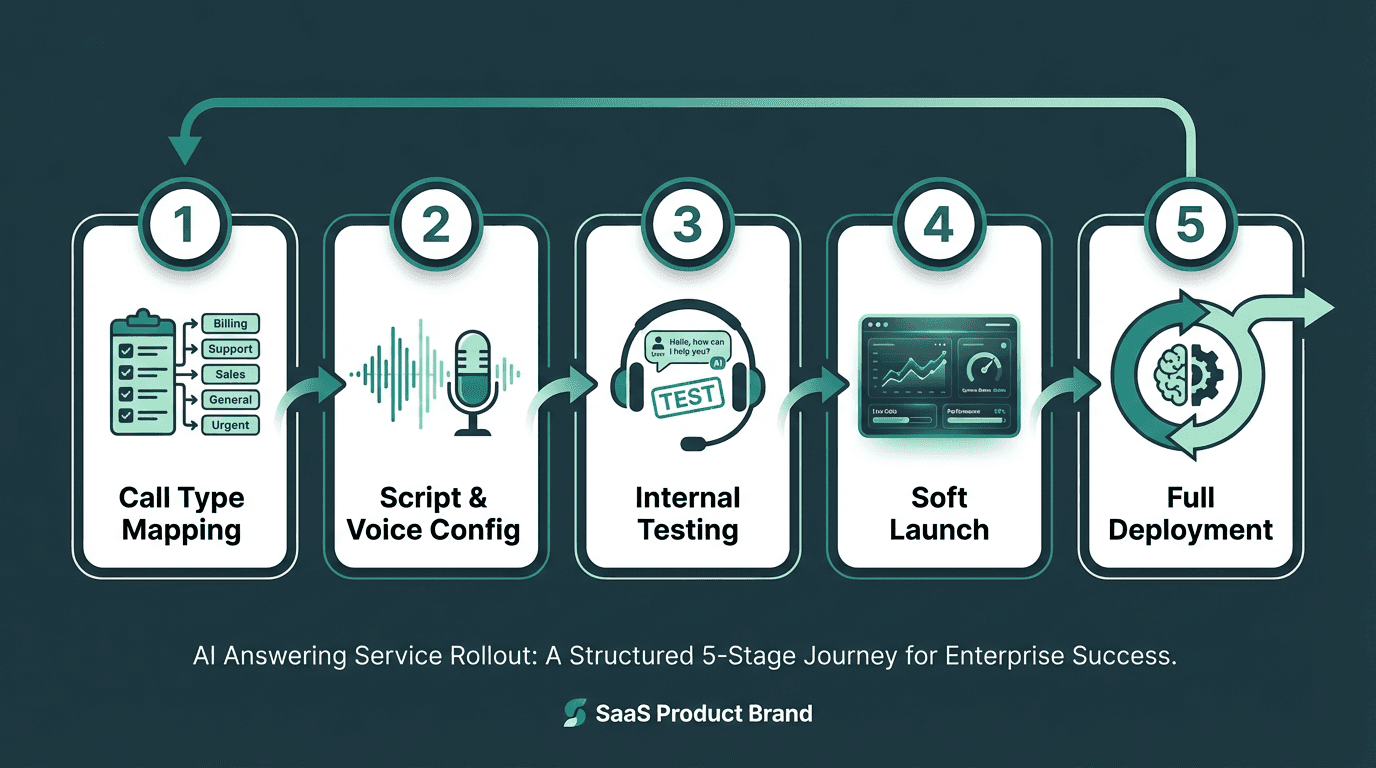
A phased rollout reduces risk and gives you real caller data before full deployment.
For small business owners, the best AI answering service for small businesses often comes down to two factors: how fast you can get it live, and how little ongoing maintenance it requires. Managed deployment options, where the provider handles configuration and updates, are worth the premium for teams without dedicated technical staff.
The ROI Case: Numbers Worth Knowing
Observations from industry reports suggest AI automation can reduce the average cost per support interaction and total support operating costs significantly within the first year. For a business fielding a high volume of calls monthly, even a modest reduction in handling cost compounds quickly into significant annual savings. The revenue side is equally significant: many consumers report preferring to interact with automated systems when they want immediate service. A caller who gets an instant answer at 11pm books an appointment. One who hits voicemail moves on to the next provider in the search results. For AI solutions for small business, the 24/7 availability factor alone often justifies the investment.
Advanced Considerations for Specific Industries
Healthcare practices need more than a pleasant voice. They need a system that avoids storing protected health information in ways that violate HIPAA, integrates with EHR scheduling systems, and handles distressed callers with appropriate sensitivity. The use case in healthcare is one of the highest-ROI applications in the category, given the sheer volume of appointment-related calls most practices field every day. For a dedicated look at how Smallest.ai handles healthcare-specific requirements, see the AI for healthcare page.
Legal intake is a different challenge entirely. Callers are often in stressful situations, and the information they share carries legal significance. The AI system must capture structured data accurately, avoid anything that could be construed as legal advice, and route urgent matters immediately. Law firms evaluating voice AI should test specifically with emotionally charged scenarios, not just routine inquiries.
Home services businesses (plumbers, HVAC contractors, electricians) have a simpler but equally urgent requirement: after-hours coverage. Most emergency service calls happen outside business hours. A system that can triage urgency, book appointments, and dispatch on-call technicians without a human in the loop is the core value proposition for this segment, and the bar for voice quality is lower than in healthcare or legal.
Key Takeaways and Next Steps
The AI answering service category has moved well past the experimental phase. The technology is production-ready, the ROI is measurable, and the cost of not deploying one is increasingly visible in missed calls and lost revenue. Businesses that benefit most in 2026 will be those that approach deployment strategically: start with a defined set of call types, build a proper escalation path, and treat the first 90 days as a calibration period rather than a finished product.
If voice quality is a priority, the TTS latency and naturalness of the underlying speech engine is the single most important differentiator between platforms. Smallest.ai's Lightning model is purpose-built for real-time voice agent applications, with responses under 200ms and voice cloning that make it a strong fit for businesses where caller experience directly affects conversion. Explore Smallest.ai's AI Answering Service to see how it handles the specific call types your business receives most.
Frequently asked questions
What is the difference between an AI answering service and a traditional IVR system?
Can an AI answering service handle calls for a small business without technical setup?
Is an AI answering service compliant with healthcare privacy regulations?
How do callers respond to AI answering services? Do they hang up?
What should I look for in an AI answering service for a high-volume business?