AI powered voice assistants for travel bookings changes refunds and itinerary help

Learn how AI voice assistants handle travel bookings, flight changes, refunds, and itinerary help. A technical guide for travel product teams and developers.
The way people interact with travel services is shifting fast. Voice assistants are no longer novelty features tucked inside smart speakers. They are becoming the primary interface through which travelers book flights, request refunds, and reorganize itineraries, often without opening an app or waiting on hold. According to Phocuswright (2025), voice-driven travel interactions are growing at double the rate of mobile app engagement, and global voice assistant transactions are projected to reach an estimated $164 billion by 2025. Those numbers are not projections to file away. They describe a channel that is already carrying real transaction volume.
This article is written for product teams, developers, and travel industry operators who want to understand how voice AI actually functions in travel contexts, where it delivers measurable value, and what it takes to deploy it well. The architecture behind travel voice assistants, the specific use cases where they outperform traditional channels, and the implementation pitfalls worth avoiding early.
What this guide covers
The sections below move from technical foundation to specific use cases: booking by voice, change and cancellation handling, refund workflows, and real-time itinerary support. From there the focus shifts to implementation decisions, the edge cases most guides skip, and a practical FAQ for teams in the build or evaluation phase.
How voice assistants work in travel: the technical foundation
A travel voice assistant is not a single technology. It is a pipeline. Automatic speech recognition (ASR) converts spoken input to text. A natural language understanding (NLU) layer extracts intent and entities, things like dates, destinations, and booking references. A dialogue manager handles multi-turn conversation logic. A text-to-speech (TTS) engine converts the system's response back into spoken audio. Each layer introduces latency and its own failure modes.
In travel, that pipeline gets stress-tested quickly. A user saying 'I need to change my return flight from London to the 14th and also check if my seat upgrade went through' is asking the NLU layer to parse two distinct intents simultaneously. That is a genuinely hard problem, and most consumer-grade voice interfaces still struggle with it. For a full breakdown of how these systems are architected, the comprehensive guide to AI voice assistants covers the complete stack in detail.
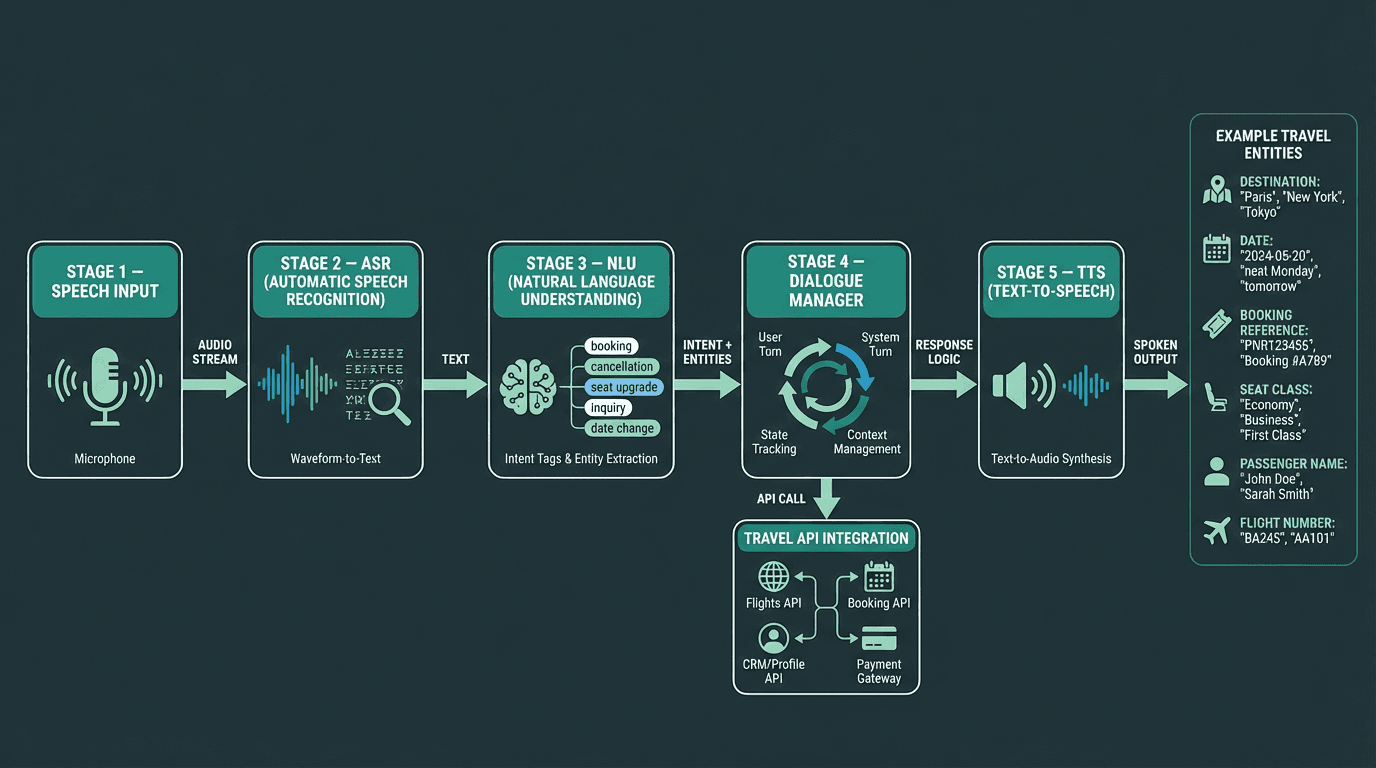
A travel voice assistant pipeline spans five distinct layers, each with its own accuracy and latency profile.
Booking by voice: what works and what does not
Voice booking works best for narrow, well-defined queries. 'Book me the cheapest direct flight from New York to Miami on Friday' is exactly the kind of request a well-built voice assistant handles confidently. The intent is singular, the entities are clear, and the confirmation step is simple. A growing share of voice assistant usage is concentrated in travel queries, destination searches, status checks, and price lookups, precisely the tasks where voice has a natural advantage.
Multi-variable searches are a different story. Comparing three airlines across cabin classes, layover preferences, and loyalty program redemptions is still better handled visually. Voice assistants are not trying to replace the booking interface entirely. They are trying to eliminate the steps that do not require a screen: the back-and-forth clarifications, the status checks, the confirmations. That is where the real efficiency gain is.
See how Smallest.ai's voice agents can power travel booking experiences
Handling changes and cancellations through voice AI
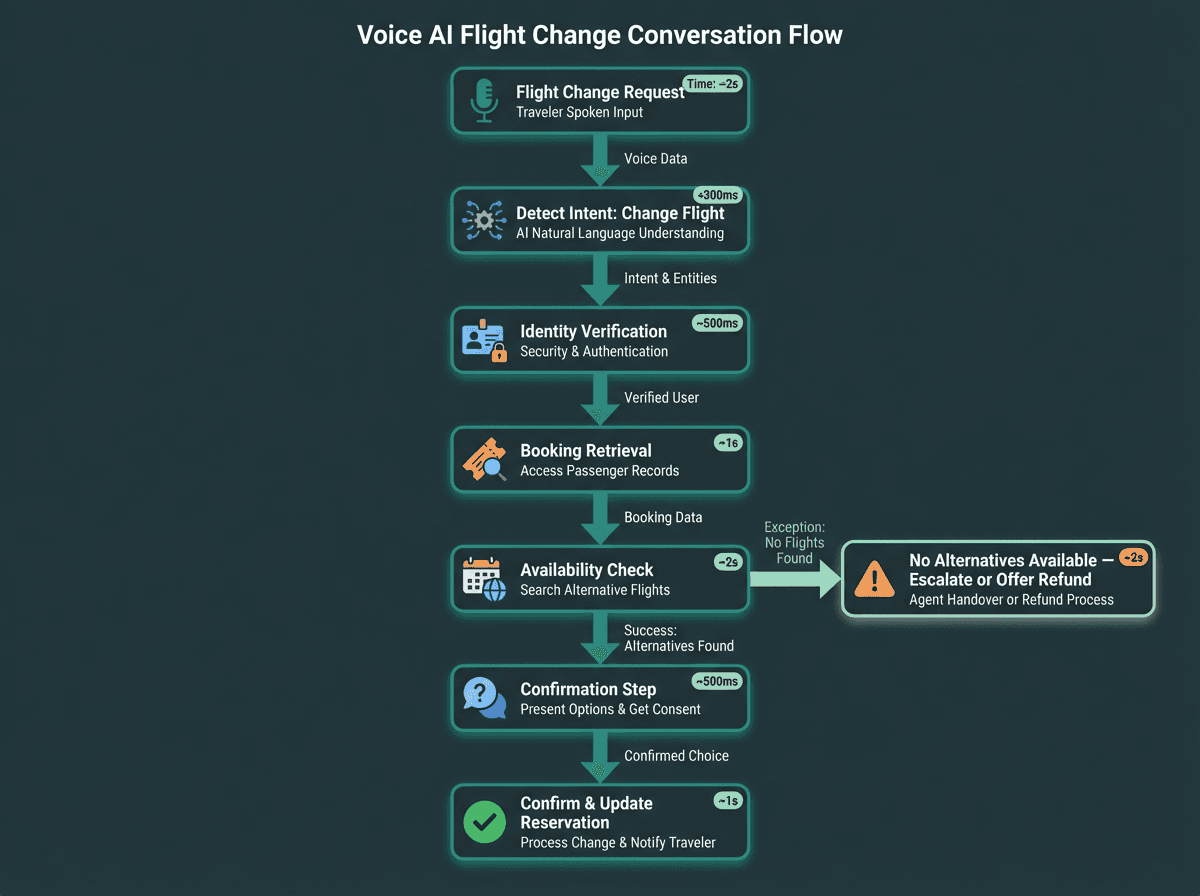
A well-designed change flow resolves most requests in under 90 seconds without agent involvement.
Flight changes and cancellations are high-volume, high-stress interactions. Travelers calling from airports, dealing with delays, and needing answers fast represent the clearest ROI case for voice AI in travel. The traditional path, navigating an IVR menu and waiting for a human agent, is exactly the kind of friction that erodes brand loyalty at the worst possible moment.
A voice assistant integrated with your booking system can handle the full change workflow conversationally: the user identifies themselves, states the change needed, the system retrieves available alternatives, presents the best option with fare difference if applicable, and confirms the change. All in a single conversation. For voice assistants in customer support contexts, this pattern consistently reduces average handle time and improves first-contact resolution rates.
The critical technical requirement is real-time API integration. The voice assistant needs live access to inventory, fare rules, and customer booking records. A system working off cached data will quote options that are no longer available, which is worse than no automation at all. Latency matters too: a voice response taking more than two seconds feels broken to a caller under stress.
Refund workflows: where voice AI removes friction
Refund requests carry more emotional weight than change requests. A traveler asking for a refund has usually had something go wrong, and the voice interaction needs to be accurate, empathetic in tone, and fast. This is where TTS voice quality matters more than most teams expect. A flat, robotic voice delivering refund status updates reads as dismissive. A natural, well-paced voice with appropriate prosody signals that the system is taking the request seriously. That distinction affects whether the traveler trusts the outcome. Models like Smallest.ai's Atom TTS are engineered specifically for this kind of low-latency, high-naturalness speech output.
What a voice assistant can handle autonomously in a refund workflow:
Verifying booking eligibility based on fare rules
Confirming the refund amount and expected timeline before processing
Initiating the refund to the original payment method
Sending confirmation to the traveler's registered contact
Escalating to a human agent when the case falls outside standard rules, including partial refunds, disputed charges, or force majeure situations
That escalation path deserves emphasis. Voice AI should not attempt to handle every refund case. Complex disputes, travel insurance involvement, or situations requiring policy exceptions need human judgment. A well-designed system recognizes these cases early and hands off gracefully, passing full context to the agent so the traveler does not have to repeat themselves from the beginning.
Itinerary management and real-time travel support
A study by Amadeus found that 64% of global travelers would pay for an AI assistant that provides in-trip information. That figure signals something important: travelers are not merely tolerating AI assistance. They are actively willing to pay for it when it solves real problems mid-journey.
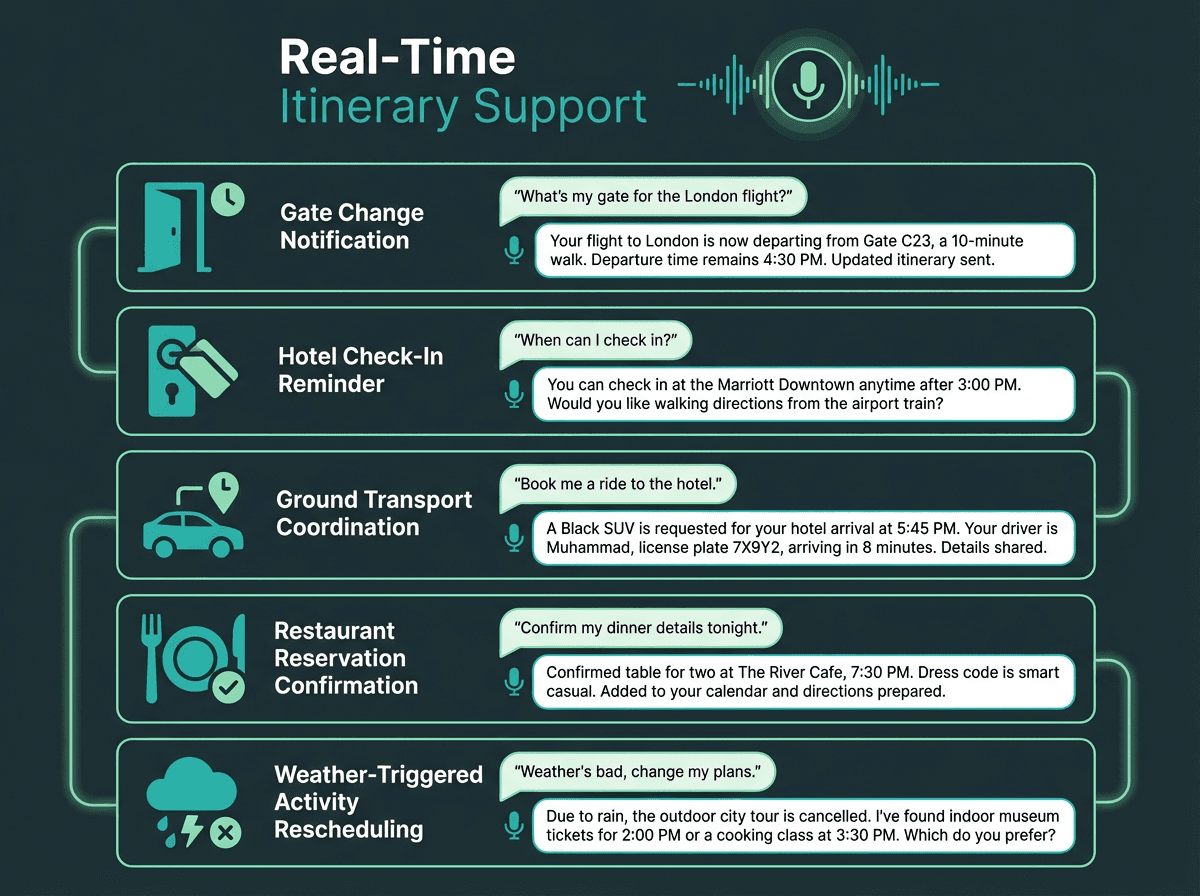
Real-time itinerary support covers everything from gate changes to activity rescheduling.
Itinerary management through voice reaches its potential when the assistant has access to full trip context: flights, hotels, ground transport, and activity bookings in one unified view. Ask 'What time do I need to leave the hotel to make my flight?' and a well-integrated assistant returns a calculated answer accounting for check-out time, transfer duration, and check-in requirements. That contextual reasoning is what separates a useful travel voice assistant from a glorified FAQ bot.
For businesses in hospitality, this extends naturally into on-property services. Guests can request room service, adjust checkout time, or get local recommendations without picking up a phone or opening an app. The conversational AI benefits for hospitality are significant here, particularly for properties looking to reduce front-desk load during peak hours.
Implementation considerations for travel businesses
Getting a travel voice assistant into production involves more than picking a speech model and connecting it to a booking API. Several decisions will shape the system's performance in ways that are difficult to reverse later.
Language and accent coverage is the first. Travel is inherently global, and a voice assistant that performs well for American English speakers but struggles with Indian English, Brazilian Portuguese, or Mandarin-accented English creates a two-tier experience. ASR models vary significantly in multilingual accuracy, and it is worth testing against your actual user base before committing to a platform.
Integration architecture is usually where projects slow down. For enterprise voice AI assistants, connecting to booking systems, loyalty platforms, payment processors, and CRM tools means navigating different APIs, authentication patterns, and rate limits. The voice assistant is only as good as the data it can access in real time. Teams that underinvest in this layer end up with a voice interface that sounds polished but gives outdated or incomplete answers.
Third, plan how you will integrate the voice assistant with your existing support and CRM infrastructure. Conversations need to be logged, escalations tracked, and customer history accessible across channels. A voice interaction that exists in isolation from your broader customer data is a missed opportunity every time.
Explore Smallest.ai's developer tools for building production-ready voice assistants
Advanced edge cases and accuracy challenges
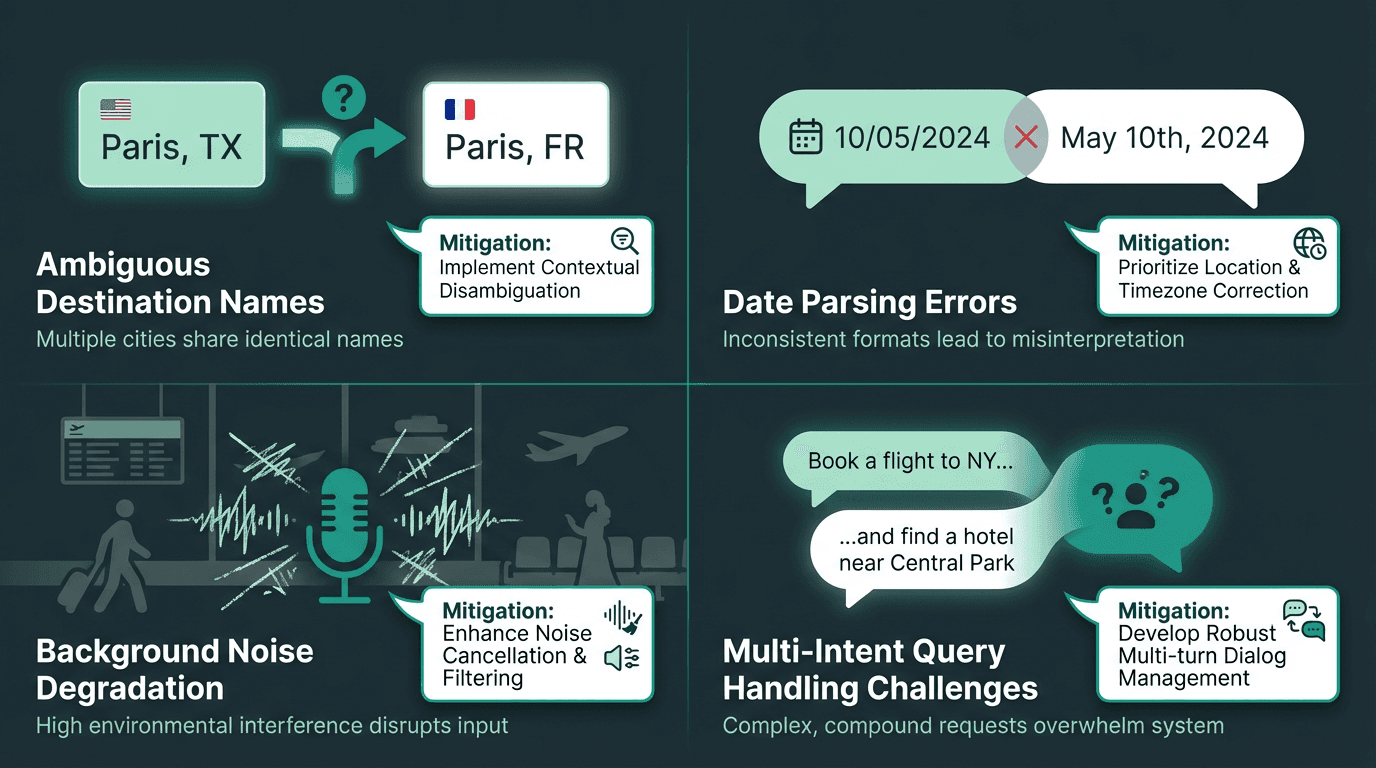
Understanding failure modes early helps teams build more resilient voice experiences.
Most guides on travel voice AI stop at the happy path. The edge cases are where a system's reputation actually gets made or broken. Ambiguous destination names are a real problem: 'Portland' could be Oregon or Maine, and 'Nice' is both a French city and an adjective. ASR systems without contextual disambiguation produce errors that feel absurd to users, the kind that get screenshotted and shared.
Background noise is an underappreciated challenge. Travelers use voice assistants in airports, train stations, and hotel lobbies, all environments with significant ambient noise. ASR models trained primarily on clean studio audio degrade noticeably in these conditions. Testing in realistic acoustic environments before launch is not optional.
Date and time parsing deserves its own attention. 'Next Friday,' 'the 14th,' 'two weeks from today,' and 'the Friday after next' are all valid ways to specify a date, and they do not all resolve to the same calendar entry. The parsing logic needs to handle each correctly relative to the current date and the traveler's timezone. A booking made for the wrong date because of a timezone mismatch is a support ticket, a refund request, and a trust problem arriving together.
Key takeaways
What to carry forward:
Voice assistants perform best in travel for high-frequency, well-defined tasks: status checks, simple bookings, changes, and refunds.
Real-time API integration is the foundation. Without live data access, voice AI gives wrong answers at the worst moments. See how Smallest.ai's voice agents are built for real-time travel API connectivity.
TTS voice quality directly affects user trust, particularly in emotionally charged interactions like refunds and cancellations.
Multilingual and accent coverage must reflect your actual user base, not just your primary market.
Edge cases including ambiguous destinations, background noise, and date parsing require explicit testing before launch.
Escalation design is as important as automation design. Know which cases need a human and hand off with full context.
Industry research consistently shows traveler expectations for digital service quality are rising. Voice AI is one of the clearest ways to meet that expectation.
The problem this technology actually solves
The travel industry has a specific, well-documented problem: high-volume, time-sensitive customer interactions that current support infrastructure handles poorly. Travelers need answers in minutes. They are dealing with disruptions, tight connections, and real financial stakes. Phone queues, email response windows, and static FAQ pages are structurally mismatched to that need. Voice AI is not a nice-to-have in this context. It is a direct response to a gap that costs travel businesses measurable revenue in abandoned bookings, unnecessary refunds, and lost customer lifetime value.
Building that response requires a speech layer that is fast, accurate, and natural enough that travelers trust it with consequential decisions. That is exactly what Smallest.ai's voice agents are built for. Smallest.ai's Atom TTS model delivers high-naturalness speech output with a verified 120ms latency, which holds up in production environments, and the platform gives developers the control needed to build travel-specific conversation flows without being locked into rigid templates. For teams serious about deploying voice AI in travel, starting with infrastructure designed for real-world, high-stakes use is the right call.
Build your travel voice assistant with Smallest.ai's speech models and developer tools
Frequently asked questions
Can a voice assistant handle complex multi-leg itinerary bookings?
How does a voice assistant verify a traveler's identity before processing changes or refunds?
What languages should a travel voice assistant support?
How do voice assistants handle situations where the traveler is in a noisy environment?
What is the typical cost structure for deploying a travel voice assistant?