AI voice assistants for appointment booking rescheduling and reminders

Learn how AI voice assistants handle appointment booking, rescheduling, and reminders. A practical guide covering architecture, deployment.
Missed appointments cost the U.S. healthcare system alone an estimated $150 billion annually.
Across industries, the problem is the same: people forget, schedules change, and staff spend hours on the phone managing logistics that should be automated. A well-built voice assistant can handle all of it, from booking a first appointment to sending a reminder the morning before, without a human ever picking up the phone.
This guide is for product managers, developers, and business operators who want to understand how AI voice assistants work in appointment workflows, what separates a good implementation from a frustrating one, and how to build or choose a solution that actually holds up in production.
By the end, you will have a clear picture of the technology, the practical steps to deploy it, and the edge cases that most vendors quietly skip over. The global voice assistant application market was valued at USD 8.92 billion in 2025 and is projected to reach USD 121.08 billion by 2034 at a CAGR of 33.61%, so the window to build a competitive advantage here is open but not indefinitely.
What a voice assistant actually does in an appointment workflow
Most people picture a voice assistant as a simple command-and-response system. You say ‘book me an appointment on Friday,’ and it either finds a slot or says it cannot. Real appointment workflows are messier. A caller might not know which service they need. They might want to reschedule but cannot remember when their original appointment was. They might call from a noisy environment and speak unclearly. The assistant has to handle all of this gracefully.
Under the hood, a voice assistant for appointment booking combines automatic speech recognition (ASR) to transcribe what the caller says, a natural language understanding (NLU) layer to extract intent and entities like dates, times, and service types, a dialogue manager to track conversation state across multiple turns, and a text-to-speech (TTS) engine to respond in a natural-sounding voice. For a technical grounding in how these layers interact, conversational AI and voice recognition is worth reading before going further.
The dialogue manager is the piece most implementations get wrong. It needs to hold context across the entire conversation, not just the last utterance. If a caller says ‘actually, make it Thursday instead’ three turns into a booking flow, the system needs to know what ‘it’ refers to. This is where shallow chatbot frameworks fall apart and purpose-built voice AI platforms pull ahead.
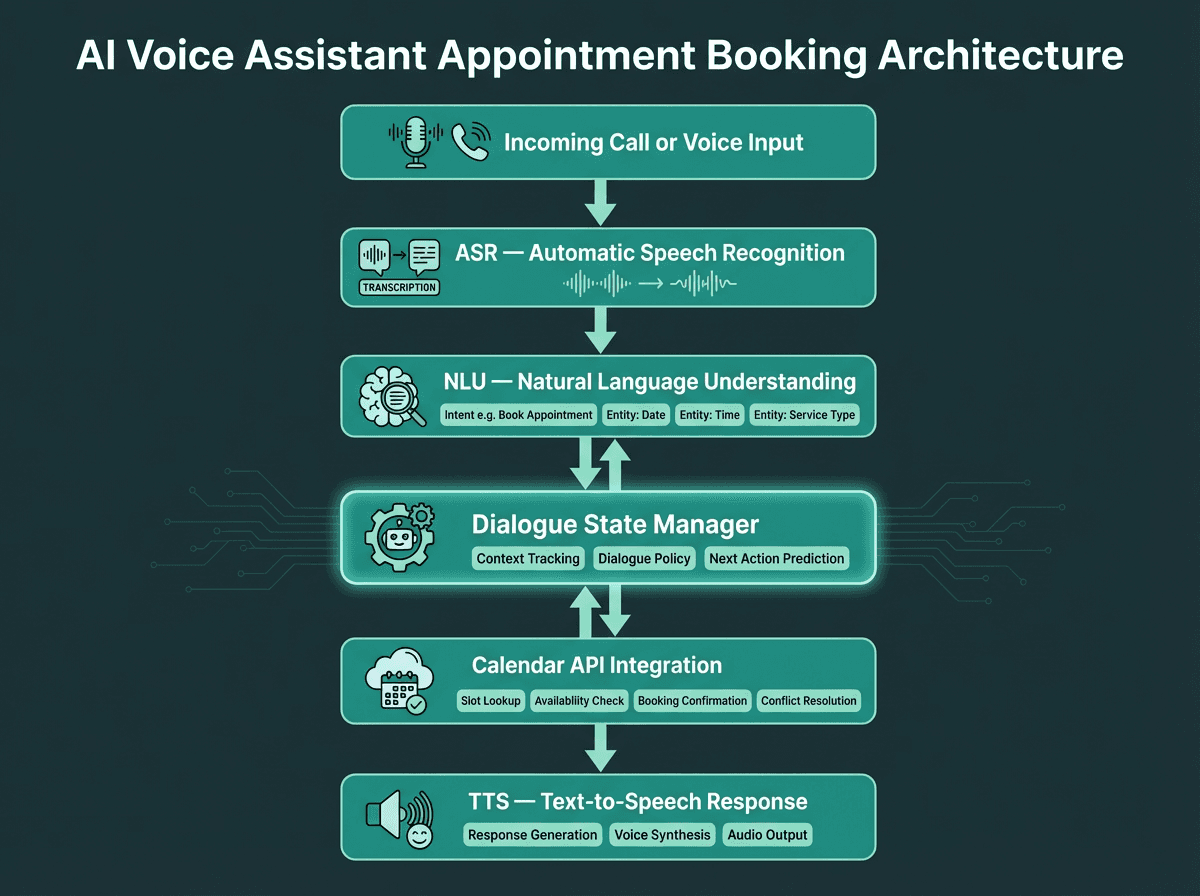
The core architecture of a voice assistant appointment system, from speech input to calendar confirmation.
Booking, rescheduling, and reminders: three distinct problems
It is tempting to treat these three functions as a single feature. They are not. Each one has different conversational patterns, different failure modes, and different integration requirements.
Booking a new appointment
New bookings involve the most back-and-forth. The assistant needs to collect the caller’s identity or create a new record, understand what service they need, check real-time availability, confirm the slot, and send a confirmation. The integration surface is wide: CRM, calendar API, payment processor if a deposit is required. The conversation design challenge is keeping this under three to four turns without making the caller feel rushed.
Rescheduling an existing appointment
Rescheduling is where most voice assistants stumble. The caller is already in the system, which sounds like it should make things easier. But the assistant now needs to authenticate the caller, retrieve their existing appointment, understand the new preference, check availability again, and update the record without creating a duplicate. If the caller is calling the day before their appointment, urgency handling matters too. A well-designed rescheduling flow can actually reduce no-shows more than any reminder, because it gives people an easy path to change rather than just not showing up.
Automated reminders
Reminder calls and messages are often the highest-ROI part of an appointment automation workflow because they directly improve attendance. In healthcare settings, a Cochrane review found that attendance increased from 67.8% with no reminders to 78.6% with mobile phone reminders and 80.3% with phone call reminders, showing why reminder workflows are usually the fastest place to start. The key word is ‘personalized.’ A reminder that addresses the patient or client by name, confirms the specific service and location, and offers a one-touch option to confirm or reschedule performs significantly better than a generic broadcast message. This is directly tied to personalizing the customer experience at scale.
Where voice assistants outperform traditional scheduling tools
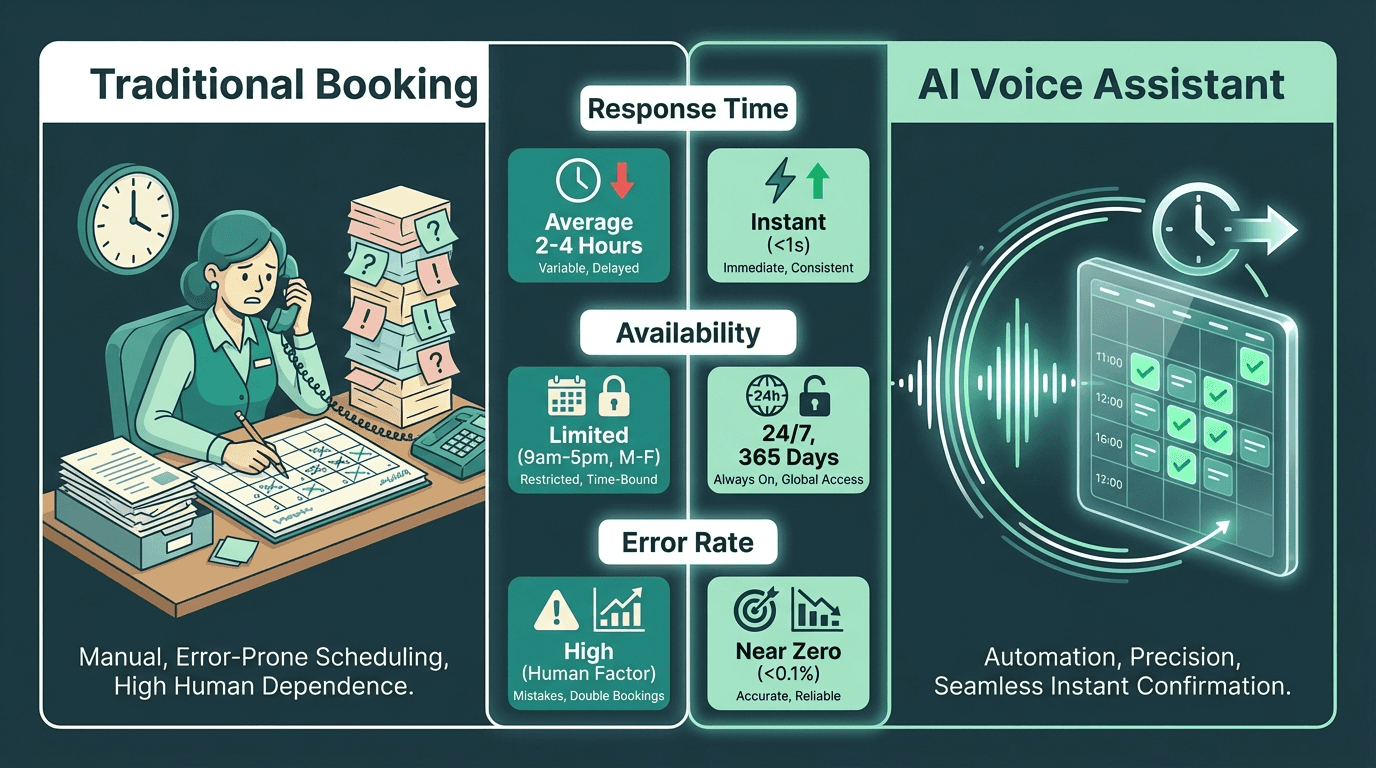
AI voice assistants eliminate the bottlenecks of manual scheduling while operating around the clock.
Online booking forms are fine for people who are already on your website, know exactly what they need, and have time to fill out a form. Voice is better for everyone else. Older demographics, people calling while commuting, and anyone who prefers talking to typing all benefit from a voice-first experience. A 2025 Gartner survey found that 51% of customers are willing to use a GenAI assistant to handle customer service interactions on their behalf, which signals that the adoption barrier is lower than many businesses assume.
The 24/7 availability argument is real but often overstated. What matters more is the quality of the interaction at 2 PM on a Tuesday when your front desk is handling three things at once. A voice assistant does not put callers on hold. It does not get the date wrong because it is distracted. And it does not forget to send the confirmation email. For industries like healthcare, legal services, and home services, where scheduling errors have real downstream consequences, that consistency is worth more than the after-hours coverage.
Industry applications worth knowing about
Healthcare is the most discussed vertical, and for good reason. Appointment no-shows in clinical settings directly affect patient outcomes and revenue. But the same logic applies across a surprising range of industries.
Industries where voice assistant scheduling delivers measurable impact:
Healthcare and dental: Patient intake, appointment reminders, prescription pickup notifications, and follow-up scheduling after procedures.
Legal services: Initial consultation booking, document submission deadlines, and court date reminders with conflict-checking against attorney calendars.
Real estate: Property viewing scheduling and follow-up calls. AI voice already handles property inquiries and scheduling effectively in this sector.
Home services: HVAC, plumbing, and cleaning companies use voice assistants to dispatch technicians and confirm arrival windows without tying up dispatch staff.
Fitness and wellness: Class bookings, personal training sessions, and membership renewal reminders where the scheduling volume is high and the margin for error is low.
Forrester’s analysis of agentic AI in healthcare notes that autonomous AI systems are already managing complex scheduling workflows, reducing administrative workload for staff and freeing them to focus on patient-centered care (Forrester, 2025). The pattern generalizes: wherever scheduling is high-volume and high-stakes, voice automation earns its place.
Building vs. buying: what the decision actually comes down to
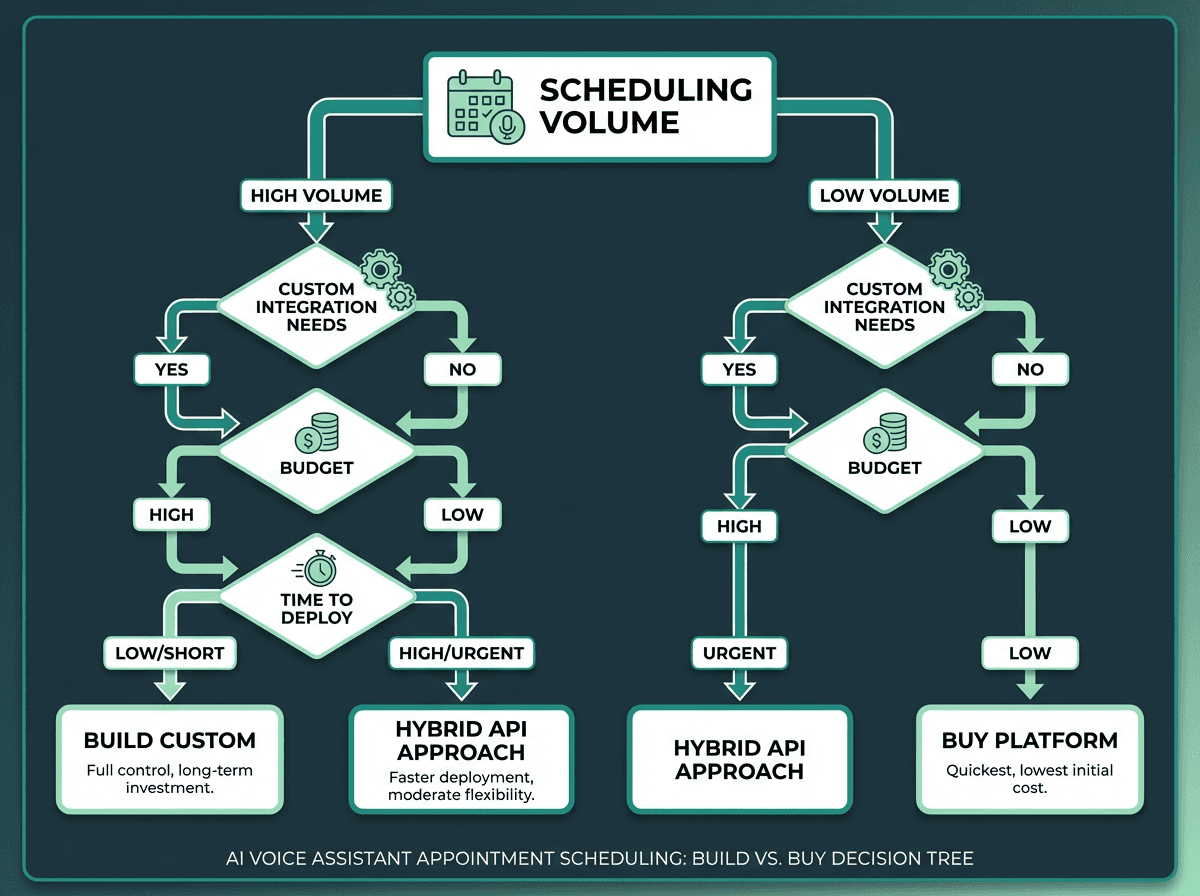
The build-vs-buy decision depends on scheduling volume, integration complexity, and time-to-market requirements.
The honest answer is that most businesses should start with a platform and customize from there. Building a production-grade voice assistant from scratch requires ASR, NLU, dialogue management, TTS, telephony integration, and calendar API work. That is a six-to-twelve month engineering project for a competent team. Smallest.ai’s platform lets you skip the infrastructure layer and focus on the conversation design and business logic.
Where building makes sense is when your scheduling workflow is genuinely unusual. If you have multi-party appointment requirements, complex eligibility checks, or deeply proprietary calendar systems, a pre-built platform will hit its limits. In those cases, using developer-level speech APIs gives you the voice quality and latency of a polished product while keeping the logic entirely in your control. For a broader view of what enterprise-grade deployments look like, enterprise voice AI assistants covers the architecture considerations in detail.
What most people get wrong about voice assistant deployment
The biggest mistake is treating voice assistant deployment as a one-time setup. You configure the flows, connect the calendar API, test it a few times, and go live. Then three months later, callers are complaining that the assistant does not understand them, or worse, they are hanging up and calling back to speak to a human.
Voice assistants degrade in subtle ways. Your service names change. New appointment types get added. Callers start using slang or shorthand that was not in the original training data. The TTS voice that sounded natural in testing starts to feel robotic after a hundred interactions. Ongoing tuning of the NLU model, regular review of call transcripts, and periodic updates to the dialogue flows are not optional maintenance tasks. They are the difference between a voice assistant that builds trust and one that erodes it.
The second common failure is ignoring the handoff to a human agent. Gartner predicts that by 2029, agentic AI will autonomously resolve 80% of common customer service issues without human intervention (Gartner, 2025). That still leaves 20% that need a person. If your voice assistant does not have a clean escalation path, those callers will have a bad experience precisely when they most need help. The escalation trigger, the handoff message, and the context passed to the human agent all need to be designed as carefully as the main booking flow. For a broader look at where automation helps and where it needs guardrails, customer service automation pros, cons, and tips is a useful reference.
Technical considerations for developers
Latency is the metric that determines whether a voice assistant feels natural or robotic. The acceptable end-to-end response time for a voice interaction is under 500 milliseconds. Beyond that, callers start to wonder if the call dropped. This means your ASR, NLU inference, calendar API call, and TTS generation all need to complete within that window. Streaming ASR, where transcription begins before the caller finishes speaking, is essential. For a technical benchmark comparison of streaming ASR systems, the comparative analysis of streaming ASR systems is worth reviewing before selecting a provider.
Calendar API integration deserves more attention than it usually gets. Most implementations use Google Calendar or Microsoft Graph for consumer and SMB use cases. Enterprise healthcare and legal deployments often require integration with proprietary practice management systems that have rate limits, inconsistent availability data, and complex authentication flows. Build in retry logic, cache availability windows where the data freshness requirements allow it, and always confirm the booking with a secondary read after the write to catch race conditions.
On the voice quality side, the TTS engine matters more than most developers expect. A voice that sounds slightly robotic on a clean audio recording sounds significantly worse over a phone line with background noise compression. Testing your TTS output through actual telephony infrastructure, not just headphones in a quiet room, is a step that gets skipped far too often. Understanding how voice recognition works at the signal processing level helps developers make better decisions about microphone input handling and noise cancellation on the ASR side.
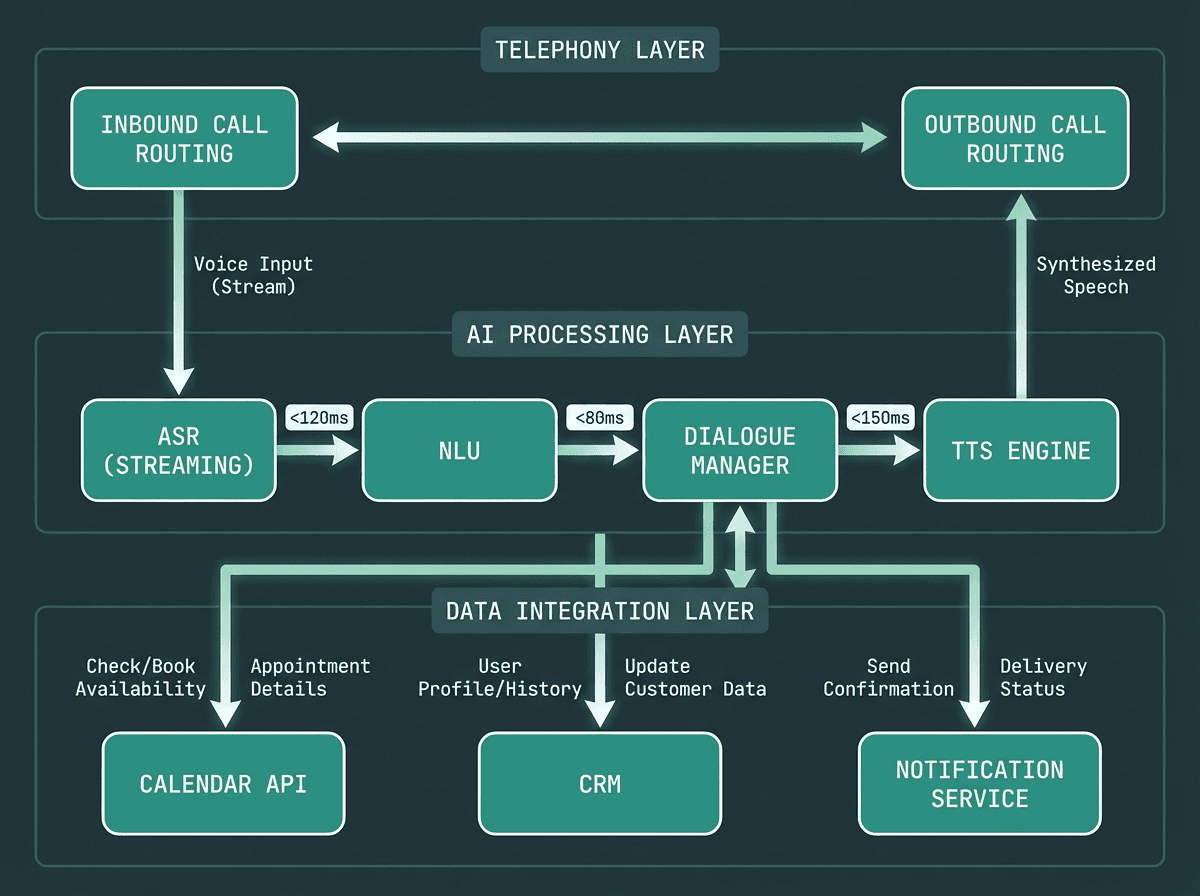
A three-tier architecture separating telephony, AI processing, and data integration for maintainability and scalability.
Key takeaways and next steps
Voice assistants for appointment booking are not a future technology. They are in production across healthcare, legal, real estate, and home services right now, handling millions of scheduling interactions daily. The market is growing fast, the technology is mature enough for production use, and the business case is clear: fewer no-shows, lower administrative overhead, and a better experience for callers who do not want to wait on hold.
Two technical hurdles determine whether a voice assistant actually delivers on that promise in production: latency and voice quality. Sub-500ms response times require a speech stack where ASR, NLU, and TTS are tightly integrated, not stitched together from separate vendors with compounding round-trip delays. Voice quality over a real phone line demands a TTS engine trained on telephony-grade audio, not studio recordings. Hydra by Smallest AI is built specifically for these constraints, with streaming ASR that begins transcription mid-utterance and a TTS engine tested against real telephony infrastructure. That is the difference between a voice assistant that callers trust and one they hang up on.
If you are starting from scratch, begin with the reminder use case. It has the highest ROI, the lowest conversation complexity, and the shortest path to production. Once that is running and you have real call data to work with, extend into inbound booking and then rescheduling. For a broader foundation on the technology before you build, a complete guide to AI voice assistants covers the core concepts in depth.
Practical next steps:
Audit your current scheduling workflow to identify where calls drop, where staff time is most consumed, and where no-shows cluster.
Choose a starting use case: outbound reminders are the fastest win, inbound booking is the highest volume opportunity.
Evaluate speech model quality by testing ASR accuracy on your actual caller vocabulary, including service names, locations, and common mispronunciations.
Design the human escalation path before you design the main booking flow. It will save you significant rework.
Plan for ongoing tuning from day one. Allocate time each month to review transcripts, update intents, and refine dialogue flows.
Frequently asked questions
Can a voice assistant handle appointment booking for multiple service types or locations?
How does a voice assistant verify caller identity before rescheduling?
What happens when the voice assistant cannot understand the caller?
Is a voice assistant suitable for high-stakes appointment types, like medical consultations or legal meetings?
How do I measure whether my voice assistant is actually improving scheduling outcomes?