AI Call Center Agents for Inbound Sales: Qualifying Leads and Routing Calls Automatically

AI call center agents can qualify inbound leads, score intent, and route calls to the right rep fast. See what to integrate, measure, and deploy.
Inbound sales is a race against clock decay. When a lead reaches out, their interest is at its peak; the first vendor to respond often has a significant advantage. Yet many revenue operations teams still route calls by hand, repeat the same qualification script on every conversation, and watch warm leads cool off in a hold queue. AI call center agents address this by qualifying and routing in real time.
This is for sales ops leaders, contact center managers, and technical decision-makers who want to understand the mechanics: how AI agents behave in an inbound sales flow, what qualification and routing logic looks like in practice, and how to roll it out without overhauling your stack. The goal is clarity on deployment, the failure modes to anticipate, and where the ROI actually shows up.
What AI Call Center Agents Actually Do in an Inbound Sales Flow
“AI call center agent” is an overloaded label, so it helps to pin it down. For inbound sales automation, it’s a voice-capable software system that answers the call, runs a structured or adaptive conversation, extracts qualification signals as the caller talks, and then executes the next step: route to a rep, book a callback, or finish the interaction end-to-end.
That’s a different product category than an IVR. IVR pushes people through a keypad menu; a voice agent holds a conversation. It can handle something like “I want to upgrade my plan but I also have a billing question” without forcing a restart or a second transfer. Under the hood, the usual conversational voice stack is speech-to-text for live transcription, a language model for intent and slot extraction, text-to-speech for responses, and a routing layer that turns what the system learned into an action.
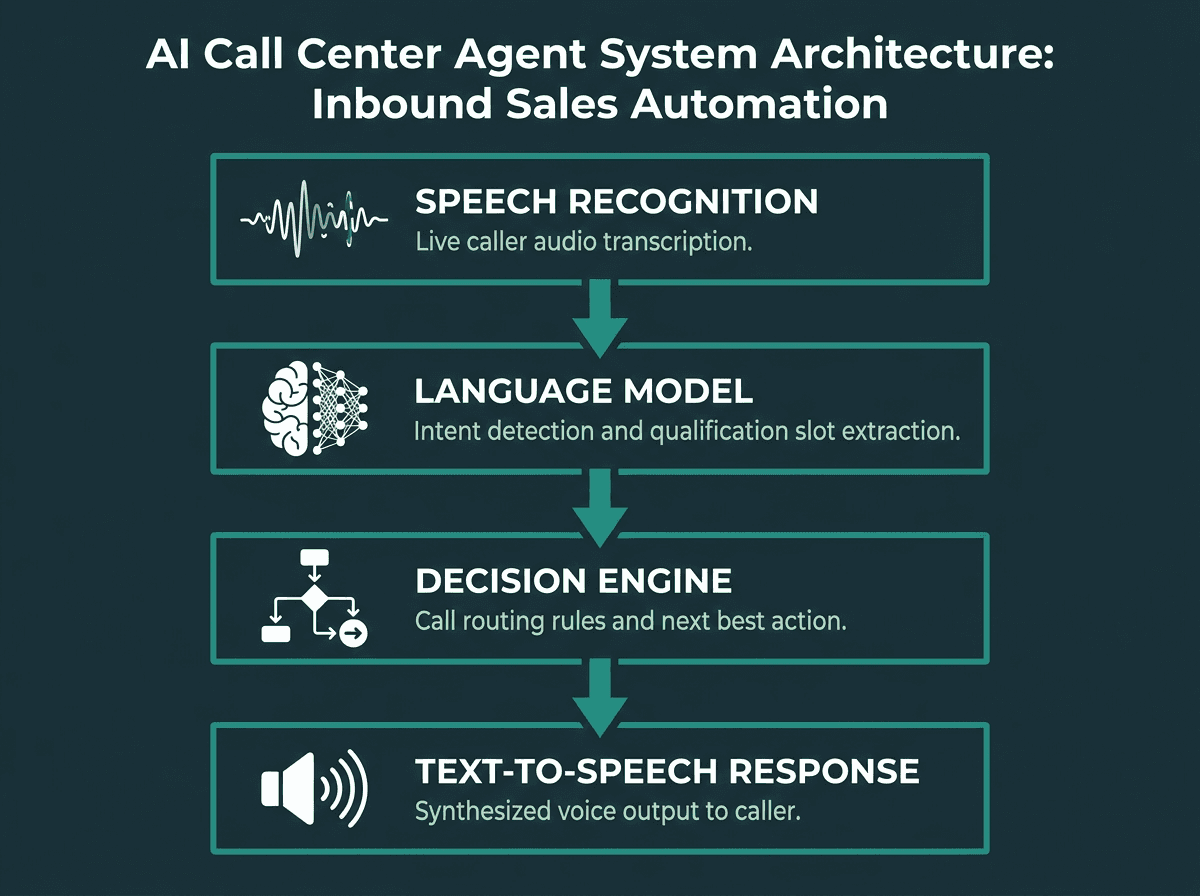
The four functional layers inside an AI call center agent handling inbound sales calls.
The Lead Qualification Problem That AI Solves
Sales teams don’t lose time because phones ring; they lose time because the wrong phones ring. A Salesforce report found that reps spend only 28% of their week actually selling. The rest gets eaten by admin work, data hygiene, and handling conversations that were never going to convert. Inbound volume isn’t the issue. Unqualified inbound volume is.
Frameworks like BANT (Budget, Authority, Need, Timeline) and MEDDIC were built for humans running discovery, but they map cleanly to AI-led calls. A voice agent using low-latency speech recognition can pull out BANT signals in the first 90 seconds without sounding like it’s reading a form, because the questions can be tucked into the caller’s actual request instead of stacked as a checklist.
The common misstep is treating AI qualification as a hard gate: pass or fail. In practice, scoring works better. The agent assigns a qualification score based on the signals it collects, and that score drives the routing path, not just whether a human gets involved. A caller with a strong budget signal but unclear authority can go to a senior rep. A caller with a clear need but no timeline can be routed into nurture. That’s where efficiency shows up: you stop spending your best human minutes on the wrong moments. There’s more detail on how to qualify leads with voice agents specifically.
How Intelligent Call Routing Works in Practice
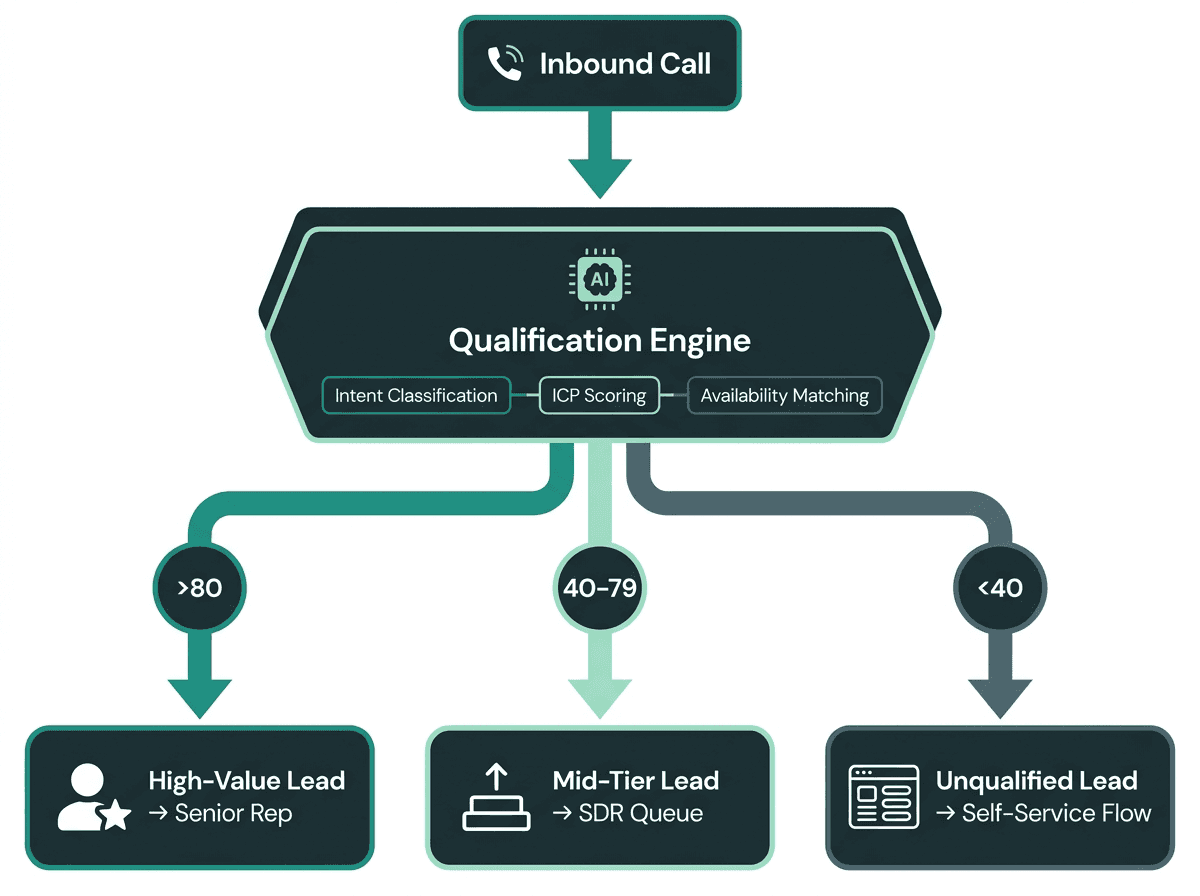
A scored qualification model drives routing decisions across three distinct call paths.
Routing is where the system stops being a clever voice interface and starts behaving like operations infrastructure. The gains from AI-enhanced routing come from a simple advantage: the system knows who it’s talking to, and why, before it transfers the call.
Good routing tends to fall into three layers. First is intent classification: what is the caller trying to do? Second is qualification scoring: how closely does this person match your ICP, right now? Third is availability and skill matching: which rep or queue is best suited to take this call at this moment? The AI agent can run those decisions live while the conversation is still happening, so the transfer is informed rather than blind.
If you want the infrastructure view, understanding the tradeoffs between full-stack and point solutions for AI call center infrastructure is key. A dedicated voice orchestration layer can reduce latency and avoid losing context between steps when qualification and routing live in the same platform.
Building the Qualification Conversation: What the Agent Actually Says
Conversation design is where a lot of deployments quietly fail. The qualification questions themselves are easy to list. The hard part is making them land like a helpful exchange instead of an intake form with a voice.
Practical principles for designing qualification conversations that convert:
Start with the caller’s stated intent, not your qualification checklist. If someone calls asking about enterprise pricing, lead with that. Qualification signals will surface naturally as you address their actual question.
Use conditional branching, not linear scripts. If a caller mentions they are already evaluating vendors, the agent should skip the ‘are you actively looking’ question and move directly to differentiators.
Capture signals, not just answers. The agent should log not just what the caller says but how they say it. Hesitation on budget questions is a signal. Unprompted mention of a competitor is a signal.
Set expectations for the handoff. Before transferring, the agent should tell the caller what is happening and why. ‘Based on what you have shared, I am connecting you with someone who specializes in enterprise accounts’ is better than a silent transfer.
Handle objections at the qualification stage. Common objections like ‘I am just researching’ or ‘I need to check with my team’ should trigger specific conversation branches, not dead ends.
Voice quality matters more than most teams budget for. If the agent sounds robotic or awkward, callers tend to disengage, providing shorter answers, less context, and fewer usable signals. Modern speech synthesis, like Lightning TTS, can fix this, but only if you treat it as part of the product spec during setup, not a cosmetic tweak at the end.
Integrating AI Agents with Your Existing CRM and Sales Stack
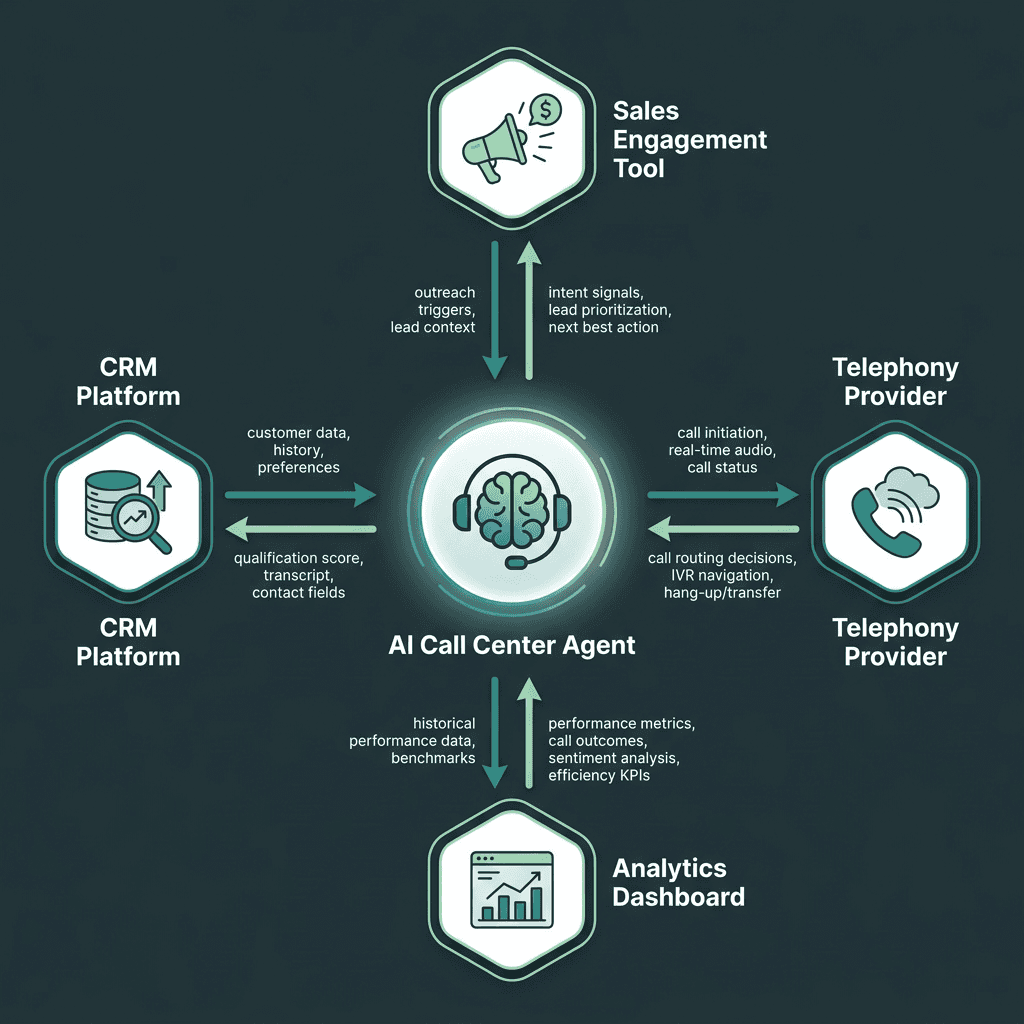
AI agents sit at the center of your sales stack, passing qualification data to CRM and routing decisions to telephony.
An agent that qualifies calls but never writes back to the CRM only does half the job. The data it captures, such as contact details, intent, qualification score, and a conversation summary, needs to land in your CRM automatically. It also needs to be structured so reps can act on it immediately.
Most platforms handle this with webhooks or native CRM integrations. At the end of the call, the agent sends a structured payload: caller ID, qualification score, extracted fields (budget range, timeline, use case), plus a transcript or summary. The CRM then updates an existing lead or creates a new one. When the call routes to a rep, the context is already on-screen before the rep says hello.
One detail that’s easy to miss is real-time CRM lookup during the call. If the agent can query your CRM mid-conversation to see whether the caller is an existing customer, an open opportunity, or a churned account, the script changes immediately. You don’t ask an existing customer whether they have budget; you ask what prompted the call today. Pulling that off means your telephony layer, AI agent, and CRM have to stay tightly connected, with low enough latency that the lookup returns before the agent needs it, typically under 300 milliseconds. This is a core focus for real-time voice AI systems.
The Human Agent Question: Where AI Ends and People Begin
The story most teams are living isn’t replacement; it’s redistribution. A 2026 Gartner survey found that 85% of customer service and support leaders are expanding human agent responsibilities as AI takes on repetitive tasks. The emerging model is specialization: AI agents handle repetitive qualification and routing workflows before escalation to human teams.
For inbound sales, that usually means AI owns the top of the funnel: answer, qualify, score, route. Human reps take the conversations that depend on judgment, relationship-building, and negotiation. Where you draw the line depends on your sales motion, but a practical test is time-to-determination: if the outcome can be decided from information the caller provides in the first two minutes, the agent can likely handle it, or at least make the handoff complete. The balance between AI and human agents is a critical component of modern conversational AI workflows, especially when using real-time conversational pipelines.
Measuring What Actually Matters: ROI and Performance Metrics
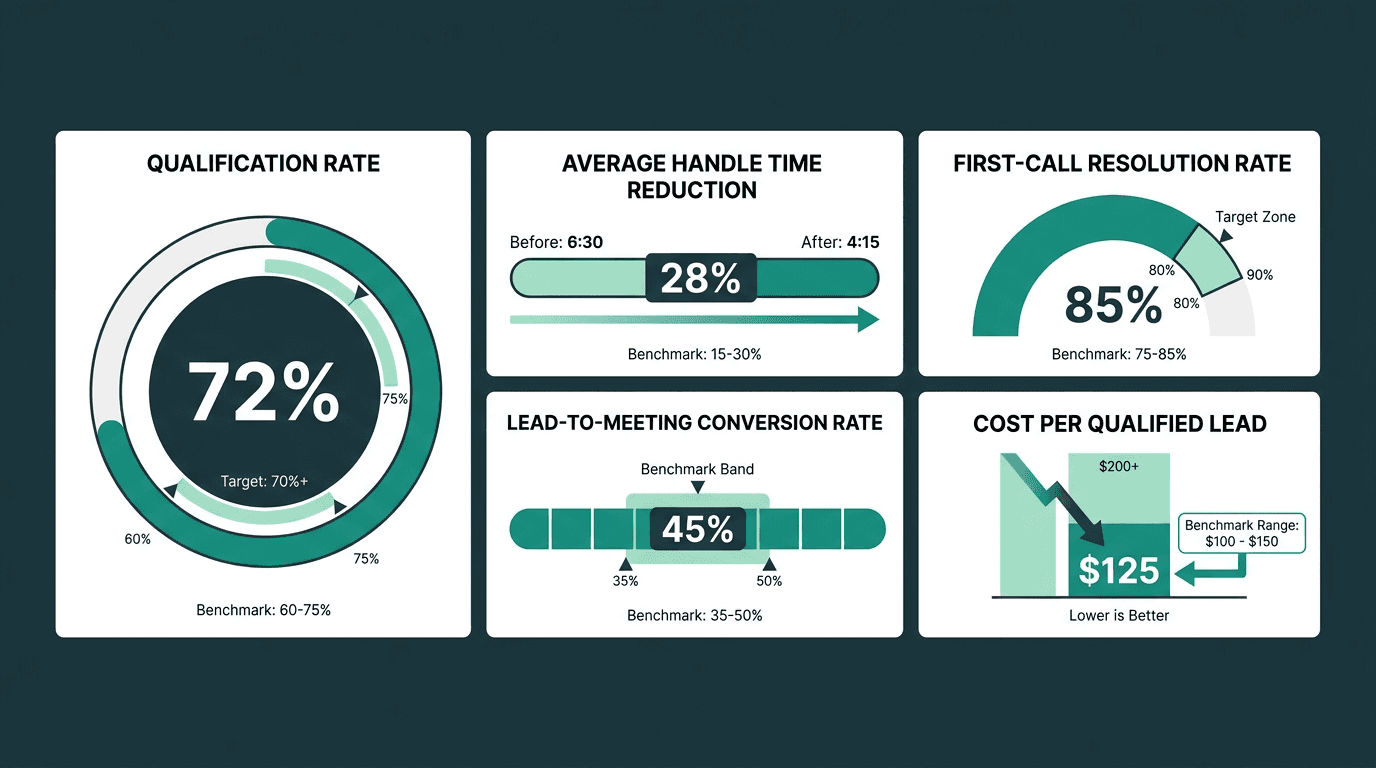
Five metrics that define whether your AI call center agent deployment is actually working.
“Calls handled” is a feel-good number, not a diagnostic. For inbound sales, the metrics worth defending are qualification rate (the share of calls that produce a qualified lead record), lead-to-meeting conversion rate, cost per qualified lead, and first-call resolution rate. A Deloitte study found that contact centers deploying generative AI capabilities are classified as “service innovators” and consistently outperform on cost and resolution metrics.
Track performance at the agent level, not just in the aggregate, or you’ll miss where the system is actually leaking. If the AI agent qualifies 60% of calls but reps convert only 15% of those qualified leads into meetings, the qualification logic isn’t the bottleneck. The handoff is, or the rep workflow is. Let the metrics tell you where to fix the pipeline. The business-case side of this involves modeling the financial impact of these improvements.
Implementation: From Zero to Live in a Realistic Timeline
Most teams get the effort distribution backwards: they worry about integrations and underestimate conversation design. Telephony setup, CRM webhooks, and routing rules are often the quick wins. Writing, testing, and refining qualification flows, covering edge cases, and tuning voice and tone is what tends to stretch the schedule.
For a mid-size inbound sales team, a realistic timeline looks like: two weeks for requirements and conversation design, one week for technical integration and routing configuration, one week of internal testing with real scenarios, then two weeks of shadow mode where the AI runs alongside humans before you flip it fully live. That’s six weeks from kickoff to production, assuming conversation design starts on day one instead of waiting for the wiring to be finished.
Teams starting from scratch can follow a structured sequence for building out their systems. The decision between building a custom solution and using a platform depends on available resources and the level of customization required for your automated call center.
Key Takeaways
AI call center agents qualify inbound leads through real-time conversational handling, not menu-driven IVR, using speech-to-text, language models, and text-to-speech working together.
Scored qualification models outperform binary pass/fail gates by enabling nuanced routing decisions based on signal strength.
Intelligent routing reduces call connection time and improves first-call resolution when qualification data flows cleanly into the routing engine.
CRM integration and real-time lookup during the call are what separate high-performing deployments from average ones.
The human-AI division of labor should be defined by complexity, not volume. AI owns the top of the funnel; humans own judgment-heavy conversations.
Measure qualification rate, lead-to-meeting conversion, and cost per qualified lead. Vanity metrics obscure where the real problems are.
The thread running through all of this is simple: inbound teams lose revenue to slow response, inconsistent qualification, and the drag of manual routing. Hiring your way out is expensive, and it doesn’t fix the variability. What does work is a system that picks up instantly, qualifies consistently, and routes with context, without a human acting as the switchboard. That’s the lane Atoms by Smallest.ai is built for. Atoms is a voice and text agent platform that combines Smallest.ai’s ultra-low-latency speech-to-speech synthesis, real-time ASR via Pulse STT, and the Electron conversational model into a single deployable agent. It is aimed specifically at inbound sales qualification and intelligent routing at scale, without the latency or voice-quality tradeoffs that erode caller trust in production voice workflows.
Frequently asked questions
What is an AI call center agent and how is it different from a traditional IVR?
Can AI call center agents handle complex qualification frameworks like BANT or MEDDIC?
How does Smallest.ai's platform support inbound sales qualification specifically?
Will deploying AI agents reduce the need for human sales reps?
What metrics should I track to evaluate whether my AI call center agent is performing well?