Top 8 Voice AI Companies Redefining Phone-Based Support

Compare the top 8 voice AI companies, understand platform capabilities, real call use cases, and factors that matter for live voice operations.
If your team still treats phone calls as a staffing problem, you are already behind the curve. Most teams searching for voice AI platforms reach that point after missed calls, long queues, or inconsistent call handling start showing up in revenue, CSAT, or compliance reviews. Voice has become the hardest channel to scale without breaking experience or cost models.
Buyers evaluating voice AI platforms are not exploring possibilities. They are under pressure to replace brittle IVRs, reduce agent load, and keep live conversations inside existing systems without adding risk. That shift is no longer theoretical. By the end of 2033, the Voice AI market is projected to reach approximately USD 65.5 billion, reflecting how fast voice automation is moving into core operations.
In this guide, we examine how production-grade voice AI works today, what capabilities matter when calls are live, and how platforms such as Smallest.ai, Sierra.ai, Decagon.ai, Observe.AI, Liberate.ai, Sonant.ai, Upfirst, and Flair AI approach real-world voice workloads.
Key Takeaways
Voice AI Is Now An Operational System: Voice AI is evaluated on uptime, latency, and call outcomes, not novelty. It now operates inside core workflows where reliability matters.
Live Call Ownership Drives Adoption: Platforms gain traction when they handle conversations end to end, including reasoning, actions, and escalation, without breaking call flow.
Industry Fit Matters More Than Feature Lists: Successful deployments align platform design with industry needs, such as insurance claims, real estate lead handling, or enterprise support calls.
Integration Determines Real Value: Voice AI creates impact only when it can read from and write to CRMs, policy systems, calendars, and call center infrastructure during calls.
Production Readiness Separates Leaders From Tools: Low latency, natural speech, monitoring, and control decide whether voice AI reduces load or introduces operational risk.
Learn how real-time voice automation reduces wait times and resolves customer issues faster during live calls. How Voice AI Automation Can Speed Up Resolution Times
Why Voice AI is Quickly Gaining Enterprise Adoption
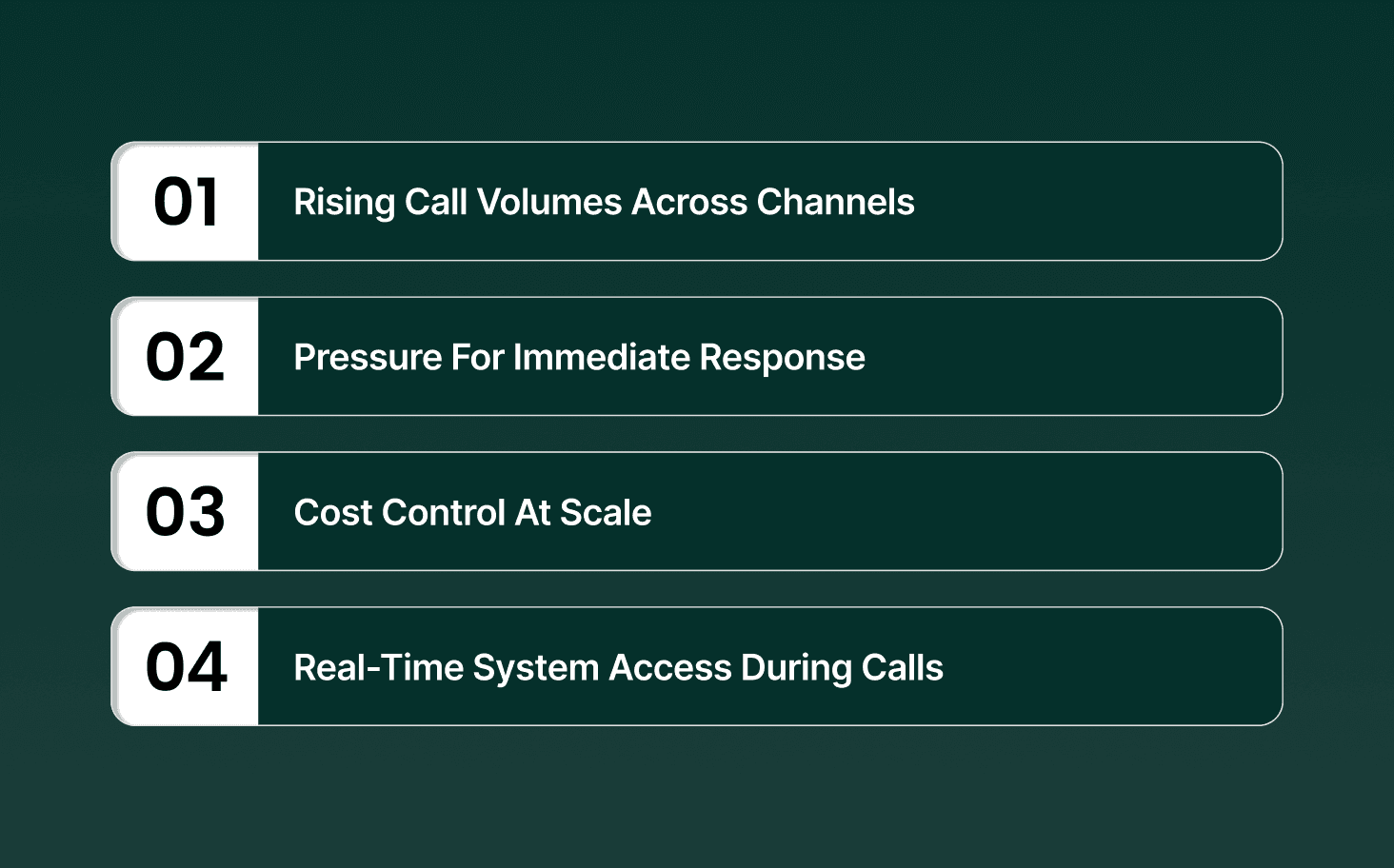
Enterprises adopt voice AI because call volumes rise, response time expectations tighten, and human-only handling creates cost, coverage, and consistency gaps. Voice systems now handle real conversations at scale, with measurable operational impact.
Rising Call Volumes Across Channels: Contact centers face sustained growth in inbound and outbound calls from support, sales follow-ups, verification, and collections, pushing teams past manual capacity limits.
Pressure For Immediate Response: Customers expect answers during the first call attempt, regardless of time or queue depth. Voice AI supports round-the-clock availability without staffing expansion.
Cost Control At Scale: High call volumes drive staffing, training, and overtime costs. Automated voice handling absorbs repetitive interactions while agents focus on exceptions.
Real-Time System Access During Calls: Modern voice AI connects directly with CRMs, ticketing tools, and databases, allowing actions during the call rather than post-call follow-ups.
Enterprise adoption grows because voice AI addresses scale, cost, and coverage challenges that human-only call operations struggle to manage under sustained demand.
Leading Voice AI Platforms Shaping Customer Conversations
Voice AI platforms now differ less by features and more by how they behave in live customer conversations. The focus has shifted to reliability, system access, and call ownership at scale.
1. Smallest.ai
smallest.ai provides an enterprise Voice AI suite built for real-time phone conversations. Its platform combines voice agents, speech models, telephony, analytics, and integrations to automate and augment contact center operations during live calls, with a focus on low latency and natural speech.
Real-Time Voice Agents: AI agents listen, reason, and respond during live phone calls instead of post-call processing, supporting active conversations at scale.
Lightning Voice AI Models: Lightweight speech models trained on human conversations deliver natural-sounding speech with low latency for real-time use cases.
End-to-End Contact Center Stack: Built-in speech-to-text, text-to-speech, voice agents, telephony, and analytics operate as a single system for live calls.
Multilingual Voice Support: Lifelike voices across 16 global languages support customer conversations across regions and markets.
Enterprise Security And Deployment Options: Supports SOC 2 Type II, HIPAA, and PCI standards with cloud and on-premise deployment for regulated environments.
Why Choose smallest.ai?
Enterprises choose smallest.ai for real-time call handling, low-latency speech, and a full-stack Voice AI platform designed specifically for live contact center operations rather than offline voice generation.
Experience real-time voice agents built for enterprise calls. Get a demo with smallest.ai.
2. Flair.ai
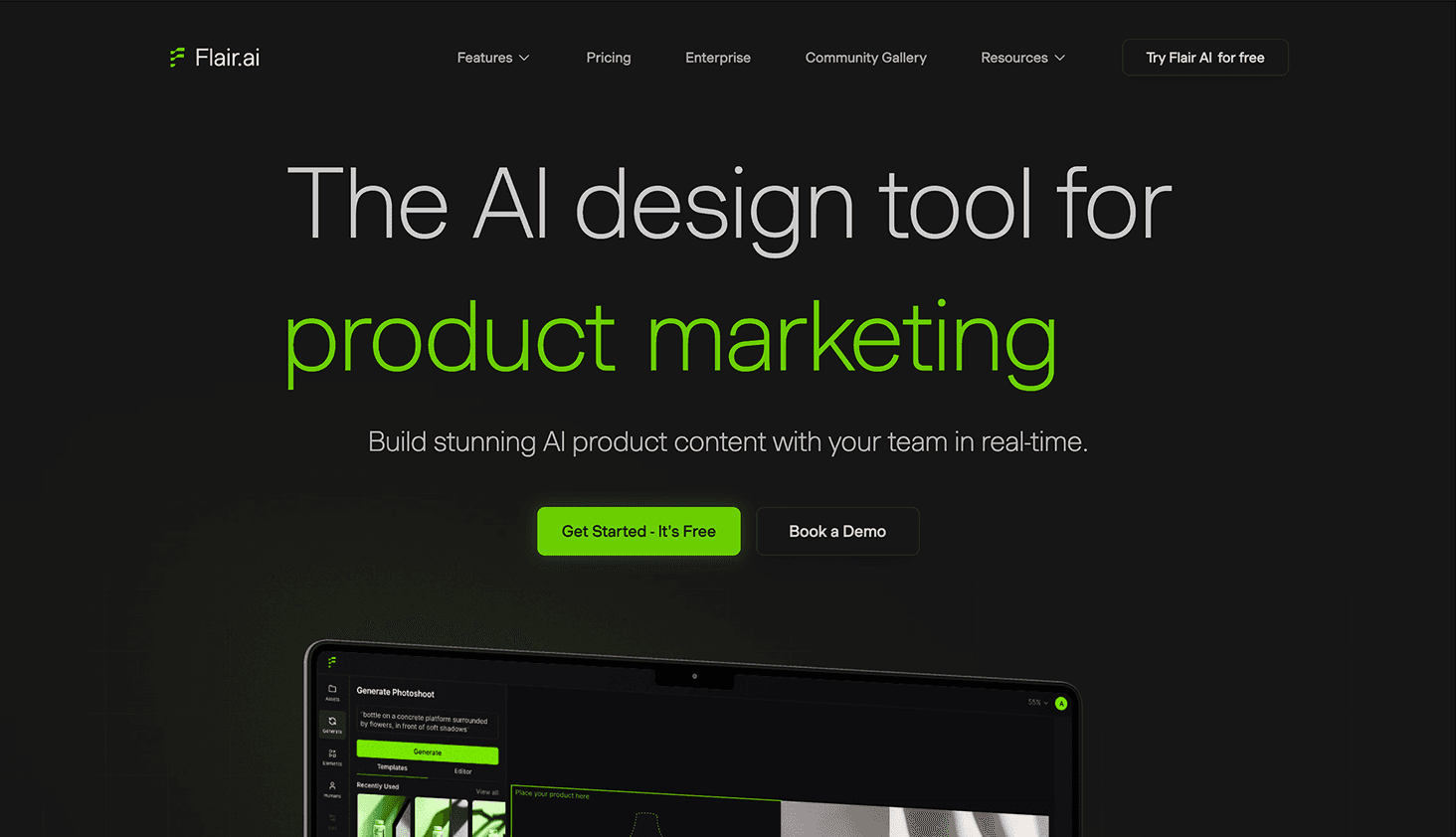
Source:- https://flair.ai/
Flair AI delivers voice-based digital assistants built for mortgage and real estate teams. The platform focuses on always-on lead engagement, follow-ups, and qualification across voice and SMS, helping teams respond to prospects faster and maintain consistent outreach outside business hours.
Always-On Digital Concierge: Voice assistants engage prospects 24/7, including nights and weekends, so inbound leads receive responses without delay.
Voice and SMS Outreach: Supports multi-channel conversations through phone calls and text messages to reach prospects across preferred touchpoints.
CRM Integrations: One-click connections sync call outcomes, lead data, and insights directly into existing CRM systems.
Why Choose Flair?
Flair fits teams that need high-volume lead follow-up, fast response times, and consistent prospect engagement across real estate and mortgage workflows without relying on manual outreach.
Cons
Industry focus is narrow, primarily centered on real estate and mortgage use cases.
Platform emphasis is on lead engagement rather than complex support or service conversations.
3. Upfirst.ai
Source:- https://upfirst.ai/
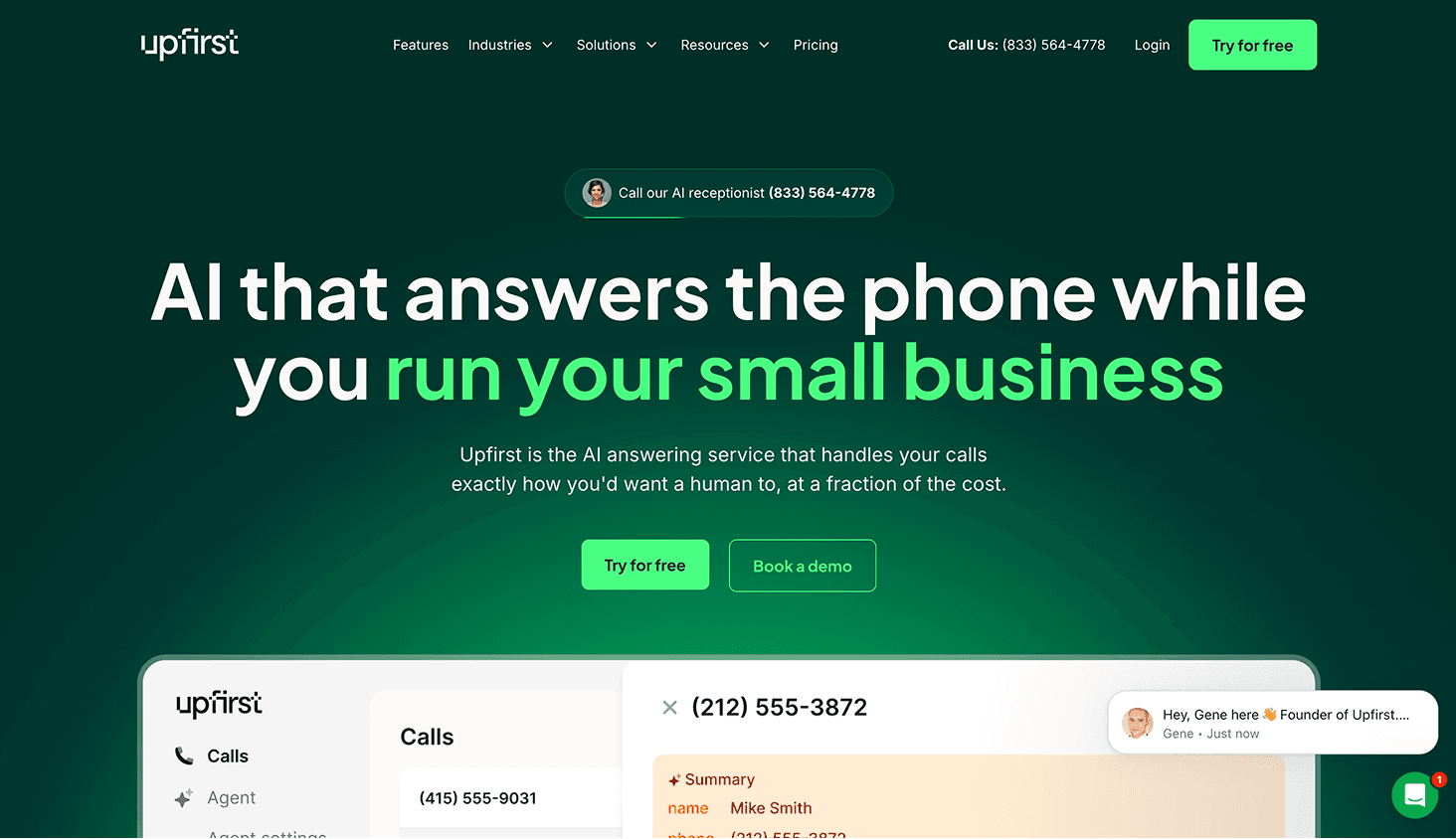
Upfirst offers an AI voice agent designed to act as an always-on receptionist for small and service-based businesses. The platform focuses on answering every inbound call, handling routine questions, booking appointments, capturing leads, and routing calls using a human-like voice, without the cost of hiring staff.
24/7 Call Answering: The AI voice agent answers inbound calls at all hours, including after-hours, weekends, and peak periods, so businesses avoid missed calls.
Human-Like Voice Experience: Callers interact with a natural, conversational voice that greets, responds, and guides them through common requests instead of voicemail.
Why Choose Upfirst?
Upfirst fits businesses that rely heavily on inbound calls and want affordable, immediate call coverage without hiring reception staff, while still maintaining a professional phone experience.
Cons
Primarily focused on inbound call handling rather than outbound or complex voice workflows.
Best suited for small and mid-sized businesses, not large enterprise contact centers.
4. Liberate.ai
Source:- https://liberate.ai/
Liberate.ai delivers voice-based AI agents purpose-built for insurance agencies and carriers. Its platform focuses on resolving sales, service, and claims calls in real time, with human-like conversations, deep system integrations, and continuous availability across contact center operations.
Insurance-Trained Voice AI: Voice agents are designed specifically for insurance workflows, handling sales inquiries, policy servicing, and claims interactions with domain-aware logic.
High Call Resolution Rates: The platform reports resolving up to 80% of customer calls end-to-end, reducing transfers and manual agent involvement.
Claims and FNOL Automation: Customers can file claims directly through voice AI, including identity verification, data capture, and claim submission without speaking to a live agent.
Why Choose Liberate?
Liberate insurance organizations that want to reduce call volumes, automate claims and service workflows, and maintain consistent customer experiences across sales, service, and claims without expanding headcount.
Cons
Platform focus is tightly centered on insurance, limiting relevance for non-insurance industries.
Deployment and customization may require coordination with enterprise systems and longer onboarding.
5. Sonant.ai
Source:- https://www.sonant.ai/
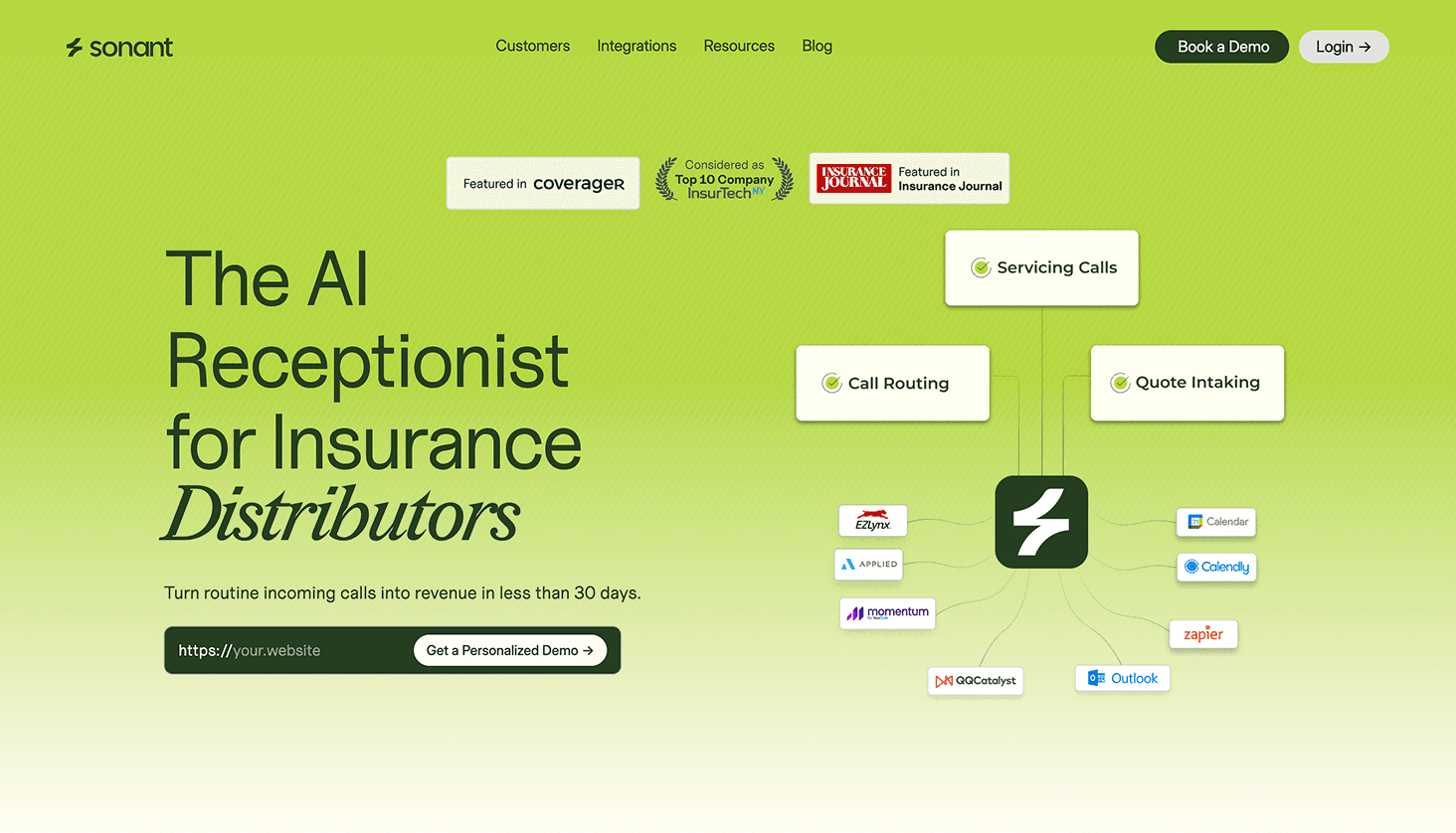
Sonant.ai provides an AI receptionist built specifically for insurance agencies. The platform automates routine inbound calls, routes customers, captures quote details, and updates systems, allowing agency staff to focus on revenue work while maintaining consistent call coverage.
Insurance-Focused AI Receptionist: Designed for P&C agencies, brokers, and distributors, handling insurance-specific calls rather than general business inquiries.
24/7 Call Coverage: Answers incoming calls at all hours with zero wait times, so agencies do not miss prospects or service requests.
Quote Intake Automation: Captures quote details directly from calls and pushes the information into agency management systems or raters.
Why Choose Sonant?
Sonant fits insurance agencies that want to reduce time spent on routine calls, increase producer availability, and maintain a consistent client experience without adding front-desk staff.
Cons
Built almost entirely for insurance use cases, limiting value for other industries.
Focuses on inbound call handling rather than outbound campaigns.
6. Sierra.ai
Source:- https://sierra.ai/
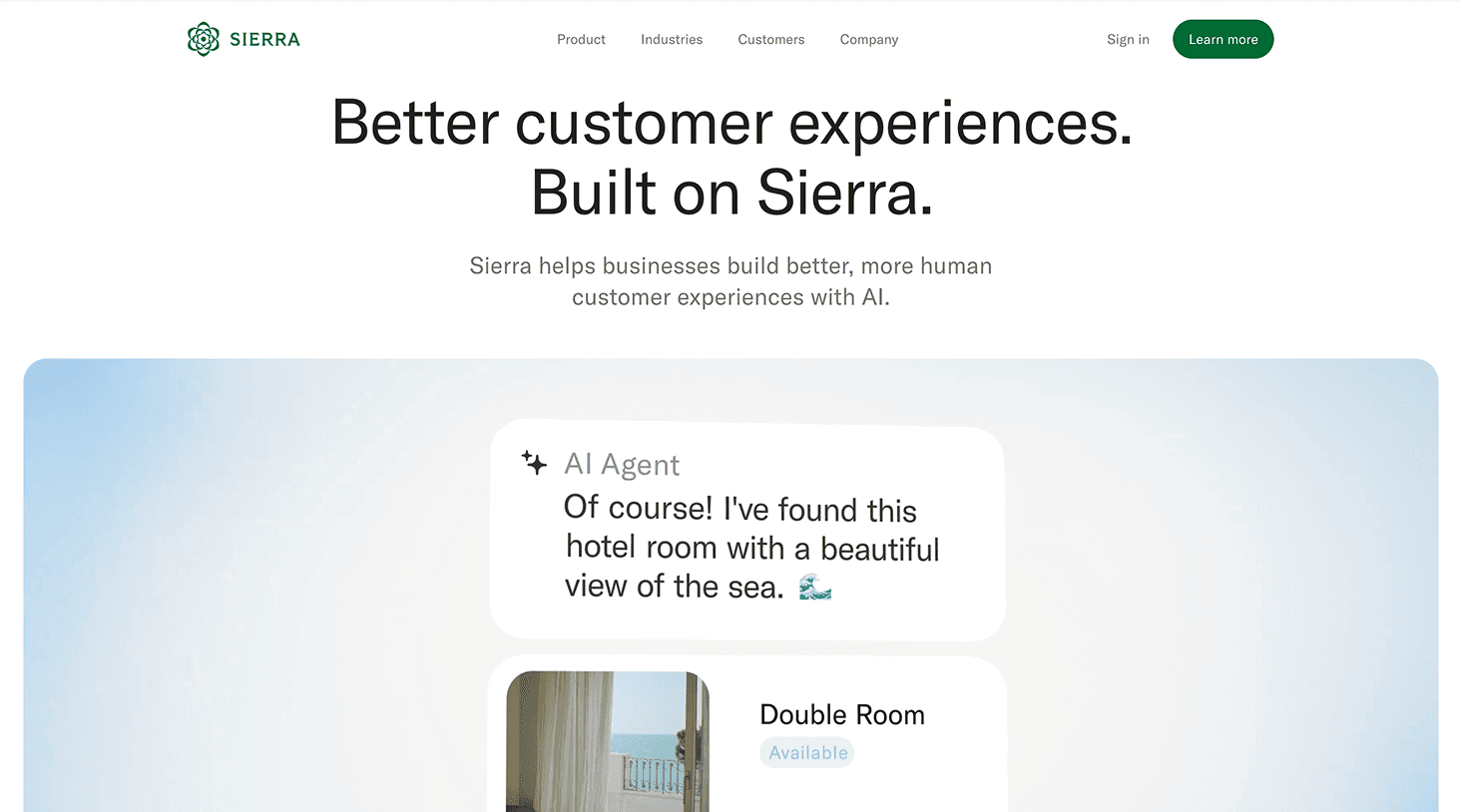
Sierra.ai provides a voice-first AI agent platform built for customer service environments. Its voice agents handle live phone conversations with natural speech, take real actions across internal systems, and integrate directly into existing call center infrastructure to improve resolution rates and customer experience.
Lifelike Voice Conversations: Voice agents speak naturally, manage interruptions, and respond without gaps or latency, creating smooth, human-like phone interactions.
Purpose-Built For Customer Service: Agents understand brand language, acronyms, product details, and customer identifiers such as order numbers and emails during live calls.
Why Choose Sierra?
Sierra fits enterprises that want voice agents capable of handling complex service conversations, taking real actions during calls, and scaling customer support without sacrificing experience quality.
Cons
Built primarily for enterprise service teams rather than small businesses.
Configuration and optimization require a structured setup and CX ownership.
7. Decagon.ai
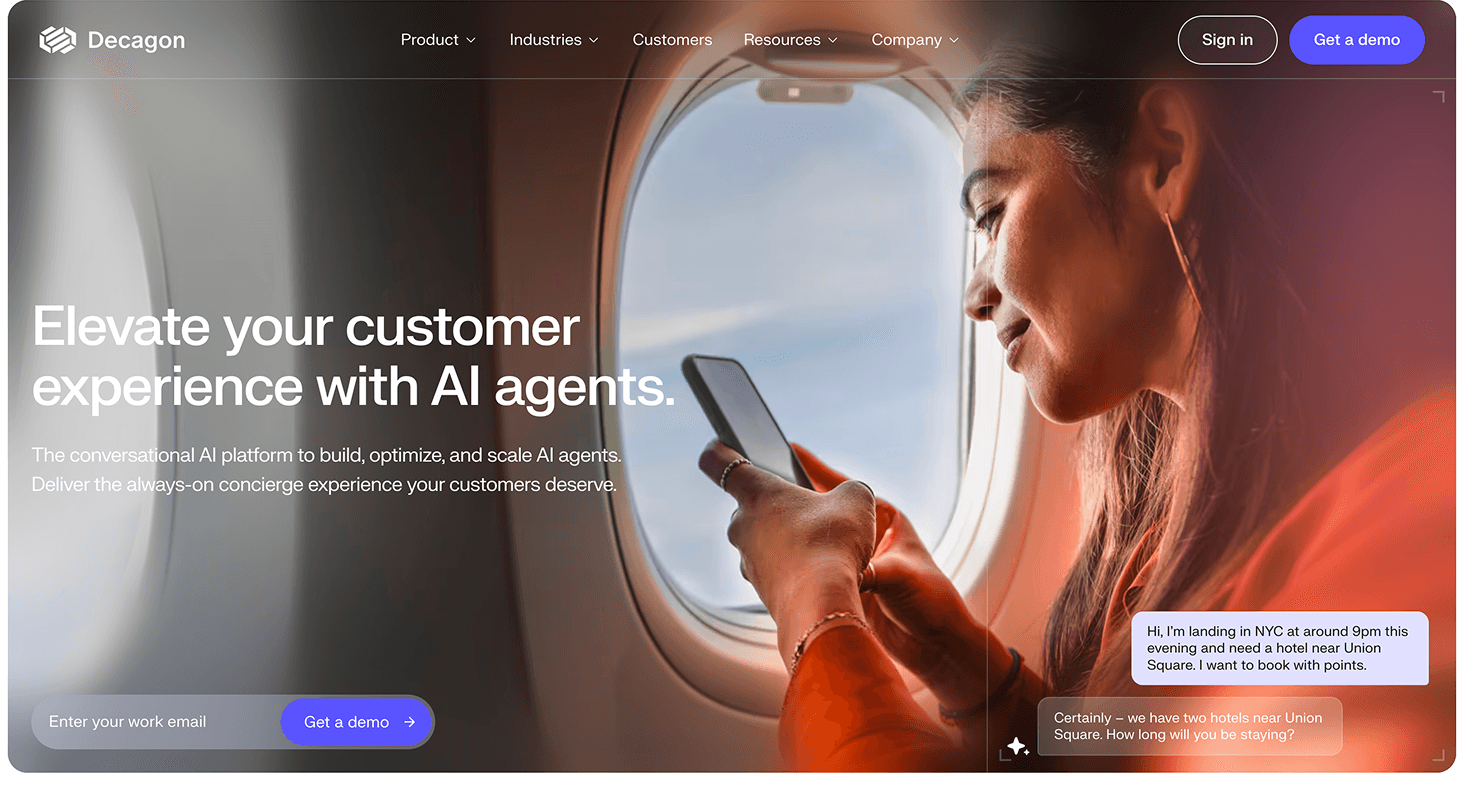
Source:- https://decagon.ai/
Decagon.ai delivers voice AI agents built for enterprise customer experience teams. The platform focuses on fast, natural conversations, brand-aligned voice behavior, and connected experiences across voice, chat, email, and SMS, with agents designed to operate continuously at scale.
Low-Latency Voice Conversations: Voice agents respond in real time, handle interruptions smoothly, and maintain natural dialogue flow during live calls.
Brand-Configurable Voice Agents: Agents can be customized for tone, terminology, speaking style, pronunciation, and pacing to reflect brand identity.
Cross-Channel Memory: Customer context carries across voice, chat, email, and SMS, allowing conversations to continue without repetition.
Why Choose Decagon?
Decagon fits enterprises that need voice agents capable of handling high-volume support with consistent brand behavior, connected customer context, and seamless escalation across channels.
Cons
The platform is designed for enterprise teams rather than small businesses.
Setup and customization require CX and brand alignment upfront.
8. Observe.ai
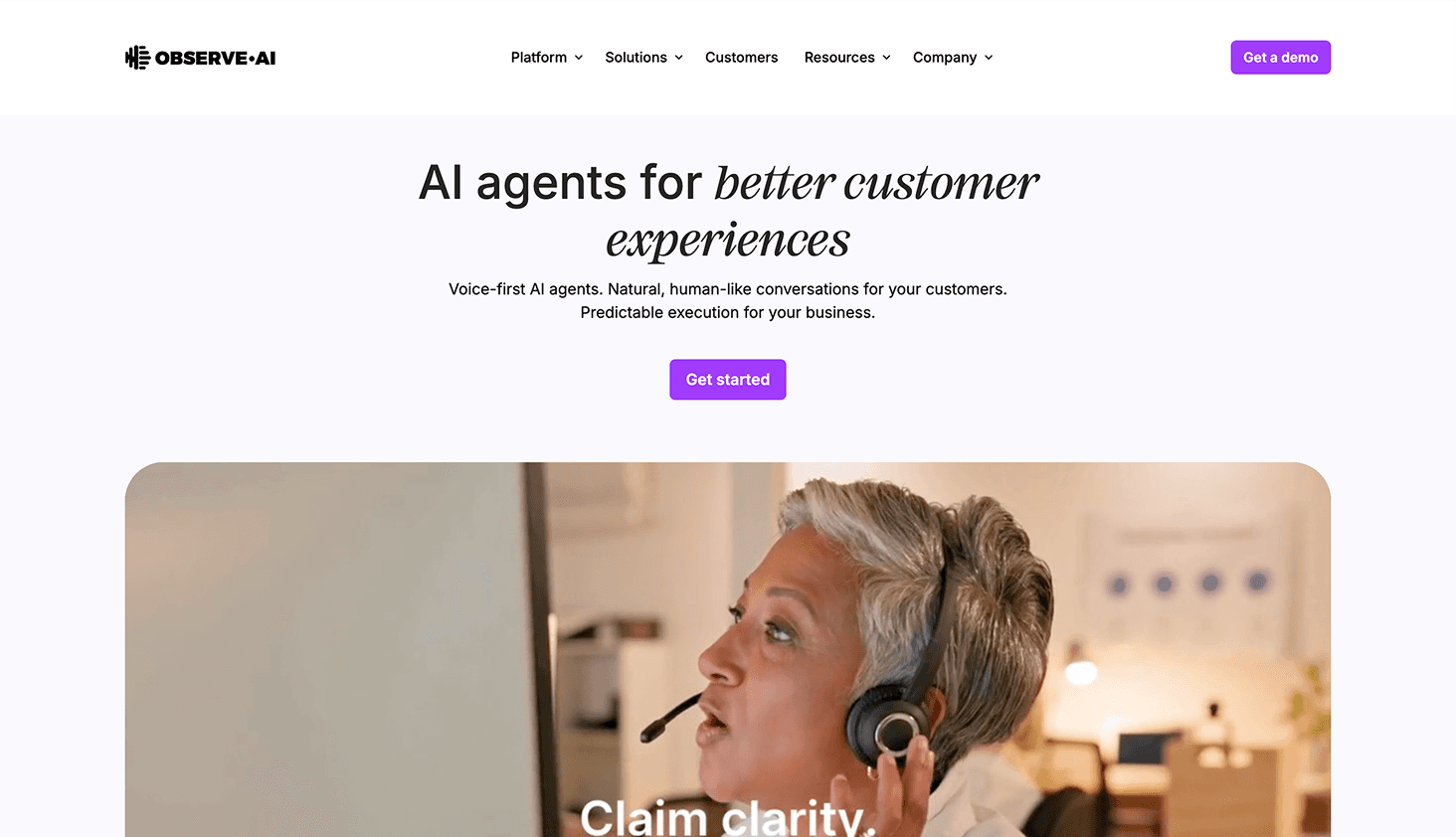
Source:- https://www.observe.ai/
Observe.AI offers Voice AI Agents built for contact centers that handle customer calls with accuracy, empathy, and speed. The platform combines speech recognition, language understanding, task-focused AI models, and natural voice output to resolve calls or route them to the right expert within existing systems.
Customized Speech-to-Text: Accurately captures accents, background noise, interruptions, and critical details such as names, numbers, dates, emails, and IDs during live support calls.
Spoken Language Understanding: Interprets disfluencies, intent shifts, and emotional cues while extracting information even in noisy, real-world call environments.
Why Choose Observe.AI?
Observe.AI suits large support organizations that need voice agents capable of handling complex calls, supporting many languages, and operating with full visibility, quality control, and integration across enterprise contact center systems.
Cons
Designed primarily for enterprise contact centers rather than small teams.
Configuration requires a clear task definition and system access.
Voice AI Platform Pricing Comparison
Platform | Entry Plan | Mid / Growth Plan | Enterprise Pricing | Pricing Model Notes |
Free – $0/ 0/month | Personal: $49/month Business: $1,999/month | Custom | Usage-based voice credits, concurrency limits, optional on-prem/VPC, SLA support | |
Flair.ai | Free – $0/ 0/month | Pro: $8/ 8/month Pro+: $26/month Scale: $38/month | Custom | Creative AI pricing, monthly image/video quotas, unlimited API at enterprise |
Upfirst.ai | Starter: $24.95/month (30 calls) | Pro: $159.95/month (300 calls) | Custom | Per-call pricing, overage fees, and spam calls excluded |
Liberate.ai | Not listed | Not listed | Custom | Insurance-focused enterprise deployments, pricing via sales |
Sonant.ai | Not listed | Not listed | Custom | Insurance agency AI receptionist, pricing via demo |
Sierra.ai | Not listed | Not listed | Custom | Enterprise CX platform, service-led pricing |
Decagon.ai | Not listed | Not listed | Custom | Enterprise CX and voice agents, demo-based pricing |
Observe.ai | Not listed | Not listed | Custom | Enterprise contact center pricing by module and scale |
These platforms show how voice AI is moving into core operations. Selection depends on industry fit, call complexity, and how much responsibility the system can safely carry.
Key Capabilities That Define a Strong Voice AI Company
A strong voice AI platform supports live conversations, handles real customer complexity, and fits directly into operational systems. These core capabilities separate production-ready voice AI from basic call automation.
Low-Latency, Natural Conversations: Delivers fast responses while managing interruptions, corrections, and fluid back-and-forth dialogue without rigid call paths.
Domain and Brand Intelligence: Understands industry terminology, product names, acronyms, and brand-specific language used in real customer calls.
Real-Time Action Execution: Completes tasks during live calls, such as updating records, booking appointments, processing requests, or triggering workflows.
Voice AI performs best when it combines conversational quality, system access, and operational control into a single, dependable platform.
What the Next Phase of Voice AI Will Look Like
The next phase of voice AI is shaped by developments already in production today, not speculative leaps. Progress centers on reliability, real-time reasoning, and tighter integration with enterprise systems as voice AI moves deeper into core operations.
Wider Use Of Real-Time Voice Reasoning: Voice agents increasingly reason during live calls rather than relying only on predefined flows, allowing them to handle interruptions, clarifications, and multi-step requests more accurately.
Stronger Integration With Operational Systems: Voice AI is gaining direct, governed access to CRMs, ticketing systems, policy tools, and databases, so actions occur during the call instead of after.
Improved Latency And Speech Quality: Ongoing advances in speech-to-text, text-to-speech, and model efficiency reduce response delays and produce more stable, natural conversations at scale.
Expanded Multilingual And Accent Coverage: Support for more languages, mixed-language conversations, and regional accents continues to improve due to larger training datasets and domain-specific tuning.
The future of voice AI builds on measurable progress already underway, with steady improvements in reasoning, system access, speech quality, and operational control defining the next phase.
Discover how voice AI lowers operational costs by handling high-volume calls and reducing agent load at scale. How Voice AI Platforms Are Reducing Contact Center Expenses
Conclusion
Voice AI has settled into an operational role. Teams now evaluate it by how reliably it performs under live call pressure, how cleanly it fits into existing systems, and how consistently it behaves across thousands of conversations. The gap continues to widen between tools that generate speech and platforms that can actually run phone operations, where reliability, latency control, and conversation ownership determine real impact.
For teams that need to run real-time phone conversations with dependable performance and production-grade control, smallest.ai is built for that reality. Explore how smallest.ai supports live voice agents at scale and see what production-ready voice AI looks like in practice. Book a demo today.
Frequently asked questions
How Do Voice AI Companies Handle Live Call Interruptions?
Are AI Voice Solutions Limited To Inbound Calls Only?
What Makes Voice-Based AI Solutions Reliable In Production?
Can Voice AI Companies Operate Inside Regulated Environments?
How Do Voice-Based AI Solutions Learn From Real Calls Over Time?