9 Ways Contact Center AI Is Changing Customer Calls Forever

Discover 9 high-impact ways contact center AI improves live calls, raises service accuracy, and helps teams handle rising volumes with greater confidence.
Call leaders who manage daily traffic know the pattern well. Calls stack up, frontline teams lose minutes hunting for scattered details, and supervisors jump between fire drills that should never reach their desks in the first place. These issues appear when real conversations move faster than the systems supporting them. This gap is the opening where voice AI, conversational AI, voice agents, and voice cloning now play a direct role in keeping operations steady.
The market sits near 15 billion dollars in 2025 with a projected 20% CAGR through 2033, and that rise reflects pressure inside enterprise contact centers. Teams adopting contact center AI see gains only when the technology handles timing, context, data capture, and multi-turn flow at the pace callers expect. Leaders exploring contact center AI want results tied to real calls, not slide decks, and that shift is driving deeper interest in systems that perform during peak loads.
In this guide, you will see 9 ways these capabilities expand what contact center teams can deliver.
Key Takeaways
Real calls require sub-second timing: Voice AI must return audio within a few hundred milliseconds to prevent caller overlap, missed cues, and repeated explanations.
Intent must update after every segment: Modern systems adjust intent mid-sentence, catching shifts like “payment issue” to “renewal question” without forcing callers through new prompts.
Status and verification steps complete instantly: High-volume tasks close fast when the system fetches refund timestamps, shipment scans, or payment entries through direct API calls.
Routing improves when models read live phrasing: Voice AI detects compound intents such as outage plus billing adjustment and routes callers to mixed-skill queues without transfers.
Structured data drives cleaner downstream work: Damage descriptions, IDs, dates, and reference numbers drop into CRM fields automatically, reducing rework for claims, billing, or support teams.
Why Fast, Human-Like Voice Response Matters in Contact Centers
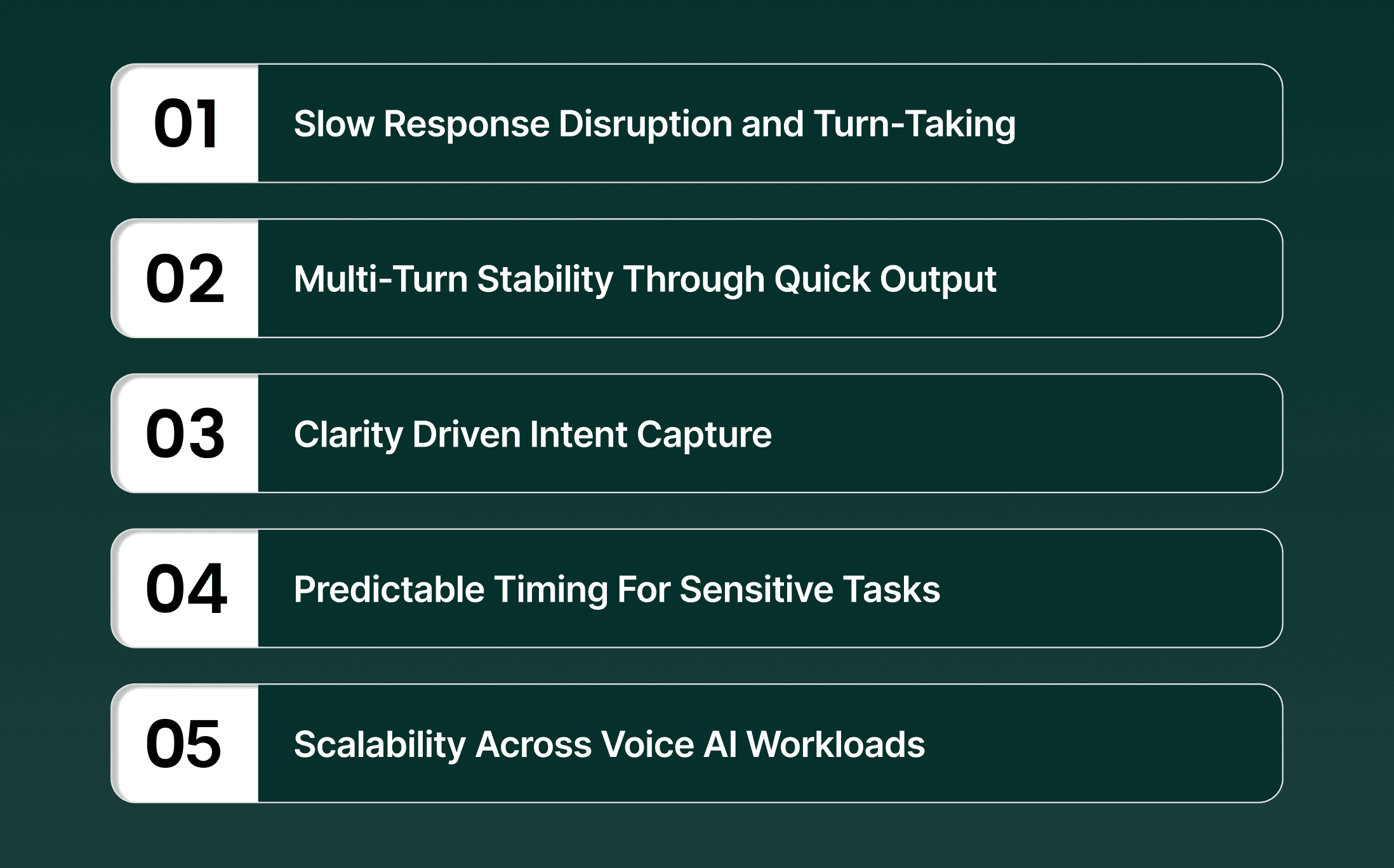
Callers expect reply timing that matches a real conversation, and contact center AI must operate within that rhythm for the call to stay stable. Any delay disrupts the exchange, raises caller effort, and pulls agents back into tasks the system could have handled. Real value appears when response timing stays tight across accents, background noise, verification steps, and long multi-turn interactions.
Slow Response Disruption and Turn-Taking: Even a short pause above a few hundred milliseconds interrupts the caller’s flow and leads to repetitions or overlapping speech.
Multi-Turn Stability Through Quick Output: Sub-second audio keeps long troubleshooting or verification paths steady by matching the tempo callers use during real technical or account conversations.
Clarity Driven Intent Capture: Natural pacing and smooth delivery improve recognition of caller cues such as uncertainty, corrections, or shifting needs during the same call.
Predictable Timing For Sensitive Tasks: Stable reply speeds build caller confidence during moments such as payment checks, identity verification, or policy-related confirmations.
Scalability Across Voice AI Workloads: Consistent timing supports contact center AI chatbot style flows, cloud-routed voice systems, and large volume routing since more calls can move to AI without harming the experience.
This is where voice systems prove they can support real callers across complex tasks, not only scripted workflows.
Core Parts of a Contact Center AI System
A contact center AI system works only when each layer can process voice, text, and events within tight timing limits. These parts form a live pipeline that converts speech to usable data, interprets intent, generates replies, and updates downstream systems. The goal is to keep the call moving at human speed while meeting enterprise rules for accuracy, privacy, and uptime. Leaders who understand these components can judge whether a system can handle real traffic or only controlled demos.
Speech Recognition and Audio Handling: The engine processes audio frames as they arrive, manages cross-talk and mobile noise, and creates timestamped text that supports routing and agent-assist tools.
Intent and Entity Extraction: The model updates intent after each segment and captures items such as policy numbers or order IDs with the precision needed for downstream actions.
Session State and Event Logic: Context refreshes after every utterance and triggers routing changes when the caller shifts topics or raises sensitive issues.
Agent Assist and Response Timing: Agents receive live transcripts and prompts while the caller speaks, and the reply audio returns within a few hundred milliseconds to maintain a natural pace.
Scalable Infrastructure and Integration: The system supports high call volume, stores audio and metadata in a secure structure, and syncs with CRM or ticketing tools through stable API paths.
For a clearer view of where real operational shifts are heading next, check out Top 10 Contact Center Automation Trends for 2025
Practical Ways Contact Centers Use Voice AI
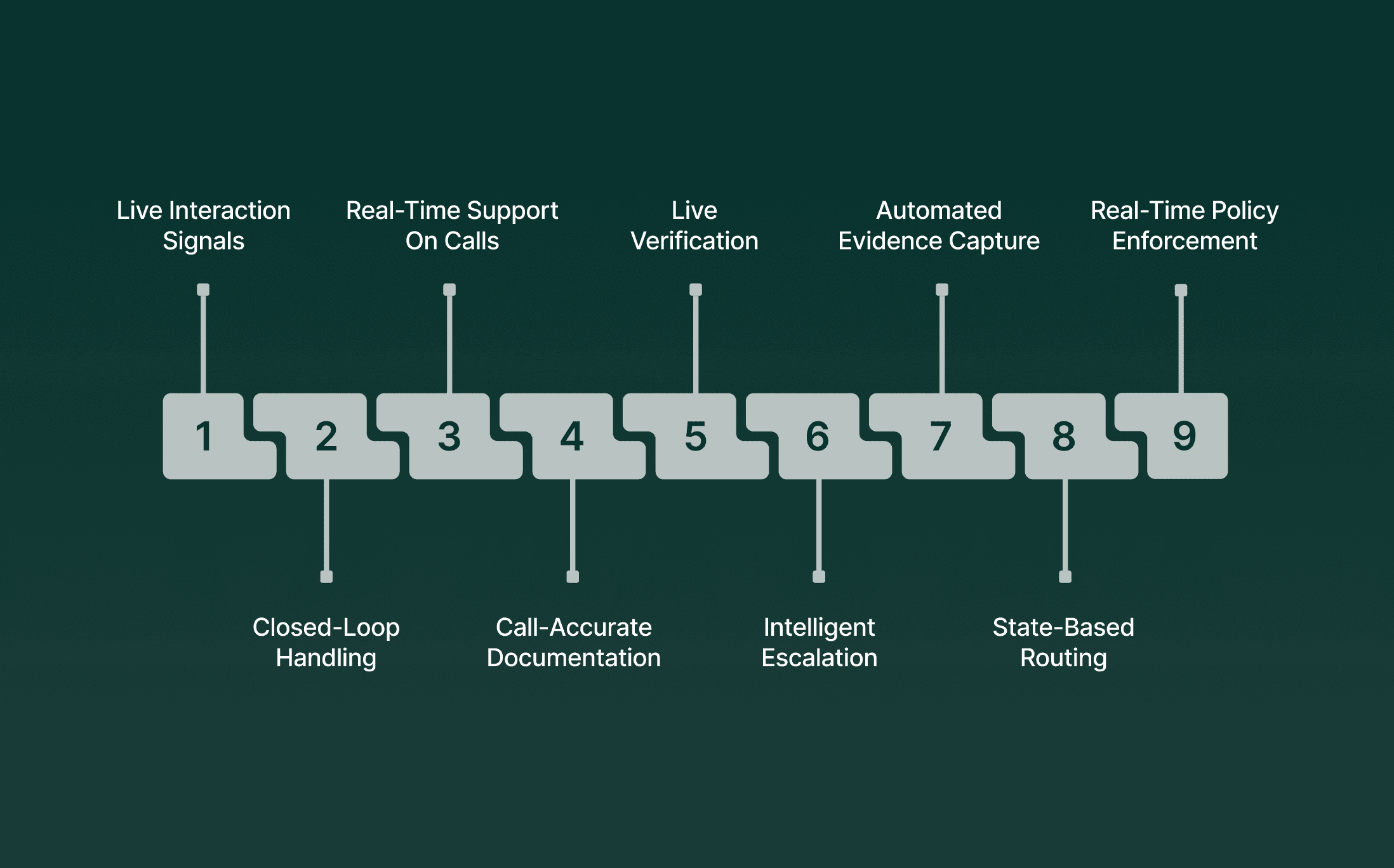
Voice AI proves its value when callers share partial details, switch tasks mid-sentence, or reference information spread across several systems. These moments usually slow agents who must confirm facts, pull records, and keep the caller engaged.
Voice AI reduces this delay by reading intent within each segment, retrieving the needed data, and guiding the next step without extra prompts or repeats.
1. Intake Built On Live Interaction Signals
Voice AI adjusts routing based on caller phrasing patterns, pace, and data cues. For example, if a caller begins with “I tried paying online and it showed an error,” then shifts into “and I also need to check my renewal,” the system detects the dual intent and routes the call to the payment team that also handles renewal-linked issues rather than forcing the caller through two different queues.
Higher Accuracy In Early Routing: If a caller mentions “card declined” followed by “transaction reference,” routing shifts to a payment-resolution queue instead of generic billing.
Stable Routing In Edge Scenarios: When a caller holds two intents, such as outage plus billing adjustment, the system recognizes the pattern and avoids misrouting to a single-skill queue.
Lower Abandon Rates: Callers reach the correct team without stepping through long menus or repeating details.
2. Closed-Loop Handling For High-Volume Tasks
Voice AI completes repetitive workflows by pulling values directly from internal systems. If a caller asks, “What is my shipment status for order #5218?” the system retrieves the status, confirms the location scan, reads back the date, and asks for acknowledgment before closing the task.
Consistent Rule Application: A balance check, for example, follows the exact path every time: authenticate caller, fetch recent transactions, present value, log confirmation.
Fewer Multi-Call Loops: A status update like “payment received today at 3:42 PM” is delivered within the same call, removing the need for callbacks.
Stable Compliance Quality: Required lines, such as confirmation prompts in payment disclosures, are included without relying on agent memory.
3. Real-Time Support On Calls With Multiple Verification Layers
Voice AI compares caller statements with internal data while the agent speaks. If the caller says, “I paid four days ago,” but the record shows the payment posted this morning, the AI flags the mismatch on screen so the agent can clarify without placing the caller on hold.
Visible Prompts For Key Items: During an identity check, if the caller shares a DOB that differs from the file by one digit, the AI highlights it instantly.
Accurate Structured Capture: Values like policy ID, last transaction amount, or device serial number are entered in the correct fields as the caller speaks them.
Lower Rework Across Teams: Teams downstream avoid sending follow-up emails when fields such as claim reference or appointment slot are already captured correctly.
4. Documentation That Mirrors The Call With Operational Fidelity
Voice AI turns the call into structured units tied to workflow checkpoints. For instance, during a claims call, the AI captures the caller’s description of damage (“front bumper dent left side”), stores it in the correct claim field, records the date the event occurred, and logs every verification action.
Clear Evidence For QA: If the caller confirmed terms like “I agree to the processing timeline,” the system tags the exact sentence and timestamp.
Faster After-Call Wrap: When the call ends, the agent sees pre-filled sections such as issue origin, steps completed, and follow-ups assigned, shortening their wrap cycle.
Reliable Cross-Team Handoff: Claim adjusters or billing teams receive a clean record with all steps mapped, including the caller’s own wording of the problem.
5. Live Verification For Sensitive Steps
Voice AI tracks each verification unit in real time. For instance, if a customer provides a partial policy number during a claims check, the system detects the missing digits and prompts the agent before the call moves forward.
Cleaner Compliance Flow: Verification steps follow the required sequence, such as DOB before policy ID in regulated calls.
Lower Hold Time: The system retrieves values like last payment date or plan status without manual searching.
Reduced Failure Rates: Missing items surface instantly, such as an unverified beneficiary ID during an account update.
6. Intelligent Escalation During High-Risk Calls
Voice AI monitors phrasing patterns that signal rising tension. For example, in a billing dispute, repeated mentions of “charged twice” paired with long pauses trigger a real-time alert for a lead to join.
Earlier Supervisor Intervention: Leads step in during the first sign of escalation, not after the caller raises their voice.
More Stable Retention Outcomes: Agents receive prompts tied to known recovery paths, such as offering a payment breakdown in renewal calls.
Better Queue Control: Supervisors see spikes in certain call types early, such as a surge in outage-related complaints.
7. Automated Evidence Capture For Claims And Disputes
Voice AI captures caller statements verbatim. If a caller says, “The shipment arrived with the screen cracked on the top left corner,” the AI tags this sentence and links it to the damage-description field.
Reliable Documentation: Agents avoid rephrasing key items such as the exact damage description or disputed amount.
Clear Audit Trail: Statements are tied to timestamps, such as when the caller confirmed the receipt date.
Fewer Re-Verification Calls: Teams receive complete evidence for decisions, such as the caller’s wording for a failed delivery claim.
8. Routing Based On System State, Not Caller Guesswork
Voice AI checks the caller’s phrasing against live system data. If the caller reports “internet slow,” and the system shows an outage in their zone, the call routes directly to outage handling without probing questions.
Higher Resolution In One Call: Calls land with the right specialists when system conditions match the caller’s issue.
Lower Misroutes: Outage cases avoid billing queues, and claim-in-review cases skip general support.
Faster Caller Relief: The agent starts with the correct context, such as active outage details already visible.
9. Real-Time Policy Enforcement
Voice AI checks each required step while the agent speaks. During a cancelation request, if the agent skips the mandatory notice statement, the AI flags it immediately.
Fewer Compliance Gaps: All required lines are delivered, such as mandatory fee explanations in certain call types.
Higher Audit Success: Recordings show each required statement tied to the point in the call when it was read.
Clear Supervisor Visibility: Leads see missing steps live instead of during retrospective audits.
Move callers through full journeys with tight timing, accurate data capture, and multilingual support powered by Smallest.ai. Book a demo.
How to Run Voice AI Across Many Languages and Heavy Call Loads
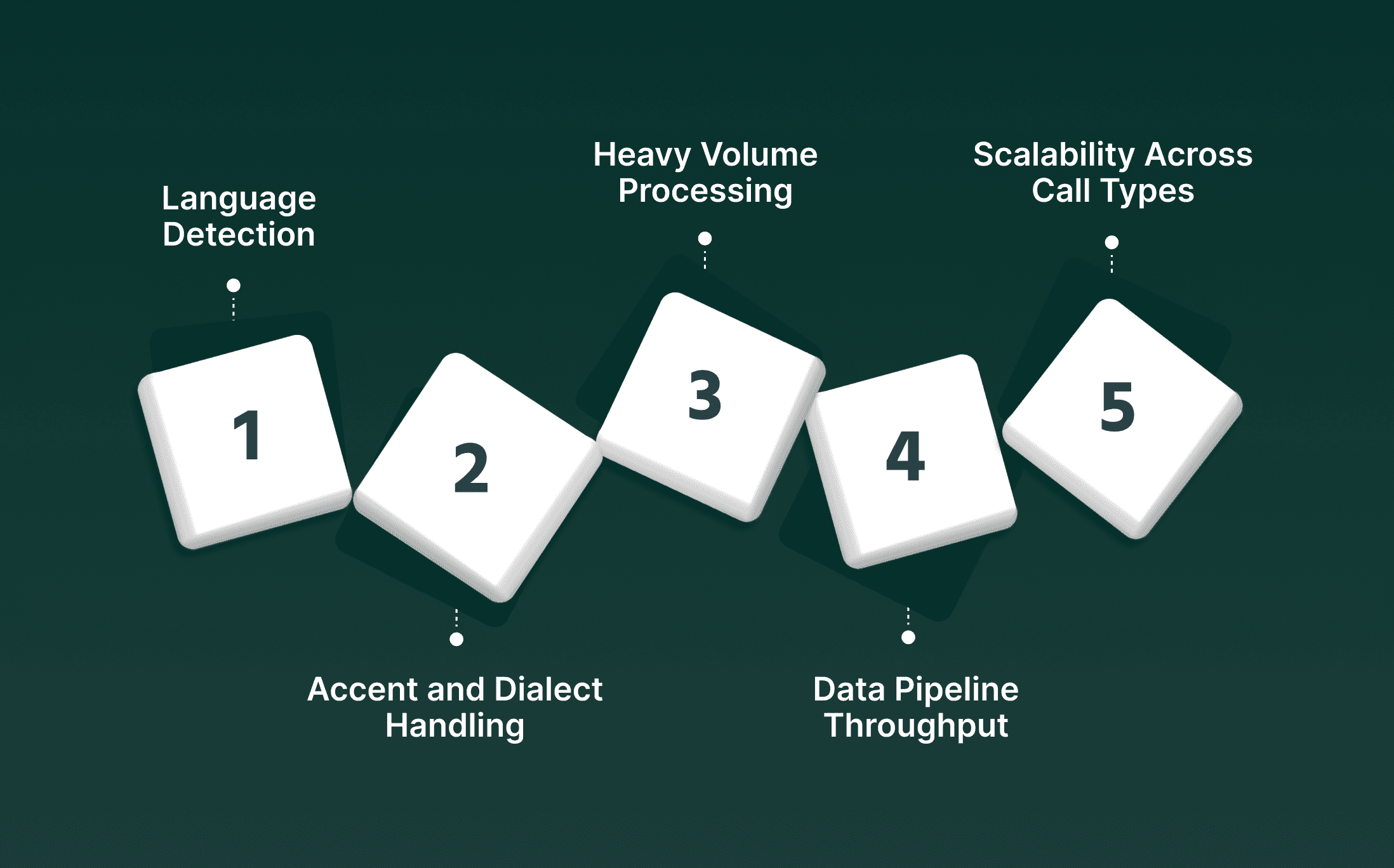
Contact centers operate voice AI across large volumes by using language models that detect caller language from acoustic patterns, token sequences, and prior interaction data, then route the call to the correct processing pipeline without adding latency. The system must handle shifts between languages, accents, and mixed phrasing while maintaining stable performance during peak loads such as outage spikes, billing cycles, or claim deadlines.
Language Detection and Model Switching: The system identifies language within the first few seconds by mapping phonetic markers and phrasing patterns, then shifts to the correct processing model without interrupting the call.
Accent and Dialect Handling: Accuracy stays stable when the system adjusts phoneme mapping for regional variants such as South Indian English, Puerto Rican Spanish, or Quebec French during real-time transcription.
Heavy Volume Processing: Peak bursts remain steady when the system distributes calls across parallel inference units that process speech frames independently without queue buildup.
Data Pipeline Throughput: Structured information stays accurate when the system pushes transcribed fields such as ID values or claim references through high-speed API paths that avoid bottlenecks during busy hours.
Scalability Across Call Types: Performance holds when diverse call types, such as payment checks, outage updates, or verification calls, run through the same architecture that retrieves values directly from internal databases without delays.
If you want a grounded look at where call handling time drops and repeat volume shrinks, explore How Voice AI Platforms Are Reducing Contact Center Expenses
Key Features to Check Before Choosing a Contact Center AI Platform
Contact centers review platforms by checking how well the system handles real call conditions, such as mixed languages, identity checks, verification steps, data retrieval, and high-volume bursts. Leaders focus on technical depth that supports daily operations rather than generic feature lists.
Feature to Check | What to Look For |
|---|---|
Language Detection Accuracy | The system identifies caller's language from early phonetic cues and switches models without interrupting the flow. |
Real Time Data Retrieval | The system fetches values such as payment entries or claim references through fast API paths without tool switching. |
Verification Handling | The system captures IDs, dates, and reference numbers accurately during calls and places each field in the correct CRM slot. |
High Volume Stability | The system processes speech frames in parallel, so peak hours do not create queue delays. |
Multichannel Workload Coverage | The system supports tasks such as status checks, policy queries, and outage updates through one architecture that maintains steady response speed. |
With the right capabilities in place, teams gain a system that supports full call journeys without adding friction to existing operations.
Current Trends in Contact Center AI
Contact centers track new patterns that shape how systems support callers, reduce load, and handle complex requests. Teams focus on changes tied to model behavior, data flow, call volume shifts, and real operational pressure rather than broad market statements.
Real-Time, Context-Aware Agent Assist: Systems now actively listen to live conversations, interpret caller intent, and surface responses and next actions during the call.
Generative AI Powering Self-Service For Tier-1 And Tier-2 Interactions: Virtual agents using large-language models handle complex queries, multi-turn conversations, and pull real-time data instead of following rigid script trees.
Predictive Routing and Intent-Based Matching Replacing Static IVR Flows: AI systems use behavioral signals, past interaction data, and live call cues to match callers with the right agent or workflow rather than standard menus.
Unified AI Layer For Quality Management, Coaching, And Compliance: AI summarizes calls, scores agent performance, monitors compliance statements, and supports multi-channel interactions (voice, chat, email) under a single framework.
Foundation Model And Platform Consolidation With Enterprise Guardrails: To scale AI in the contact centre, companies embed GenAI across their CX stack while guaranteeing governance, domain-specific fine-tuning, and integration of data across silos.
Together, these patterns show how teams are building systems that respond to real traffic pressure instead of fixed scripts.
How Smallest.ai Handles Real-Time Voice for Enterprise Contact Centers
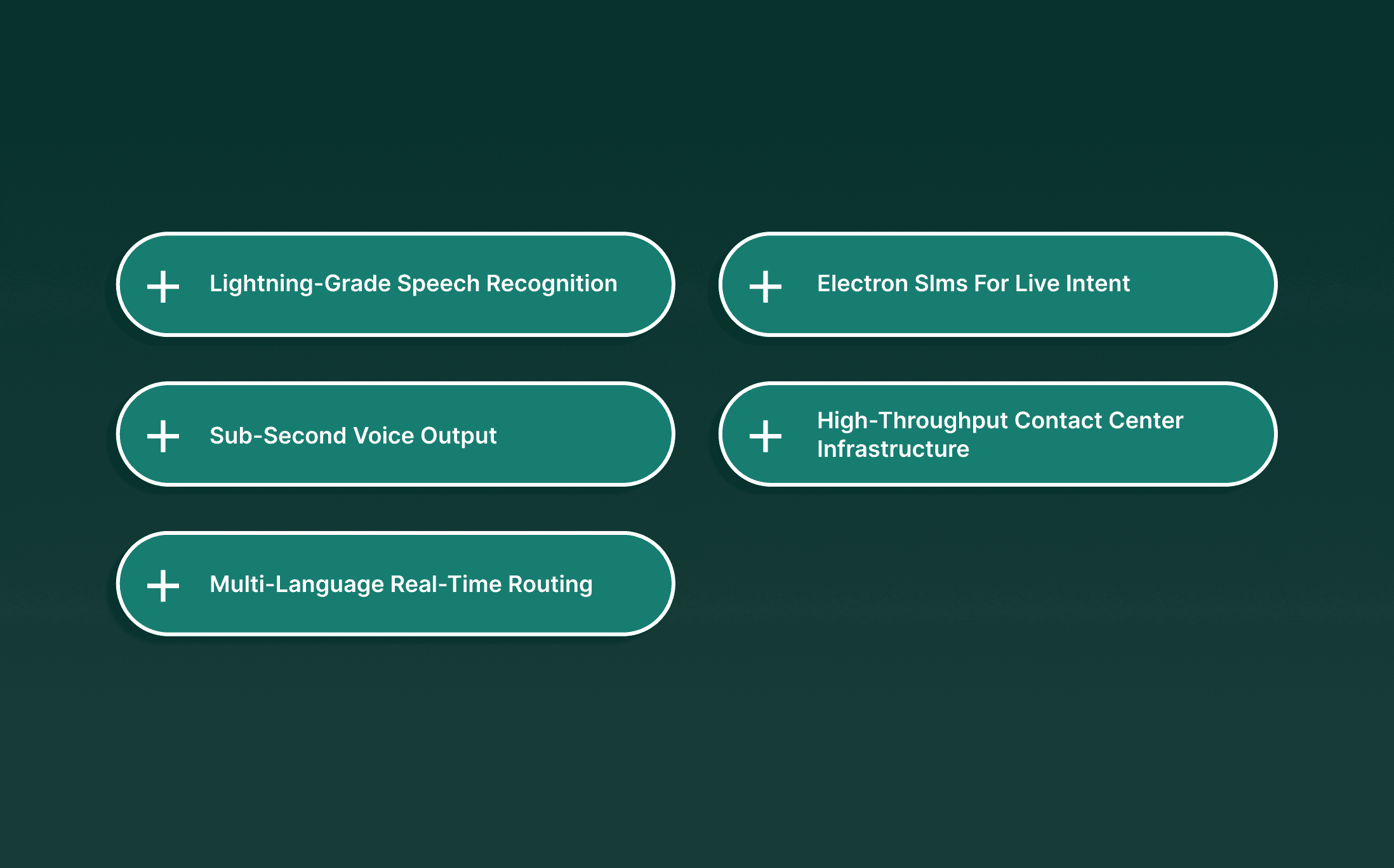
Enterprise teams adopt contact center AI only when voice processing stays tight, natural, and reliable across high call loads. Smallest.ai supports this pace by combining in-house speech models, fast audio pipelines, and deep integrations that process caller intent, structured data, and system actions at the speed of live conversation. This is how the platform keeps enterprise traffic stable across languages, industries, and operational complexity.
Lightning-Grade Speech Recognition: Models trained on millions of real calls handle mobile noise, fast talkers, and accent variation while returning accurate text with timestamps for downstream logic.
Sub-Second Voice Output: Lightning Voice AI produces human-like audio responses within a few hundred milliseconds, so callers stay in rhythm across long troubleshooting or verification steps.
Multi-Language Real-Time Routing: The system identifies language from early phonetic cues, then switches to the correct model so English, Hindi, Tamil, Spanish, or other supported languages run at equal speed.
Electron Slms For Live Intent: Electron Intelligence updates intent after each spoken segment and extracts items such as order IDs, policy numbers, or appointment details with high precision.
High-Throughput Contact Center Infrastructure: Parallel audio processing supports heavy enterprise volume, syncing transcripts, actions, and metadata with CRM or ticketing tools through stable API paths.
With these layers working together, enterprises gain a voice system that supports real callers at scale while keeping every turn of the conversation steady.
Conclusion
Call teams are moving into a phase where caller pace, clarity, and timing shape daily outcomes. The real shift happens when contact center AI supports live conversations without slowing callers who move quickly, switch topics, or speak across mixed accents and background noise. Leaders now look for systems that hold steady during high traffic while keeping tasks accurate and repeat-free. This focus makes contact center AI a practical driver of day-to-day performance rather than a side project.
Smallest.ai supports this shift with voice AI, conversational AI, voice agents, and voice cloning that keep calls moving at human speed across large volumes. The platform returns natural audio quickly, captures structured data with precision, handles multiple languages, and connects with enterprise tools without friction. These strengths help teams reduce manual work and keep service quality steady during peak load.
To see this in action for your call flow, book a demo.
FAQs About Contact Center AI
1. How does contact center AI handle callers who switch languages mid-sentence?
Modern systems detect phonetic shifts in the first few tokens and update the model path instantly, which is essential for cloud contact center AI setups.
2. Can a contact center AI chatbot manage verification steps that normally require an agent?
Yes. It captures values like dates, IDs, and reference numbers in real time and maps them into the correct CRM fields without breaking the flow.
3. What slows down understanding AI in contact center workflows during peak hours?
Bottlenecks appear when audio frames are batched instead of being streamed. Systems built for parallel inference avoid queue delays during heavy traffic.
4. How does contact center AI maintain accuracy during noisy mobile calls?
Models trained on real call noise patterns handle cross-talk, movement, and variable mic quality while keeping intent and entity extraction stable.
5. What makes it possible to scale a contact center with AI across thousands of daily calls?
High-throughput audio pipelines, timestamped transcripts, and fast data retrieval let the system take on more tasks without raising agent load.