How Banks Use Text to Speech for OTP Flows and Transactional Voice Alerts

A technical guide to implementing text to speech for banking OTP calls, fraud alerts, and transactional voice messages. Covers latency, compliance.
Text to speech has become critical infrastructure in financial services. Every time a bank calls to read out a one-time password, confirm a transfer, or warn about suspicious activity, a TTS engine is at work. This guide is for developers, product managers, and technical architects building or upgrading voice alert systems. You will understand how TTS engines function inside banking pipelines, what separates a reliable implementation from a fragile one, and how to choose the right platform. The stakes are high: a poorly implemented voice alert system does not just frustrate customers, it creates compliance exposure, erodes brand trust, and can directly cause financial harm when OTPs fail to deliver on time.
How text to speech fits into banking communication
The global TTS market was valued at USD 4.55 billion in 2024 and is projected to reach USD 37.55 billion by 2032 (Data Bridge Market Research).
A significant share of this growth comes from financial services, where voice synthesis handles everything from fraud alerts to account balance readouts. At the infrastructure level, a banking TTS pipeline works like this: a core banking system triggers an event, a message template is populated with data, the text is sent to a TTS API, and a telephony platform delivers the call. The entire chain must complete in under two seconds for OTP flows.
Banking communication spans four distinct message categories, each with different latency tolerances and regulatory requirements. OTP delivery is the most time-critical. Fraud alerts carry the highest emotional weight. Transaction confirmations are the most frequent. Account service messages are the most varied in structure. A TTS implementation that treats all four as identical will underperform on at least three of them. Define message categories early, assign latency and quality targets to each, and configure your pipeline accordingly.
The telephony layer matters as much as the TTS engine. Most banking voice alert systems route through a leading CPaaS platform or through an in-house IVR platform. The CPaaS provider handles call initiation, DTMF input collection, and call status callbacks.
The TTS API handles audio synthesis. A common architectural mistake is synthesizing audio on every call attempt, including retries. Pre-synthesizing static message segments and caching them reduces API calls, lowers cost, and cuts latency on retry attempts.
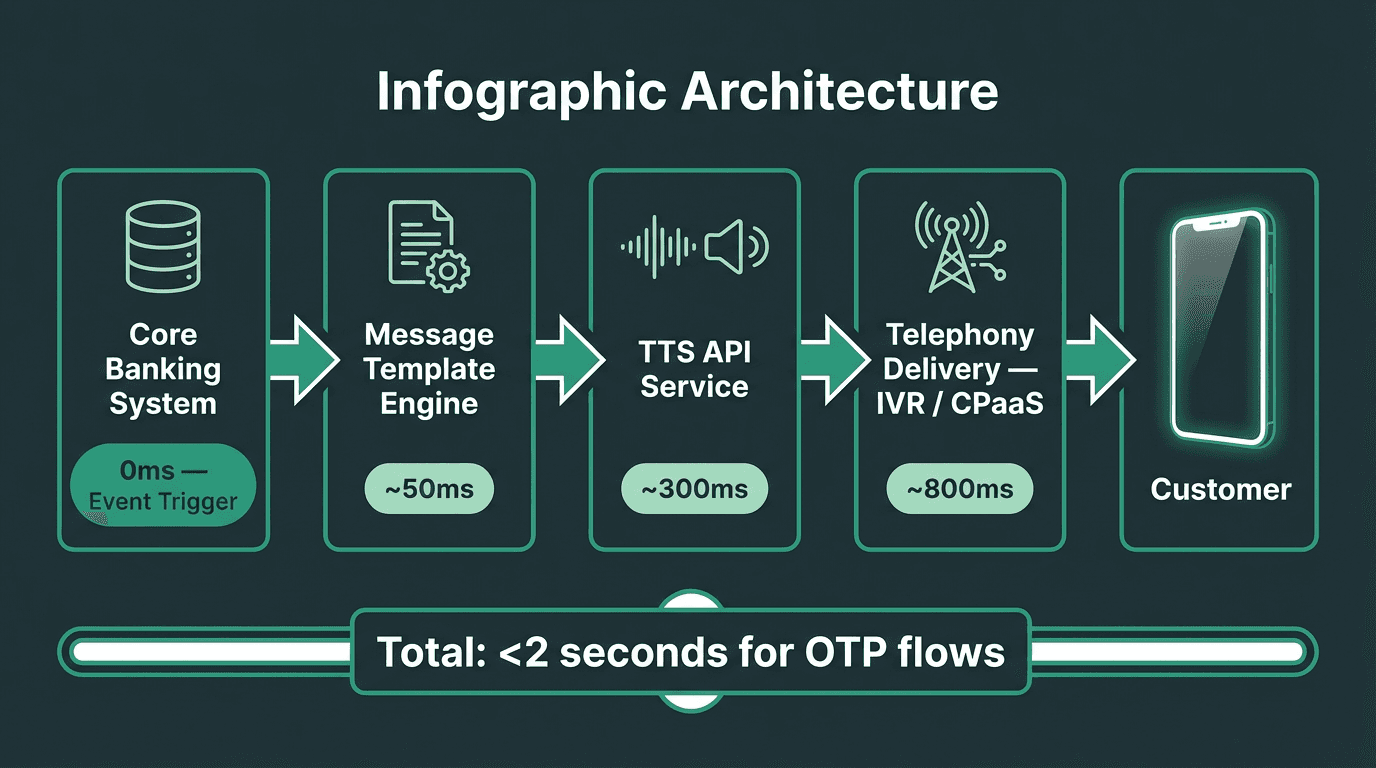
A typical banking TTS pipeline from event trigger to customer delivery, with latency at each stage.
OTP delivery: where latency and accuracy are non-negotiable
OTP voice calls are the highest-stakes text to speech use case in banking. A customer is waiting for a six-digit code. If the call is late, sounds garbled, or reads the wrong number, the session times out and trust erodes.
Most OTP systems set a 30 to 90 second expiry window, so the entire telephony and TTS chain must complete well within that time. The most common failure mode is speed, not voice quality. Select a TTS API with streaming support and sub-300ms time-to-first-audio, and pre-warm API connections — see the fastest text-to-speech APIs for a current benchmark comparison. A TTS engine that reads '847291' as a single number is useless for OTPs. Format digits with spaces or use SSML to force individual character pronunciation.
Beyond latency, OTP calls have a specific structural requirement: the code must be repeated. A customer who mishears the first reading has no way to recover if the call ends immediately. The standard pattern is to read the code once, pause for one second, then read it again at a slightly slower rate. SSML break tags handle the pause. Rate adjustment handles the second reading. This two-pass pattern adds roughly 1.5 seconds to call duration but significantly reduces failed authentication attempts caused by mishearing.
Retry logic is another area where many implementations fall short. If a customer does not answer, the system should attempt a second call after 30 to 60 seconds. If the OTP has expired by the time the second call connects, the system should either request a new OTP automatically or instruct the customer to request one through the app. Build retry logic at the telephony layer, not the application layer, so it executes even if the originating server is under load.
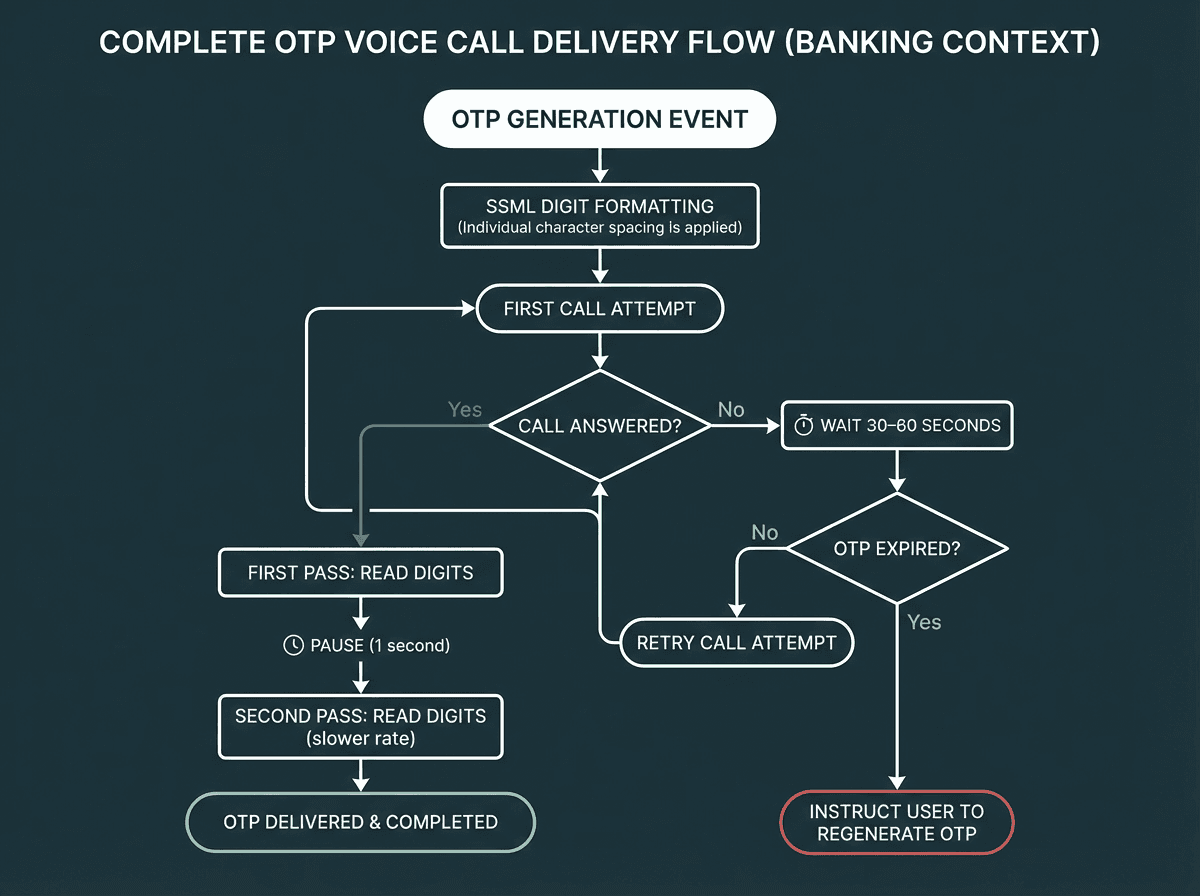
A well-designed OTP voice call flow includes digit formatting, a repeat pass, retry logic, and expiry validation at each stage.
Designing transactional voice messages that customers trust
A 2024 J.D. Power survey found that while 54% of financial services customers have used a generative AI tool, only 27% trust AI for serious financial information and advice. That trust gap is a design problem as much as a technology problem. Voice selection is a strategic decision. For fraud alerts, a slightly elevated pace signals urgency without causing panic. For transaction confirmations, a warmer delivery reduces cognitive load. Modern TTS platforms support SSML for rate and pitch control, and the best ones offer human-like AI voices with emotional range that can be tuned per message category.
Message structure is as important as voice quality. A customer receiving a fraud alert at 2am is disoriented and potentially alarmed. The message must establish identity immediately, state the nature of the alert in plain language, and give a clear action. Burying the institution name at the end, or leading with legal disclaimers, causes customers to hang up before they hear the important part. The same principle applies to transaction confirmations: state what happened, state the amount, confirm the account, and give the customer a next step.
Currency amounts require specific handling. A TTS engine passed the string '$1,250.00' may read it as 'one thousand two hundred fifty dollars and zero cents' or misparse the comma entirely. Normalize currency strings before passing them to the TTS API: write out the amount in words in your message template. For amounts with cents, include them explicitly. This normalization belongs in the message template engine so it applies consistently across all message types.
Practical message design rules for transactional voice alerts:
Lead with the institution name to establish identity
State the action type before amounts
Read currency amounts as full words: 'two hundred fifty dollars'
Repeat critical information like OTP digits or amounts once
End with a clear instruction: 'Press 1 to confirm, press 2 to report fraud'
Remove all filler language and legal boilerplate from the spoken message
Test every message template with at least three different data inputs to catch edge cases in number formatting
Compliance: what the FCC and OCC actually require
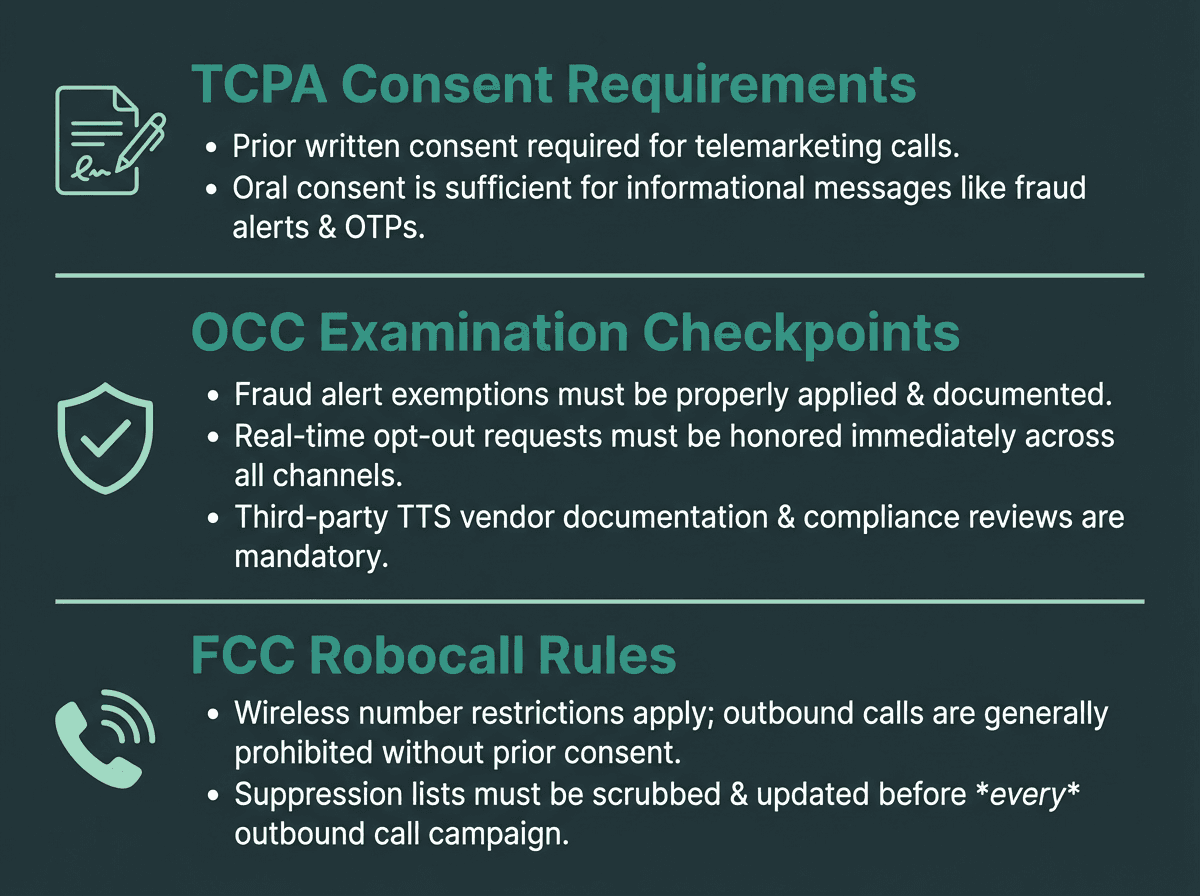
Key regulatory frameworks governing automated voice calls in US banking contexts.
The FCC requires prior written consent before making a prerecorded telemarketing call to a wireless number. For informational messages like fraud alerts and transaction confirmations, oral consent may be sufficient. A transaction confirmation is informational, but adding a product offer makes it marketing. A legal analysis by Debevoise and Plimpton (2023) highlights that banks must have processes for honoring opt-out requests in real time. Your TTS pipeline must check a consent and suppression list before every outbound call, not just at enrollment.
The OCC's guidance on operational risk in technology systems (OCC Bulletin 2023-17) is directly relevant to TTS infrastructure. Examiners assess whether banks have documented third-party dependencies in their customer communication stack, including TTS API providers. If your TTS vendor experiences an outage, your bank is expected to have a documented fallback procedure. Maintain a vendor risk assessment covering uptime SLA, data handling practices, and incident response procedures. For a broader view of how voice AI is reshaping banking infrastructure, that overview is a useful complement to the regulatory picture.
State-level regulations add another layer. California, Florida, and Texas each have specific provisions affecting how banks initiate outbound voice calls, in some cases stricter than federal TCPA requirements. If your institution operates across multiple states, your consent management system must be jurisdiction-aware. A single national consent flag is not sufficient. The suppression check must resolve the customer's state of residence and apply the correct rule set before initiating the call.
Selecting a text to speech API for financial use cases
Not all TTS APIs are built for banking's latency and reliability needs. The key criteria are streaming latency, uptime SLA (99.9% minimum), SSML support, and predictable pricing at high volume. Smallest.ai's speech models are built for low-latency, high-throughput voice delivery, with streaming output and fine-grained SSML control. A 2025 ABA Banking Journal survey found that 44% of banking customers would use automated phone voice assistants for customer service. On pricing, understand whether a provider charges per character, second, or request, and model your costs before committing.
Uptime SLA is the most underweighted criterion in most vendor evaluations. A TTS API with 99.5% uptime experiences roughly 44 hours of downtime per year. For a bank sending 50,000 OTP calls per day, that translates to thousands of failed authentications annually. Require 99.9% uptime as a minimum, and ask vendors for historical incident data, not just their contractual commitment. A TTS API that is slow during peak load is nearly as damaging as one that is fully down.
SSML support depth varies significantly between providers. Basic support covers break tags and rate control. Full support adds say-as tags for character-by-character pronunciation, phoneme tags for proper nouns, and prosody control at the word level. For banking use cases, say-as tags are non-negotiable for OTP digit pronunciation. Test your actual message templates against each candidate API before making a selection, not just generic benchmark sentences.
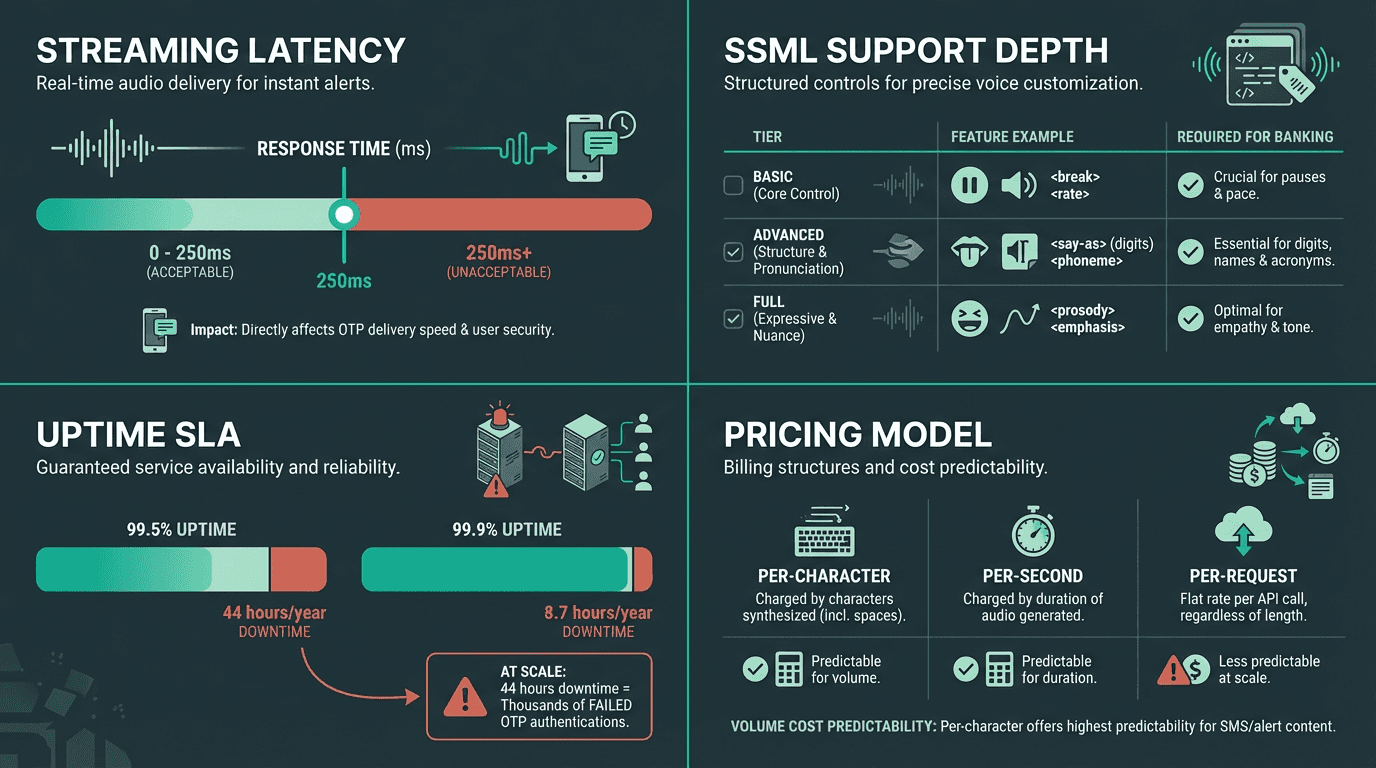
Evaluating TTS APIs for banking requires assessing latency benchmarks, SSML depth, uptime history, and volume pricing together rather than in isolation.
Advanced considerations: voice consistency and fallback logic
Voice consistency is a trust signal. If your fraud alert uses a different voice than your OTP call, customers notice. Standardize on a single voice persona per language across all outbound communications. The most realistic text-to-speech AI options today make it practical to find natural, consistent voices that hold up across message types and emotional registers. Document the voice ID, language code, and SSML defaults for each approved voice in your system configuration, and enforce them through a shared message rendering service.
Fallback logic is the part of TTS infrastructure that most teams build last and test least. There are three failure scenarios to plan for. First, the TTS API is unavailable: serve pre-synthesized audio clips for your highest-volume message types and instruct the customer to use the app or call support. Second, the TTS API is slow: streaming output with a timeout threshold allows partial audio delivery rather than a silent call. Third, the call is not answered: a fallback to SMS should trigger automatically after a configurable number of unanswered attempts, particularly for OTP flows where time pressure is highest.
Multilingual deployments require separate approved voice configurations for each locale. A voice model trained primarily on one language will produce poor prosody in others. Test multilingual message templates with native speakers before deploying to production, as automated pronunciation scoring tools miss prosody errors that native speakers catch immediately.
Instrument your pipeline to track time-to-first-audio per API call, call completion rate, DTMF response rate, and retry rate per message type. Set alert thresholds that trigger before customer impact becomes significant. A rising retry rate on OTP calls is typically the earliest signal of latency degradation in the TTS or telephony layer.
Key takeaways and next steps
TTS in banking is not a commodity. It is a compliance-critical, trust-sensitive system that demands deliberate engineering. Institutions that get it right treat voice quality, consent management, API performance, and operational monitoring as first-class requirements from the start, not as refinements added after launch. The cost of getting it wrong is measured in failed authentications, regulatory exposure, and customers who stop trusting automated calls entirely.
For teams building or upgrading banking voice alert systems, Lightning by Smallest AI directly addresses the constraints this guide covers: sub-300ms streaming latency, full SSML support including say-as tags for OTP digit pronunciation, and uptime built for high-throughput financial workloads. If the failure modes outlined here — late OTPs, garbled currency amounts, inconsistent voice personas — are live problems in your stack, Lightning is purpose-built to close them.
Immediate actions to take:
Audit your current TTS pipeline for time-to-first-audio latency under production load
Verify that your OTP text input forces individual digit pronunciation across all supported languages
Confirm your consent and suppression list is checked at the event trigger layer, not the telephony layer
Standardize on a single voice persona per language across all outbound banking communications
Build and test pre-rendered audio fallbacks for your five most common message types
Instrument your pipeline with latency, completion rate, and retry rate metrics and set alert thresholds
Frequently asked questions
What is the minimum latency requirement for TTS in OTP voice calls?
Do banking TTS voice calls require customer consent under FCC rules?
How should OTP digits be formatted in the TTS text input?
Can a single TTS voice be used across multiple languages for global banking deployments?
What is the difference between TTS for banking alerts and TTS for IVR customer service?
What fallback options should a bank have if its TTS API goes down?
How should banks monitor the health of their TTS voice alert pipeline?