Automatic speech recognition for call centers what improves accuracy in real audio

Discover how to improve call center ASR accuracy with better audio quality, speaker separation, and domain-tuned speech recognition models.
Automatic speech recognition (ASR) is a technology that converts spoken language into machine-readable text. For call centers, this means transforming the chaotic, unpredictable audio from customer and agent conversations into structured data that can be analyzed, searched, and used to trigger automated workflows. It's the foundational layer for tools like real-time agent assist, automated quality assurance, and post-call analytics.
This isn't about simply getting a rough transcript. The utility of ASR in a high-stakes environment like a contact center is directly proportional to its accuracy. An 85% accurate transcript might be acceptable for personal notes, but a 15% error rate in a call center can lead to incorrect sentiment analysis, failed compliance checks, and flawed agent performance metrics. The challenge is achieving high accuracy not in a quiet lab, but with real-world audio plagued by background noise, diverse accents, and industry-specific jargon.
Why Accuracy in Call Center ASR Is a Non-Negotiable Requirement
We’ve built and deployed speech models for years. A recurring theme we've seen is teams underestimating the impact of small-percentage accuracy drops. When you process millions of call minutes, a 5% increase in Word Error Rate (WER) isn't a minor inconvenience; it's thousands of misunderstood customer intents, missed compliance phrases, and skewed analytics that lead to poor business decisions. The difference between a 92% accurate model and an 87% accurate one is the difference between a reliable operational tool and a frustratingly inconsistent gadget.
The value chain in a call center is unforgiving. Consider these dependencies:
Analytics and Business Intelligence: Inaccurate transcripts corrupt the data fed into analytics platforms. If your ASR system misinterprets “cancel my account” as “cancel my amount,” your churn prediction models will be built on flawed data. Garbage in, garbage out.
Agent Performance and Training: Automated call center quality monitoring relies on ASR to flag script adherence, check for required disclosures, and score agent interactions. High error rates lead to unfairly penalized agents and missed coaching opportunities.
Real-Time Agent Assist: Tools that provide agents with live suggestions depend on correctly identifying customer questions and sentiment. If the transcript is wrong, the assistance is irrelevant at best and damaging at worst.
Compliance and Legal Risk: In regulated industries like finance and healthcare, ASR is used to verify that agents are reading mandatory legal disclaimers. A single mis-transcribed word can mean the difference between a compliant call and a significant fine.
Modern ASR systems can achieve Word Error Rates (WER) below 10% under many conditions, a threshold often cited for a transcript to be useful with minimal correction (VoiceToNotes, 2025). However, call center audio is rarely ‘many conditions’. It's a stress test of background noise, emotional speech, and overlapping speakers. This is where generic, off-the-shelf models often fail.
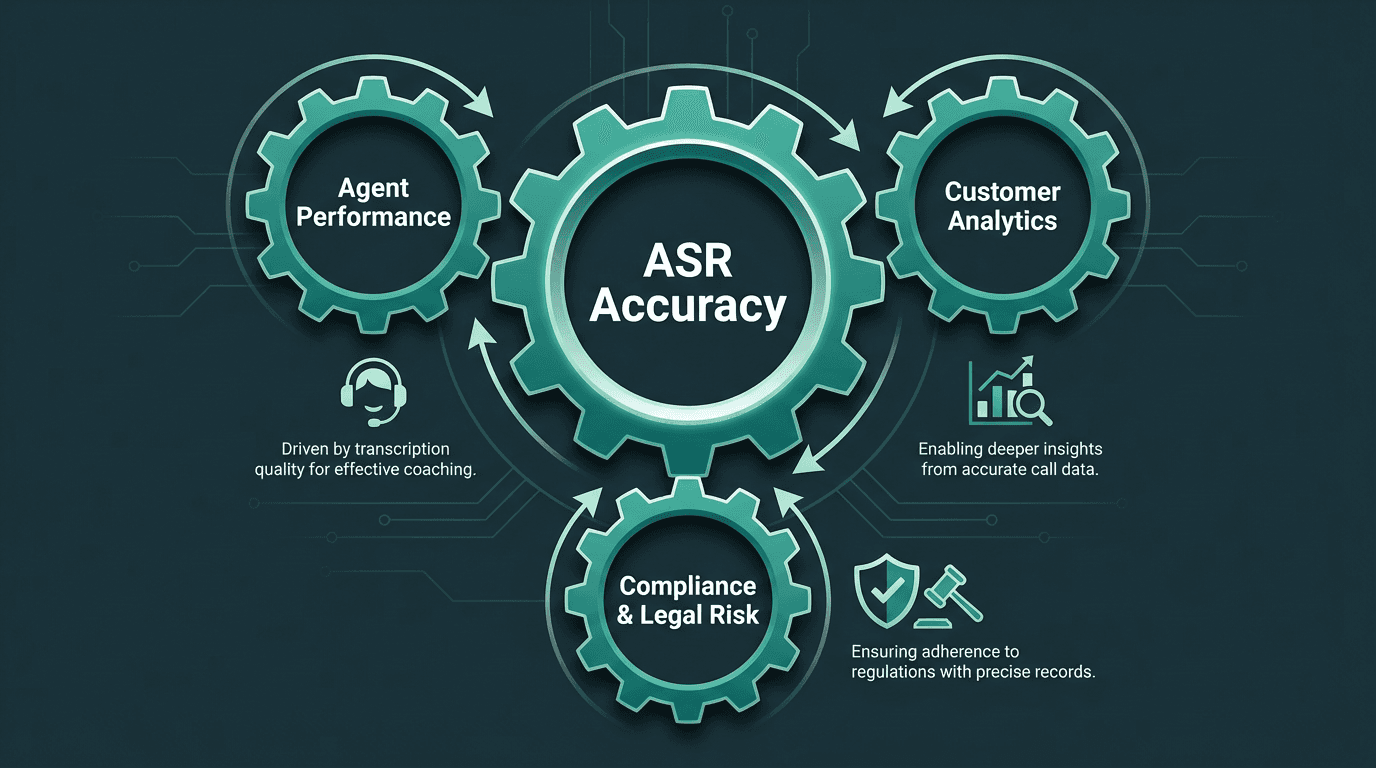
ASR accuracy is not an isolated metric; it's the engine for multiple critical call center operations.
How Automatic Speech Recognition Technology Works: From Sound Wave to Text
To understand what improves accuracy, we first need a clear picture of the transcription pipeline. It’s not a single monolithic block but a sequence of specialized components, each a potential point of failure or optimization. The process generally involves an acoustic model, a pronunciation model, and a language model working in concert.
Step 1: The Acoustic Model - Interpreting the Sound
The process begins with a raw audio signal, a waveform. The acoustic model’s job is to dissect this signal into its constituent phonetic parts. It takes small chunks of audio (typically 10-25 milliseconds) and converts them into a mathematical representation, often called features. It then maps these features to phonemes, the smallest units of sound in a language (like /k/, /æ/, and /t/ in ‘cat’). This model is trained on thousands of hours of audio paired with human-verified transcripts. Its performance is heavily dependent on the diversity of that training data: accents, pitches, and acoustic environments.
This is where the first major challenge arises. An acoustic model trained primarily on clean, studio-quality audio from a single demographic will struggle with the reality of a call center: low-bitrate VoIP codecs, background noise (other agents, keyboards, sirens), and a wide range of speaker accents.
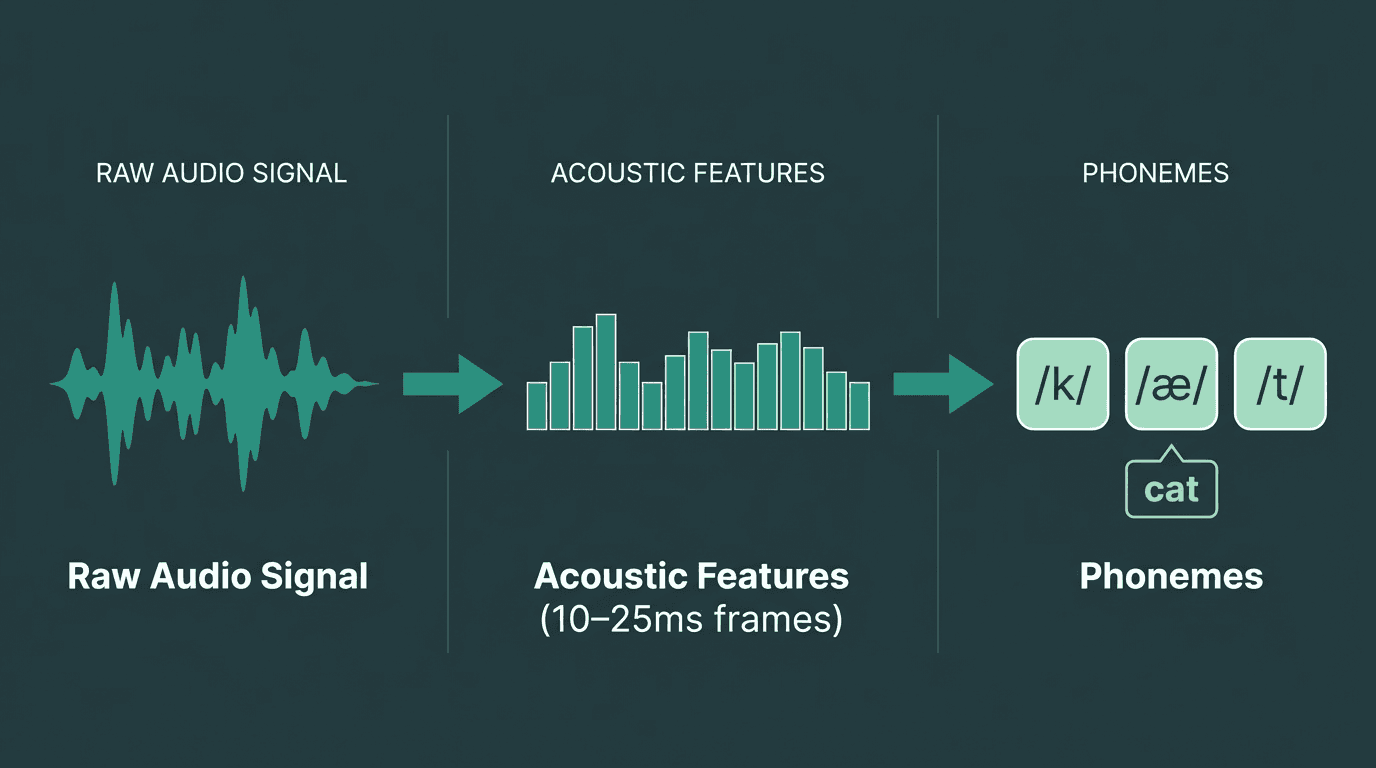
The acoustic model translates the raw physics of sound into the building blocks of language.
Step 2: The Pronunciation Model (Lexicon) - Connecting Sounds to Words
Once the acoustic model has produced a sequence of likely phonemes, the pronunciation model, or lexicon, takes over. This is essentially a massive dictionary that maps sequences of phonemes to actual words. For example, it knows that the sequence /kæt/ corresponds to the word “cat.”
The lexicon must also account for variations in pronunciation. The word “either” can be pronounced with a long ‘e’ or a long ‘i’. A robust lexicon contains these alternate pronunciations. This component is where domain-specific jargon becomes critical. If your call center deals with pharmaceutical products, your lexicon must include the correct phonetic spellings for drug names like “atorvastatin” or it will never be transcribed correctly, no matter how good the acoustic model is.
Step 3: The Language Model - Predicting the Next Word
The acoustic and pronunciation models can generate multiple possible word candidates for a given sound. The language model’s job is to determine the most probable sequence of words. It’s a statistical model that understands grammar, syntax, and the likelihood of words appearing together. It knows that “please cancel my account” is a far more probable phrase than “please cancel my amount,” even if the two sound similar.
Language models are trained on vast amounts of text data. A generic language model is trained on web-scale text, making it good at general conversation. For call center use, however, a generic model is insufficient. It needs to be fine-tuned on text that reflects the specific context: call transcripts, support documentation, and product manuals from that particular industry. This helps it understand that in a banking call center, the phrase “check balance” is more likely than “Czech balance.” This contextual understanding is a key part of improving speech-to-text accuracy.
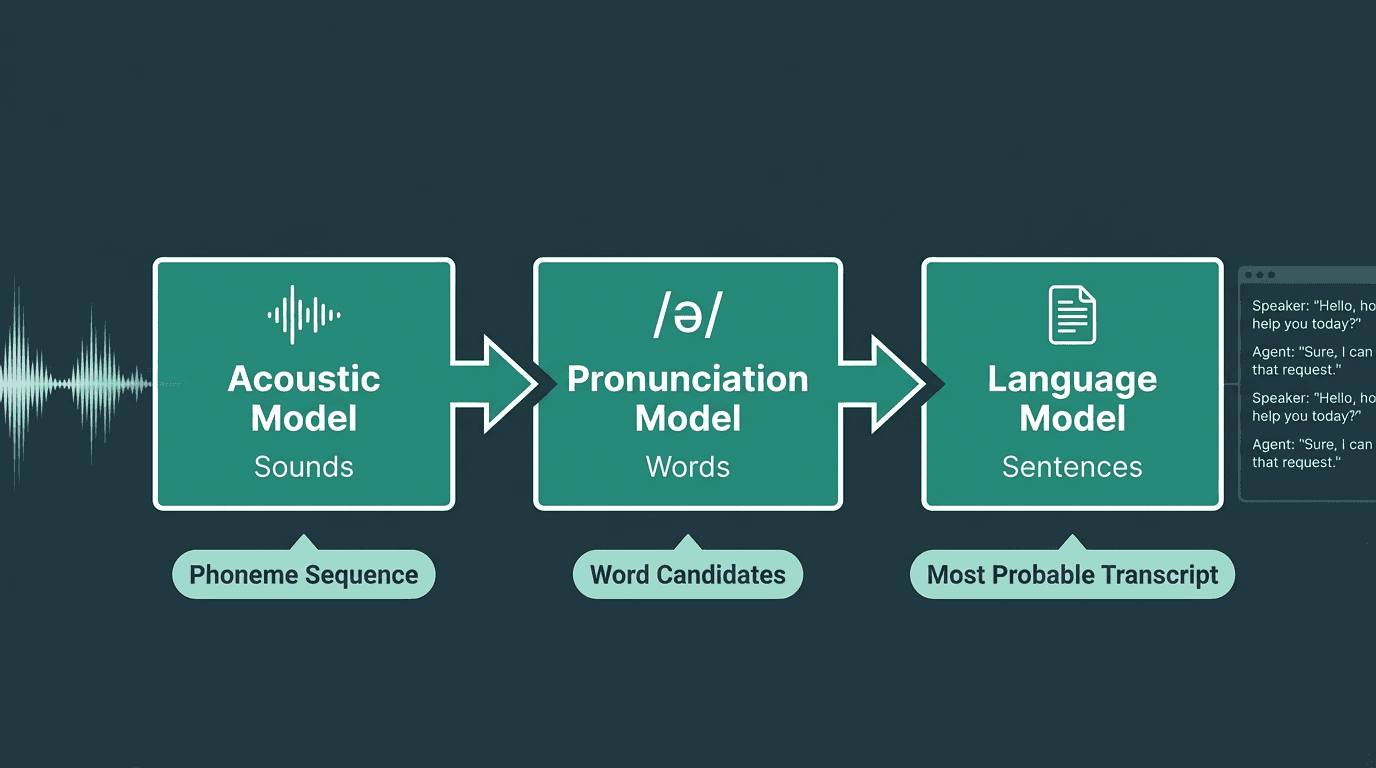
Each stage in the ASR pipeline refines the output, from raw sound to coherent text.
Explore our production-ready speech models built for real-world enterprise audio.
The Real-World Factors That Degrade ASR Accuracy
In our labs, we can achieve near-human transcription accuracy. But production environments are not labs. The gap between benchmark performance and real-world performance is where most ASR projects stumble. Understanding the specific sources of error is the first step to mitigating them.
1. Acoustic Environment: Noise and Channel Effects
This is the most obvious and impactful factor. ASR models are sensitive to any sound that isn’t the primary speaker’s voice. In a call center context, this includes:
Background Noise: Other agents talking, keyboards clicking, office announcements, and even noise from the customer’s end (traffic, television, dogs barking). A study cited by ResearchGate (2025) noted that word error rates can increase by over 40% in the presence of significant background noise.
Reverberation: Sound waves bouncing off hard surfaces in a room can cause echoes that smear the audio signal, making it difficult for the acoustic model to isolate phonemes.
Channel Distortion: The audio is not captured by a studio microphone. It’s compressed by a VoIP codec, transmitted over a variable-quality internet connection, and played through different headsets. Each step can introduce artifacts, dropouts, and frequency limitations that degrade the signal.
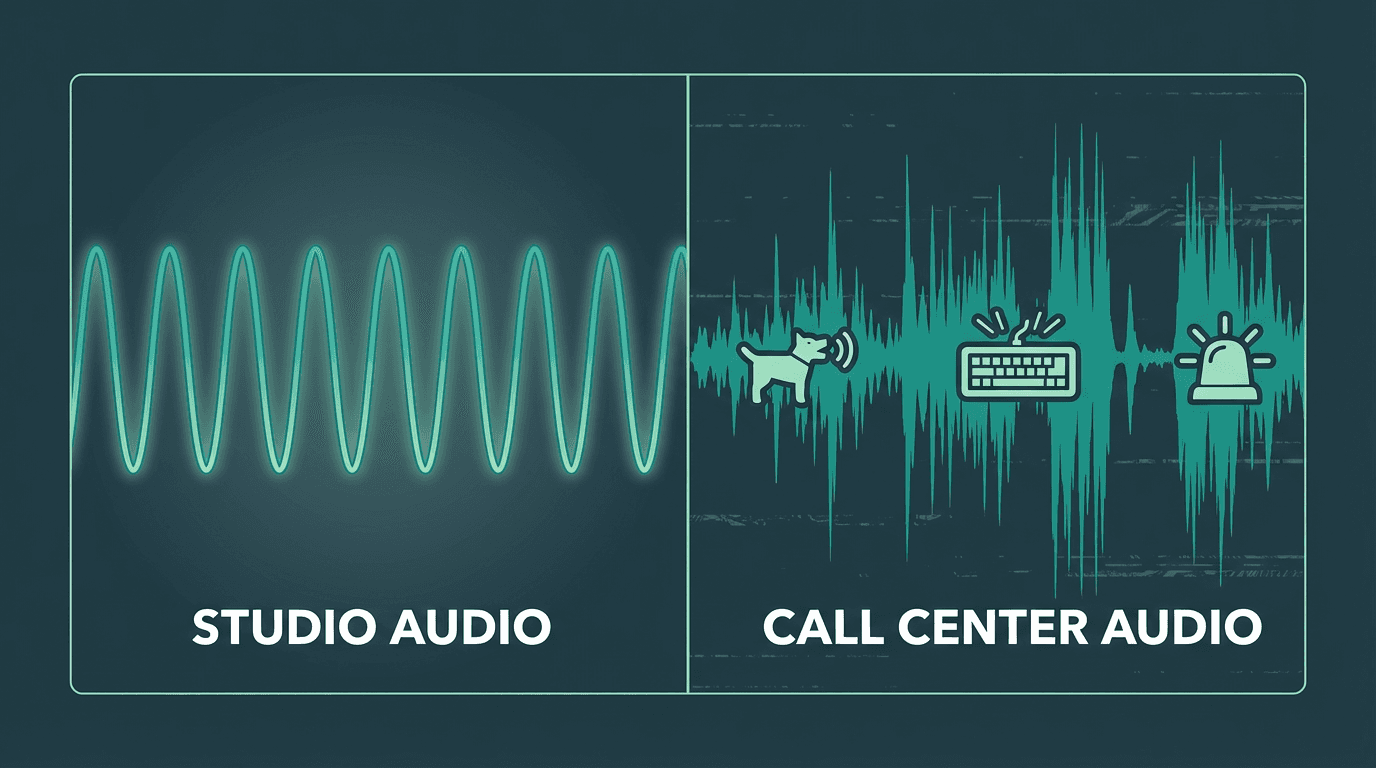
The acoustic gap between training data and production audio is a primary source of transcription errors.
2. Speaker Variability: Accents, Dialects, and Emotion
People don't speak like news anchors. An ASR system for a global call center must handle immense variability:
Accents and Dialects: Models trained predominantly on one accent will perform poorly on others. This is a well-documented problem. Research from Stanford University (2020) found that leading ASR systems from major tech companies had error rates nearly twice as high for Black speakers compared to white speakers, a direct result of imbalanced training data.
Speech Rate and Volume: People speak at different speeds and volumes, especially when they are frustrated or excited. An agitated customer speaking quickly and loudly presents a very different acoustic profile than a calm one.
Code-Switching: In many regions, it's common for speakers to mix languages within a single conversation (e.g., English and Spanish). Most ASR systems are trained for a single language and fail completely when this happens.
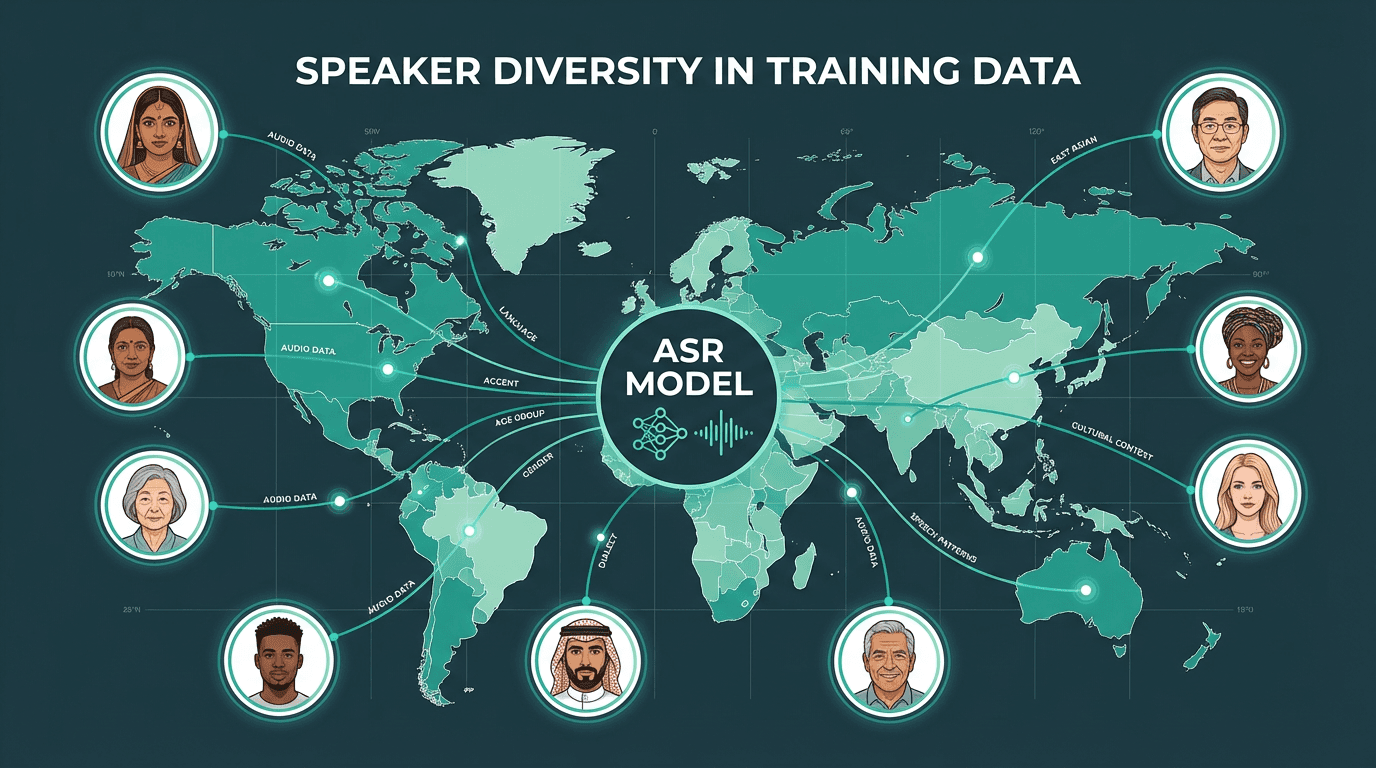
Speaker diversity in training data isn't a feature; it's a prerequisite for accuracy.
3. Linguistic Content: Jargon, Entities, and Ambiguity
The words themselves present a significant challenge. A generic language model has no knowledge of your company’s specific terminology.
Domain-Specific Jargon: A financial services call center will use terms like “amortization,” “escrow,” and “subprime.” A healthcare provider will discuss “co-pays,” “deductibles,” and specific medical conditions. These words are rare in general language and will be consistently mis-transcribed without specific model training.
Proper Nouns: Product names, competitor names, and people’s names (especially non-Anglicized ones) are a major source of errors. The system might hear a unique product name like “ChronoSync” and transcribe it as the more common phrase “chrono sink.”
Homophones: Words that sound the same but have different meanings and spellings (e.g., “their,” “there,” “they’re”) can only be disambiguated by the language model's understanding of context. A weak language model will frequently make these errors.
Proven Techniques to Improve ASR Accuracy in Call Centers
Improving accuracy isn't about finding one magic bullet. It’s a systematic process of addressing the specific failure points in the ASR pipeline. We’ve found that a multi-pronged approach yields the best results. Here’s what has worked for us and our customers.
Technique 1: Domain Adaptation and Model Fine-Tuning
This is the single most effective strategy. Instead of using a generic, one-size-fits-all model, you adapt it to your specific acoustic and linguistic environment. This involves two key processes:
Acoustic Model Adaptation:
Collect Representative Audio: Gather audio samples that match your production environment. This means using the same VoIP codecs, headsets, and capturing audio from your actual call center floors, complete with background noise.
Fine-Tuning: Use this collected audio to continue training the base acoustic model. This process adjusts the model’s internal parameters to become more attuned to the specific acoustic characteristics of your calls. It learns to distinguish speech from your particular type of background noise.
Language Model Adaptation:
Compile a Domain Corpus: Create a large text file containing domain-specific language. This should include product names, industry jargon, agent scripts, help center articles, and even transcripts of past calls.
Fine-Tuning: Train the base language model on this corpus. This teaches the model the relationships between your specific terms, making it much more likely to transcribe “adjust my premium” correctly in an insurance context.
The impact is significant. We’ve seen relative WER reductions of 15-30% from domain adaptation alone. It directly addresses the jargon and noise problems that plague generic models.
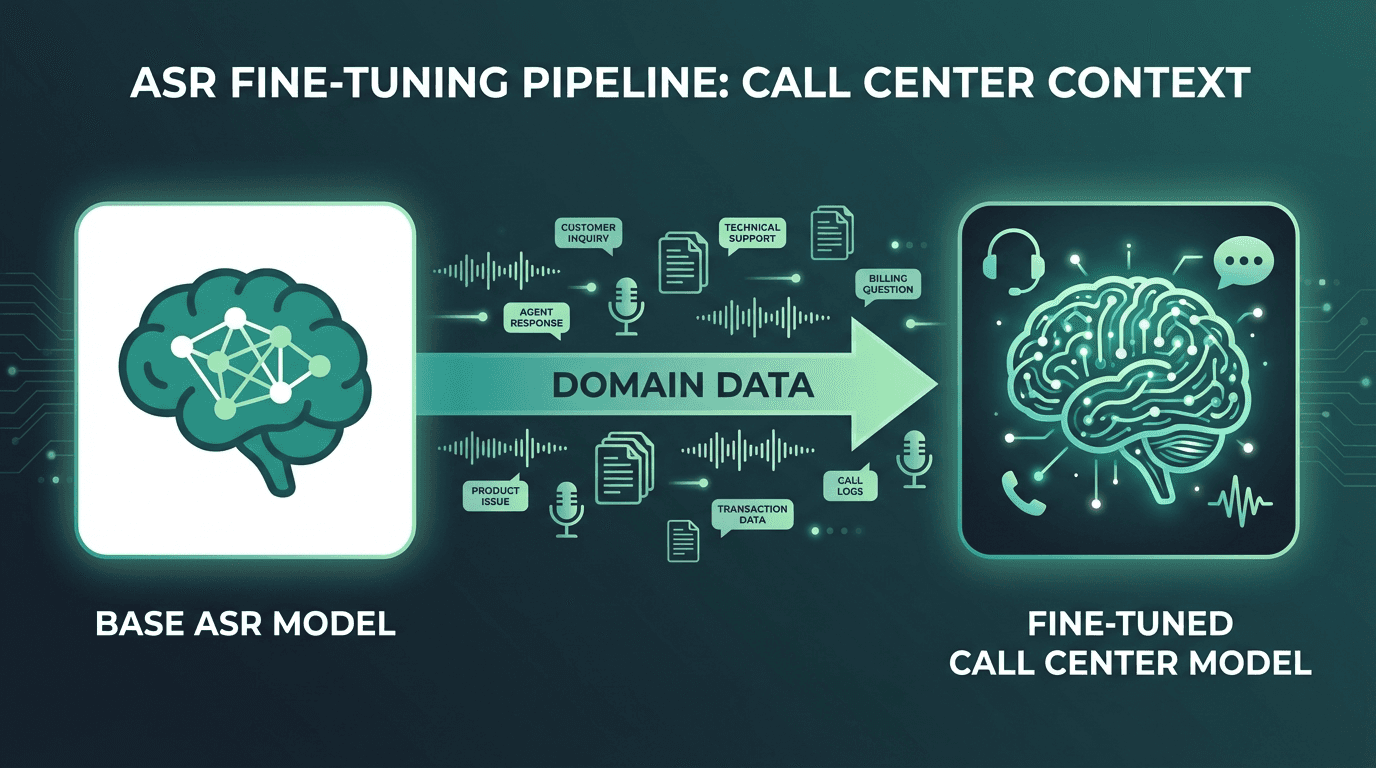
Without domain context, an ASR system will consistently fail on the most important keywords in a conversation.
Technique 2: Phrase Hinting and Custom Vocabularies
Sometimes, you don't need to retrain the entire model. For quickly adding new, uncommon words like product names or competitor names, you can use a feature often called ‘phrase hinting’ or ‘custom vocabulary’. You provide the ASR system with a list of specific words and phrases you expect to hear. As documented by Google Cloud (2019), providing these contextual hints can significantly boost the recognition accuracy for those specific terms.
Here’s what we learned: This is not a replacement for language model adaptation, but a powerful supplement. It works best for words that are acoustically distinct and have a low probability of being confused with common words. It’s highly effective for:
New Product Launches: Adding a new product name like “AquaGuard 5000” to a custom vocabulary list before launch ensures it’s transcribed correctly from day one.
Proper Nouns: A list of key executive names, partner companies, or specific location names.
Technical Acronyms: For example, ensuring “SLA” (Service Level Agreement) is transcribed correctly instead of “es el ay.”
This failed-here’s why: Early on, we saw teams try to use phrase hinting as a crutch for a poor base model. They would upload thousands of words, hoping to fix everything. This backfired. Overloading the system with too many hints, especially for common words, can actually decrease overall accuracy by creating ambiguity. The key is to use it surgically for high-value, low-frequency terms.
Technique 3: Diarization and Speaker Separation
A raw transcript that mixes agent and customer speech into a single block of text is of limited use. Speaker diarization is the process of segmenting the audio and identifying who spoke when (e.g., “Speaker 1,” “Speaker 2”). This is essential for any downstream analysis. For instance, you can’t measure agent script adherence if you don’t know which lines were spoken by the agent.
Accuracy here is critical. If the diarization is wrong, you might attribute a customer’s complaint to an agent, completely inverting the meaning of the conversation for an analytics engine. Modern systems achieve this by creating a unique voice “fingerprint” for each speaker in the call and then labeling audio segments accordingly. For call centers, this can be enhanced by using channel information. Since the agent and customer are on separate audio channels (in a stereo recording), the system can use this to achieve near-perfect separation, which is a significant advantage of two-channel audio.
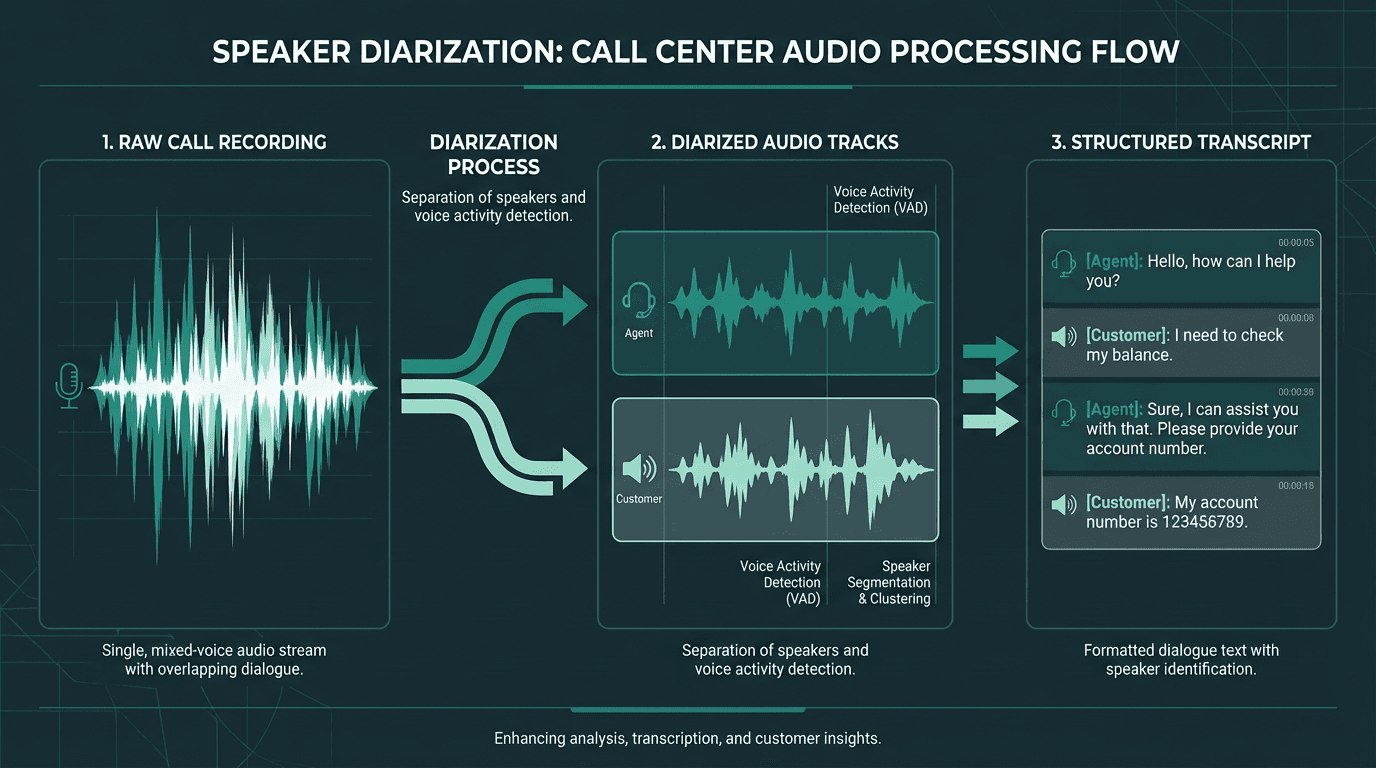
Accurate diarization is crucial for understanding the conversational dynamics of a call.
Technique 4: Upstream Audio Quality Improvements
This is often overlooked. You can have the world’s best ASR model, but it can’t transcribe what it can’t hear. Improving the quality of the audio signal before it ever reaches the ASR engine is a high-leverage investment.
High-Quality Headsets: Invest in noise-canceling headsets for agents. This single change can dramatically reduce the amount of background noise (keyboards, other agents) in the agent’s audio channel, leading to a cleaner signal.
Use Stereo Recording: Whenever possible, record calls in stereo, with the agent on one channel and the customer on the other. This makes speaker separation trivial and allows the ASR model to process each speaker’s audio independently, without interference from the other.
Codec Selection: If you have control over your VoIP infrastructure, choose a codec that prioritizes audio quality over extreme compression, such as Opus over G.729. Higher fidelity audio contains more information for the acoustic model to work with.
Learn how AI voice agents can transform your contact center operations.
Common Misconceptions About ASR Accuracy
We often see teams approach ASR with expectations shaped by consumer assistants. The call center environment is fundamentally different, which leads to a few persistent misconceptions.
Misconception 1: “A 95% accuracy rate means it gets 19 out of 20 words right.” This is technically true, but misleading. The 5% of errors are not randomly distributed. They tend to cluster on the most important words: proper nouns, technical jargon, and keywords that signify intent. The model might perfectly transcribe all the filler words but fail on the one product name that was the entire reason for the call. The business impact of the errors is far greater than their percentage suggests.
Misconception 2: “More training data is always better.” More high-quality, relevant data is better. Simply dumping terabytes of generic audio into a model can actually harm its performance on your specific task, a phenomenon known as catastrophic forgetting. The data must be clean, correctly transcribed, and representative of the target domain. A smaller dataset of 100 hours of your own call center audio is more valuable than 10,000 hours of random YouTube videos.
Misconception 3: “We can fix the errors with post-processing rules.” Some teams try to use simple find-and-replace logic to correct common ASR errors (e.g., always change “chrono sink” to “ChronoSync”). This is a brittle, unscalable solution. It fails as soon as context matters (what if they were actually talking about a sink?) and creates a massive maintenance burden as your language and products evolve. It’s a band-aid on a problem that needs to be solved at the model level.
Putting It All Together: A Practical Approach
Achieving high-accuracy automatic speech recognition in a real-world call center is not a one-time setup. It's an iterative process of measurement, analysis, and refinement. The goal is to create a tight feedback loop.
Our recommended workflow:
1. Benchmark: Start by running a baseline test. Transcribe a representative set of 50-100 of your calls with a generic ASR model and manually calculate the Word Error Rate (WER).
2. Analyze Errors: Don't just look at the overall WER. Categorize the errors. Are they mostly jargon? Proper nouns? Caused by background noise on the customer's side? This analysis tells you where to focus your efforts.
3. Implement and Test: Based on your analysis, apply the most relevant techniques. If jargon is the main issue, start with language model adaptation. If it's new product names, implement phrase hinting. Measure the WER again on a new set of calls to validate the improvement.
4. Automate and Monitor: Once deployed, this process shouldn't stop. Continuously sample production calls and have human reviewers check transcripts. Feed these corrections back into your model for continuous fine-tuning. This loop ensures your model adapts as your business, products, and customers evolve.
This data-driven approach moves you from guessing what might work to systematically improving your system's performance. It’s the difference between treating ASR as a black box and engineering it as a reliable component of your infrastructure for call center automation and real-time speech analytics.
Frequently asked questions
What is a good Word Error Rate (WER) for a call center?
How much audio data do I need to fine-tune an ASR model?
Can ASR handle multiple languages in the same call?
How does real-time ASR differ from batch transcription?
Is it better to build our own ASR model or use a third-party API?