What is Call Center Quality Monitoring? Use Cases and Benefits

Learn what call center quality monitoring is, why it matters, and where it delivers value across compliance, performance, and customer experience. Read more.
Every call shapes how a customer views your business. A missed disclosure, an incomplete answer, or an unclear resolution can quickly turn a routine interaction into a costly follow-up or escalation. At scale, those small gaps compound.
That is why teams evaluating call center quality monitoring are usually asking a practical question: how do we consistently verify call quality, compliance, and agent performance when volume keeps growing? The stakes are high. Research shows that 87% of customers stop doing business with a company after a poor service experience, making conversation quality a direct driver of retention and revenue.
Effective call center quality monitoring gives contact centers a way to spot risks early, correct agent behavior, and maintain consistent standards across every interaction.
In this guide, we break down what call center quality monitoring involves, where it delivers the most value, how Voice AI changes the process, and how to build a program that holds up in modern contact center operations.
Key Takeaways
Quality Monitoring Is Structured, Not Subjective: Call center quality monitoring relies on defined scorecards, recordings, and repeatable criteria rather than manager opinion or ad-hoc reviews.
Compliance and Risk Control Are Central Use Cases: Quality monitoring validates disclosures, consent, and policy adherence, helping regulated contact centers reduce audit risk and legal exposure.
Voice AI Expands Coverage to Every Call: Voice AI allows full call coverage, real-time analysis, and consistent scoring without relying on limited manual sampling.
Quality Data Drives Coaching and Training Outcomes: Quality scores link directly to targeted coaching, training evaluation, and faster agent readiness across teams.
Scalable Systems Require Security and Integration: Effective quality monitoring systems support high call volumes, secure deployments, and integration with existing telephony and CRM tools.
What Is Call Center Quality Monitoring?
Call center quality monitoring refers to the structured process of reviewing, measuring, and scoring customer interactions to verify agent performance, compliance adherence, and overall contact center quality across voice and digital channels. It relies on defined evaluation criteria, recorded conversations, and repeatable scoring models rather than subjective feedback.
Key Components of Call Center Quality Monitoring
Effective call center quality monitoring relies on several core components that work together to evaluate every interaction consistently.
Interaction Evaluation Framework: Uses predefined scorecards to assess call handling, script adherence, tone, resolution accuracy, and closing practices across monitored interactions.
Compliance and Policy Verification: Reviews calls against regulatory, legal, and internal policy requirements, which matter for industries such as BFSI, healthcare, and debt collection.
Agent Performance Measurement: Tracks consistency, accuracy, and communication behavior at an agent level to identify skill gaps, coaching needs, and repeat errors.
Call Center Monitoring System: Captures and stores call recordings, transcriptions, metadata, and quality scores across inbound and outbound interactions.
Quality Monitoring Call Center Analytics: Aggregates scores to highlight trends such as repeated compliance misses, low-resolution quality, or customer dissatisfaction drivers.
Transcription Accuracy and Speech Intelligence Layer: Converts call audio into high-fidelity transcripts that reliably capture accents, numbers, regulated language, and speaker turns, forming the foundation for quality scoring, compliance validation, and behavioral analysis at scale.
Call center quality monitoring serves as the operational foundation for maintaining contact center quality, reducing risk exposure, and creating measurable standards across every monitored interaction.
Why Call Center Quality Monitoring Matters for Modern Contact Centers
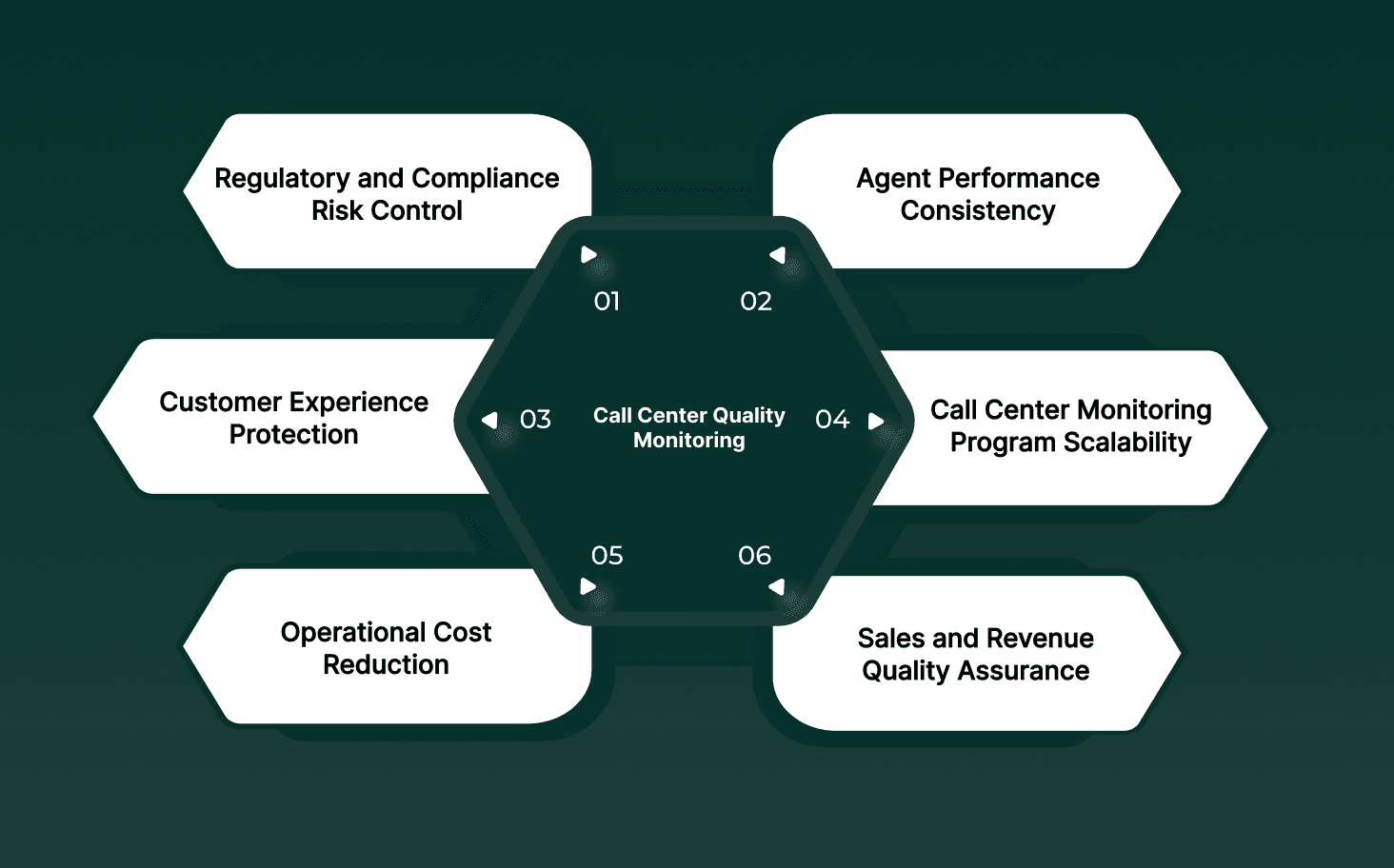
Call center quality monitoring plays a direct role in protecting revenue, meeting regulatory requirements, and maintaining consistent customer experiences as contact centers scale across channels, regions, and agent teams. With rising call volumes and stricter compliance expectations, informal reviews or random audits fail to surface real performance risks.
Regulatory and Compliance Risk Control: Monitors disclosures, consent capture, KYC scripts, and call handling rules for industries such as BFSI, healthcare, and collections, where a single violation can trigger penalties or audits.
Agent Performance Consistency: Identifies deviations in call flow, objection handling, escalation logic, and resolution accuracy across agents, shifts, and locations.
Customer Experience Protection: Surfaces repeat friction points such as long hold explanations, incorrect information, or poor empathy indicators that directly impact contact center quality scores.
Call Center Monitoring Program Scalability: Allows teams to move from reviewing small call samples to monitoring every interaction using structured frameworks and automated analysis.
Operational Cost Reduction: Reduces repeat calls, escalations, and rework by detecting quality gaps early and directing targeted coaching rather than broad retraining.
Sales and Revenue Quality Assurance: Verifies qualification accuracy, upsell disclosures, and closing practices to prevent mis-selling and downstream churn.
Transcription Accuracy as a Quality Control Layer: High-accuracy transcripts enable reliable detection of compliance gaps, incorrect information, and behavioral issues across every call, preventing false signals and hidden risk at scale.
Strong call center quality monitoring turns raw conversations into measurable performance signals that support compliant growth, predictable service outcomes, and sustained contact center quality at scale.
If you’re planning future upgrades to your customer operations, explore the Top 10 Contact Center Automation Trends for 2025.
Best Use Cases of Call Center Quality Monitoring
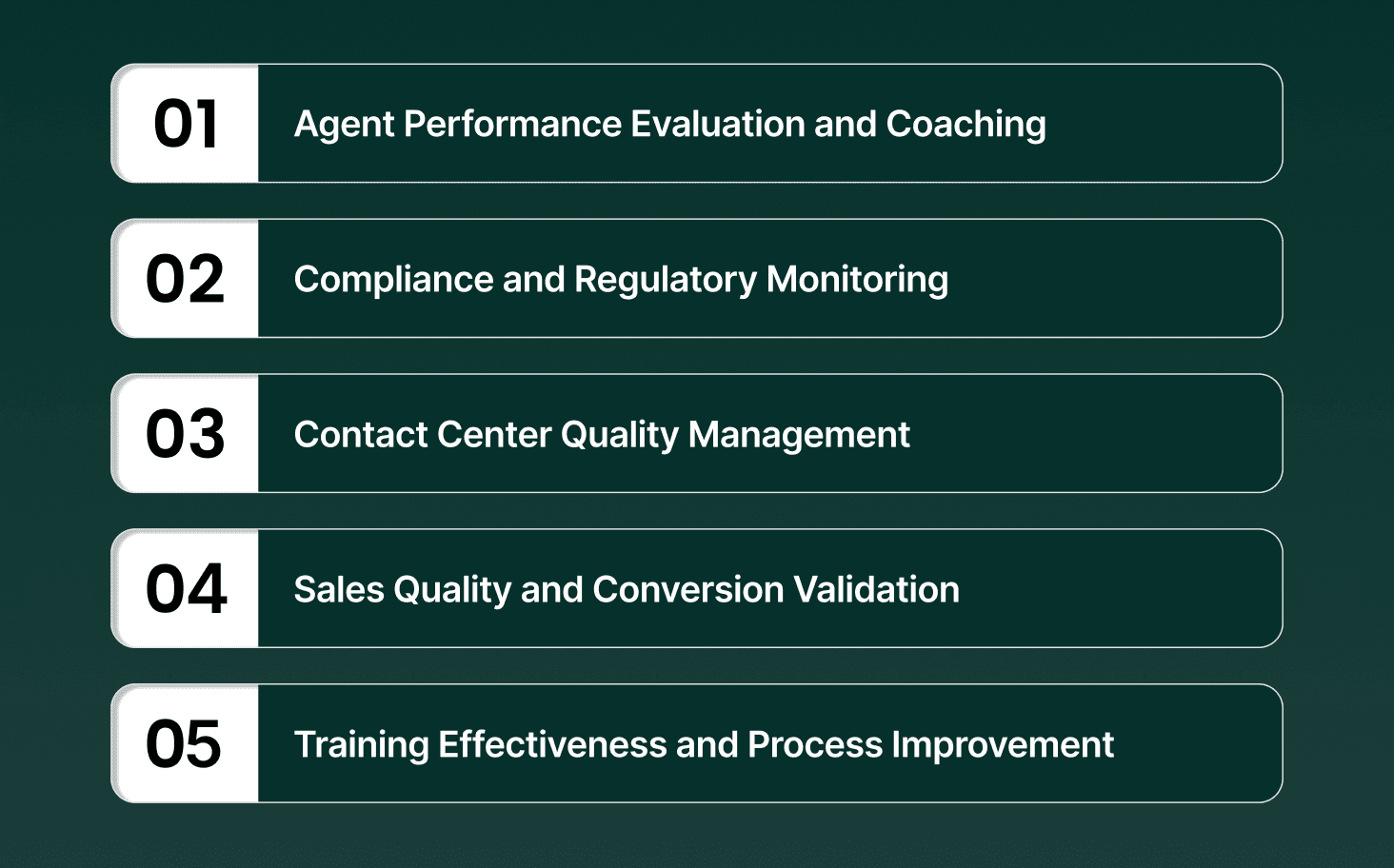
Call center quality monitoring applies across operational, compliance, and revenue-focused workflows, helping teams evaluate real interactions and correct issues that affect contact center quality at scale. These use cases focus on measurable outcomes tied directly to calls, agents, and customer results.
1. Agent Performance Evaluation and Coaching
Quality monitoring identifies how agents handle conversations in real scenarios, based on defined scoring criteria rather than manager judgment or isolated feedback.
Skill Gap Identification: Detects gaps in product knowledge, objection handling, call control, or empathy using scored call reviews.
Targeted Coaching Programs: Links quality scores to specific coaching actions such as script corrections or communication training.
Performance Benchmarking: Compares agent behavior against team or role-based standards within a call center monitoring system.
Consistency Across Teams: Maintains uniform service quality across shifts, geographies, and outsourced teams.
2. Compliance and Regulatory Monitoring
Quality monitoring call center programs help organizations verify adherence to industry rules, internal policies, and legal obligations.
Disclosure Verification: Confirms that required statements, consent language, and disclosures are delivered accurately during each call.
Audit Readiness: Stores call recordings, transcripts, and scoring history for internal and external compliance reviews.
Violation Detection: Flags missed disclosures, incorrect claims, or restricted language in regulated environments such as BFSI and healthcare.
Risk Reduction: Reduces exposure to fines, disputes, and legal escalation through early detection.
3. Customer Experience and Contact Center Quality Management
Call center quality monitoring systems surface interaction-level issues that customer surveys or NPS data often miss.
Friction Point Detection: Identifies where customers express confusion, frustration, or dissatisfaction during calls.
Resolution Accuracy Tracking: Verifies whether agents provide correct and complete solutions on the first interaction.
Tone and Behavior Analysis: Reviews agent communication style, clarity, and responsiveness during live conversations.
Experience Standardization: Applies quality benchmarks evenly across inbound and outbound interactions.
4. Sales Quality and Conversion Validation
Quality monitoring supports revenue teams by validating the quality of conversations, not only conversion outcomes.
Lead Qualification Review: Confirms that agents follow qualification criteria and avoid overpromising.
Pitch and Offer Accuracy: Checks accuracy of pricing, product details, and eligibility messaging.
Mis-Sell Prevention: Detects misleading statements that could lead to churn, disputes, or refunds.
Revenue Attribution Clarity: Connects quality scores to sales outcomes within the call center monitoring program.
5. Training Effectiveness and Process Improvement
Quality monitoring provides direct feedback on whether training and process updates are reflected in real calls.
Training Outcome Measurement: Evaluates post-training performance through quality score trends.
Process Validation: Confirms whether new scripts, workflows, or policy changes are correctly followed by agents.
Continuous Improvement Signals: Uses recurring quality issues to guide updates in scripts or onboarding material.
Time-to-Competency Tracking: Measures how quickly new agents meet quality benchmarks.
6. Transcription Accuracy Validation and QA Signal Reliability
High-quality transcription is foundational to every quality monitoring outcome. This use case focuses on verifying that transcripts are accurate, consistent, and reliable enough to support compliance and performance decisions at scale.
Transcript Integrity Monitoring: Validates speech-to-text accuracy across accents, fast speech, overlapping dialogue, and background noise to reduce QA blind spots.
False Flag Reduction: Prevents incorrect compliance or quality alerts caused by transcription errors rather than agent behavior.
Audit-Grade Transcripts: Produces transcripts suitable for internal reviews and regulatory audits without manual correction.
Numeric and Identifier Accuracy Checks: Confirms correct transcription of phone numbers, account references, monetary values, and regulated language used in quality scoring.
7. Behavioral and Paralinguistic Signal Analysis from Transcripts
Modern quality monitoring extends beyond words to how conversations unfold. Transcription enriched with behavioral signals allows teams to detect risks and opportunities that traditional QA reviews miss.
Emotion and Stress Detection: Identifies frustration, anger, confusion, or escalation patterns directly from speech signals linked to transcript segments.
Speaker Attribute Classification: Extracts speaker gender and age range to support demographic-aware quality analysis at scale.
Conversation Dynamics Analysis: Detects interruptions, talk-time imbalance, and pacing issues that affect resolution quality.
Early Risk Identification: Surfaces behavioral warning signs before they result in complaints, escalations, or churn.
Across these use cases, call center quality monitoring systems convert everyday conversations into structured performance data that supports compliance, agent development, and consistent contact center quality.
Smallest.ai is already deployed in enterprise contact center environments, processing high-concurrency call streams to extract transcription-level and paralinguistic signals including speaker gender classification, age range estimation, emotion detection, and behavioral indicators in real time. Get a demo of Smallest.ai today.
How Voice AI and Transcriptions Transforms Call Center Quality Monitoring
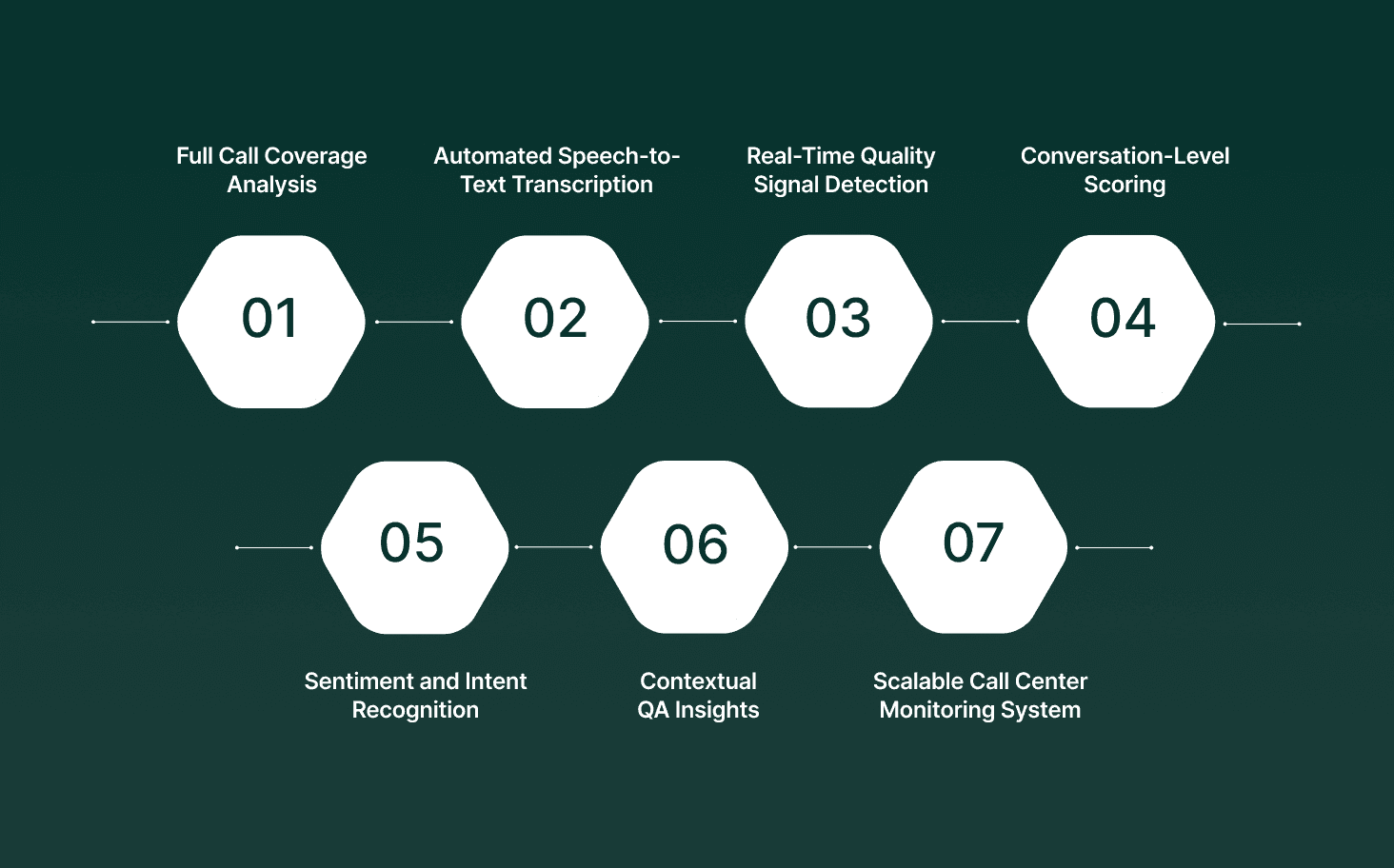
Voice AI changes call center quality monitoring by shifting coverage from manual sampling to continuous, interaction-level analysis across 100% of calls. Instead of relying on post-call reviews by QA teams, Voice AI processes live or recorded audio, converts speech to text, and evaluates conversations against predefined quality, compliance, and performance criteria.
Full-Coverage Transcription Across 100 Percent of Calls: Voice AI transcribes every inbound and outbound call, removing blind spots created by random QA sampling and allowing quality monitoring programs to operate on complete interaction data.
Enterprise-Grade Automated Speech-to-Text Accuracy: Advanced transcription handles accents, fast speech, interruptions, and background noise, producing clean transcripts that can be trusted for compliance checks, scoring, and audits.
Real-Time and Post-Call Signal Extraction: Transcripts are analyzed during or immediately after calls to surface missed disclosures, incorrect responses, or deviations from approved call flows.
Precision Handling of Numbers and Regulated Language: Voice AI accurately captures phone numbers, account references, monetary values, and required disclosures, which is critical for regulated contact centers where transcription errors create false risk signals.
Conversation-Level Quality Scoring: Quality rules are applied directly to transcript segments rather than evaluator interpretation, reducing inconsistency across agents, teams, and reviewers.
Segment-Linked QA Review and Coaching: Quality flags map back to exact moments in the transcript, allowing faster reviews and precise coaching without replaying entire calls.
Scalable Monitoring Without QA Headcount Growth: High-accuracy transcription supports large call volumes and concurrency, allowing quality monitoring systems to scale without adding manual reviewers.
Voice AI transforms call center quality monitoring into a data-driven, scalable practice that improves coverage, accuracy, and response time across every monitored interaction.
If you’re mapping out automation priorities for your contact center, start with The Ultimate Guide to Contact Center Automation.
How to Implement Call Center Quality Monitoring Step by Step
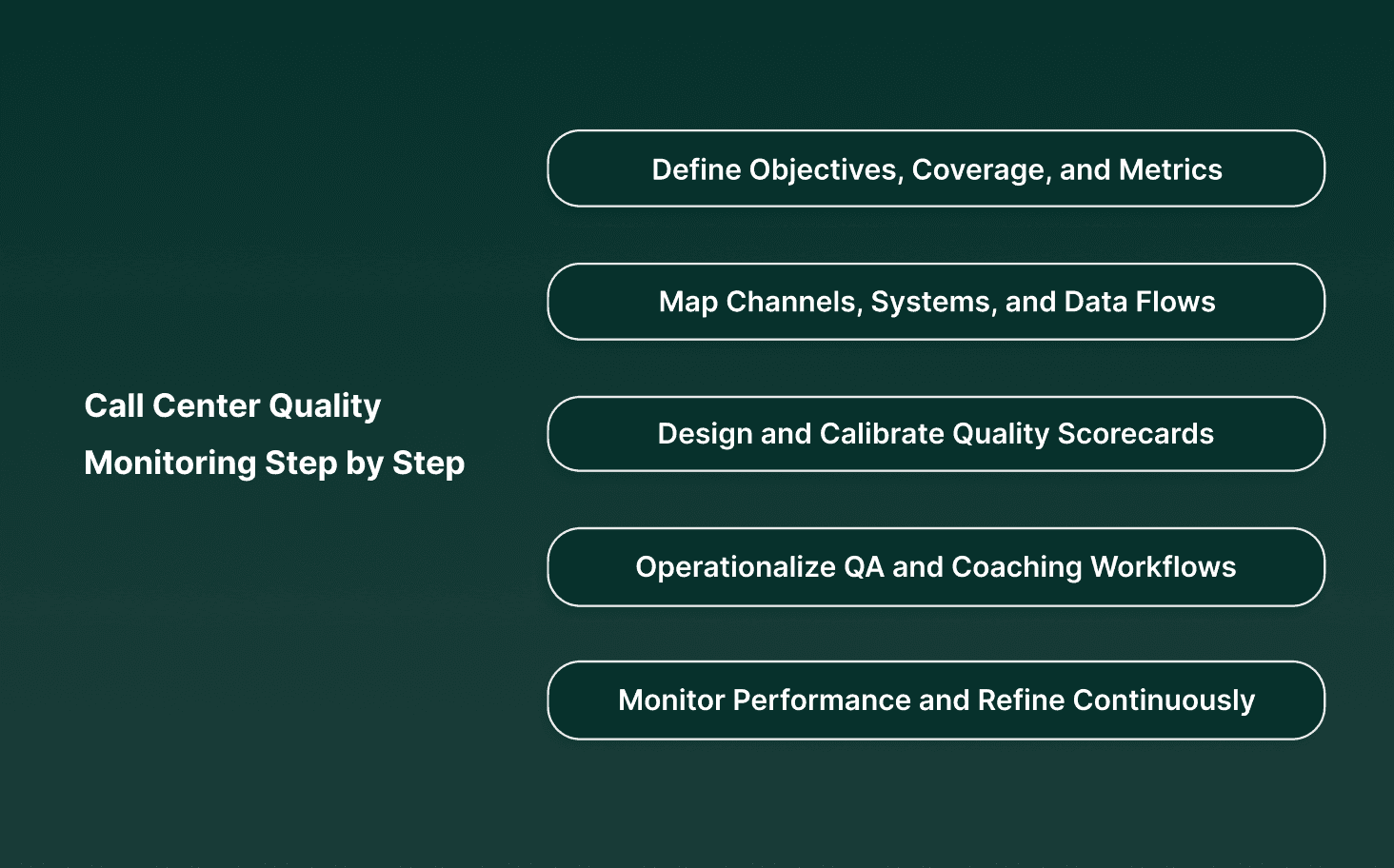
Call center quality monitoring is most effective when implementation focuses on a small number of tightly defined steps that connect measurement, compliance, and coaching.
Define Objectives, Coverage, and Metrics: Set clear goals for the call center quality monitoring program, decide which queues require full coverage versus sampling, and define metrics such as compliance accuracy, resolution quality, and sales correctness.
Map Channels, Systems, and Data Flows: Identify call sources, recording systems, CRM integrations, and Voice AI transcription inputs that feed the call center monitoring system.
Design and Calibrate Quality Scorecards: Create role- and call-type-specific scorecards, align scoring weights, and run calibration sessions across QA, supervisors, and compliance teams to maintain consistent contact center quality evaluation.
Operationalize QA and Coaching Workflows: Configure how calls move from recording to scoring to coaching, link quality results to agent KPIs, and assign clear ownership for review and dispute resolution.
Monitor Performance and Refine Continuously: Review quality data on a fixed cadence, adjust criteria as scripts or regulations change, and use trends to prevent repeat issues rather than reacting to isolated failures.
A focused implementation approach allows call center quality monitoring systems to scale without sacrificing accuracy, accountability, or contact center quality standards.
How Smallest.ai Improves Call Center Quality Monitoring with Voice AI and Transcriptions
Smallest.ai improves call center quality monitoring by treating transcription accuracy and speech intelligence as the primary control layer for QA, compliance, and performance analysis. Instead of relying on sampled reviews or post-hoc analysis, its Voice AI stack transcribes and interprets conversations in real time at enterprise scale, creating reliable quality signals from every call.
Industry-Leading Real-Time Transcription: Pulse STT delivers sub-70 ms time to first transcript with low word error rates across 30+ languages and global accents, enabling dependable quality scoring on live and recorded calls.
Precise Capture of Regulated and Numeric Speech: Accurately transcribes disclosures, phone numbers, account references, and monetary values, reducing false compliance flags in regulated contact centers.
Real-Time Speech Intelligence Powered by Hydra: Hydra’s full-duplex architecture preserves emotion and intent during live conversations, enabling detection of sentiment shifts, escalation risk, and behavioral signals as calls unfold.
Full Call Coverage at Enterprise Scale: Supports thousands of concurrent calls without latency or accuracy degradation, enabling quality monitoring across 100 percent of interactions.
Secure, Flexible Deployment Options: Available in on-premise and secure cloud deployments aligned with SOC 2 Type II, HIPAA, PCI, and ISO standards.
By combining real-time Voice AI performance, scalable call handling, and strict data security controls,Smallest.ai allows call center quality monitoring systems to operate with higher accuracy, broader coverage, and stronger compliance control at enterprise scale.
Final Thoughts!
As contact centers grow in size and complexity, quality gaps rarely appear as single failures. They build quietly across hundreds of everyday interactions, often remaining invisible until costs rise, complaints increase, or audits surface issues late. Addressing those risks requires systems that keep pace with real call volumes and evolving customer expectations.
Well-structured call center quality monitoring supports that shift by turning conversations into actionable signals rather than after-the-fact reviews. When applied consistently, call center quality monitoring creates clarity across performance, compliance, and customer outcomes without slowing operations or relying on guesswork.
This is where purpose-built platforms for real-time Voice AI matter. With Pulse STT delivering sub-70 ms, low-WER transcription across global accents and Hydra enabling full-duplex, emotion-preserving speech intelligence, Smallest.ai allows contact centers to move from sampled oversight to full interaction coverage in regulated, high-volume environments.
Explore how Smallest.ai can support scalable, real-time quality monitoring across every call. Request a demo today.
FAQs About Call Center Quality Monitoring
1. How does call center quality monitoring differ from a standard call center monitoring system?
Call center quality monitoring focuses on scoring, compliance validation, and agent behavior, while a call center monitoring system primarily handles call recording, storage, and retrieval without structured quality evaluation.
2. Can contact center quality monitoring be applied to outbound and blended call programs?
Yes, contact center quality monitoring supports outbound sales, collections, and blended queues by applying call-type–specific scorecards and compliance checks across different interaction flows.
3. What determines the effectiveness of a call center monitoring program at scale?
Effectiveness depends on full call coverage, consistent scorecards, calibrated evaluations, and the ability to analyze conversations using automated methods rather than limited manual sampling.
4. How do call center quality monitoring systems handle regulatory variation across regions?
Call center quality monitoring systems apply separate evaluation rules, disclosures, and consent checks based on geography, helping make sure that contact center quality remains compliant across regions.
5. Does quality monitoring call center data influence customer retention outcomes?
Yes, quality monitoring call center insights identify incorrect resolutions, repeated misinformation, and poor communication patterns that often lead to churn, disputes, or repeat contacts.