The Ultimate Guide to Real-Time Speech Analytics

Unlock enhanced customer experiences and business efficiency with real time speech analytics insights. Explore AI-powered solutions now.
Every call your business handles is full of insights, yet most of them get lost after the conversation ends. Relying on manual reviews or scattered notes means missed trends, delayed problem-solving, and overlooked customer sentiment. This is why real time speech analytics is becoming a critical tool for modern enterprises.
For decision-makers, the goal isn’t just adopting technology; it’s about improving response speed, ensuring compliance, and keeping customers satisfied in every interaction. With the global speech analytics market expected to hit USD 7.3 billion by 2029, it’s clear that turning voice data into immediate, actionable insights is no longer optional.
In this guide, you’ll discover how real time speech analytics works, the value it brings to your organization, and how teams can use it to act instantly on customer interactions, enhance operational efficiency, and maintain high standards of service and compliance.
Key Takeaways
Instant insights enhance the customer experience: Detect emotions and address issues immediately to improve satisfaction.
AI-guided agents improve performance: Real-time prompts and feedback help agents resolve queries efficiently.
Compliance is automated and auditable: Monitoring scripts and regulations reduce risk and ensure traceable records.
Scalable platforms handle enterprise needs: Cloud-based RTSA supports thousands of simultaneous calls globally.
Actionable analytics drive outcomes: Alerts, dashboards, and AI actions turn conversations into measurable business improvements.
What is Real-Time Speech Analytics?
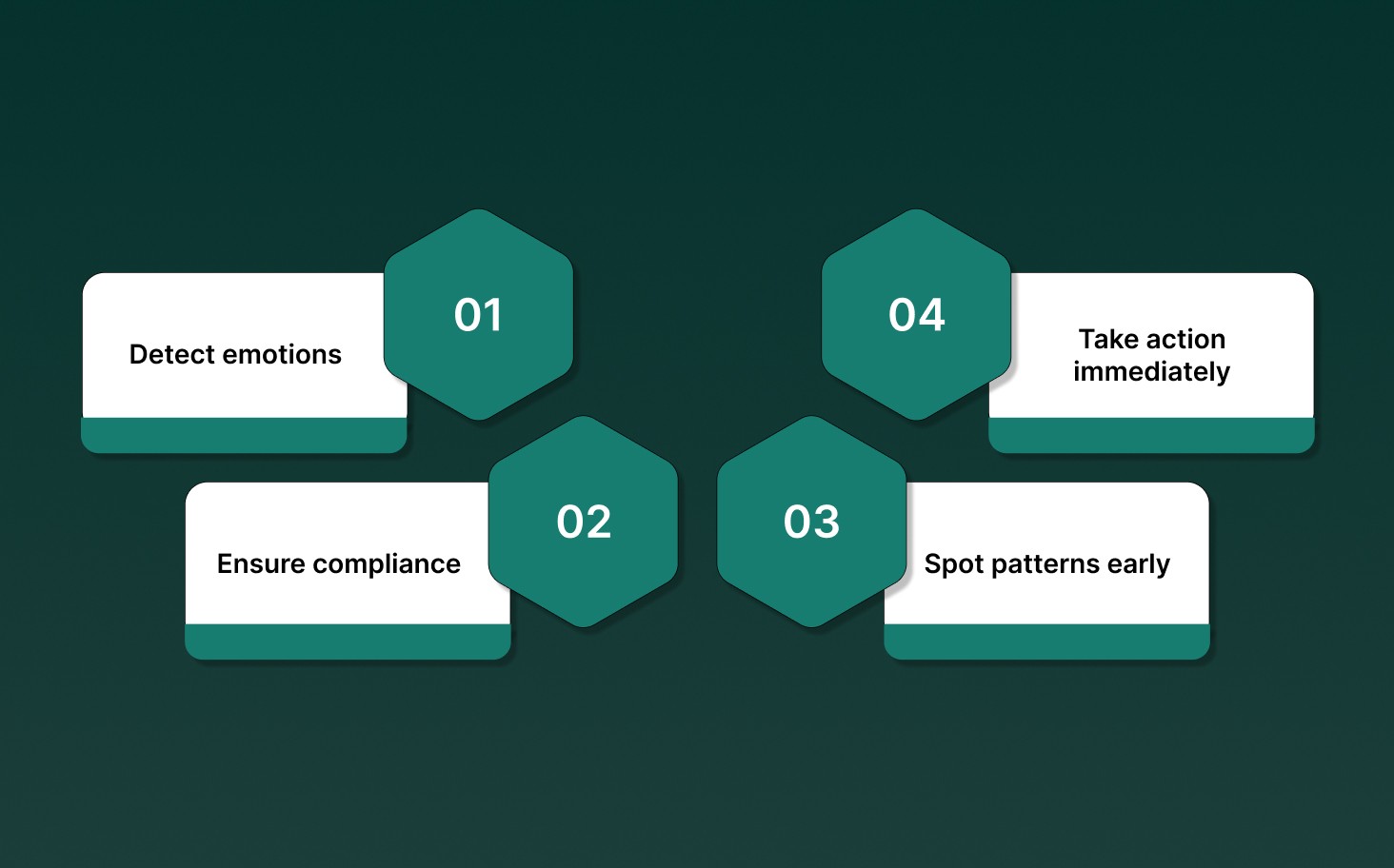
Real-time speech analytics (RTSA) is a technology that listens to conversations as they happen and turns them into useful insights. Unlike traditional call monitoring, which reviews recordings later, RTSA captures every word, tone, and emotion in real time.
Here’s why it matters:
Detect emotions: Spot frustration, happiness, urgency, or confusion instantly.
Ensure compliance: Automatically verify that agents follow scripts, legal rules, and industry regulations.
Spot patterns early: Find repeated issues, common questions, or delays in real time.
Take action immediately: Alert supervisors, guide agents, or let AI handle simple queries automatically.
Example: If a banking customer is frustrated about a delayed transaction, RTSA can flag the call immediately so the agent or AI system resolves the issue before it escalates.
Understanding what RTSA does is just the start. Let’s see why businesses need it today.
Why Businesses Need Real-Time Speech Analytics
Today, companies handle thousands of live calls and chats every day. Waiting to review them later can cause missed opportunities or compliance issues. RTSA solves this problem by giving instant insights.
Here are some key benefits:
Better customer experience: Solve problems faster and respond to emotions in the moment.
Stronger agent performance: Give live suggestions or coaching to reduce mistakes.
Stronger compliance: Reduce the risk of missed scripts or legal errors.
Instant insights: Identify recurring issues, feedback, or process gaps immediately.
Support growth: Spot upselling, cross-selling, or retention opportunities as they happen.
With these advantages in mind, it’s worth examining the main features that make RTSA so effective.
5 Essential Key Features of Real-Time Speech Analytics
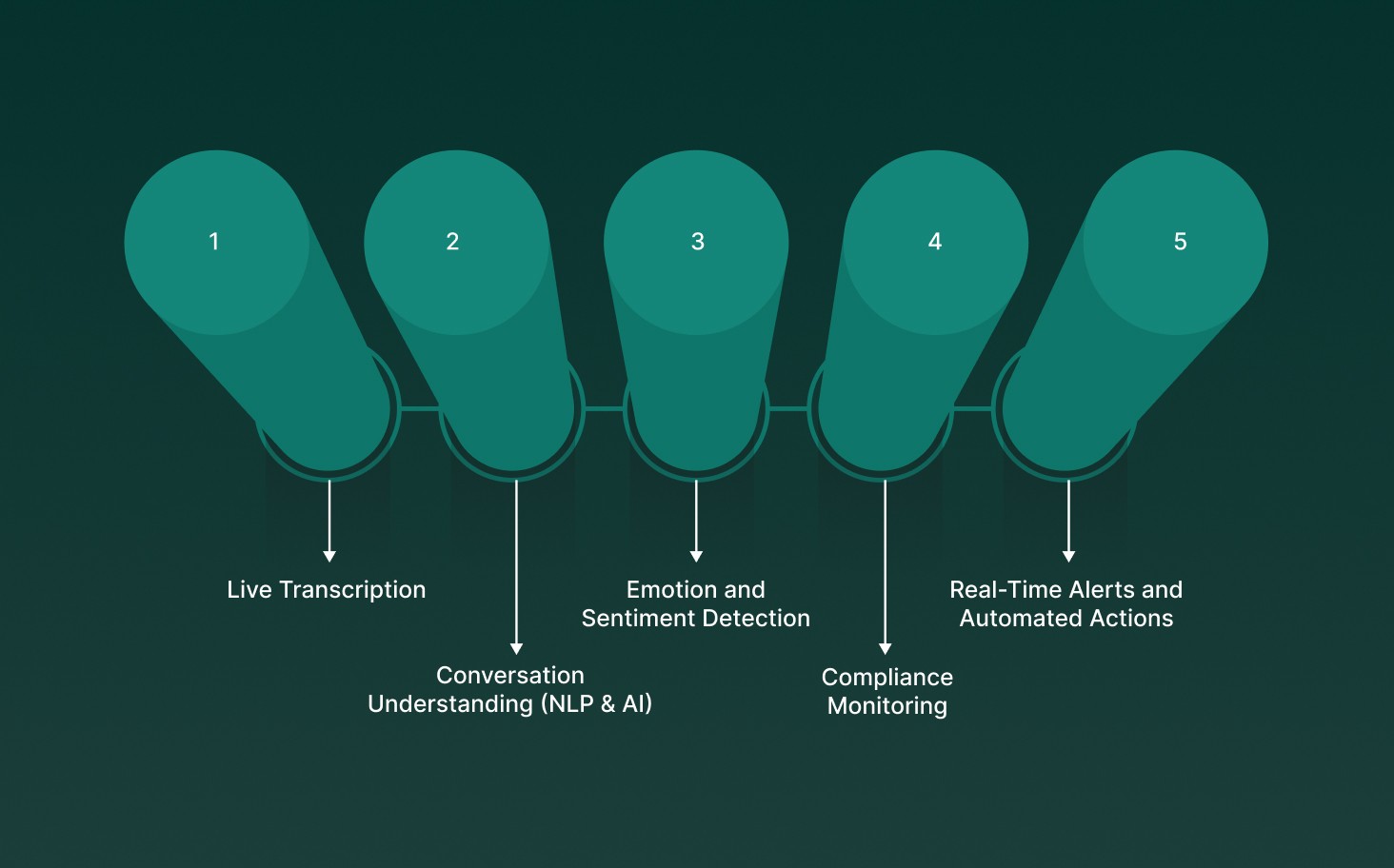
Real-time speech analytics is more than just call recording. It transforms voice conversations into actionable insights that help businesses act faster, ensure compliance, and improve customer experience.
1. Live Transcription
What it does: Instantly converts spoken words into text across multiple channels, including phone, IVR, and apps.
Why it matters: Makes conversations searchable, trackable, and ready for real-time analysis.
Example: A support agent can quickly see the transcript of a frustrated customer’s words and respond appropriately without waiting for a post-call review.
2. Conversation Understanding (NLP & AI)
What it does: Identifies customer intent, main topics, and key phrases automatically using AI.
Why it matters: Highlights important information, detects trends, and captures subtle cues such as confusion or excitement.
Example: In an e-commerce call, the system detects that a customer is interested in upgrading their delivery option, triggering a suggested action for the agent.
3. Emotion and Sentiment Detection
What it does: Measures the emotional tone of conversations in real time.
Why it matters: Helps agents adjust their responses for empathy and effectiveness, improving customer satisfaction.
Example: A banking call flagged for rising frustration can alert a supervisor immediately or escalate to a priority support team.
4. Compliance Monitoring
What it does: Checks conversations against scripts, regulatory requirements, and legal disclosures instantly.
Why it matters: Reduces the risk of violations and ensures consistent adherence to industry standards.
Example: During insurance verification calls, the system flags any missed regulatory disclosures, helping avoid compliance penalties.
5. Real-Time Alerts and Automated Actions
What it does: Sends live notifications to supervisors and allows AI agents to handle routine tasks automatically.
Why it matters: Ensures urgent issues are addressed instantly, and repetitive tasks are automated, improving efficiency.
Example: An AI agent automatically handles standard refund requests, while supervisors are alerted to high-risk complaints.
These features work together to turn every conversation into measurable action, improving service quality, agent performance, compliance, and operational efficiency in real time.
Now that we understand the features, it’s clear why RTSA is no longer optional but critical for modern enterprises.
Also Read: Multilingual Customer Support: Definition, Tips and Strategies
With these features, RTSA transforms every conversation into measurable business action. Next, let’s explore how this process works step by step.
How Real-Time Speech Analytics Works: 5 Major Steps
Real-time speech analytics transforms these interactions into actionable insights, helping teams respond faster, improve service, and make data-driven decisions. Here’s how it works step by step:
Step 1: Capturing Conversations
All interactions from phone calls and IVR systems to mobile apps are collected into a unified platform. This ensures every conversation is recorded and available for analysis.
Step 2: Processing in Real Time
AI converts speech into text instantly. Natural language processing and machine learning analyze tone, intent, and patterns, transforming raw audio into structured data.
Step 3: Generating Actionable Insights
Key signals trigger alerts to agents or supervisors. Routine queries are handled automatically by AI agents, while dashboards update with live metrics such as customer satisfaction, call trends, and agent performance.
Step 4: Creating a Feedback Loop
Insights from each conversation continuously improve conversational AI models. This enhances detection of sentiment, intent, and escalation signals, making future interactions more accurate and actionable.
Step 5: Scaling Securely
The platform can handle thousands of simultaneous calls without delay. Enterprise-grade encryption and role-based access ensure sensitive data remains protected.
Now that the workflow is clear, let’s see how RTSA benefits different industries with real-world use cases.
Top 8 Use Cases: How Real-Time Speech Analytics Helps Different Industries
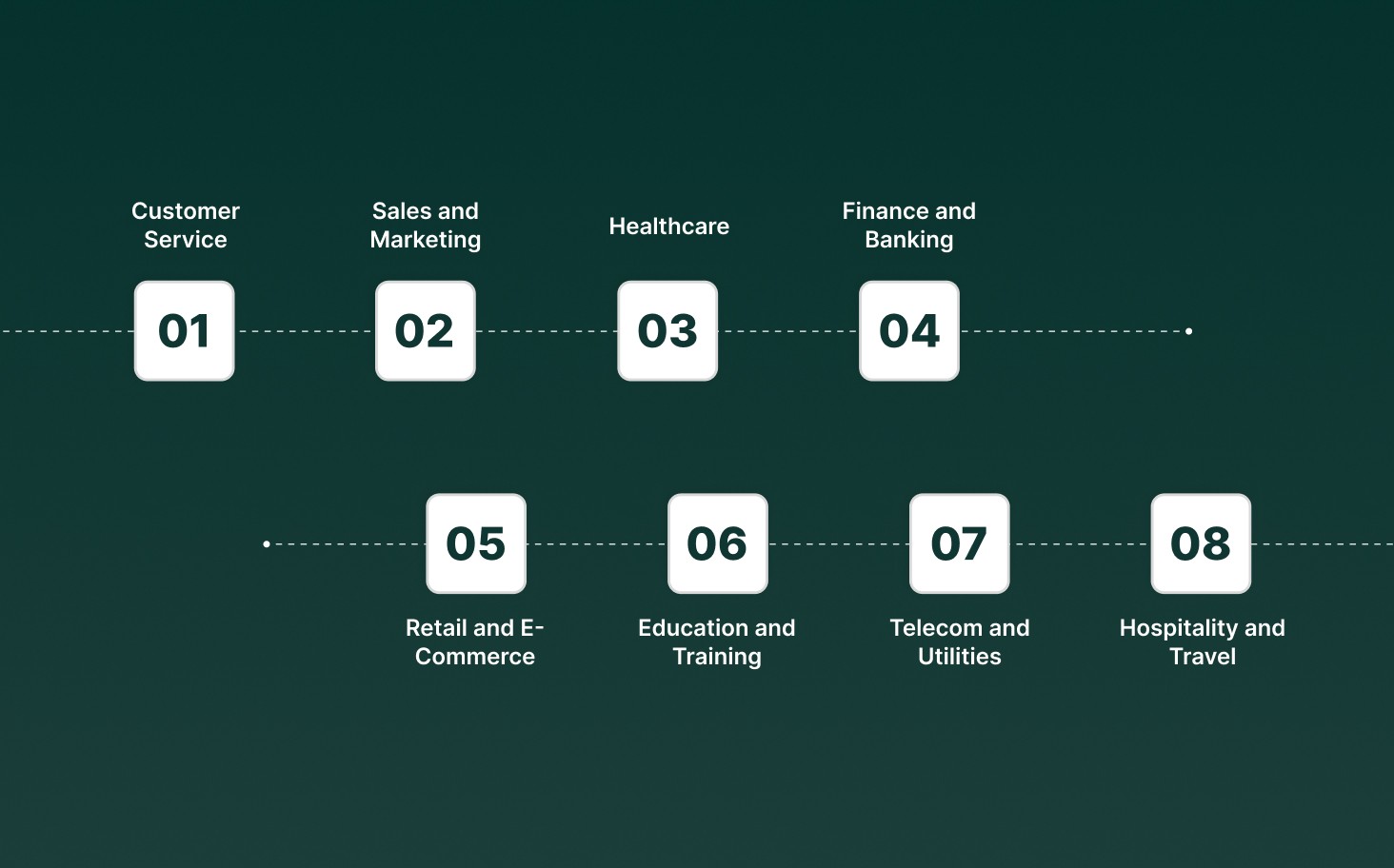
Every conversation is a source of insight. Real-time speech analytics transforms these interactions into actionable data, enabling faster decisions, better compliance, and enhanced customer experiences. Different industries benefit in specific ways:
Customer Service: By automating routine queries and identifying frustration or escalations early, teams can focus on complex issues and improve satisfaction.
Sales and Marketing: Real-time insights detect buying intent, suggest next steps, and help sales teams engage customers at the right moment.
Healthcare: Patient sentiment tracking, automated appointment scheduling, and compliance monitoring ensure accurate and empathetic care.
Finance and Banking: Fraud detection, identity verification, and compliance monitoring streamline operations while reducing risk.
Retail and E-Commerce: Analytics captures customer feedback, resolves order issues quickly, and highlights upsell opportunities for better engagement.
Education and Training: Monitor learner-instructor interactions, capture feedback, and measure engagement to enhance learning outcomes.
Telecom and Utilities: Early detection of service complaints, prioritized routing, and call quality monitoring help reduce churn and improve satisfaction.
Hospitality and Travel: Speech insights track guest sentiment, enable personalized service, and automate updates to bookings or inquiries.
By applying speech analytics across these sectors, organizations not only respond faster but also gain operational clarity, optimize workflows, and strengthen customer trust.
With these use cases in mind, it’s clear that RTSA brings measurable value, but implementing it comes with challenges. Let’s see how to address them next.
Key Challenges and Solutions for Real-Time Speech Analytics Deployment
Implementing real-time speech analytics can transform enterprise operations, but it comes with specific technical, operational, and compliance challenges. Success depends on choosing the right infrastructure, integrating systems effectively, and ensuring agents use insights in their workflows.
Below is a clear breakdown of common challenges and practical solutions to help enterprises deploy speech analytics at scale while maintaining efficiency and security:
Area | Challenges | Solutions |
Scalable Systems | High call volumes can overload processing pipelines. | Use a cloud- or hybrid-infrastructure designed for real-time speech analytics. Ensure the platform supports low-latency, high-concurrency environments. |
Integrating Systems | Connecting analytics with CRMs, ticketing, or workflow tools can be complex. | Select platforms with robust APIs and prebuilt integrations to ensure seamless data flow and automation. |
Secure Data | Handling sensitive customer information raises compliance and privacy concerns. | Implement encryption, role-based access controls, audit logs, and secure storage, aligned with regional and industry regulations. |
Staff Adoption | Agents may not use insights effectively if workflows are unclear. | Provide training, clear dashboards, and actionable prompts to integrate speech analytics into daily operations. |
Accuracy & Noise | Background noise, accents, and multilingual calls can reduce transcription accuracy. | Deploy models trained on domain-specific language, accents, and noise patterns. Regularly review and update models. |
Once these challenges are addressed, organizations can fully use RTSA. Looking ahead, let’s explore the emerging trends shaping the future of speech analytics.
4 Emerging Trends in Real-Time Speech Analytics
As enterprise communication shifts toward faster, voice-driven interactions, speech analytics is moving beyond monitoring into active decision support. Organizations now expect systems that predict intent, guide conversations, and connect insights directly to operations.
The next phase focuses on speed, automation, and deeper intelligence across every interaction channel.
Here is where real time speech analytics is heading:
Predictive customer intelligence: Advanced models analyze historical and live conversations to anticipate customer needs, detect risk signals early, and suggest next best actions before issues escalate.
Unified multilingual and multichannel analysis: Future platforms combine voice agents, chat, and video conversations into a single analytics layer, helping global teams maintain consistent insights across languages, regions, and communication formats.
AI-driven operational decisions: Speech analytics increasingly triggers automated workflows such as routing, alerts, compliance checks, and service recovery actions based on conversation patterns detected in real time.
Continuous learning from conversations: Systems improve accuracy through ongoing data learning, enabling more precise intent detection, sentiment tracking, and performance benchmarking across large interaction volumes.
Businesses that adopt real time speech analytics early gain a measurable advantage by converting everyday conversations into faster decisions, stronger compliance, and consistently improved customer experiences.
How Smallest.ai Enhances Real-Time Speech Analytics?
Real-time speech analytics transforms voice interactions into actionable insights, but enterprise deployments can face challenges like high call volumes, delays, or complex workflows. Smallest.ai addresses these challenges with Pulse, its advanced speech-to-text (STT) engine, designed for both real-time and batch transcription.
To support enterprise-scale deployments, Smallest.ai offers the following real-time speech analytics capabilities:
Live Transcription & Insights: Captures spoken words as they happen, detecting intent, sentiment, and key topics instantly.
Multi-Language & Accent Support: Handles diverse customer interactions across more than 30+ languages and regional accents.
Seamless Integration: Feeds insights directly into CRMs, dashboards, and operational workflows, enabling instant updates and informed decision-making.
Scalable & Low-Latency: Processes thousands of simultaneous calls with minimal delay, ensuring real-time actions without disrupting customer experience.
Actionable Analytics: Converts conversations into structured data, allowing teams to identify trends, spot issues, and respond quickly.
Voice cloning for consistency: Generate production-ready voices from just five seconds of input, maintaining a consistent brand voice across regions while keeping interactions engaging.
By using Pulse, businesses can move beyond passive monitoring. Every call becomes a source of actionable intelligence improving operational efficiency, strengthening compliance, and enhancing customer satisfaction.
Conclusion
For enterprise leaders, efficiency and actionable insight go hand in hand. Implementing real-time speech analytics with best practices transforms everyday voice interactions into measurable, operational outcomes. By combining live analytics with automated execution, organizations move from delayed reporting to instant decision-making, ensuring compliance, accuracy, and performance across every team.
Smallest.ai enhances this approach with real-time AI agents, hyper-realistic voice, and seamless workflow integrations, enabling speech data to drive immediate action. Each interaction is analyzed, context-aware, and fully auditable, creating a foundation for intelligent, responsive, and scalable operations.
Discover how your organization can unlock the full potential of conversations and drive measurable business impact with real-time speech analytics. Book a demo today.
Frequently asked questions
How is speech analytics different from basic call recording?
Can speech analytics support live operational decisions?
What business problems does speech analytics typically solve?
Does speech analytics work across multiple channels?
What results can teams expect after implementation?