Top 6 AI Voice Transcription for Customer Support Teams

Compare top AI voice transcription for customer support, focusing on real-time accuracy, latency, and scalability across live calls that operate at scale.
Picture a support manager watching queues spike while agents scramble to keep up, key details slipping through fast-moving calls. That moment is exactly why teams search for top AI voice transcription for customer support when accuracy and speed start affecting outcomes. Speech analytics are booming, projected to reach $7.3 billion by 2029 with a 18.6% CAGR, driven by live customer conversations that demand precision.
For customer support leaders, top AI voice transcription for customer support signals a need for real-time visibility, not post-call clean-up. The focus is on live accuracy, operational control, and systems that work under pressure.
In this guide, we break down how leading platforms differ, what technical capabilities actually matter in live support environments, and how to evaluate AI voice transcription tools built for real customer conversations, not demos.
Key Takeaways
Real-Time Execution Matters: Transcription creates impact only when it runs during live calls, allowing immediate supervision, escalation, and workflow actions.
Latency is the Differentiator: Sub-second latency decides whether voice data supports live decisions or stays limited to post-call analysis.
Support Calls Are a Hard Use Case: Meeting and media transcription tools fail under VoIP noise, long calls, and structured data requirements.
Transcription Plays Different Roles: Some platforms use it as core infrastructure, others as agent signals or post-call analytics.
Infrastructure Determines Scale: High-volume contact centers need streaming ASR and predictable performance during peak concurrency.
Why AI Voice Transcription Has Become Core to Modern Customer Support
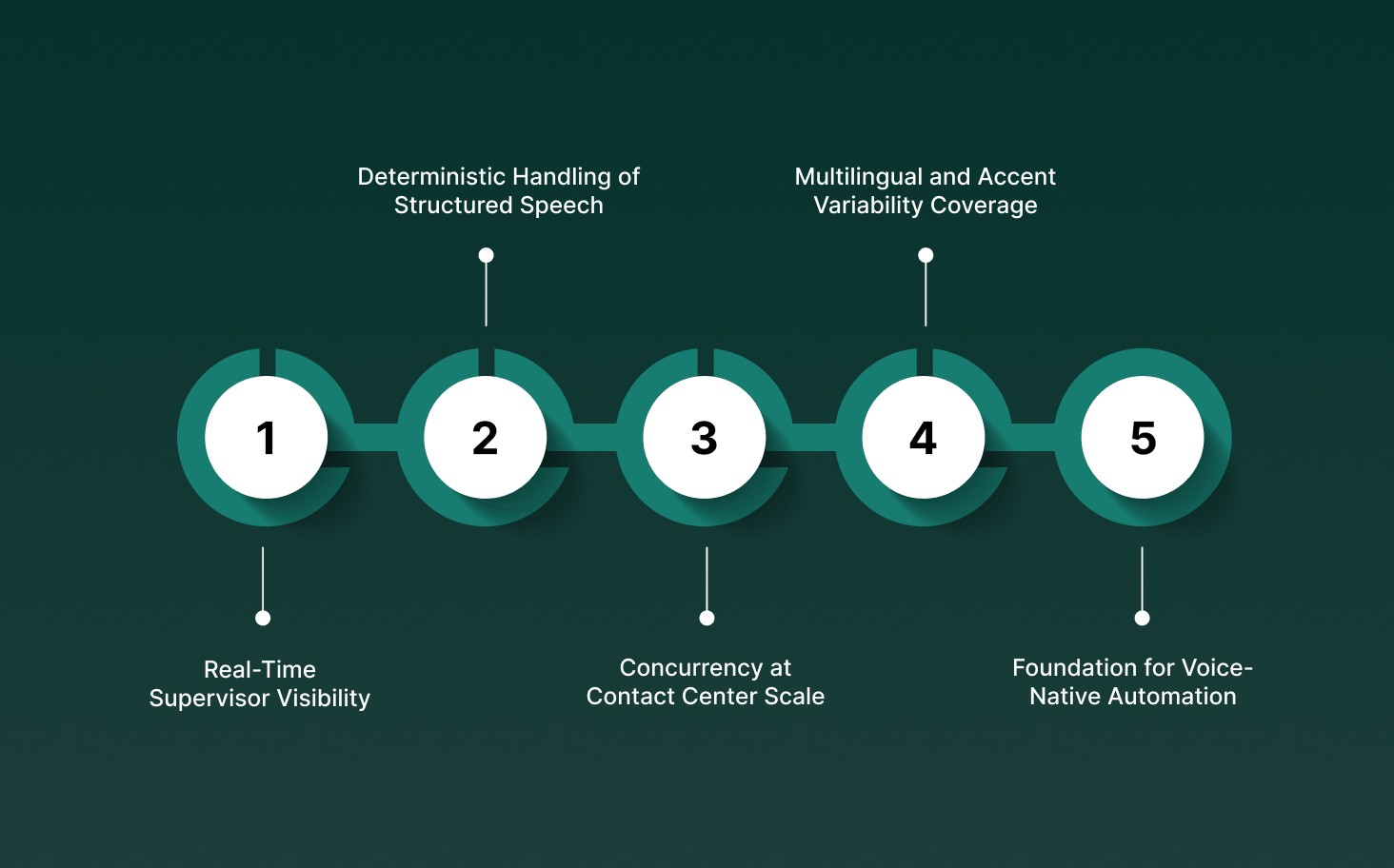
AI voice transcription has shifted from a support add-on to core contact center infrastructure because modern customer support operates in real time, at scale, and under strict quality, compliance, and cost controls. Voice data must now be processed, interpreted, and acted on while the call is still live.
Real-Time Supervisor Visibility: Live transcription allows supervisors to inspect call content mid-conversation, detect escalation triggers, and intervene without silent monitoring or delayed QA reviews.
Deterministic Handling of Structured Speech: Modern transcription systems are trained to accurately capture credit card digits, policy numbers, dates, order values, and confirmation codes with correct pacing and token separation, which directly impacts downstream automation.
Concurrency at Contact Center Scale: AI voice transcription systems now operate across thousands of parallel calls, requiring low-latency inference pipelines, memory-efficient models, and predictable throughput under peak loads.
Multilingual and Accent Variability Coverage: Support teams increasingly serve customers across regions, making transcription accuracy dependent on acoustic robustness across accents, code-switching, and mixed-language utterances within a single call.
Foundation for Voice-Native Automation: Live transcription feeds agent assist, call scoring, compliance prompts, and post-call analytics pipelines, acting as the primary structured input for voice-first AI systems rather than a passive text artifact.
Explore how real-time voice infrastructure supports live customer interactions and see where low-latency speech generation fits into modern support stacks in Top Fastest Text-to-Speech APIs in 2025.
Top AI Voice Transcription Solutions for Customer Support
AI voice transcription in customer support now spans infrastructure-grade streaming ASR, agent assist systems, and full voice-agent platforms. The real differentiation lies in latency tolerance, execution timing, and how transcription feeds live workflows versus retrospective analysis.
At a Glance:
Platform | Core Focus | Real-Time Voice Transcription | Voice Agents | Best Fit |
Voice AI infrastructure | Native, streaming, sub-second | Yes | Real-time contact centers, voice automation at scale | |
Conversation intelligence | Post-call and near-real-time | No | QA-heavy contact centers | |
Sierra AI | AI voice agents | Yes (embedded) | Yes | Large consumer brands |
Cresta | Agent assist + AI agents | Yes (supporting layer) | Yes | Regulated enterprise contact centers |
Decagon AI | Autonomous AI agents | Yes (supporting layer) | Yes | Omnichannel resolution automation |
Salesforce Agentforce Voice | CRM-native voice agents | Yes (CRM-embedded) | Yes | Salesforce-centric enterprises |
1. Smallest.ai
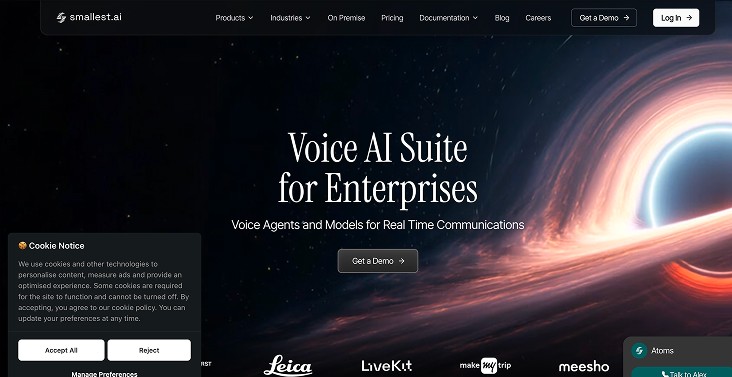
Smallest.ai is an enterprise-grade, real-time voice AI platform that powers conversational agents and transcription across live calls, allowing contact centers and customer support to automate and analyze voice interactions with low-latency, high-fidelity speech.
Key Features:
Streaming Text-to-Speech Synthesis: Delivers hyper-realistic speech with sub-100 millisecond generation time for live interactions and automated responses, critical for conversational continuity.
Lightning ASR (Automatic Speech Recognition): Streaming ASR optimized for low latency across 15+ languages with adaptive noise suppression and punctuation restoration for accurate live transcripts.
Context-Aware Conversational Agents: Voice agents that handle structured workflows and complex SOPs in real time, managing thousands of parallel calls.
Voice Cloning and Customization: Instant voice cloning in 16+ languages and emotions supports personalized voice experiences in support, marketing, and media scenarios.
Global Language Support: Multi-lingual handling across global languages allows enterprises to deploy voice services in diverse regional markets.
Enterprise-Grade Compliance and Security: SOC 2 Type II, HIPAA, and PCI compliance provide secure processing for sensitive voice data in regulated industries.
Best for: Real-time contact center automation, live voice interaction deployment, and integration into enterprise customer support workflows requiring concurrent, low-latency speech processing.
Smallest.ai Price Details:
Free Plan: Basic access with one template AI agent and limited TTS testing credits.
Personal Plan: US$49/month with no-code builder, premium voices, and 3 concurrent requests.
Business & Enterprise: US$1,999/month with SLA, integrations, on-prem deployments, and dedicated support.
Explore Smallest.ai to deploy real-time, enterprise-ready voice AI agents and secure low-latency transcription for customer support.
2. Observe AI
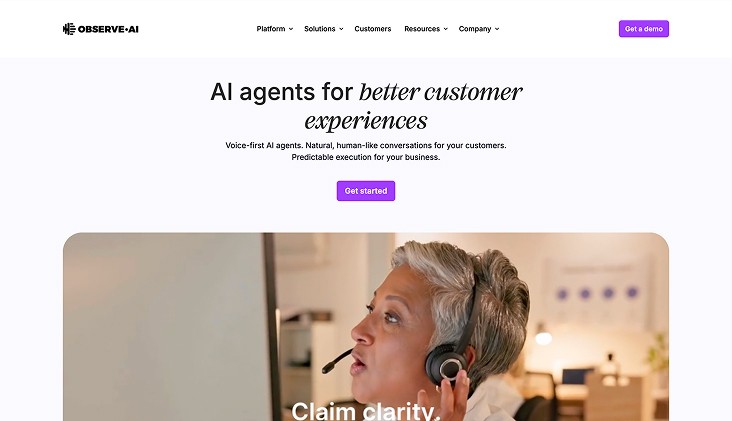
Observe AI is a contact center intelligence platform focused on post-call and near-real-time conversation analysis. It centralizes customer conversations to support quality management, agent coaching, compliance monitoring, and performance visibility across distributed support teams.
Key Features:
Conversation Intelligence at Scale: Transcribes and analyzes 100 percent of customer calls, converting unstructured conversations into searchable data for quality, compliance, and performance measurement across large support operations.
Automated Quality Management: Uses AI-driven Auto QA to score interactions consistently, reducing manual review effort while improving coverage, calibration accuracy, and audit readiness.
Compliance and Brand Monitoring: Detects deviations from approved scripts, disclosures, and messaging standards, helping contact centers mitigate regulatory risk and maintain brand consistency.
Agent Coaching and Insights: Identifies skill gaps and behavioral trends from call data, allowing targeted coaching programs based on real interaction evidence rather than sampled reviews.
Best for: Mid to large contact centers focused on quality management, compliance oversight, agent performance improvement, and post-call conversation analytics across voice and digital channels.
Observe Price Details:
Pricing is not publicly listed and varies by contact center size and modules selected.
Typically sold as an enterprise contract with per-agent or per-seat pricing.
Advanced features like Auto QA and Copilots are priced as add-ons.
3. Sierra AI
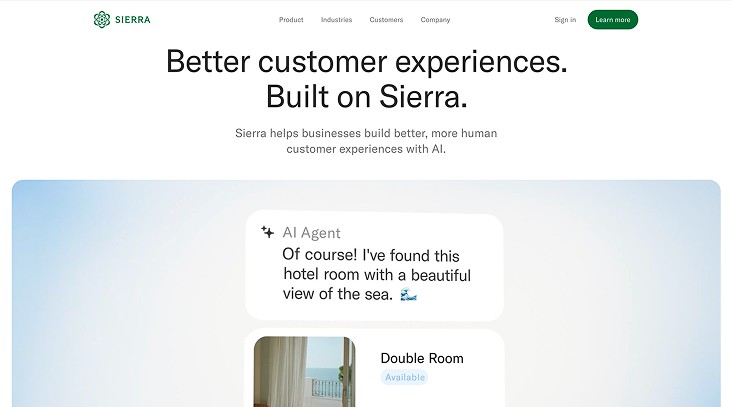
Sierra is an enterprise conversational AI platform focused on deploying AI agents across chat and voice channels. It emphasizes lifelike AI phone calls, deep contact center integration, and end-to-end customer experience continuity rather than standalone transcription.
Key Features:
Voice-First AI Agents: Delivers natural, low-latency AI phone conversations with humanlike cadence, interruption handling, and emotional awareness, designed to replace brittle IVRs and reduce live agent dependency.
Contextual Enterprise Knowledge: AI agents operate with full business context, understanding brand language, product catalogs, internal systems, and customer history to execute complex service tasks during live calls.
Automatic Transcription and Analysis: All voice interactions are recorded, transcribed, and tagged in real time, allowing topic-based review, sentiment analysis, summaries, and operational reporting.
Contact Center Ecosystem Integration: Integrates with existing IVRs, BPOs, routing systems, compliance tools, and call platforms, supporting gradual rollout without replacing core contact center infrastructure.
Best for: Large consumer brands and enterprises seeking AI voice agents that can handle end-to-end customer service calls, reduce hold times, and deliver consistent experiences across chat and phone channels.
Sierra AI Price Details:
Pricing is not publicly disclosed and is customized per enterprise deployment
Typically structured around usage, scale, and supported channels
Outcome-based pricing models are available for AI agent–driven workflows
4. Cresta
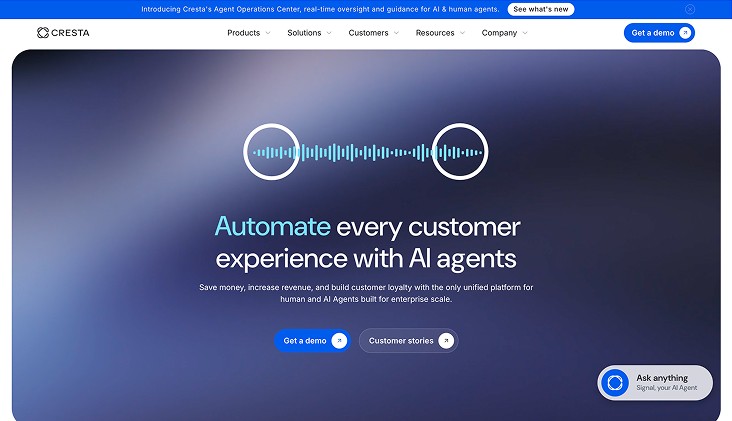
Cresta is an enterprise AI platform for contact centers that combines AI agents, agent assist, and conversation intelligence into a single system. It focuses on real-time guidance, operational oversight, and post-call intelligence across human and AI-led interactions.
Key Features:
Real-Time Agent Guidance: Provides live, in-call recommendations, next-best actions, and workflow automation to agents, driven by real-time conversation analysis and contextual signals.
Conversation Intelligence at Scale: Captures and analyzes voice conversations across channels to surface customer intent, sentiment shifts, compliance gaps, and behavioral patterns for operational and strategic use.
Unified Human and AI Agent Platform: Runs human agents and AI agents on the same orchestration layer, allowing enterprises to mix containment, assistive AI, and full automation without fragmented tooling.
Enterprise AI Orchestration and Guardrails: Supports multi-model architectures, fine-tuning on proprietary data, rigorous testing, and enterprise-grade guardrails to meet reliability, compliance, and governance needs.
Best for: Large, regulated contact centers seeking real-time agent assistance, AI-led containment, and deep conversation intelligence to improve CX, QA coverage, and revenue outcomes at enterprise scale.
Cresta Price Details:
Pricing is not publicly disclosed and is customized per enterprise deployment
Typically structured per agent, per module, and usage volume
Advanced capabilities like AI Agents and Auto QA are priced as premium add-ons
5. Decagon AI
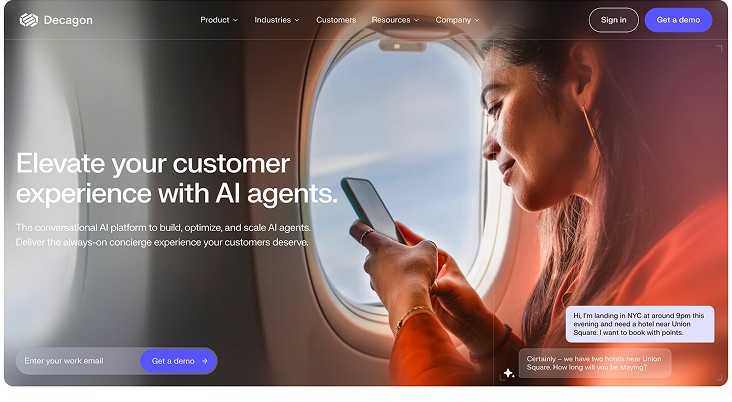
Decagon AI is an enterprise conversational AI platform built to deploy, control, and scale AI agents across chat, voice, email, and SMS. It emphasizes deterministic execution through Agent Operating Procedures and unified omnichannel resolution.
Key Features:
Agent Operating Procedures (AOPs): Uses natural language instructions compiled into executable logic, allowing CX teams to encode complex SOPs while maintaining deterministic behavior and guardrails under real-world customer scenarios.
True Omnichannel AI Engine: Runs a single AI brain across voice, chat, email, SMS, and APIs, ensuring consistent intent handling, memory retention, and resolution logic without fragmented channel-specific systems.
Voice and Chat Resolution at Scale: Supports high-resolution rates across voice and chat with cross-channel memory, allowing AI agents to maintain continuity across interactions and reduce repeat contacts.
Enterprise Observability and Control: Provides full traceability into agent reasoning, decision paths, and system actions, allowing operators to debug, test, and iterate AI behavior safely in production environments.
Best for: Enterprises seeking AI agents that can autonomously resolve customer issues across voice and digital channels while maintaining strict control, transparency, and reliability at scale.
Decagon AI Price Details:
Pricing is not publicly disclosed and is customized per enterprise deployment
Typically structured around resolution volume, channels used, and feature modules
Voice capabilities and advanced observability are sold as part of enterprise contracts
6. Salesforce Agentforce Voice
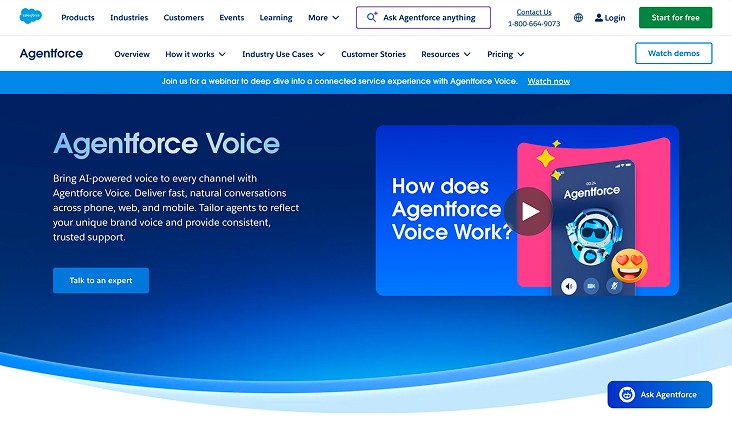
Salesforce Agentforce Voice is an AI-powered voice agent platform embedded natively within Salesforce. It allows enterprises to design, deploy, and manage voice-enabled AI agents that handle real-time customer conversations across phone, web, and mobile channels, grounded directly in CRM data.
Key Features
Salesforce-Native Voice Agents: Voice agents are built and deployed directly inside Salesforce, inheriting CRM context, workflows, security controls, and governance without external middleware or parallel AI platforms.
Unified Low-Code Agent Builder: Teams use the same Agentforce Builder to create chat and voice agents, simplifying testing, deployment, and maintenance while ensuring consistent logic across channels.
CRM-Grounded Conversations: Voice agents access live customer records, histories, preferences, and past interactions, allowing personalized, context-aware conversations that resolve issues faster and reduce repeat contacts.
Ultra Low-Latency Voice Interactions: Designed for real-time conversational flows with minimal response delay, allowing agents to manage complex, multi-turn phone conversations without IVR-style friction.
Best for: Enterprises deeply invested in the Salesforce ecosystem that want CRM-native AI voice agents to automate customer service, maintain data continuity, and scale consistent support experiences.
Salesforce Agentforce Price Details:
Pricing is not publicly disclosed and varies by Salesforce edition and usage
Typically bundled with Salesforce Service Cloud and Agentforce modules
Voice capabilities are priced based on agent volume, interaction usage, and add-ons
Learn how speech recognition and voice synthesis work together to power real-time customer interactions in Speech-to-Text and Text-to-Speech Technology: Making Interactions Smarter.
Real-Time vs Post-Call Transcription
The difference between real-time and post-call transcription is architectural, not cosmetic. In customer support environments, transcription timing determines whether voice data can drive live decisioning, enforcement, and intervention or remain limited to retrospective analysis.
Dimension | Real-Time Transcription | Post-Call Transcription |
Processing Window | Sub-second streaming inference during live audio frames | Batch inference after call termination |
Latency Budget | Typically under 300 ms end-to-end to remain operationally useful | Latency is irrelevant since the output is delayed |
Error Recovery | Supports live correction via contextual continuation and rolling confidence updates | Errors persist across the full transcript with limited recovery |
Supervisor Actionability | Allows mid-call escalation, agent coaching, and compliance interruption | Restricts action to post-call QA and audits |
Structured Data Capture | Extracts numbers, IDs, and entities while they are spoken | Requires retroactive parsing, often with reduced accuracy |
Integration Path | Directly feeds agent assist, sentiment scoring, and live workflows | Feeds analytics, reporting, and training systems only |
Compare how modern voice platforms handle real-time transcription, latency, and scale by exploring Top Voice API Providers: Revolutionizing Speech Recognition
Key Capabilities to Look for in the Top AI Voice Transcription Tools
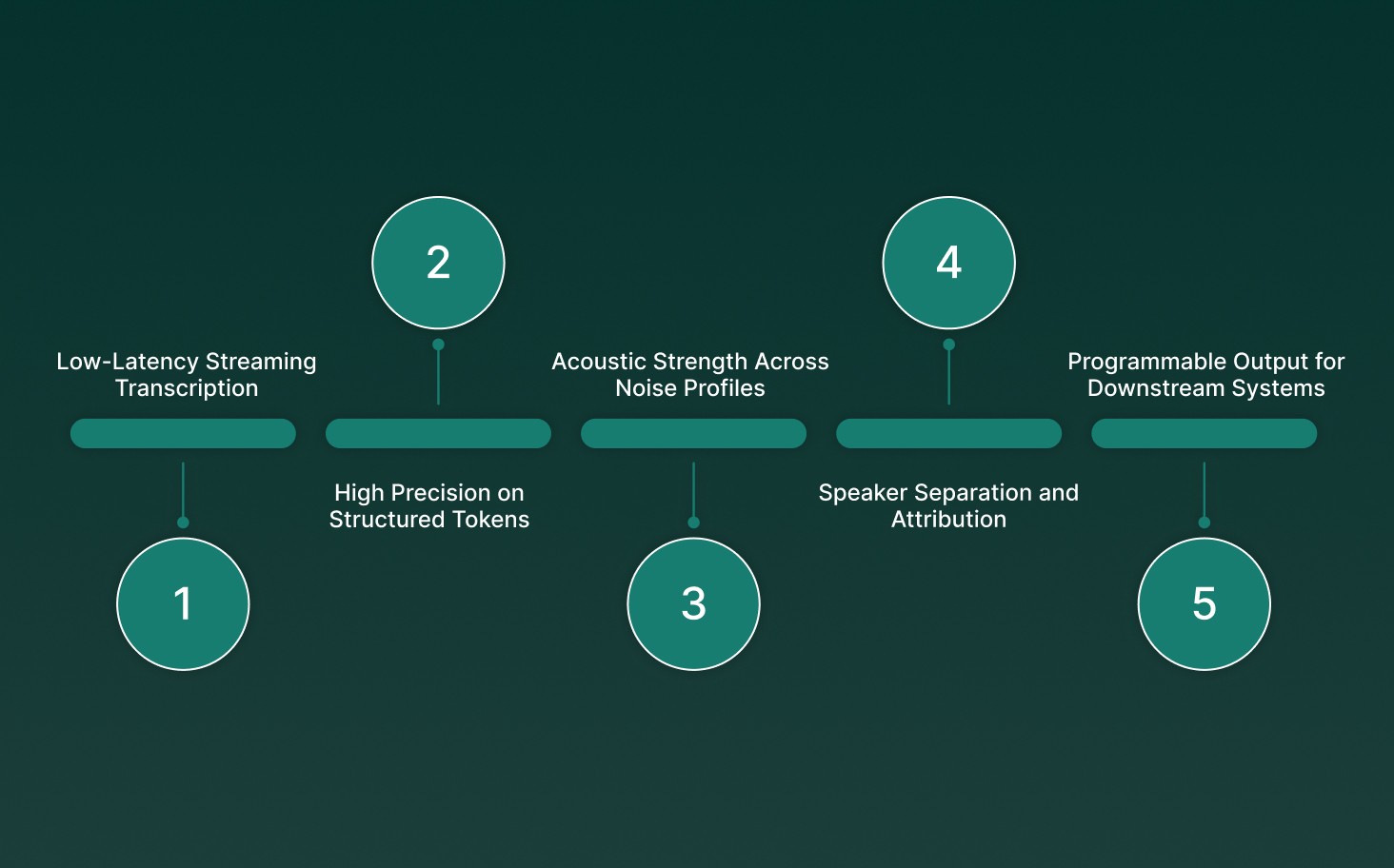
In customer support, voice transcription must go beyond simple speech-to-text conversion. It needs to deliver structured data, high fidelity under operational constraints, and deep integration with live support workflows that affect automation, analytics, and compliance.
Low-Latency Streaming Transcription: Transcription engines must process live call audio in micro-batches with total processing delay below 300 ms to support real-time agent assist, keyword trigger detection, and automated workflows without interrupting the call.
High Precision on Structured Tokens: The system must accurately recognize and normalize structured speech, such as alphanumeric order IDs, time stamps, policy codes, and monetary values, using tokenization models targeting low token error rates in support contexts.
Acoustic Strength Across Noise Profiles: Top tools should use noise-rich feature extraction and domain-specific training to maintain transcription integrity under typical call center audio conditions (e.g., VoIP jitter, background chatter, multi-mic echo).
Speaker Separation and Attribution: The ability to identify and label multiple speakers (agent vs. customer) with temporal alignment is essential for accurate sentiment scoring, escalation detection, and automated summary generation.
Programmable Output for Downstream Systems: Transcription outputs must be structured (JSON with timestamps, entities, confidence scores) and easily consumable by analytics, CRM systems, QA platforms, and compliance auditing tools without post-processing cleanup.
Leading voice transcription tools must combine stream performance, structured accuracy, and operational integration to support live decisioning and post-call analytics in complex customer support environments.
Final Thoughts!
Customer support teams are moving toward systems that act while the conversation is still unfolding. The shift is not toward transcripts for record keeping, but toward voice data that can guide actions, enforce standards, and surface risk in real time. As call volumes rise and expectations tighten, execution timing becomes the differentiator.
Platforms built for live voice workflows set a different baseline for support operations. If real-time transcription, low-latency response, and operational control are priorities, Smallest.ai provides the voice AI foundation designed for high-throughput, live customer interactions.
Talk to a voice expert and see how Smallest.ai fits into your customer support stack.
Frequently asked questions
Does AI voice transcription accuracy degrade on long customer support calls?
How does call concurrency affect AI voice transcription performance?
Can AI voice transcription work reliably with VoIP packet loss and jitter?
Is real-time AI transcription usable for compliance enforcement during live calls?
What happens to transcription accuracy when customers switch languages mid-call?