Blogs

/

Top Vogent AI Alternative for 2025: Why Smallest AI Stands Out

6 Voice AI Tools Built for High-Volume Customer Service in 2026

Explore 6 voice AI solutions for customer service in 2026, covering real-time calls, automation depth, integrations, scalability, and platform fit. Read more.

Hamees Sayed

Updated on

January 19, 2026 at 11:16 AM

6 Voice AI Tools Built for High-Volume Customer Service in 2026

“Hi, I have a quick question.”
It sounds simple, but support teams know it rarely is. One call turns into multiple system checks, repeated verification, and longer handle time than planned.

That friction is why teams search for Voice AI in Customer Service. Phone support still handles urgent, high-context issues, yet expectations for speed and accuracy keep rising. Operations and CX leaders are looking for ways to resolve calls faster without adding headcount or increasing risk.

Interest in voice AI solutions for customer service keeps growing as these pressures compound. By the end of 2033, the Voice AI market is projected to reach approximately USD 65.5 billion, reflecting demand for faster conversations, consistent handling, and always-available support. Buyers evaluating voice AI are focused on whether it can manage live calls, follow service rules, and fit into existing systems.

In this guide, we examine how platforms such as Smallest.ai, Sierra.ai, Agentforce Voice AI, Decagon.ai, Cresta, and Observe.AI provide voice AI solutions for customer services and where each fits in real support environments.

Key Takeaways


  • Voice AI Is Now Operational: Teams use voice AI to handle real calls at scale, not pilots or experiments.

  • Call Ownership Matters More Than Features: Platforms are judged by resolution depth, not demos or surface capabilities.

  • Latency Directly Impacts Trust: Faster responses and clean turn-taking shape caller confidence and completion rates.

  • System Access Separates Leaders: Voice agents that act inside CRMs and billing tools outperform reply-only systems.

  • Platform Fit Beats Rankings: The right choice depends on call volume, workflows, and deployment control.

Why Customer Service Teams Are Adopting Voice AI at Scale
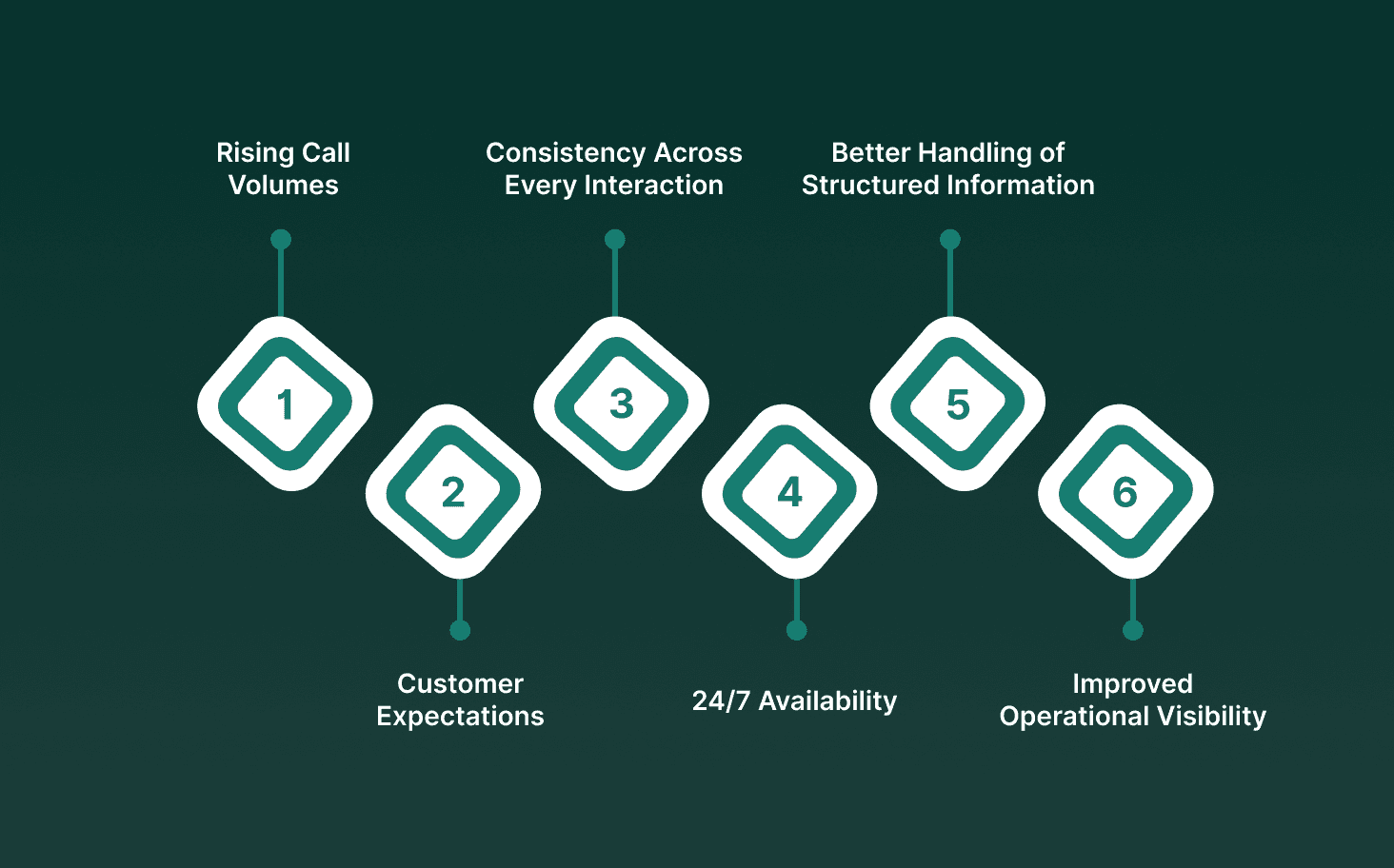

Why Customer Service Teams Are Adopting Voice AI at Scale

Customer service teams face rising call volumes, tighter response expectations, and growing pressure to control costs while maintaining service quality. Voice AI solutions for customer service adoption reflect these operational realities rather than experimentation.


  • Rising Call Volumes Without Headcount Growth: Support teams handle more inbound and outbound calls each year, while hiring and training agents remains slow and costly. Voice AI absorbs repetitive and high-frequency requests without adding staff.

  • Customer Expectations for Immediate Resolution: Callers expect fast answers and minimal hold times. Voice AI responds instantly, handles common issues end-to-end, and reduces queue lengths during peak hours.

  • Consistency Across Every Interaction: Human agents vary by shift, experience level, and workload. Voice AI follows the same rules, scripts, and policies on every call, reducing errors in pricing, eligibility, and account details.

  • 24/7 Availability Without Overtime Costs: Global customers call outside standard business hours. Voice AI provides continuous coverage for support, collections, and appointment handling without night shifts or overtime.

  • Better Handling of Structured Information: Voice AI manages numbers, dates, balances, reference IDs, and verification steps with accuracy, lowering rework and call transfers caused by manual entry mistakes.

  • Improved Operational Visibility: Every interaction is logged and measurable. Teams gain clear insight into call outcomes, drop-offs, escalation reasons, and resolution patterns that manual reviews often miss.

Voice AI adoption is driven by scale, predictability, and service continuity, helping customer service teams meet demand without sacrificing response quality or operational control.

Best Voice AI Solutions for Customer Service in 2026

Voice AI solutions in customer service vary widely in scope, depth, and operating model. Some systems focus on fully automated phone conversations, while others prioritize agent assistance, analytics, or CRM-embedded workflows

Key differences show up in call handling depth, latency tolerance, language coverage, deployment control, and how tightly each platform connects to existing contact center infrastructure. Understanding these distinctions helps teams match platform strengths to real operational needs rather than feature checklists.

1. Smallest.ai

Smallest.ai

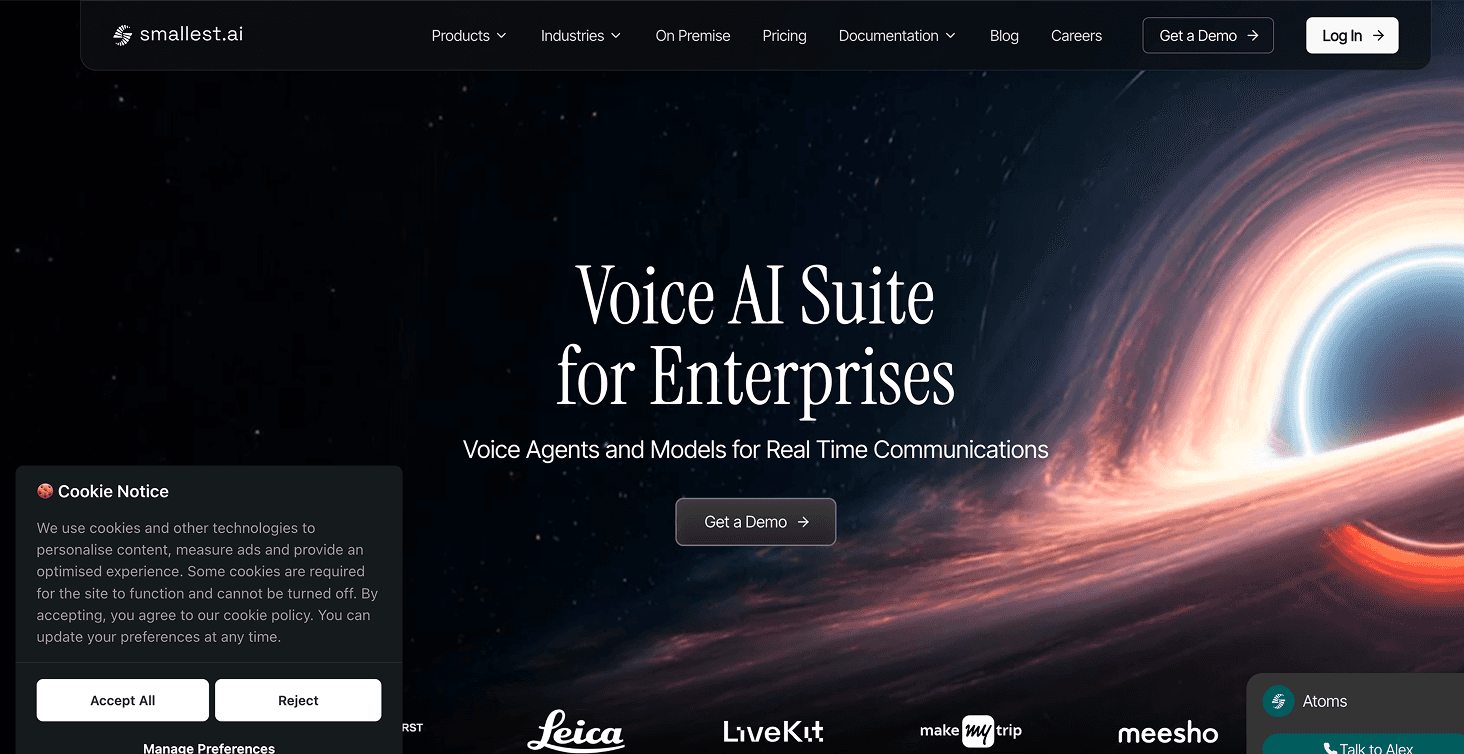
Smallest.ai is a voice-first AI platform built for customer service teams that run high-volume, real-time phone operations. It focuses on low-latency voice agents, strong language handling, and deployment options that meet enterprise security and scale requirements.

  • Real-Time Voice Agents: Handles live inbound and outbound calls with low latency, enabling full conversations rather than post-call analysis.

  • Human-Like Speech Generation: Uses expressive text-to-speech models that maintain natural pacing, tone variation, and clarity across long calls.

  • Accuracy With Structured Data: Reliably captures and speaks numbers, dates, balances, IDs, and verification details during calls.

  • High Concurrency Handling: Supports thousands of parallel calls per day without degrading response time or call quality.

  • Multilingual Coverage: Operates across 16+ languages, allowing customer service teams to support global callers from a single system.

  • Custom Agent Logic: Agents follow defined scripts, business rules, and SOPs, covering complex edge cases common in support and collections.

  • On-Premise and Cloud Deployment: Can run on customer infrastructure or cloud environments to meet data residency and compliance needs.

  • Enterprise Security Standards: Designed to align with SOC 2 Type II, HIPAA, and PCI requirements for regulated industries.

  • Developer-Friendly Integration: Offers SDKs and APIs for Python, Node.js, and REST to connect with telephony, CRMs, and internal systems.

Best For: Customer service teams that rely heavily on phone-based support, require predictable call handling at scale, and need strong control over latency, language quality, and data deployment.

Explore how Smallest.ai supports real-time customer service at scale. Request a demo to see live voice agents in action.

2. Sierra.ai

Sierra.ai

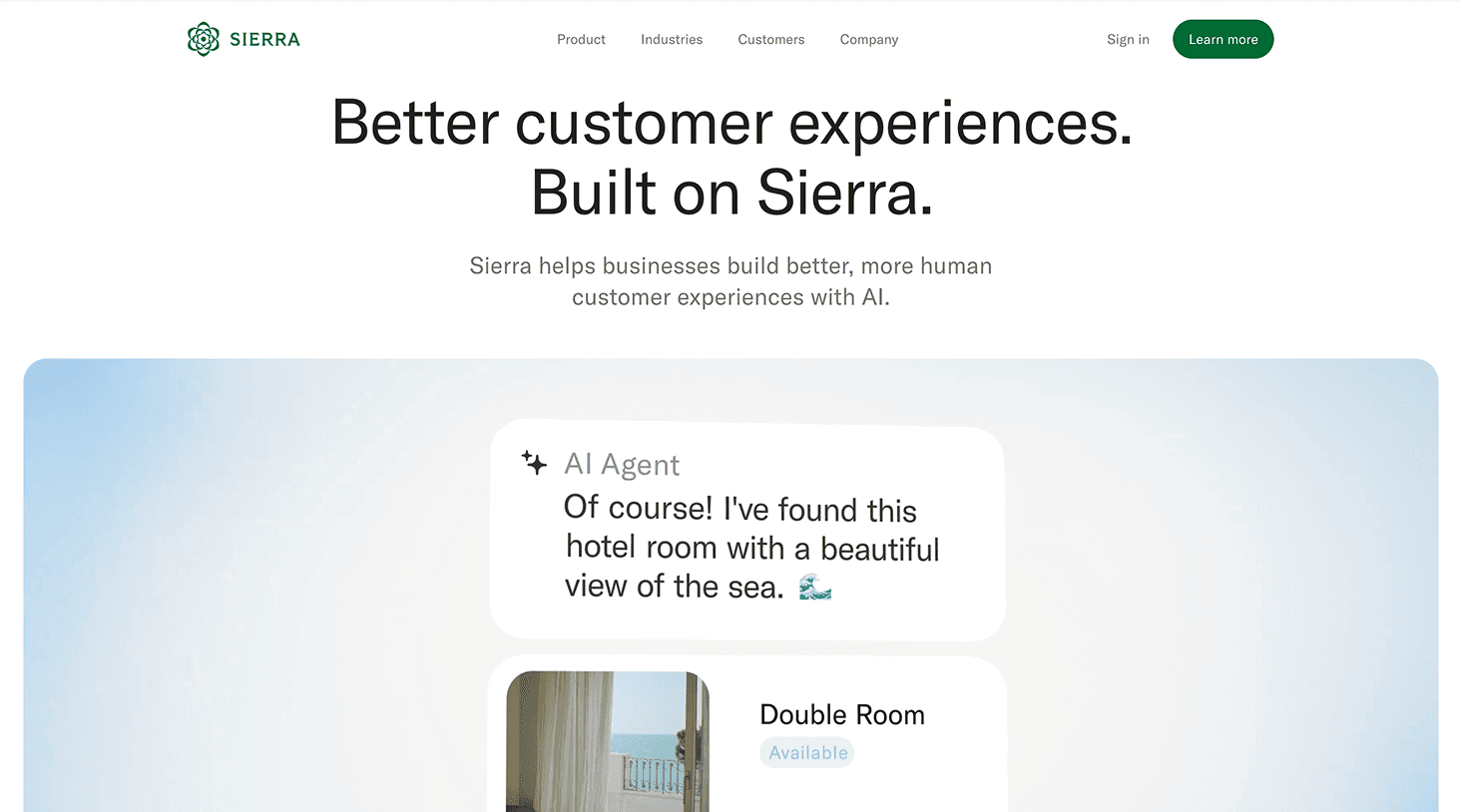
Sierra.ai is a voice-focused AI platform designed to handle customer service phone calls with natural conversation flow and deep integration into contact center systems. It emphasizes lifelike speech, service-specific logic, and consistent experiences across voice and digital channels.

  • Lifelike Voice Conversations: Delivers natural speech with controlled pacing, interruption handling, and low response gaps to support long service calls.

  • Service-First Agent Design: Trains agents to recognize brand language, acronyms, product names, order numbers, and customer context.

  • Action-Oriented Voice Agents: Connects directly to internal systems so agents can complete tasks rather than only answer questions.

Cons

  • An enterprise-oriented setup may require longer onboarding cycles.

  • Pricing and configuration details are less transparent for smaller teams.

  • Heavier focus on CX workflows than on lightweight transactional use cases.

Best For: Large customer service organizations that prioritize phone-based CX, require deep call center integration, and want consistent service behavior across voice and digital channels.

3. Agentforce Voice AI

Agentforce Voice AI

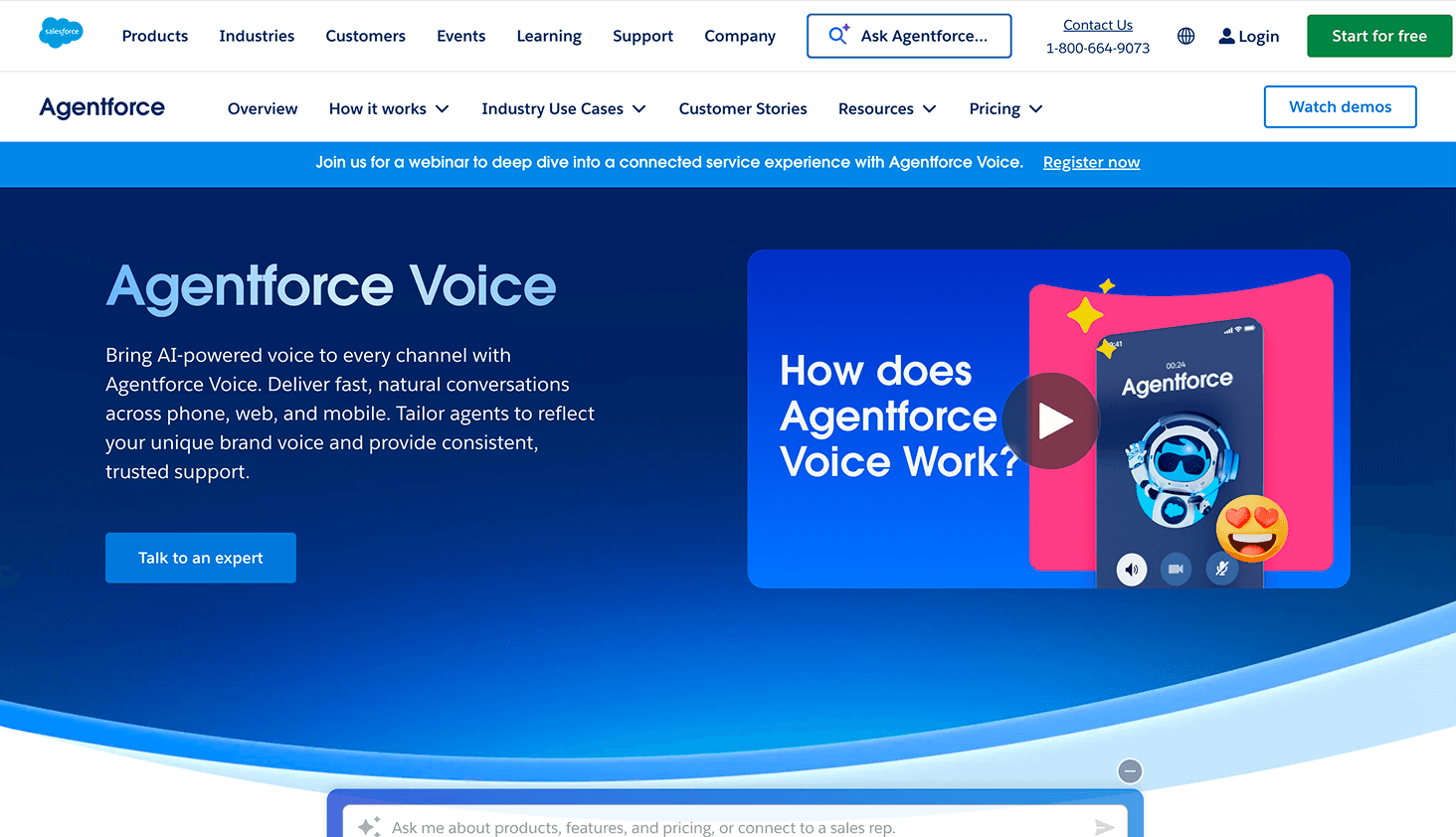
Agentforce Voice AI is Salesforce’s voice-enabled agent system designed to handle customer service conversations across phone, web, and mobile channels. It extends existing Agentforce capabilities to voice, allowing teams to manage real-time conversations using CRM context and shared service logic.

  • Salesforce-Native Voice Agents: Voice agents are built directly within the Salesforce ecosystem, using the same Agentforce Builder used for digital agents.

  • Multi-Channel Voice Deployment: A single agent configuration can operate across phone, web, and mobile channels, supporting consistent customer interactions.

  • CRM-Grounded Conversations: Voice agents access customer history, preferences, and prior interactions stored in Salesforce to guide responses and actions.

Cons

  • Strong dependency on Salesforce limits flexibility for non-Salesforce environments.

  • Setup and customization may require Salesforce expertise and configuration time.

  • Pricing structure can be complex for smaller support teams.

Best For: Customer service organizations already operating on Salesforce that want to add voice-based AI support while keeping all agent logic, customer data, and workflows within a single CRM platform.

4. Decagon.ai

Decagon.ai

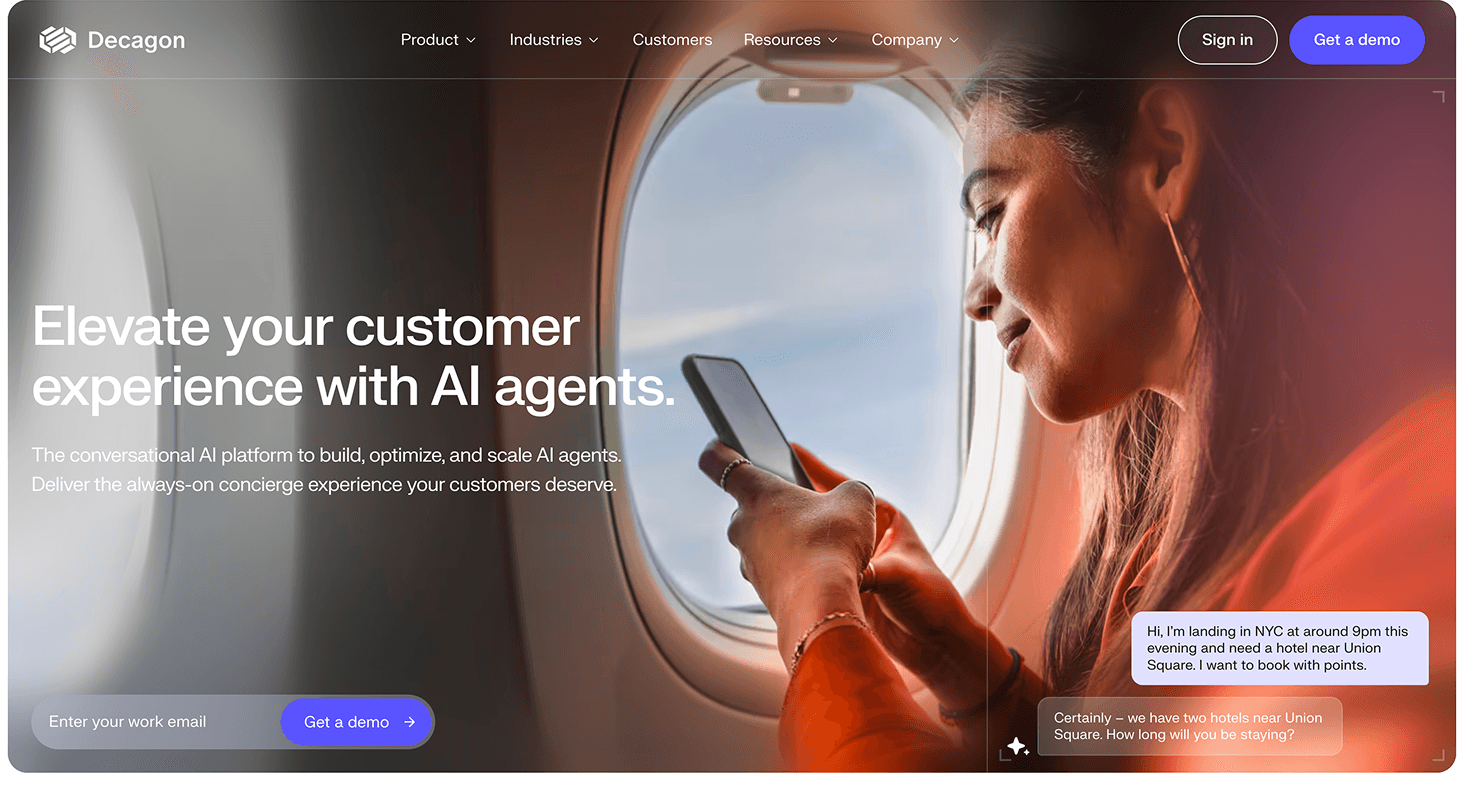
Decagon.ai is a voice AI platform designed to handle customer service calls with natural dialogue, low latency, and strong brand control. It focuses on real-time voice agents that maintain context across channels and support smooth transitions between automated and human-assisted support.

  • Real-Time Voice Conversations: Delivers fast, human-like responses while managing interruptions and shifts in customer intent during live calls.

  • Brand-Customized Voice Agents: Allows teams to adjust tone, language, pronunciation, and speaking style to match brand guidelines and domain terminology.

  • Cross-Channel Memory: Preserves customer context across voice, chat, email, and SMS to support connected, continuous service experiences.

Cons

  • An enterprise-focused feature set may exceed the needs of small support teams.

  • Configuration of brand voice and cross-channel flows can require upfront setup time.

  • Pricing details are not publicly disclosed.

Best For: Enterprises that want voice AI agents capable of natural conversations, strong brand alignment, and consistent customer context across multiple service channels.

5. Cresta

Cresta

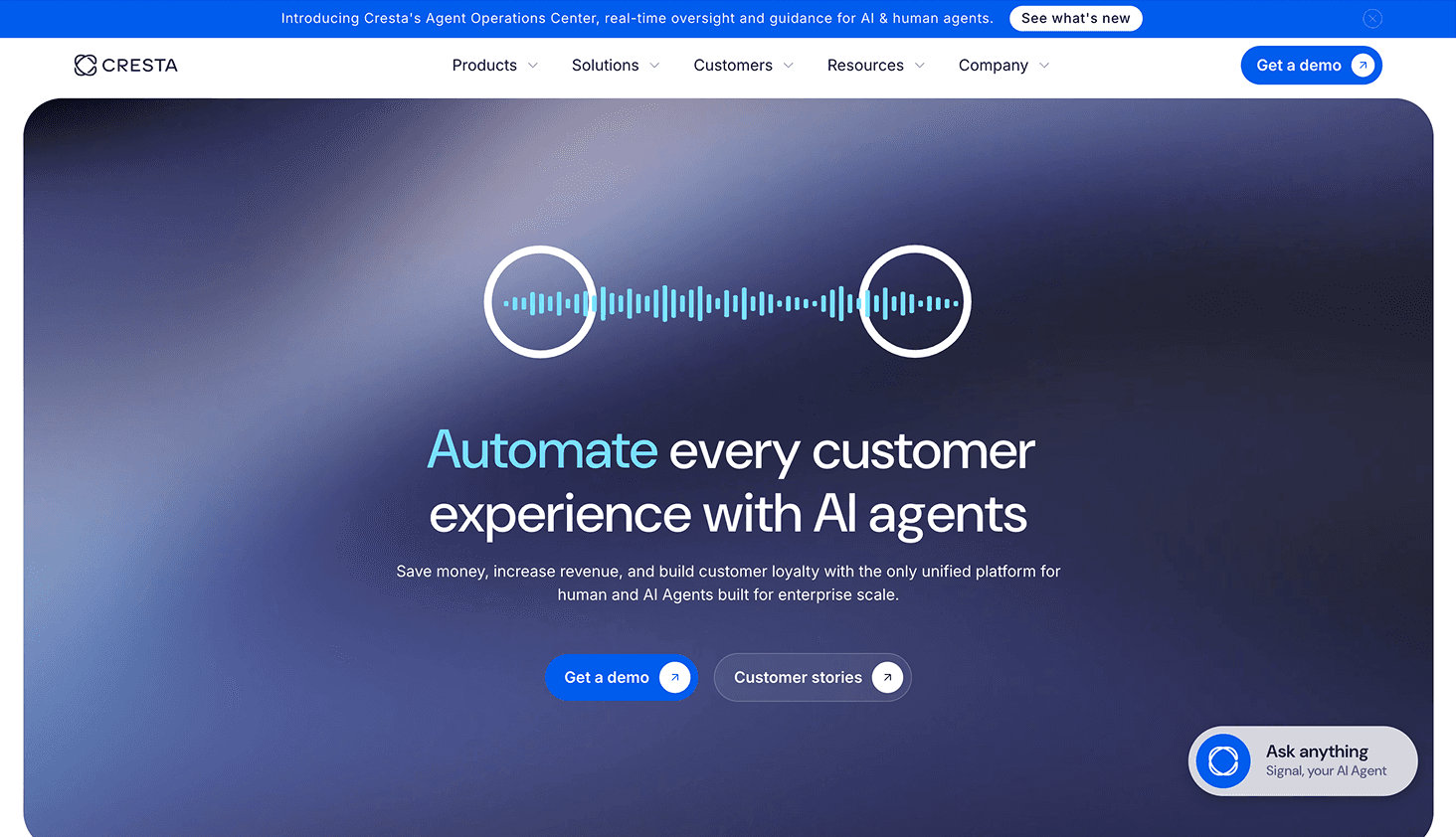
Cresta is a conversation intelligence and agent guidance platform built for enterprise contact centers. It focuses on analyzing customer conversations in real time and at scale to improve agent performance, quality management, and operational outcomes across voice and digital channels.

  • AI-Powered Conversation Intelligence: Analyzes conversations for context, behavior, and outcomes rather than simple keyword detection, helping teams focus on what drives results.

  • Real-Time Agent Assist: Provides in-the-moment alerts and guidance to agents during live conversations to improve accuracy, compliance, and resolution quality.

  • Outcome-Driven Insights: Prioritizes insights based on business goals such as resolution rates, handle time, sales outcomes, and customer satisfaction.

Cons

  • Does not operate as a standalone voice agent for handling calls end-to-end.

  • Best value depends on having sufficient call volume and agent activity.

  • Primarily focused on intelligence and guidance rather than call automation.

Best For: Enterprise contact centers that want deep visibility into customer conversations, real-time agent guidance, and measurable improvements in quality, coaching, and performance outcomes.

6. Observe.AI

Observe.AI

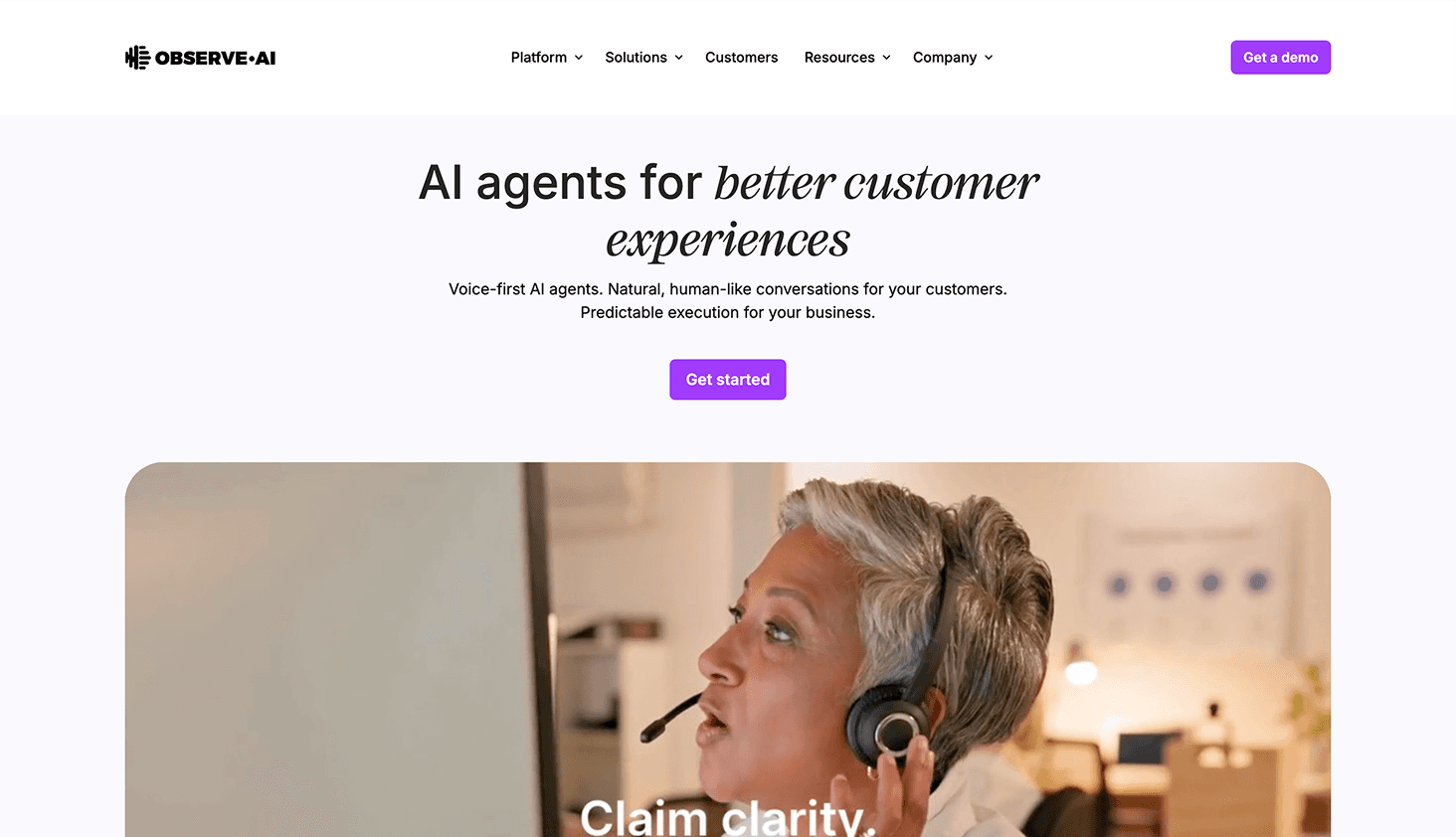
Observe.AI offers voice-first AI agents designed to handle customer service calls with accuracy, speed, and controlled handoffs to human agents. The platform combines speech recognition, language understanding, task-specific models, and natural speech output to support real-world contact center operations.

  • Customized Speech-to-Text: Captures names, numbers, dates, amounts, emails, and IDs reliably, even with accents, background noise, and interruptions.

  • Spoken Language Understanding: Interprets disfluencies, emotions, and turn-taking to maintain accurate call flow in noisy support environments.

  • Task-Specific AI Models: Use purpose-built models for defined workflows, supporting multi-step reasoning and accurate task execution.

Cons

  • Configuration and quality tuning may require careful setup for complex workflows.

  • Enterprise pricing and feature depth may exceed the needs of small teams.

  • Focus is broader across AI agents and copilots rather than voice-only use cases.

Best For: Large contact centers that want voice AI agents integrated into existing systems, with strong speech accuracy, multilingual coverage, and controlled escalation to human support.

Voice AI Pricing Comparison for Customer Service (2026)


Platform

Entry Pricing

Pricing Model

Voice Usage Pricing

Enterprise / On-Prem

Smallest.ai

Free plan available

Subscription + usage

From ~$0.07–$0.20 per minute (region & plan based)

Custom pricing with on-prem / VPC support

pasted

Sierra.ai

Not publicly listed

Enterprise contract

Custom

Enterprise-only, sales-led

Agentforce Voice AI

$2 per conversation or $500 per 100k Flex Credits

Consumption-based (Conversations or Flex Credits)

Voice actions consume Flex Credits

Salesforce enterprise licensing required

pasted

Decagon.ai

Not publicly listed

Enterprise subscription

Custom

Enterprise-only, sales-led

Cresta

Not publicly listed

Enterprise subscription

Not usage-based voice pricing

Enterprise contact centers

Observe.AI

Not publicly listed

Enterprise plans by capability

Custom

Enterprise-only pricing

pasted


Choosing the right voice AI solutions for customer service depends on call volume, system complexity, and how much responsibility AI should carry. In 2026, teams prioritize reliability, control, and operational fit over surface-level features.

Explore how production-grade voice agents improve call handling, reliability, and scale in real operations. Key Benefits of Voice AI in Customer Service

What’s Next for Voice AI Solution in Customer Experience: 5 2026 Predictions

By 2026, Voice AI shifts from assisted automation to primary execution within customer service operations. Teams focus on systems that handle real calls reliably, act inside core business tools, and deliver consistent outcomes across high volumes and regulated workflows.

  • Voice AI Takes First-Call Ownership: Voice agents resolve complete requests such as balance checks, order updates, appointment changes, and eligibility verification without default handoffs. Escalation occurs only when policy, risk, or exception thresholds are reached.

  • Latency Becomes a CX Performance Metric: Sub-second response timing and stable turn-taking directly influence caller trust and call completion rates. Platforms that reduce speech gaps and interruptions outperform slower systems during live conversations.

  • Structured Data Accuracy Becomes Non-Negotiable: Accurate capture and playback of numbers, names, dates, reference IDs, and verification steps separates production-ready systems from pilots, especially in financial services, healthcare, and telecom support.

  • Voice Agents Operate Inside Core Systems: AI agents read and write directly to CRMs, billing platforms, order systems, and ticketing tools. Voice AI shifts from answering questions to completing actions during the call.

  • Context Persistence Across Channels Becomes Standard: Callers carry history from chat, email, and prior calls into new voice interactions. Repetition drops as agents reference past intent, outcomes, and unresolved issues automatically.

In 2026, Voice AI succeeds where it delivers predictable call resolution, fast response timing, and direct system execution, positioning voice as a primary service channel rather than a supporting layer.

See how real-time response speed impacts call quality, agent performance, and customer experience at scale. Why Low Latency Is the Real MVP in Voice AI

Final Thoughts!

Voice AI solutions for customer service have settled into an execution phase. Teams now judge platforms by how reliably they handle live calls, how well they fit into existing operations, and how much confidence they provide under real call volume. The shift is away from experimentation and toward predictable performance, control, and measurable call outcomes.

For teams that rely on phone-based support at scale, smallest.ai is built specifically for real-time voice operations. Its focus on low-latency conversations, live system access, and production-grade deployment makes it a practical choice for running voice agents in active customer environments. 

Explore how smallest.ai supports dependable voice agents in production. Get a demo.

FAQs

1. Which AI Model Is Best for Real-Time Customer Support?

The best AI model for real-time customer support is one built for low-latency voice or chat interactions, accurate intent detection, and stable performance during live conversations. Models used in production support environments prioritize fast response timing, structured data handling, and consistent behavior under high call or message volume.

2. What Are the Best AI Customer Support Tools for 2025?

The best AI customer support tools for 2025 are platforms that handle live customer interactions across voice and digital channels while connecting directly to CRMs and support systems. Buyers look for tools that resolve issues during the interaction rather than routing customers through multiple handoffs.

3. What Are the Best AI Tools for Customer Service Automation?

The best AI tools for customer service automation automate high-frequency tasks such as account lookups, order status checks, appointment changes, and verification flows. Strong tools operate within existing workflows and follow service rules, rather than acting as standalone bots.

4. What Makes a Top-Rated AI Customer Service Tool?

Top-rated AI customer service tools are measured by reliability, response speed, and resolution consistency. Ratings tend to favor platforms that reduce repeat contacts, handle live conversations accurately, and provide clear visibility into call outcomes and agent performance.

5. Is It the Best Conversational AI for Customer Service?

A conversational AI platform is considered among the best for customer service when it can manage natural dialogue, handle interruptions, and complete tasks during the interaction. Buyers usually validate this by testing live conversations, escalation handling, and system integration rather than relying on demo scripts.

“Hi, I have a quick question.”
It sounds simple, but support teams know it rarely is. One call turns into multiple system checks, repeated verification, and longer handle time than planned.

That friction is why teams search for Voice AI in Customer Service. Phone support still handles urgent, high-context issues, yet expectations for speed and accuracy keep rising. Operations and CX leaders are looking for ways to resolve calls faster without adding headcount or increasing risk.

Interest in voice AI solutions for customer service keeps growing as these pressures compound. By the end of 2033, the Voice AI market is projected to reach approximately USD 65.5 billion, reflecting demand for faster conversations, consistent handling, and always-available support. Buyers evaluating voice AI are focused on whether it can manage live calls, follow service rules, and fit into existing systems.

In this guide, we examine how platforms such as Smallest.ai, Sierra.ai, Agentforce Voice AI, Decagon.ai, Cresta, and Observe.AI provide voice AI solutions for customer services and where each fits in real support environments.

Key Takeaways


  • Voice AI Is Now Operational: Teams use voice AI to handle real calls at scale, not pilots or experiments.

  • Call Ownership Matters More Than Features: Platforms are judged by resolution depth, not demos or surface capabilities.

  • Latency Directly Impacts Trust: Faster responses and clean turn-taking shape caller confidence and completion rates.

  • System Access Separates Leaders: Voice agents that act inside CRMs and billing tools outperform reply-only systems.

  • Platform Fit Beats Rankings: The right choice depends on call volume, workflows, and deployment control.

Why Customer Service Teams Are Adopting Voice AI at Scale


Why Customer Service Teams Are Adopting Voice AI at Scale

Customer service teams face rising call volumes, tighter response expectations, and growing pressure to control costs while maintaining service quality. Voice AI solutions for customer service adoption reflect these operational realities rather than experimentation.


  • Rising Call Volumes Without Headcount Growth: Support teams handle more inbound and outbound calls each year, while hiring and training agents remains slow and costly. Voice AI absorbs repetitive and high-frequency requests without adding staff.

  • Customer Expectations for Immediate Resolution: Callers expect fast answers and minimal hold times. Voice AI responds instantly, handles common issues end-to-end, and reduces queue lengths during peak hours.

  • Consistency Across Every Interaction: Human agents vary by shift, experience level, and workload. Voice AI follows the same rules, scripts, and policies on every call, reducing errors in pricing, eligibility, and account details.

  • 24/7 Availability Without Overtime Costs: Global customers call outside standard business hours. Voice AI provides continuous coverage for support, collections, and appointment handling without night shifts or overtime.

  • Better Handling of Structured Information: Voice AI manages numbers, dates, balances, reference IDs, and verification steps with accuracy, lowering rework and call transfers caused by manual entry mistakes.

  • Improved Operational Visibility: Every interaction is logged and measurable. Teams gain clear insight into call outcomes, drop-offs, escalation reasons, and resolution patterns that manual reviews often miss.

Voice AI adoption is driven by scale, predictability, and service continuity, helping customer service teams meet demand without sacrificing response quality or operational control.

Best Voice AI Solutions for Customer Service in 2026

Voice AI solutions in customer service vary widely in scope, depth, and operating model. Some systems focus on fully automated phone conversations, while others prioritize agent assistance, analytics, or CRM-embedded workflows

Key differences show up in call handling depth, latency tolerance, language coverage, deployment control, and how tightly each platform connects to existing contact center infrastructure. Understanding these distinctions helps teams match platform strengths to real operational needs rather than feature checklists.

1. Smallest.ai


Smallest.ai

Smallest.ai is a voice-first AI platform built for customer service teams that run high-volume, real-time phone operations. It focuses on low-latency voice agents, strong language handling, and deployment options that meet enterprise security and scale requirements.

  • Real-Time Voice Agents: Handles live inbound and outbound calls with low latency, enabling full conversations rather than post-call analysis.

  • Human-Like Speech Generation: Uses expressive text-to-speech models that maintain natural pacing, tone variation, and clarity across long calls.

  • Accuracy With Structured Data: Reliably captures and speaks numbers, dates, balances, IDs, and verification details during calls.

  • High Concurrency Handling: Supports thousands of parallel calls per day without degrading response time or call quality.

  • Multilingual Coverage: Operates across 16+ languages, allowing customer service teams to support global callers from a single system.

  • Custom Agent Logic: Agents follow defined scripts, business rules, and SOPs, covering complex edge cases common in support and collections.

  • On-Premise and Cloud Deployment: Can run on customer infrastructure or cloud environments to meet data residency and compliance needs.

  • Enterprise Security Standards: Designed to align with SOC 2 Type II, HIPAA, and PCI requirements for regulated industries.

  • Developer-Friendly Integration: Offers SDKs and APIs for Python, Node.js, and REST to connect with telephony, CRMs, and internal systems.

Best For: Customer service teams that rely heavily on phone-based support, require predictable call handling at scale, and need strong control over latency, language quality, and data deployment.

Explore how Smallest.ai supports real-time customer service at scale. Request a demo to see live voice agents in action.

2. Sierra.ai


Sierra.ai

Sierra.ai is a voice-focused AI platform designed to handle customer service phone calls with natural conversation flow and deep integration into contact center systems. It emphasizes lifelike speech, service-specific logic, and consistent experiences across voice and digital channels.

  • Lifelike Voice Conversations: Delivers natural speech with controlled pacing, interruption handling, and low response gaps to support long service calls.

  • Service-First Agent Design: Trains agents to recognize brand language, acronyms, product names, order numbers, and customer context.

  • Action-Oriented Voice Agents: Connects directly to internal systems so agents can complete tasks rather than only answer questions.

Cons

  • An enterprise-oriented setup may require longer onboarding cycles.

  • Pricing and configuration details are less transparent for smaller teams.

  • Heavier focus on CX workflows than on lightweight transactional use cases.

Best For: Large customer service organizations that prioritize phone-based CX, require deep call center integration, and want consistent service behavior across voice and digital channels.

3. Agentforce Voice AI


Agentforce Voice AI

Agentforce Voice AI is Salesforce’s voice-enabled agent system designed to handle customer service conversations across phone, web, and mobile channels. It extends existing Agentforce capabilities to voice, allowing teams to manage real-time conversations using CRM context and shared service logic.

  • Salesforce-Native Voice Agents: Voice agents are built directly within the Salesforce ecosystem, using the same Agentforce Builder used for digital agents.

  • Multi-Channel Voice Deployment: A single agent configuration can operate across phone, web, and mobile channels, supporting consistent customer interactions.

  • CRM-Grounded Conversations: Voice agents access customer history, preferences, and prior interactions stored in Salesforce to guide responses and actions.

Cons

  • Strong dependency on Salesforce limits flexibility for non-Salesforce environments.

  • Setup and customization may require Salesforce expertise and configuration time.

  • Pricing structure can be complex for smaller support teams.

Best For: Customer service organizations already operating on Salesforce that want to add voice-based AI support while keeping all agent logic, customer data, and workflows within a single CRM platform.

4. Decagon.ai


Decagon.ai

Decagon.ai is a voice AI platform designed to handle customer service calls with natural dialogue, low latency, and strong brand control. It focuses on real-time voice agents that maintain context across channels and support smooth transitions between automated and human-assisted support.

  • Real-Time Voice Conversations: Delivers fast, human-like responses while managing interruptions and shifts in customer intent during live calls.

  • Brand-Customized Voice Agents: Allows teams to adjust tone, language, pronunciation, and speaking style to match brand guidelines and domain terminology.

  • Cross-Channel Memory: Preserves customer context across voice, chat, email, and SMS to support connected, continuous service experiences.

Cons

  • An enterprise-focused feature set may exceed the needs of small support teams.

  • Configuration of brand voice and cross-channel flows can require upfront setup time.

  • Pricing details are not publicly disclosed.

Best For: Enterprises that want voice AI agents capable of natural conversations, strong brand alignment, and consistent customer context across multiple service channels.

5. Cresta


Cresta

Cresta is a conversation intelligence and agent guidance platform built for enterprise contact centers. It focuses on analyzing customer conversations in real time and at scale to improve agent performance, quality management, and operational outcomes across voice and digital channels.

  • AI-Powered Conversation Intelligence: Analyzes conversations for context, behavior, and outcomes rather than simple keyword detection, helping teams focus on what drives results.

  • Real-Time Agent Assist: Provides in-the-moment alerts and guidance to agents during live conversations to improve accuracy, compliance, and resolution quality.

  • Outcome-Driven Insights: Prioritizes insights based on business goals such as resolution rates, handle time, sales outcomes, and customer satisfaction.

Cons

  • Does not operate as a standalone voice agent for handling calls end-to-end.

  • Best value depends on having sufficient call volume and agent activity.

  • Primarily focused on intelligence and guidance rather than call automation.

Best For: Enterprise contact centers that want deep visibility into customer conversations, real-time agent guidance, and measurable improvements in quality, coaching, and performance outcomes.

6. Observe.AI


Observe.AI

Observe.AI offers voice-first AI agents designed to handle customer service calls with accuracy, speed, and controlled handoffs to human agents. The platform combines speech recognition, language understanding, task-specific models, and natural speech output to support real-world contact center operations.

  • Customized Speech-to-Text: Captures names, numbers, dates, amounts, emails, and IDs reliably, even with accents, background noise, and interruptions.

  • Spoken Language Understanding: Interprets disfluencies, emotions, and turn-taking to maintain accurate call flow in noisy support environments.

  • Task-Specific AI Models: Use purpose-built models for defined workflows, supporting multi-step reasoning and accurate task execution.

Cons

  • Configuration and quality tuning may require careful setup for complex workflows.

  • Enterprise pricing and feature depth may exceed the needs of small teams.

  • Focus is broader across AI agents and copilots rather than voice-only use cases.

Best For: Large contact centers that want voice AI agents integrated into existing systems, with strong speech accuracy, multilingual coverage, and controlled escalation to human support.

Voice AI Pricing Comparison for Customer Service (2026)


Platform

Entry Pricing

Pricing Model

Voice Usage Pricing

Enterprise / On-Prem

Smallest.ai

Free plan available

Subscription + usage

From ~$0.07–$0.20 per minute (region & plan based)

Custom pricing with on-prem / VPC support

pasted

Sierra.ai

Not publicly listed

Enterprise contract

Custom

Enterprise-only, sales-led

Agentforce Voice AI

$2 per conversation or $500 per 100k Flex Credits

Consumption-based (Conversations or Flex Credits)

Voice actions consume Flex Credits

Salesforce enterprise licensing required

pasted

Decagon.ai

Not publicly listed

Enterprise subscription

Custom

Enterprise-only, sales-led

Cresta

Not publicly listed

Enterprise subscription

Not usage-based voice pricing

Enterprise contact centers

Observe.AI

Not publicly listed

Enterprise plans by capability

Custom

Enterprise-only pricing

pasted


Choosing the right voice AI solutions for customer service depends on call volume, system complexity, and how much responsibility AI should carry. In 2026, teams prioritize reliability, control, and operational fit over surface-level features.

Explore how production-grade voice agents improve call handling, reliability, and scale in real operations. Key Benefits of Voice AI in Customer Service

What’s Next for Voice AI Solution in Customer Experience: 5 2026 Predictions

By 2026, Voice AI shifts from assisted automation to primary execution within customer service operations. Teams focus on systems that handle real calls reliably, act inside core business tools, and deliver consistent outcomes across high volumes and regulated workflows.

  • Voice AI Takes First-Call Ownership: Voice agents resolve complete requests such as balance checks, order updates, appointment changes, and eligibility verification without default handoffs. Escalation occurs only when policy, risk, or exception thresholds are reached.

  • Latency Becomes a CX Performance Metric: Sub-second response timing and stable turn-taking directly influence caller trust and call completion rates. Platforms that reduce speech gaps and interruptions outperform slower systems during live conversations.

  • Structured Data Accuracy Becomes Non-Negotiable: Accurate capture and playback of numbers, names, dates, reference IDs, and verification steps separates production-ready systems from pilots, especially in financial services, healthcare, and telecom support.

  • Voice Agents Operate Inside Core Systems: AI agents read and write directly to CRMs, billing platforms, order systems, and ticketing tools. Voice AI shifts from answering questions to completing actions during the call.

  • Context Persistence Across Channels Becomes Standard: Callers carry history from chat, email, and prior calls into new voice interactions. Repetition drops as agents reference past intent, outcomes, and unresolved issues automatically.

In 2026, Voice AI succeeds where it delivers predictable call resolution, fast response timing, and direct system execution, positioning voice as a primary service channel rather than a supporting layer.

See how real-time response speed impacts call quality, agent performance, and customer experience at scale. Why Low Latency Is the Real MVP in Voice AI

Final Thoughts!

Voice AI solutions for customer service have settled into an execution phase. Teams now judge platforms by how reliably they handle live calls, how well they fit into existing operations, and how much confidence they provide under real call volume. The shift is away from experimentation and toward predictable performance, control, and measurable call outcomes.

For teams that rely on phone-based support at scale, smallest.ai is built specifically for real-time voice operations. Its focus on low-latency conversations, live system access, and production-grade deployment makes it a practical choice for running voice agents in active customer environments. 

Explore how smallest.ai supports dependable voice agents in production. Get a demo.

FAQs

1. Which AI Model Is Best for Real-Time Customer Support?

The best AI model for real-time customer support is one built for low-latency voice or chat interactions, accurate intent detection, and stable performance during live conversations. Models used in production support environments prioritize fast response timing, structured data handling, and consistent behavior under high call or message volume.

2. What Are the Best AI Customer Support Tools for 2025?

The best AI customer support tools for 2025 are platforms that handle live customer interactions across voice and digital channels while connecting directly to CRMs and support systems. Buyers look for tools that resolve issues during the interaction rather than routing customers through multiple handoffs.

3. What Are the Best AI Tools for Customer Service Automation?

The best AI tools for customer service automation automate high-frequency tasks such as account lookups, order status checks, appointment changes, and verification flows. Strong tools operate within existing workflows and follow service rules, rather than acting as standalone bots.

4. What Makes a Top-Rated AI Customer Service Tool?

Top-rated AI customer service tools are measured by reliability, response speed, and resolution consistency. Ratings tend to favor platforms that reduce repeat contacts, handle live conversations accurately, and provide clear visibility into call outcomes and agent performance.

5. Is It the Best Conversational AI for Customer Service?

A conversational AI platform is considered among the best for customer service when it can manage natural dialogue, handle interruptions, and complete tasks during the interaction. Buyers usually validate this by testing live conversations, escalation handling, and system integration rather than relying on demo scripts.

Automate your Contact Centers with Us

Experience fast latency, strong security, and unlimited speech generation.

Automate Now

Talk to a voice expert

Experience the fastest voice ai, book a demo now!

1160 Battery Street East, San Francisco, CA, 94111

Products

Coming Soon

Coming Soon

Coming Soon

Coming Soon

Coming Soon

Coming Soon

Industries

Coming Soon

Coming Soon

Coming Soon

Coming Soon

Coming Soon

Coming Soon

Coming Soon

Others

Coming Soon

Coming Soon

Legal

Coming Soon

Coming Soon

Coming Soon

Coming Soon

Coming Soon

Coming Soon

Talk to a voice expert

Experience the fastest voice ai, book a demo now!

1160 Battery Street East, San Francisco, CA, 94111

Products

Coming Soon

Coming Soon

Coming Soon

Coming Soon

Coming Soon

Coming Soon

Industries

Coming Soon

Coming Soon

Coming Soon

Coming Soon

Coming Soon

Coming Soon

Coming Soon

Others

Coming Soon

Coming Soon

Legal

Coming Soon

Coming Soon

Coming Soon

Coming Soon

Coming Soon

Coming Soon

Talk to a voice expert

Experience the fastest voice ai, book a demo now!

1160 Battery Street East, San Francisco, CA, 94111

Products

Coming Soon

Coming Soon

Coming Soon

Coming Soon

Coming Soon

Coming Soon

Industries

Coming Soon

Coming Soon

Coming Soon

Coming Soon

Coming Soon

Coming Soon

Coming Soon

Others

Coming Soon

Coming Soon

Legal

Coming Soon

Coming Soon

Coming Soon

Coming Soon

Coming Soon

Coming Soon