Why Advanced AI Assistants Now Sit Inside Banking Operations

Learn why manual banking controls fail under pressure and how advanced AI assistants move fraud detection and execution into live customer interactions.
In 2024, Nationwide Bank in the UK was fined £44 million for long-standing failures in financial crime controls that allowed fraud-related payments to pass through unchecked. This was not a systems outage or a cyber breach.
It was a breakdown of manual oversight, fragmented workflows, and delayed detection inside everyday banking operations. Fraud was not missed because signals were unavailable. It was missed because humans and legacy processes were expected to react fast enough, consistently enough, under volume and pressure.
This is where AI in banking enters the picture, not as a digital assistant for convenience, but as an operational necessity. Advanced AI assistants now operate inside live customer interactions, listening, verifying, and acting in real time.
They authenticate callers during conversations, detect fraud signals as they emerge, and block risky actions before money moves or data is exposed. Unlike manual reviews or post-event audits, these systems apply the same controls on every call, every time, without fatigue or delay.
This blog examines what advanced AI assistants for banking truly represent today. It breaks down how they differ from traditional AI chatbots, where they outperform human-led workflows, and why voice has become the control layer for modern banking operations
Key Takeaways
Advanced AI Assistants Fix Operational Failures: Banking failures arise from slow manual controls. Advanced AI enforces verification, fraud detection, and compliance during live customer interactions.
Voice Becomes the Control Layer: Real-time voice AI authenticates, evaluates risk, and executes regulated actions before funds move or data is exposed.
Execution Replaces Conversation: Advanced AI assistants complete banking actions end-to-end, eliminating repeat calls, agent handoffs, and unresolved service tickets.
Fraud Detection Moves Upstream: Behavioral risk, identity verification, and action gating occur during calls, not after transactions or audits.
Scale Without Losing Control: Deterministic workflows and full audit trails allow banks to handle peak volumes without increasing agents or regulatory exposure.
What Advanced AI Assistants for Banking Really Mean Today
Advanced AI assistants for banking are not upgraded chatbots, and they are not scripted virtual agents. They function as real-time execution layers that can listen, decide, act, and verify outcomes inside regulated banking workflows.
Today, an advanced AI assistant is defined by what it can complete, not what it can answer.
Instead of responding to FAQs, these assistants:
Authenticate customers during live voice interactions.
Execute account actions across core banking systems.
Detect risk signals mid-conversation and intervene immediately.
Route or escalate only when human judgment is required.
Log every decision path for audit and compliance review.
The practical impact is structural. Banks move from support automation to operational automation inside customer conversations.
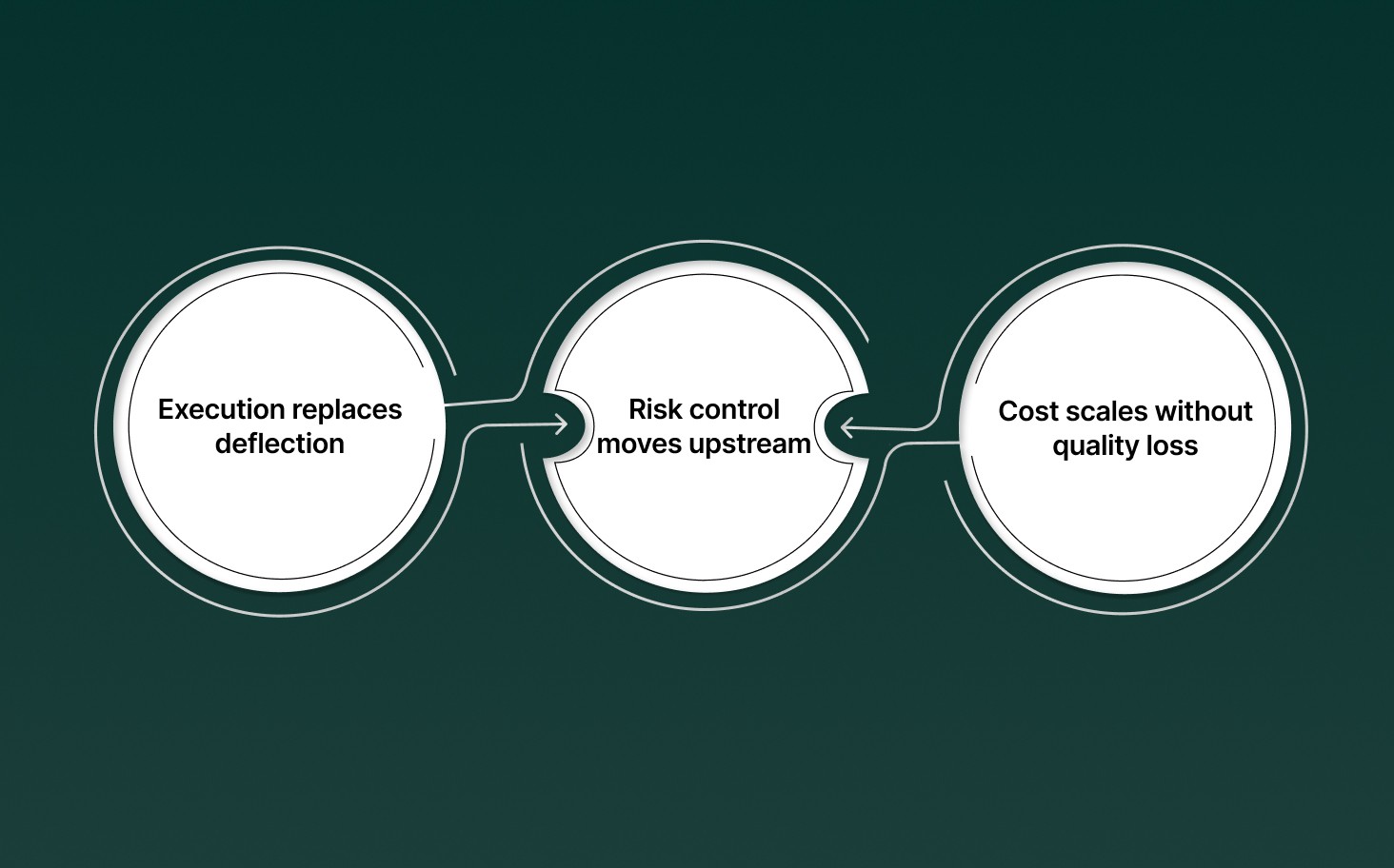
From a business output perspective, this shift delivers three measurable results:
1. Execution replaces deflection: Advanced AI assistants complete tasks end to end. Balance checks, card blocks, payment confirmations, EMI reminders, delinquency follow-ups, and service requests close inside a single interaction. This reduces repeat calls, human handoffs, and unresolved tickets.
2. Risk control moves upstream: Fraud detection, identity verification, and anomaly detection happen during the conversation, not after. Voice patterns, intent shifts, and behavioral signals are evaluated in real time, reducing fraud exposure before funds move or data is disclosed.
3. Cost scales without quality loss: Banks handle peak volumes without adding agents. Service levels remain consistent because the assistant follows deterministic workflows, enforces policy logic, and never deviates under pressure.
What makes these assistants “advanced” is not intelligence in isolation, but control:
Control over timing
Control over actions
Control over compliance
Control over escalation
In practice, advanced AI assistants become part of the bank’s operational fabric. They do not sit on top of systems. They operate inside them, executing safely, measurably, and at scale.
This is why banks evaluating advanced AI assistants are no longer asking what it can say. They are asking what it can safely do, at volume, under regulation.
See the leading options for automated response systems and compare capabilities in 6 of the Best AI Answering Services You Must Check Out
AI Chatbot for Banking vs Advanced Voice AI Assistant: A Practical Comparison
The difference between an AI chatbot for banking and an advanced voice AI assistant is not capability depth alone. It is an operational responsibility. One answers questions. The other executes regulated workflows.
Dimension | AI Chatbot for Banking | Advanced Voice AI Assistant for Banking |
Primary Role | Responds to customer queries | Executes banking actions end-to-end |
Interaction Mode | Text-first, form-based | Real-time voice with interruption handling |
Task Completion | Information delivery and ticket creation | Action completion inside core systems |
Identity Verification | OTP or post-handoff verification | Continuous voice-based authentication |
Fraud Handling | Flags issues after interaction | Detects and blocks risk during the call |
Compliance Coverage | Partial, post-interaction review | Full call-level logging and audit trails |
Escalation Logic | Manual or rule-based handoff | Context-aware escalation with summaries |
Peak Volume Handling | Degrades under load | Scales without latency or quality loss |
Error Tolerance | High retries and repeated calls | Single-call resolution focus |
Business Outcome | Cost deflection | Cost reduction with risk control |
Impact in practice
Chatbots reduce agent workload by deflecting queries.
Advanced voice AI assistants reduce operational costs by completing transactions.
Banks using chatbots still rely on human agents for identity checks, sensitive actions, and fraud handling. Banks using advanced voice AI assistants shift those responsibilities safely into automated execution.
The output difference is clear:
Fewer repeat calls
Lower fraud exposure
Higher first-call resolution
Predictable compliance outcomes
This is why advanced voice AI assistants are deployed where failure is expensive and latency matters, while chatbots remain limited to low-risk, informational use cases.
Core Capabilities of Advanced AI Assistants for Banking
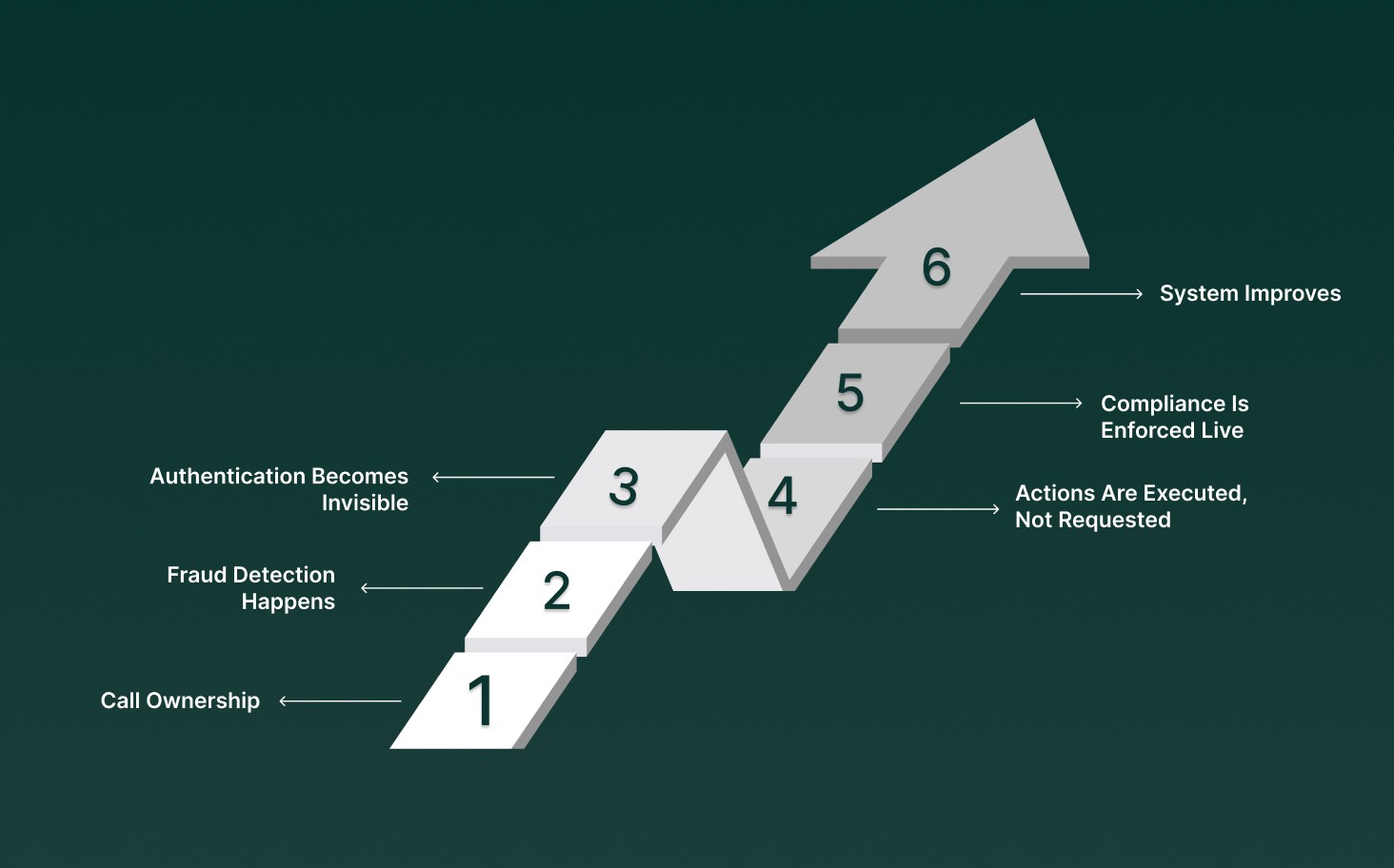
Advanced AI assistants for banking exist to replace failure points in current contact center and service operations. Their value is not conversational quality. Their value is control, execution, and risk containment at scale.
1. Call Ownership From First Second to Final Outcome
Traditional AI chatbots deflect calls. Advanced AI assistants own the call end-to-end.. They identify intent immediately, authenticate continuously, execute the required banking action, and close the interaction without handoffs or human cleanup.
What changes in practice:
Calls stop bouncing between IVR, bots, and agents.
First-call resolution becomes the default, not a metric to chase.
Contact centers stop acting as routing hubs and start acting as exception handlers.
2. Fraud Detection Happens During the Conversation, Not After
Most banking fraud controls activate after money moves or data is exposed. Advanced AI assistants detect risk during live voice interactions. They monitor voice behavior, response timing, language shifts, and transaction context during the call.
What changes in practice:
Social engineering attempts are interrupted mid-call.
High-risk actions are blocked before execution.
Fraud teams receive fewer alerts but higher-quality ones.
3. Authentication Becomes Invisible for Legitimate Customers
Legacy systems rely on step-based verification that frustrates real users and still fails against skilled attackers. Advanced AI assistants implicitly authenticate using voice, behavioral signals, and session context throughout the entire interaction.
What changes in practice:
Fewer security questions, PIN resets, or callbacks.
Lower abandonment during sensitive workflows.
Stronger security without adding customer friction.
4. Actions Are Executed, Not Requested
Chatbots stop at intent recognition. Advanced AI assistants complete banking actions. They update account states, trigger workflows, log disclosures, and apply business rules in real time.
What changes in practice:
Balance checks turn into completed transfers.
Card issues turn into instant blocks and reissues.
Payment reminders turn into confirmed settlements.
No follow-ups. No agent dependency.
5. Compliance Is Enforced Live, Not Audited Later
Compliance failures usually surface during audits, long after the customer interaction ends. Advanced AI assistants enforce compliance inside the conversation. They apply jurisdiction rules, capture consent, enforce disclosures, and log evidence automatically.
What changes in practice:
QA stops sampling and starts seeing full coverage.
Regulatory risk shifts from reactive to preventative.
Compliance teams review outcomes, not transcripts.
6. The System Improves From Operational Outcomes, Not Scripts
Chatbots improve by tuning prompts. Advanced AI assistants improve by analyzing what actually failed. Escalations, fraud flags, repeat calls, and unresolved issues feed back into execution logic.
What changes in practice:
Resolution rates improve without retraining agents.
Call flows evolve without manual redesign.
Operational cost declines structurally, not incrementally.
Why This Is the Core of the Shift
Advanced AI assistants do not optimize conversations. They replace brittle service infrastructure with systems that can safely act, verify, and comply in real time.
At this layer, AI stops being a support tool and becomes a banking-grade operational infrastructure.
See how leading financial institutions are applying AI across risk, service, and operations in Top 6 Applications of AI in Financial Services Today
Advanced AI Assistants Powering Modern Banking Operations
Banks are deploying advanced AI assistants to handle real-time conversations, execute backend actions, and enforce compliance across service, fraud, and collections. These systems combine voice or chat interfaces with orchestration, analytics, and governance layers to support production banking workloads.
Smallest.ai: Real-time voice AI stack with sub-second latency, streaming ASR/TTS, deterministic call control, and programmable agent logic. Designed for regulated banking use cases such as collections, fraud callbacks, and service escalations where turn-level accuracy and auditability matter.
Decagon AI: Autonomous AI agents capable of handling multi-step customer service workflows across chat and voice. Supports intent resolution, backend action execution, and tool orchestration for account servicing and support automation.
Cresta: Conversation intelligence and agent-assist system using real-time NLP, knowledge retrieval, and behavioral models. Focused on live guidance, compliance cues, and performance lift during complex banking interactions.
Observe AI: Speech analytics and automated QA platform with growing agent capabilities. Strong on call transcription accuracy, compliance monitoring, sentiment detection, and scalable conversation review for banking ops teams.
Salesforce Agentforce / Salesforce Einstein: CRM-native AI assistants embedded in Service Cloud. Provides workflow automation, case summarization, intent routing, and data-aware responses tied directly to core banking customer records.
The strongest platforms differentiate in latency, execution control, data access, and regulatory readiness. Selection depends on whether the priority is real-time voice execution, contact center intelligence, or CRM-native automation.
Build real-time banking agents with sub-second voice response, deterministic call control, and compliance-first execution using Smallest.ai.
Fraud Detection and Account Security Through Voice AI Assistants
Fraud in banking contact centers does not begin with transactions. It begins inside live conversations. Voice AI assistants shift fraud control upstream by identifying risk signals during the call itself, before credentials, payments, or account changes are exposed.
Security Control Area | What Voice AI Actually Does | Why It Matters in Banking | Measurable Output |
Pre-Authentication Risk Scoring | Analyzes caller behavior, speech patterns, and intent before credentials are verified | Stops social-engineering attempts before any sensitive data is exposed | Fewer unauthorized balance disclosures and credential resets |
Continuous Voice Authentication | Verifies voice identity throughout the call, not once at login | Prevents mid-call takeovers after initial verification | Reduction in post-auth fraud incidents |
Behavioral Anomaly Detection | Flags abnormal urgency, scripted phrasing, hesitation, or repeated attempts | Detects fraud patterns humans miss during high-volume calls | Higher fraud catch rate with lower false positives |
Real-Time Action Gating | Blocks or delays risky actions like card reissue or payment changes | Prevents irreversible actions during suspicious interactions | Lower financial loss per fraud attempt |
Dynamic Step-Up Verification | Triggers additional verification only when risk increases | Balances security without degrading legitimate CX | Reduced customer friction with stronger controls |
Agent-Independent Enforcement | Applies the same security logic on every call, every time | Removes inconsistency caused by agent judgment or fatigue | Uniform compliance across all interactions |
Full Interaction Audit Trail | Logs decisions, risk scores, and blocked actions automatically | Supports regulatory review and internal investigations | Faster audits and fewer compliance escalations |
Advanced voice AI converts the contact center from a fraud entry point into an active control layer. The outcome is measurable: fewer unauthorized actions, earlier fraud interruption, and consistent enforcement that does not depend on human judgment.
Implementation Roadmap for Advanced AI Assistants in Banking
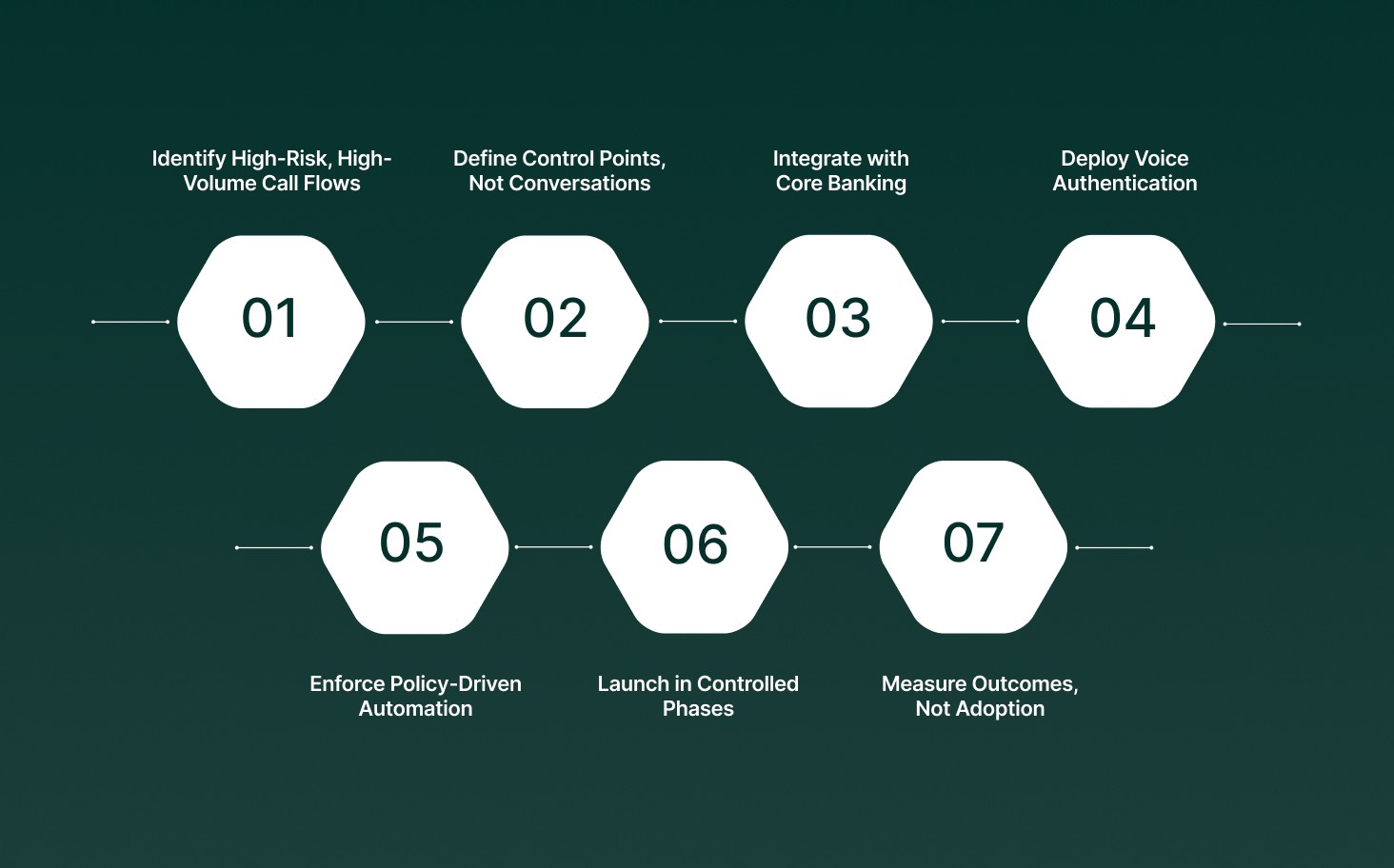
Deploying advanced AI assistants in banking is not a tooling exercise. It is a controlled shift in how calls are verified, decisions are made, and risk is managed in real time across high-impact workflows.
Step 1: Identify High-Risk, High-Volume Call Flows: Start where losses, delays, or escalations already exist, such as authentication, card actions, loan status, or payment changes. Clear priority list of workflows where AI impact is immediate and measurable.
Step 2: Define Control Points, Not Conversations: Map where verification, decisioning, and escalation must occur inside each call, rather than designing scripts. Deterministic rules for what the AI can approve, block, or escalate.
Step 3: Integrate with Core Banking and Risk Systems: Connect the assistant to CRM, account data, fraud signals, and case management tools. Real-time decisions backed by live data, not static responses.
Step 4: Deploy Voice Authentication and Risk Scoring: Introduce continuous voice verification and behavioral risk scoring from call start to call end. Early fraud detection and fewer post-interaction losses.
Step 5: Enforce Policy-Driven Automation
Apply consistent security, compliance, and escalation rules across all calls. Removal of agent-level inconsistency and reduced audit exposure.Step 6: Launch in Controlled Phases: Begin with monitored production rollout before expanding to full call volumes. Stable performance with low operational risk.
Step 7: Measure Outcomes, Not Adoption: Track fraud prevention rate, call resolution speed, escalations avoided, and compliance adherence. Clear ROI tied to risk reduction, cost savings, and service reliability.
Banks that follow a staged, control-first rollout move faster with lower risk. The outcome is measurable: fewer fraud losses, shorter resolution cycles, and consistent compliance at scale.
Why Smallest.ai Fits the Advanced AI Assistant Layer for Banking
Smallest.ai is not positioned as a generic chatbot platform. It fits the advanced AI assistant layer in banking because it is built around real-time voice execution, control, and reliability rather than scripted conversation handling.
Built for Real-Time Voice, Not Deferred Responses: Smallest.ai’s Lightning models generate speech in sub-100ms latency and sustain thousands of concurrent calls. Banking workflows like authentication, card blocking, payment confirmation, and fraud intervention happen inside the call window, not after it.
Enterprise-Grade Control Over Inference and Deployment: Banks can deploy Smallest.ai on-premise or on private infrastructure and run inference on custom hardware. Full data residency, predictable latency, and zero dependency on shared cloud environments for regulated operations.
Voice Accuracy Where Banking Breaks Most Systems: The models handle numbers, acronyms, credit card sequences, OTPs, and account identifiers with correct pacing and intonation. Fewer verification errors, fewer call retries, and lower downstream fraud exposure.
Agent Architecture Designed for Complex SOPs: Smallest.ai agents are built to manage hundreds of edge cases and exception paths instead of linear flows. Banks can automate real workflows like delinquency calls, dispute handling, and compliance-heavy interactions without constant human fallback.
Native Multilingual Execution at Scale: Support for 16+ languages with consistent voice quality across regions. One assistant layer can serve diverse customer bases without fragmenting operations or training multiple systems.
Audit-Ready by Design: SOC 2 Type II, HIPAA, PCI alignment, strict internal audits, and detailed call logs. Every interaction is traceable, reviewable, and defensible during audits.
Developer-First Integration Model: Python, Node.js, REST APIs, and telephony integrations allow banks to plug the voice layer directly into existing stacks. Faster rollout without re-architecting core banking systems.
Smallest.ai fits the advanced AI assistant layer because it executes banking conversations as real-time operational systems, not conversational experiments. The output is measurable: lower fraud exposure, faster resolution, predictable compliance, and voice automation that holds up under enterprise load.
Final Thoughts!
Banks do not fail at fraud prevention or service quality because they lack tools. They fail when manual processes cannot keep pace during live customer interactions. Advanced AI assistants change this by moving control, verification, and execution into the conversation itself, where risk actually emerges.
This is not a shift toward better conversations. It is a shift toward safer, faster, and more reliable operations at scale. Banks that adopt this layer reduce exposure, shorten resolution cycles, and enforce policy consistently under volume and pressure.
Smallest.ai is built for that execution layer. Its real-time voice infrastructure enables banking actions, controls, and compliance to run during live calls, not after.
See how Smallest.ai powers advanced AI assistants for banking. Talk to a voice expert today.
Frequently asked questions
How are advanced AI assistants for banking evaluated beyond customer experience metrics?
Can an AI chatbot for banking handle regulated actions without human approval?
Why do banks deploy advanced AI assistants for banking alongside, not instead of, human agents?
What operational risks increase when banks rely only on an AI chatbot for banking?
How do advanced AI assistants for banking change compliance review processes?