Voice Agent: What It Is & How It Works in 2026

Learn what a voice agent is, how STT, LLMs, and TTS work together, key use cases, common misconceptions, and why latency matters in 2026.
A voice agent is an AI system that listens to spoken language, interprets what the speaker means, and answers back with synthesized speech in real time. Unlike a basic voice command layer, a voice agent can handle multi-turn dialogue, choose between options, and carry out actions for a user or a business.
How a Voice Agent Actually Works
Under the hood, most voice agents still boil down to the same three-stage loop. Speech-to-Text (STT) turns the caller's audio into a transcript. A Large Language Model (LLM) reads that transcript, infers intent, and produces the next response. Text-to-Speech (TTS) turns the response into audio the caller can hear. Each hop adds latency, which is why how to build faster AI voice agents remains one of the most fought-over engineering topics in voice.
The three core stages in detail:
Speech-to-Text (STT): Captures the caller's audio stream and transcribes it with low latency. Get this wrong and everything downstream is guessing from noisy input.
LLM reasoning layer: Processes the transcript against a system prompt, conversation history, and any connected tools or APIs. This is where intent classification, slot filling, and decision logic happen.
Text-to-Speech (TTS): Synthesizes the LLM's text output into natural-sounding audio. Latency here is the difference between a snappy exchange and an awkward pause.
Real deployments add an orchestration layer on top of that loop: it tracks conversation state, supports interruptions (barge-in), escalates to a human when confidence drops, and writes the right logs for QA and compliance. If you want a concrete view of how teams assemble these pieces, the breakdown on designing voice assistants maps the major decisions across the pipeline.
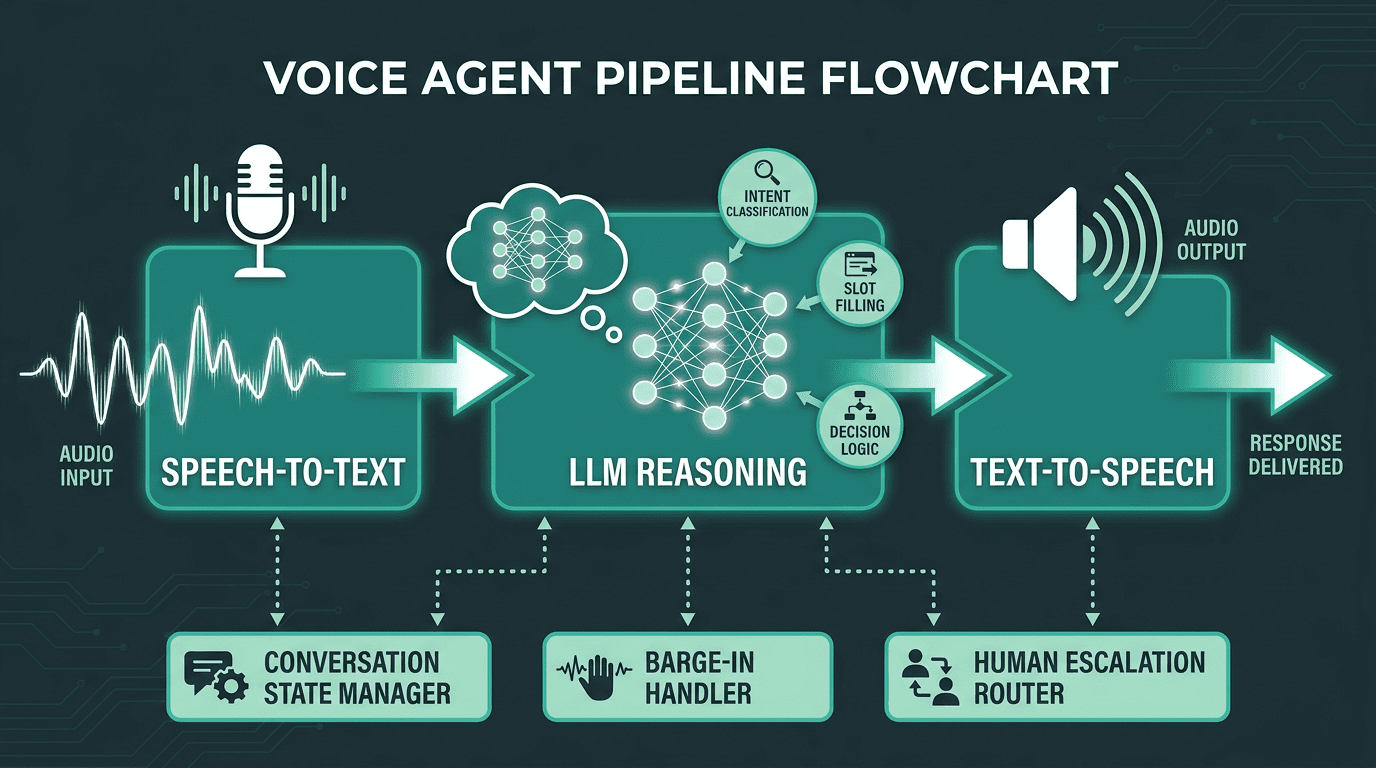
The STT → LLM → TTS loop powers every voice agent, with an orchestration layer handling state, barge-in, and escalation.
Types of Voice Agents
Voice agents are not a single product category so much as a spectrum. The differences matter, because the right architecture (and the right expectations) depends on what you are asking the system to do.
Task-specific agents stay inside a narrow workflow: appointment booking, order status checks, password resets. That constraint is a feature, not a limitation. They are faster to ship, cheaper to operate, and predictable when the call stays within scope. Many enterprise rollouts start here for exactly that reason.
Conversational agents operate across broader domains and more varied conversations than task-specific agents.
Agentic voice systems push past conversation into execution. When a voice agent can pull a CRM record, update a ticket, send a follow-up email, and confirm the outcome out loud on the same call, you are in agentic territory. The AI voice agent frameworks used to build these systems look meaningfully different from what you would use for a simple task agent.
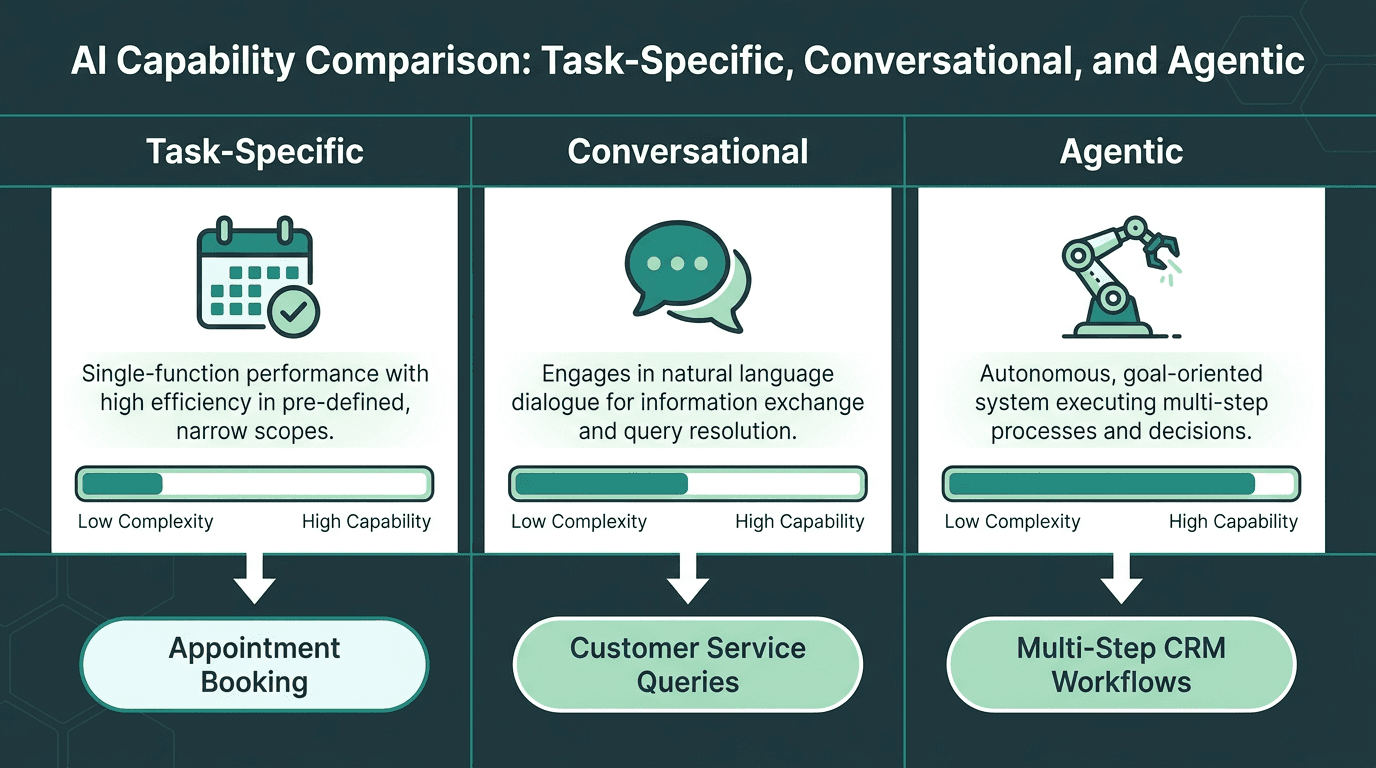
Voice agents span a spectrum — from narrow task executors to fully agentic systems handling multi-step workflows.
Where Voice Agents Are Already Deployed
The best proof that voice agents have grown up is where companies are willing to put them: directly in front of customers, on high-volume lines, with real operational consequences.
Healthcare scheduling is a natural fit because the call volume is relentless and the requests are often repetitive. Clinics and hospital networks use voice agents for appointment booking, prescription refill reminders, and post-discharge follow-up calls. The agent covers the routine work 24/7, while clinical staff stay focused on care delivery.
Financial services use voice agents for account balance inquiries, fraud alert confirmations, and loan application status updates. The bar is higher here: accuracy, auditability, and complete call logging are table stakes. Modern voice agent platforms are built with those requirements in mind, which is why the category is showing up in regulated environments at all.
Retail and e-commerce lean on voice agents for order tracking, return initiation, and promotional outreach. Outbound voice campaigns stand out because concurrency is the whole point: the agent can place and handle thousands of calls at once, without the staffing math collapsing.
Three Things People Get Wrong About Voice Agents
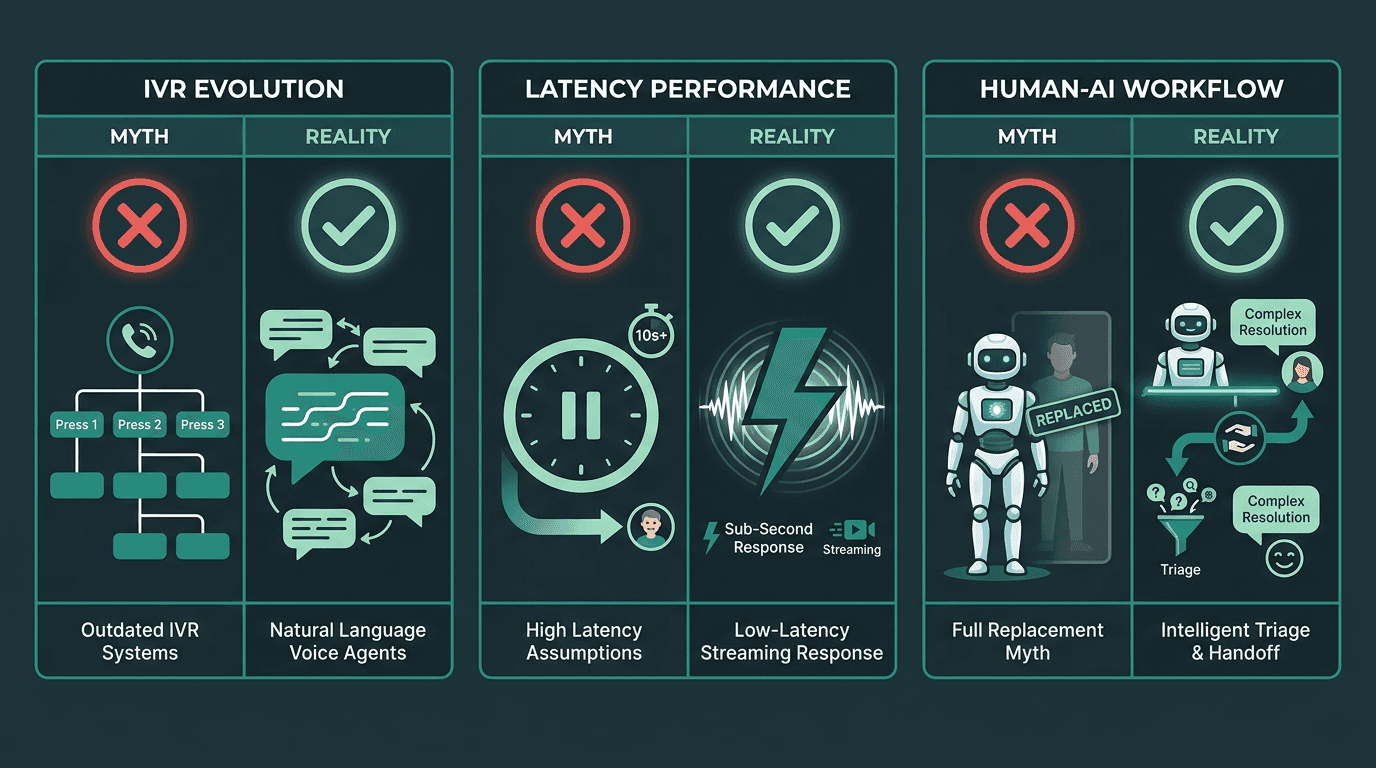
Modern **voice agents** go far beyond IVR — busting three myths about how the technology actually works.
Misconception 1: Voice agents are just upgraded IVR systems. Traditional IVR systems rely on predefined menus and rigid flows. Modern voice agents are designed for natural language interactions and can respond to a wider range of user inputs.
Misconception 2: High latency is unavoidable. Early voice AI often paused for two to four seconds before answering, which is long enough to make people talk over the system or assume it failed. Modern architectures can significantly reduce response latency through streaming speech recognition, optimized inference, and low-latency speech synthesis. Latency is a solvable engineering constraint, not a law of nature.
Misconception 3: Voice agents replace human agents entirely. The deployments that work treat voice agents as a front line, not a full replacement. Let the agent absorb the high-volume, routine calls, then hand off the complex cases (or the emotionally charged ones) to humans. Done well, that is intelligent triage: the agent covers routine and repetitive interactions and escalates the rest.
Key Takeaways
What you need to know about voice agents:
A voice agent is an AI system that takes spoken input, interprets intent with an LLM, and answers with synthesized speech in real time.
The backbone is STT, LLM reasoning, and TTS. Everything else (state, barge-in, escalation) is layered on top.
Voice agents span a range: narrow task agents, broader conversational agents, and agentic systems that take actions via tools and APIs.
Voice agents are increasingly being deployed in customer-facing workflows where reliability and user experience matter.
Latency is the main engineering fight. With the right architecture, response times can be significantly reduced.
Voice agents are increasingly being used across customer support, operations, and business automation workflows.
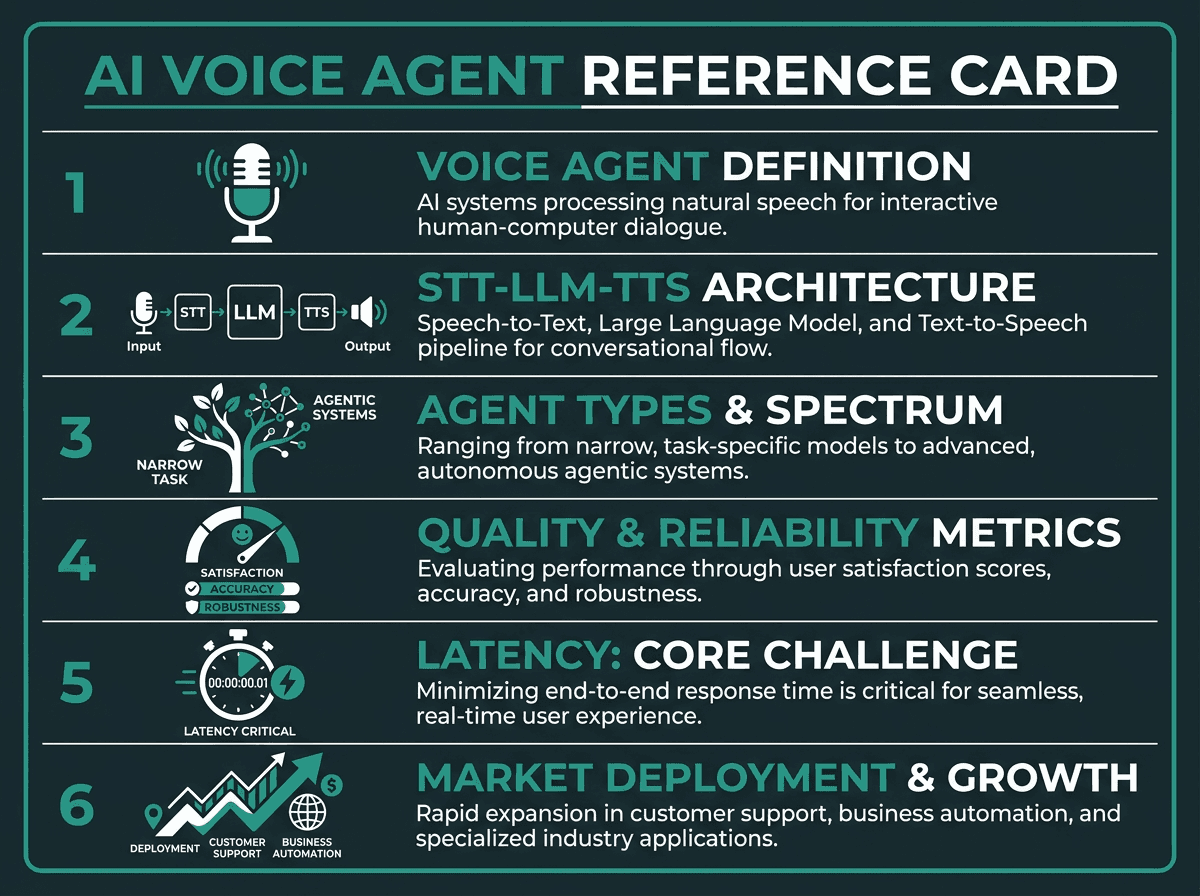
Six essential facts about voice agents - from architecture to latency to market deployment in 2026.
The Problem This Technology Was Built to Solve
The problem is scale without quality collapsing. Many businesses field thousands of calls a day, and staffing enough humans to answer all of them, consistently, 24/7, does not pencil out. Traditional automation tried to bridge the gap with rigid IVR trees, but those systems mostly trained customers to mash "0" and hope a person picks up. The distance between "automated" and "useful" was wide, and callers noticed.
Modern voice agents narrow that distance by handling natural language, coping with unexpected phrasing, and taking actions in connected systems while keeping response times fast. For most teams, the debate has shifted: it is less about whether voice agents work and more about whether you can deploy them without shipping a frustrating experience.
Smallest.ai combines speech recognition, speech synthesis, and agent orchestration within a single platform designed for voice applications. The Atoms platform is built for real-time voice interactions and agent deployment workflows. If you are building a first agent or trying to scale an existing one, you can use voice agents from Smallest.ai. Want to see it live?
Frequently asked questions
What is the difference between a voice agent and a chatbot?
How long does it take to build and deploy a voice agent?
What languages do voice agents support?
Can a voice agent handle interruptions mid-sentence?
How do I get started building a voice agent with Smallest.ai?