Complete Guide to Speech Analytics: Workflow, Benefits, and Applications

Uncover how speech analytics boosts call center efficiency. Transform audio with AI to enhance CX, ensure compliance, and reduce costs. Click now!
Conversations flow through support lines, sales teams, and service desks every day, yet most voice data disappears once the call ends. Teams depend on delayed reviews or scattered notes, which makes it difficult to catch compliance gaps, recurring issues, or customer sentiment early. That is often when organizations turn to speech analytics as call volumes rise and manual monitoring falls behind.
For enterprise leaders, speech analytics becomes essential when costs increase, regulations tighten, and customer expectations demand faster, more consistent responses. The global speech analytics market is expected to approach USD 15.31 billion by 2034, reflecting its growing role in contact centers and enterprise operations.
In this guide, you will learn what speech analytics involves, how it turns conversations into structured insights, and how teams use it to improve compliance, performance, and customer experience at scale.
Key Takeaways
Speech analytics strengthens enterprise operations: Structured conversation analysis ensures interactions are measurable, consistent, and aligned with operational goals.
Voice intelligence and AI integration enhance efficiency: Combining real-time transcription, sentiment detection, and automation enables faster responses and reduced manual monitoring.
Compliance and quality assurance improve: Automated script tracking, risk alerts, and performance scoring help teams maintain regulatory standards and service consistency.
Scalability and performance are built in: Centralized dashboards and low-latency processing allow organizations to manage growing call volumes without operational delays.
Smallest.ai connects insights with real-time execution: Integrating speech analytics with Pulse and LIghtning turns conversations into immediate actions, workflow triggers, and measurable business outcomes.
What Is Speech Analytics?
Speech analytics captures spoken interactions and converts them into structured, actionable data. By applying Automatic Speech Recognition (ASR), natural language processing (NLP), and machine learning, voice data from calls or other channels becomes searchable, trackable, and operationally useful.
Once data is captured, platforms can evaluate language patterns, emotional cues, and customer intent at scale. This enables teams to monitor service quality, maintain compliance, uncover recurring issues, and optimize workflows efficiently.
Before exploring where speech analytics creates value, it helps to look at the specific outcomes organizations gain from analyzing voice conversations through conversational AI models:
Converts live and recorded conversations into structured text that can be analyzed across systems.
Detects recurring themes, customer needs, and frequently mentioned products or problems.
Evaluates emotional tone to highlight frustration, urgency, satisfaction, or confusion.
Verifies whether required disclosures and regulatory scripts are followed during interactions.
Reveals operational patterns such as repeated escalations, service delays, or workflow gaps.
This is where Smallest.ai comes in. With Pulse, its real-time speech-to-text engine, enterprises can transcribe live calls, monitor customer sentiment instantly, and feed actionable insights into dashboards and CRMs, helping teams respond faster and more accurately.
Also Read: Top 10 Contact Center Automation Trends for 2025
Once these capabilities are in place, organizations begin to see clear operational advantages that extend beyond basic reporting.
Speech Analytics vs Conversation Intelligence: Key Differences
While both technologies support customer interactions, their roles in business operations differ. Speech analytics concentrates on extracting patterns and signals from voice conversations, whereas conversation intelligence connects insights across channels and links them to measurable business outcomes.
The comparison below shows where each one fits in modern enterprise workflows.
Feature | Speech Analytics | Conversation Intelligence |
Primary Focus | Voice and audio analysis | Omnichannel interaction intelligence |
Channels Covered | Mainly voice calls | Voice, chat, email, messaging, meetings |
Data Processing | Transcription, keywords, acoustic signals | Contextual analysis across full conversations |
Insights Depth | Sentiment, silence, tone, escalation detection | Intent mapping, outcomes, journey tracking |
Actionability | Insights, alerts, dashboards | Automated actions and workflow triggers |
Automation Level | Limited automation | Direct integration with automation systems |
Use Cases | Compliance monitoring, QA scoring, call reviews | Performance optimisation, CX improvement, revenue tracking |
Operational Integration | Reporting tools and analytics dashboards | CRM, ticketing, workflow, and business systems |
Real Time Capability | Real-time alerts during calls | Real-time decision making and execution |
Team Usage | QA teams, compliance, support leaders | Operations, sales, CX, and executive teams |
Performance Measurement | Agent behavior and call quality metrics | Business KPIs, conversions, retention metrics |
Example Scenario | Detect frustration or compliance risk in a call | Trigger follow-ups, schedule tasks, and update systems automatically |
Used together, these capabilities help enterprises move from passive monitoring to active execution. Next, let’s see why speech analytics is critical in today’s environment.
Also Read: The Ultimate Guide to Contact Center Automation.
Why Speech Analytics Matters Today?
Voice conversations carry intent, emotion, urgency, and decision signals that written channels often miss. As enterprises handle thousands of live interactions daily, speech analytics moves from a support tool to a core operational capability.
Here are several real-world shifts that make it essential right now:
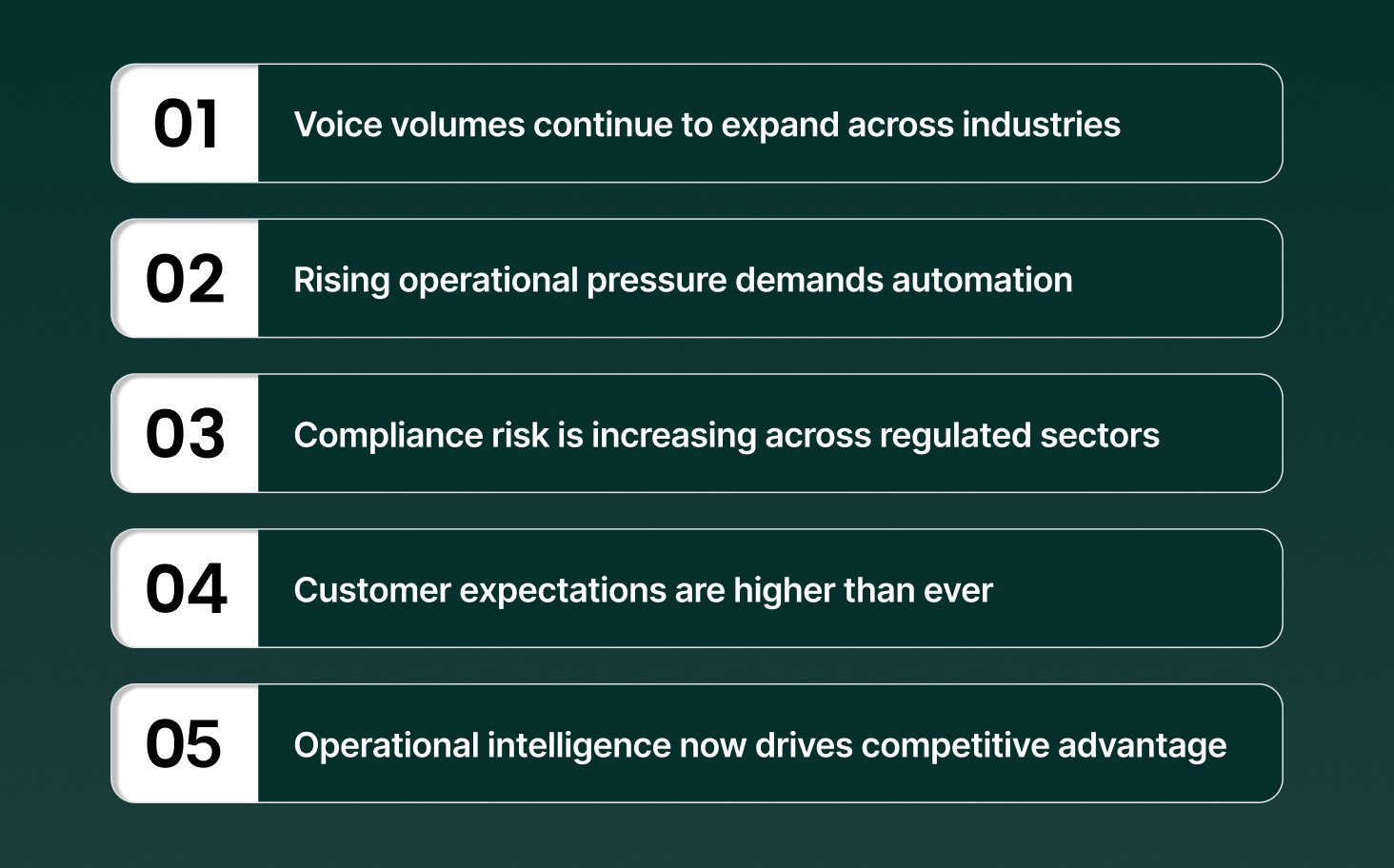
Voice volumes continue to expand across industries: Contact centres, banking, telehealth, retail, and logistics rely heavily on voice agents for high-value and time-sensitive interactions. Every call contains operational signals that impact revenue, risk, and service quality.
Rising operational pressure demands automation: Manual call reviews consume time, vary across teams, and capture only small samples. Speech analytics consistently analyzes large volumes of interactions, reducing monitoring effort while improving coverage.
Compliance risk is increasing across regulated sectors: Industries such as BFSI, healthcare, and insurance must verify disclosures, approvals, and policy adherence. Automated speech monitoring flags missed scripts, risky language, or compliance gaps during conversations.
Customer expectations are higher than ever: Customers expect faster responses, personalized engagement, and consistent service. Speech analytics identifies intent, frustration, and escalation signals early, so teams respond before issues grow.
Operational intelligence now drives competitive advantage: Speech data reveals recurring problems, process delays, product feedback, and training gaps. Teams convert conversations into structured insights that improve workflows, service delivery, and decision making.
When implemented effectively, speech analytics turns everyday voice interactions into measurable operational improvements, stronger compliance control, and more responsive customer experiences.
Once these drivers are clear, it’s easy to see how speech analytics converts daily interactions into measurable improvements.
What Are the Key Steps in a Modern Speech Analytics Process?
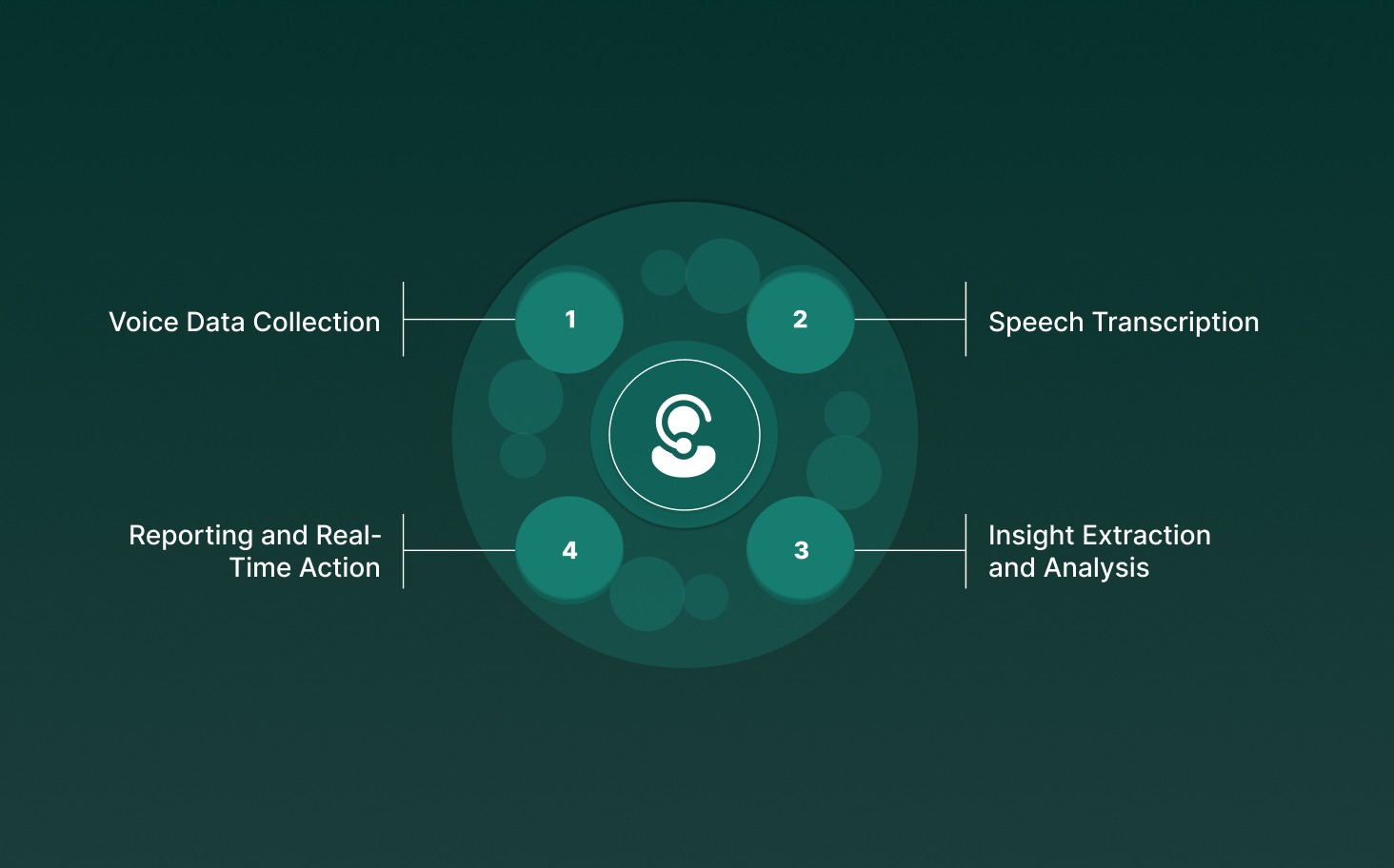
Speech analytics follows a structured flow that converts live conversations into usable operational insight. Each stage captures voice data, converts it into text, analyzes context, and turns findings into measurable actions that improve service delivery and performance monitoring.
To understand how this process works in production environments, here is how speech analytics moves from raw audio to actionable intelligence:
Step 1: Voice Data Collection
Every speech analytics workflow begins by capturing audio interactions from multiple enterprise communication channels to ensure full visibility into conversations.
Audio is captured from contact center calls to monitor customer interactions and support operations.
IVR and automated voice systems provide structured interaction data for workflow tracking.
VoIP platforms and digital communication tools supply voice inputs from remote and hybrid environments.
Mobile applications support voice interactions through customer self-service and app-based communication.
Real-time streaming and batch recording capabilities ensure that both live and historical conversations are captured without gaps.
Step 2: Speech Transcription
Once audio is captured, Automatic Speech Recognition converts spoken words into structured text that can be searched, analyzed, and processed by enterprise systems.
Speech is converted into machine-readable text so conversations become measurable and analyzable data.
Advanced recognition models handle accents, background noise, and industry-specific terminology common in enterprise environments.
Multilingual processing allows organizations to manage global customer interactions with consistent accuracy.
High-speed processing ensures transcripts are generated within milliseconds, enabling real-time analytics workflows.
Support for more than 30 languages enables scalable deployment across global teams and regions.
Step 3: Insight Extraction and Analysis
After transcription, natural language processing and machine learning models analyze conversations to identify patterns, customer intent, and operational risks.
Keyword spotting identifies recurring issues, product mentions, and service bottlenecks across large volumes of calls.
Sentiment analysis evaluates emotional signals such as frustration, urgency, satisfaction, or confusion during conversations.
Intent detection predicts customer goals and likely next steps to support proactive decision making.
Trend analysis uncovers recurring service gaps, escalation patterns, and performance challenges across teams.
Behavioral signals help organizations monitor agent performance and identify opportunities for process improvement.
Step 4: Reporting and Real-Time Action
The final stage transforms analytics into dashboards, alerts, and automated workflows that help teams respond immediately during live interactions.
KPI dashboards present performance metrics, conversation trends, and operational insights in structured formats.
Sentiment heatmaps visualize customer emotions across interactions to highlight service strengths and weaknesses.
Real-time alerts notify supervisors when high-risk conversations or escalations occur.
Intelligent routing directs calls to the right teams based on detected intent and conversation context.
Automated workflows trigger follow-ups, ticket creation, and operational updates without manual intervention.
After understanding the workflow, let’s explore industry applications.
How Speech Analytics Delivers Value Across Industries: Top Use Cases
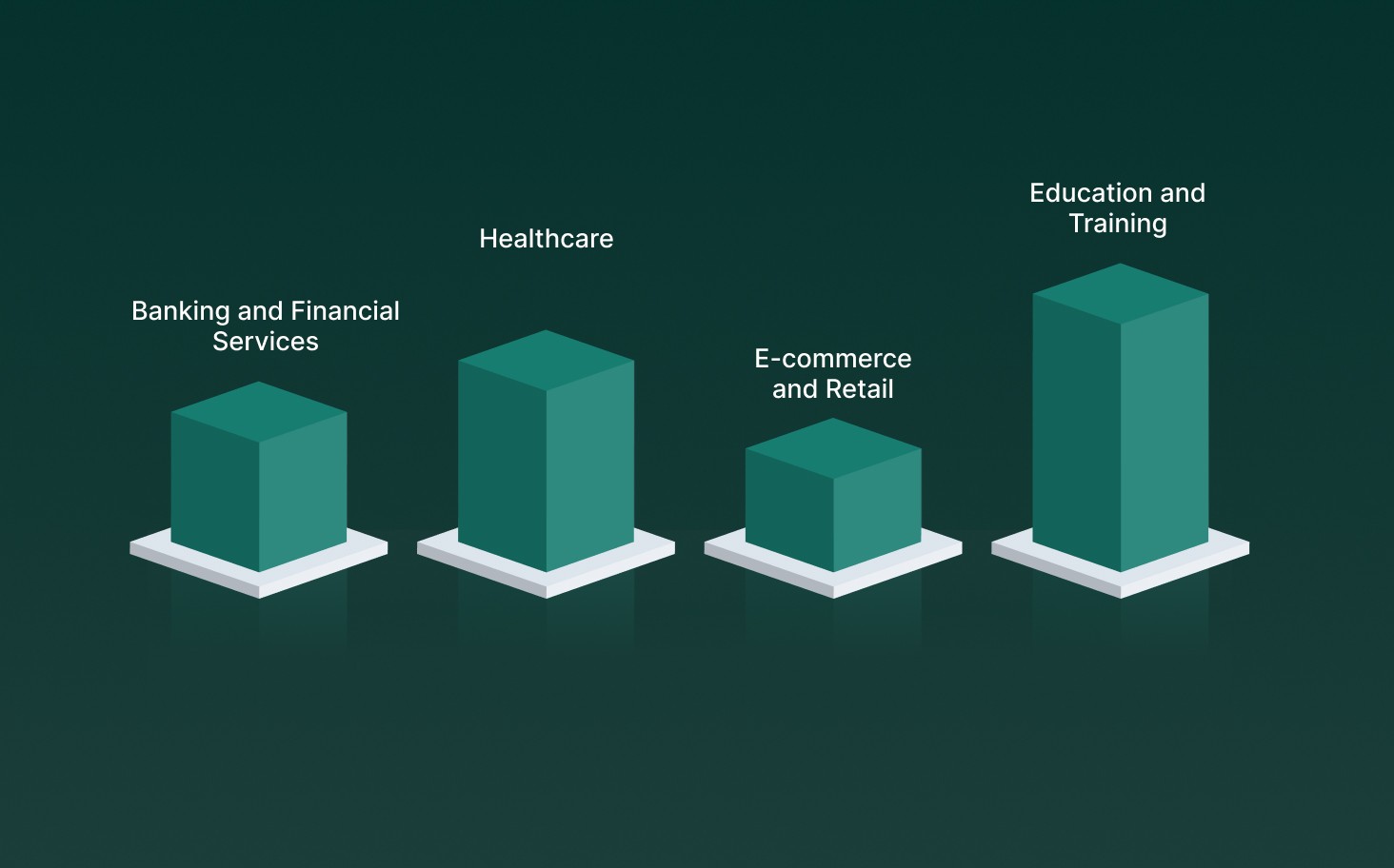
Across sectors, organizations use live voice insights to reduce manual effort, maintain compliance, capture structured data, and respond to customer intent faster. The applications vary by industry, but the objective stays consistent: turn conversations into measurable actions that improve service quality and operational control.
Below are key industry segments where speech analytics drives measurable outcomes:
1. BFSI (Banking and Financial Services)
Speech analytics helps financial institutions manage compliance, reduce risk, and maintain consistent customer verification during high-volume interactions.
Key Applications
Real-time fraud detection through voice behavior patterns and intent changes
Automated debt collection conversations with built-in verification steps
Live compliance monitoring for disclosures and regulated scripts
Loan, insurance, and KYC data capture during customer calls
Risk alerts triggered by urgency, tone, and interaction history
2. Healthcare
Healthcare teams use speech analytics to manage patient communication efficiently while maintaining documentation accuracy and regulatory compliance.
Key Applications
Appointment booking, rescheduling, and automated reminders
Patient sentiment tracking during telehealth conversations
Consent and regulatory compliance checks in patient communication
Automated call summaries capturing symptoms and follow-up actions
Post consultation reminders for medication and recovery plans
3. E-commerce and Retail
Retail and e-commerce teams rely on speech analytics to resolve order issues quickly and improve post purchase customer experiences.
Key Applications
Automated order tracking, cancellations, refunds, and return handling
Voice-driven customer feedback collection during interactions
Real-time upsell and cross-sell prompts based on intent signals
Complaint detection with priority routing for urgent issues
Delivery and logistics issue capture linked to backend workflows
4. Education and Training
Education providers use speech analytics to monitor learner support interactions and maintain consistent communication across training environments.
Key Applications
Learner feedback analysis from support and training calls
Monitoring instructor learner interaction quality
Admission enquiry handling with structured data capture
Student support triage for payments, access, and technical issues
Performance insights from recorded learning sessions
Let’s now look at what it takes to implement speech analytics successfully.
Best Practices and Common Challenges in Speech Analytics Implementation
Deploying speech analytics successfully requires more than installing a tool and collecting transcripts. Real value appears when teams align analytics with operational goals, maintain clean data pipelines, and prepare for common challenges such as noisy audio, fragmented systems, or compliance risks.
The table below outlines practical best practices alongside the challenges organizations typically face during real production deployments.
Area | Best Practices | Common Challenges |
Data Quality | Capture high-quality audio streams and maintain consistent recording standards across channels. | Background noise, cross-talk, and poor microphone quality reduce transcription accuracy. |
Model Training | Train models using domain-specific language, industry terminology, and real call samples. | Generic models struggle with accents, jargon, or specialized vocabulary. |
Real Time Processing | Use streaming pipelines that analyze conversations while they happen. | Batch processing delays insights and limits real-time response capabilities. |
Integration | Connect speech analytics with CRM, ticketing, and workflow systems for automated updates. | Disconnected platforms create data silos and require manual reconciliation. |
Compliance Monitoring | Configure automated checks for mandatory disclosures and regulatory scripts. | Inconsistent monitoring increases legal risk and compliance gaps. |
Agent Adoption | Provide clear dashboards and training so frontline teams can use insights during calls. | Low adoption occurs when analytics remain complex or disconnected from workflows. |
Multilingual Support | Deploy models trained on regional accents and multiple languages used in operations. | Language switching and regional dialects can reduce accuracy if not supported properly. |
Continuous Optimization | Review performance metrics regularly and retrain models based on new conversation trends. | Static models lose accuracy as customer behavior and product terms evolve. |
Privacy and Security | Apply encryption, role-based access, and data retention policies aligned with regulations. | Poor governance increases the risk of privacy violations or audit failures. |
Scalability | Design infrastructure that handles high call volumes with low-latency processing. | Performance bottlenecks appear during peak traffic if systems are not built for scale. |
By following these best practices when preparing for operational challenges, organizations move beyond passive call analysis and build a speech analytics system that supports real-time decision-making, compliance controls, and continuous performance improvement.
How Smallest.ai Powers Real-Time Speech Analytics for Enterprise Operations?
Many enterprises treat speech analytics as a reporting layer instead of an execution layer. Smallest.ai combines hyper-realistic voice technology with real-time AI automation that analyzes conversations, extracts insights, and triggers actions during live interactions. This converts speech-to-text structured workflows instead of static transcripts.
To support real production environments, Smallest.ai delivers the following speech analytics capabilities:
Pulse transcribes live and recorded calls in real time, supports multiple languages and accents, and feeds structured insights into dashboards and CRMs.
Lightning generates natural, human-like speech in under 100ms, ideal for IVRs, voice agents, and interactive applications.
Rapid voice replication for scalable communication: Generate production-ready voices from just five seconds of input, enabling consistent brand voice across regions while maintaining a human-like tone.
Live conversation intelligence and automated execution: The platform analyzes ongoing conversations, captures intent instantly, and initiates actions automatically without interrupting the flow of interaction.
Enterprise integrations for connected operations: Speech insights sync with CRM platforms, ticketing systems, and internal workflows so data updates are instantly, trigger tasks, and keeps downstream processes accurate.
Optimized for high-volume speech environments: Processes large call volumes with consistent low-latency performance, enabling organizations to scale speech analytics across thousands of daily interactions.
Actionable analytics that improve operational outcomes: Combines real-time intelligence, natural voice output, fast processing, and enterprise scalability so speech insights translate into measurable business impact.
With real-time intelligence at its core, enterprises move beyond passive monitoring toward speech analytics that support automation, efficiency, and scalable contact center performance.
Final Thoughts!
Speech analytics decisions often fail when treated as reporting upgrades instead of execution upgrades. The real question is whether your system can capture live voice data, trigger actions instantly, and support teams under real call pressure without slowing operations. That difference separates basic monitoring from operational intelligence.
As enterprises evaluate speech analytics platforms, the focus shifts to real-time processing, depth of automation, and how closely insights connect to workflows. Tools that only analyze conversations help you look back. Systems that act on conversations shape outcomes in the moment.
If you are exploring speech analytics built for live enterprise environments,Smallest.ai is designed for that reality. Pulse delivers natural, real-time voice interactions and turns insights into immediate actions during conversations.
Book a demo today to see how Smallest.ai powers real-time speech analytics and AI-driven contact center operations at scale.
Frequently asked questions
Which industries benefit most from real-time speech analytics?
How does Smallest.ai ensure fast voice processing during live interactions?
Can AI agents act automatically on insights from real-time speech analytics?
How do enterprises maintain privacy and compliance with speech analytics?
How does multilingual speech analytics support global operations?