How to Reduce AHT: 2026 Tips Every Contact Center Team Should Know

A practical look at how to reduce AHT by addressing system lag, process gaps, and ACW friction so support teams deliver faster, smoother customer conversations.
When hold music keeps looping or a customer says, “I already told someone this,” the stress lands on support leaders who need answers, not platitudes. That is usually the moment teams start searching for Average Handle Time, not to shave seconds for its own sake, but to find the exact friction that makes calls feel slow or disorganized. If you are looking up Average Handle Time right now, you are probably trying to locate where time leaks occur and which fixes give the biggest impact without raising risk or cost.
SQM Group’s 2024 benchmarks show that improving First Call Resolution directly improves customer experience, with each 1% FCR increase driving an average 1.4-point gain in interactional NPS, while customer research confirms that first-contact resolution remains the top expectation across contact centers.
In this guide, we will map the operational causes of AHT, show how those causes change what customers feel during calls, and give precise, measurable interventions teams can apply immediately.
Key Takeaways
System Friction Drives Most AHT: Delays usually come from slow tools, multi-system hops, and lookup wait times, not agent speed.
Verification Steps Add Predictable Time: Static scripts and repeated questions inflate AHT; conditional logic removes unnecessary steps.
Knowledge Retrieval Shapes Hold Time: Agents lose seconds scanning long articles; step-level guidance and intent-based tagging shorten pauses.
ACW Is One of the Easiest AHT Levers: Automating summaries, dispositions, and metadata reliably cuts 15–45 seconds per interaction.
Real-Time Intelligence Reduces Hidden Delays: Smallest.ai shortens calls by removing workflow friction, not by rushing conversations.
What is Average Handle Time (AHT)?
Average Handle Time measures the full duration of a customer interaction, covering the live conversation, any pauses for internal work, and the wrap-up steps required to close the case. Operations teams track AHT to understand workload patterns, staffing needs, and interaction cost at a granular level.
Key Elements Within AHT
Talk Time: The live segment of the call, including verification steps, clarifying questions, and issue resolution.
Hold Time: Time spent pausing the interaction to pull records, review policies, run checks, or access internal tools. Rising hold time often reflects workflow friction or slow systems.
After-Call Work (ACW): Tasks completed once the customer disconnects. This can include updating CRM fields, adding dispositions, summarizing outcomes, and preparing follow-ups.
Total Handle Window: The combined length of talk, hold, and ACW. AHT refers to this complete window rather than the conversation alone.
How To Calculate AHT
AHT follows a fixed, industry-standard formula
AHT = (Total Talk Time + Total Hold Time + Total ACW) ÷ Number of Completed Interactions
Example:
If a team records 3,000 seconds of talk time, 600 seconds of hold time, and 900 seconds of ACW across 50 calls:
AHT = (3,000 + 600 + 900) ÷ 50 = 96 seconds
This gives leaders a precise view of how long each interaction consumes from start to finish, guiding staffing plans, performance baselines, and workflow improvements.
What Causes High AHT in Contact Centers?
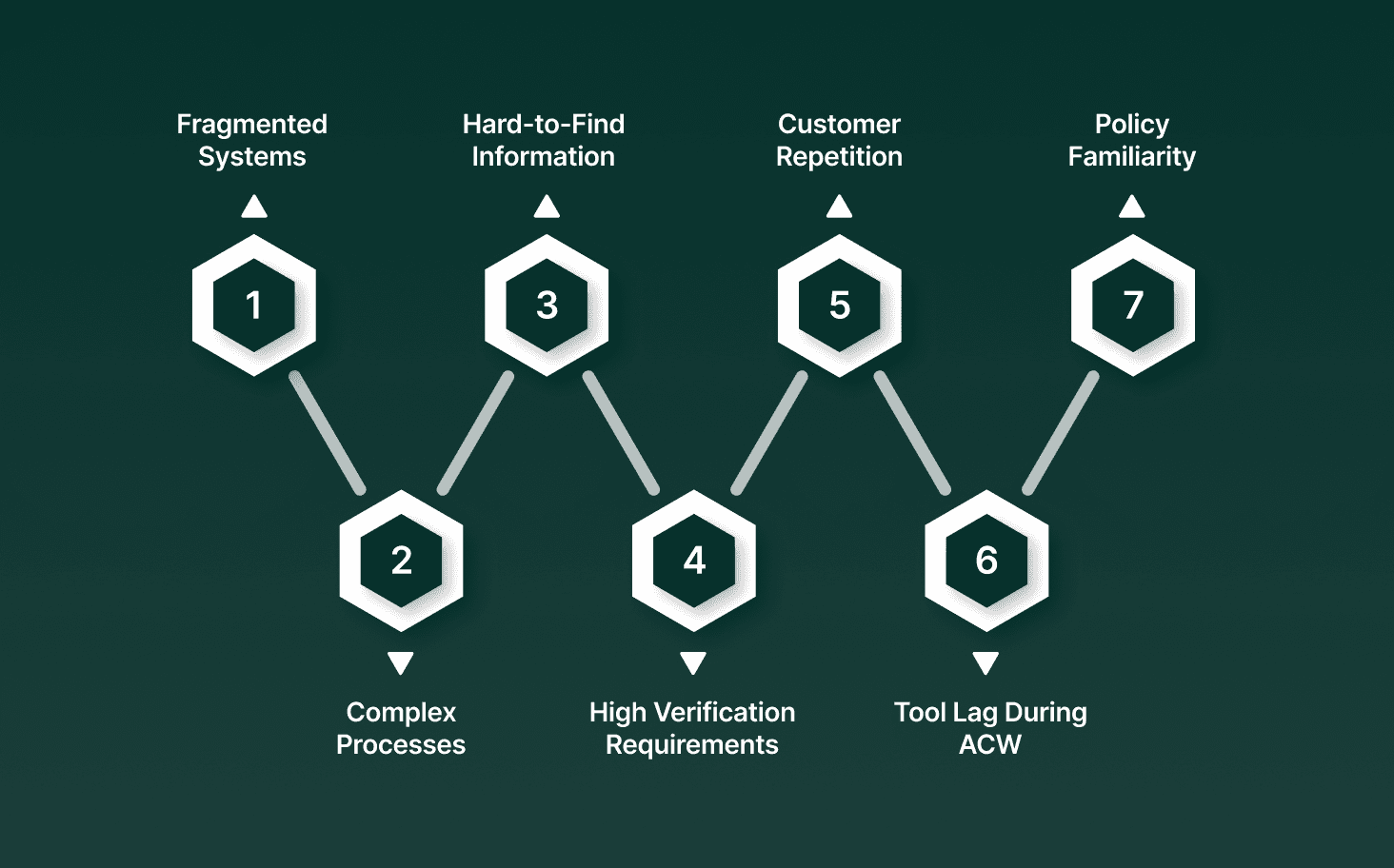
High AHT usually signals friction in tools, workflows, or agent knowledge. In most centers, the drivers are traceable to very specific operational gaps rather than broad performance issues. Understanding these root causes helps teams identify where time is lost inside each interaction cycle.
Slow or Fragmented Systems: Agents switch between CRM, knowledge bases, ticketing tools, and policy documents. Each lookup adds seconds. Legacy systems with long load times can significantly extend hold time.
Unclear or Complex Processes: When steps vary by product line, customer type, or region, agents cross-check guidelines before taking action. This increases both talk time and ACW.
Inaccurate or Hard-to-Find Information: Outdated instructions, missing policy details, or poorly indexed knowledge articles force agents to verify details with supervisors, leading to prolonged holds.
High Verification Requirements: Industries such as BFSI or healthcare require multi-step identity checks. These add a predictable but unavoidable time to the start of each call.
Customer Repetition Due to Poor Call Routing: If routing sends the customer to an agent without the right permissions or data access, the agent re-collects information already provided in the IVR.
Tool Lag During ACW: Auto-save delays, slow CRM field updates, and manual data entry extend wrap-up time even when the conversation ended cleanly.
Low Product or Policy Familiarity: New hires or cross-trained agents spend longer confirming details, especially for exceptions or uncommon scenarios.
When teams isolate the exact moments where time is lost, they can target fixes that reduce AHT without harming call quality or compliance.
See how Smallest.ai removes lookup delays, automates ACW, and delivers sub-100 ms guidance to help teams cut AHT without changing existing workflows.
How To Reduce AHT: Practical Steps and Actionable Tips
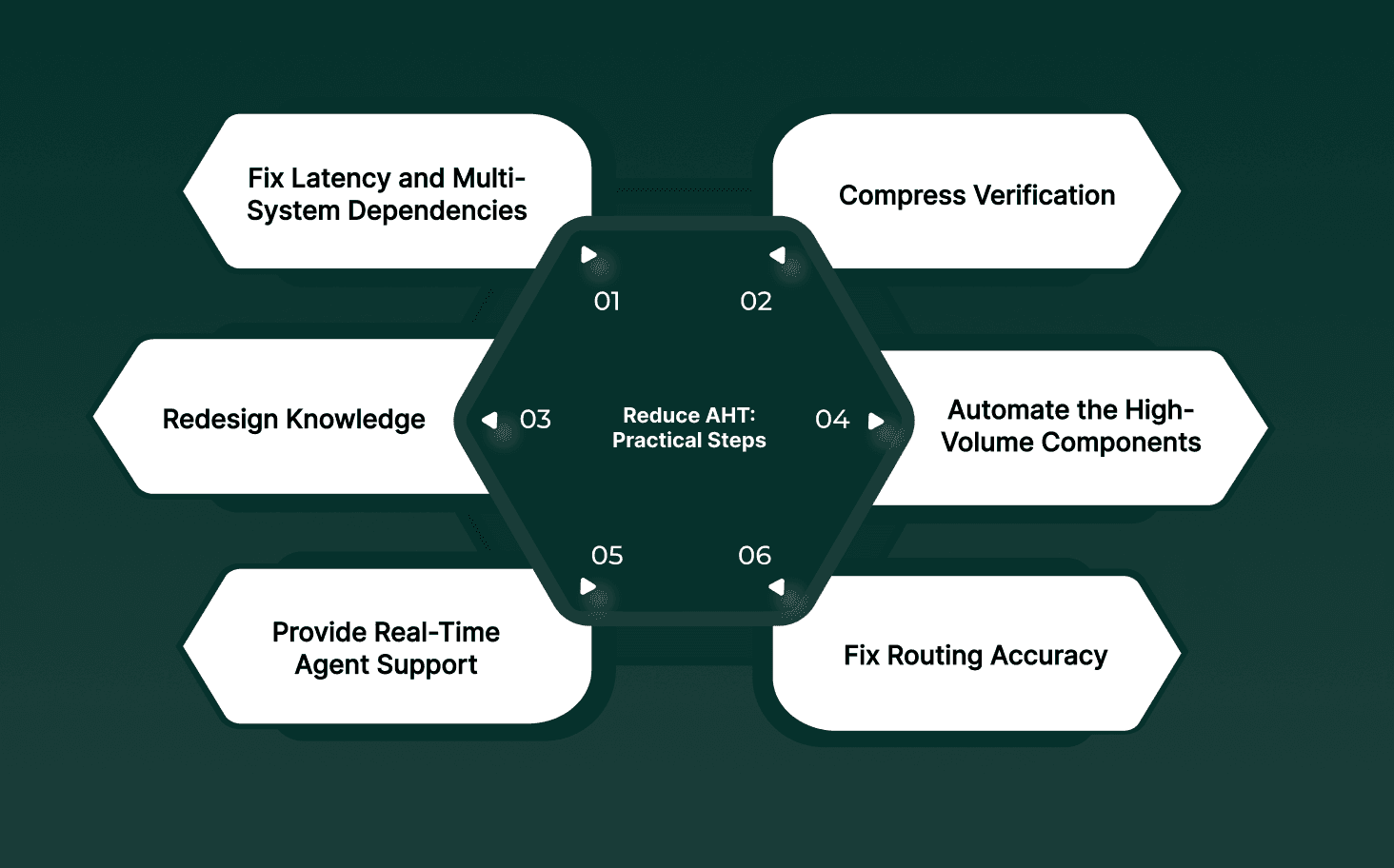
Reducing AHT requires removing the exact workflow and system events that add seconds during verification, data retrieval, troubleshooting, and ACW. Each step below corresponds to measurable, time-bound inefficiencies seen in enterprise contact centers.
1. Fix Latency and Multi-System Dependencies
Most AHT inflation traces back to tool latency and the number of systems an agent must touch during a single interaction.
Tips:
Pre-load customer data before call connect: Use ANI or CRM lookup triggers so account details, prior tickets, and authentication flags load in the agent UI before the call appears in the queue.
Reduce system hops to ≤2 platforms: Map every interaction type and remove tools that duplicate the same information (e.g., agents check billing status in both CRM and ERP unnecessarily).
Set SLA thresholds for load times: CRM screens, knowledge searches, and ticket creation pages should load under 500–700 ms. Engineering teams track and fix any breaches.
Outcome:
Direct reduction in both talk time and hold time because agents do not wait for system responses.
2. Compress Verification Time Using Conditional Logic
Verification steps often run longer than needed because they follow a static script instead of reflecting the real customer context.
Tips:
Skip redundant questions using prior-auth flags: If the customer authenticated in-app or passed IVR KBA within the last 5 minutes, suppress repeated identity questions.
Use dynamic KBA branching: High-risk accounts (recent password reset, failed login, disputed charge) trigger 3-step verification; low-risk accounts require fewer steps.
Auto-surface only fields needed for that customer type: Prevent agents from reading full verification scripts that don’t apply to the interaction.
Outcome:
20–40 seconds drop in the opening segment of calls, especially in finance, telecom, and insurance.
3. Redesign Knowledge Retrieval Around Actual Agent Query Paths
Knowledge friction is one of the largest, most measurable drivers of high AHT.
Tips:
Replace long articles with step-level cards: Instead of a 12-step troubleshooting doc, show one step at a time based on the agent’s current selection (reduces scanning time).
Tag content using verb-based queries from call transcripts: Agents search “reverse charge,” “reset PIN rules,” “SIM activation limit.” Articles must match these exact phrases.
Add policy certainty markers: Highlight non-negotiable rules directly in the article so agents don’t pause to confirm with supervisors.
Outcome:
Reduction in hold time because agents find the correct resolution path without escalating or cross-checking.
4. Automate the High-Volume Components of After-Call Work
ACW is predictable, repetitive, and often inflated due to manual text entry or unclear categories.
Tips:
Auto-assign disposition codes based on call reason signals: IVR path + key call terms (“refund request,” “address mismatch”) can map to a single disposition with no manual selection.
Use structured summary templates: For recurring cases (e.g., plan downgrade, billing correction), provide pre-filled templates with editable slots.
Auto-populate metadata: Product type, customer tier, region, device model, or claim category should populate from CRM and IVR, not require agent input.
Outcome:
ACW consistently drops by 15–45 seconds, depending on segment complexity.
5. Provide Real-Time Agent Support for Exception Cases
Exception handling drives unpredictable spikes in AHT because unfamiliar scenarios require searching or supervisor confirmation.
Tips:
Exception detection via keyword monitoring: When terms like “chargeback filing,” “number port stuck,” or “coverage exclusion” appear, the system pushes the correct workflow instantly.
Display only the next required step: Show step-by-step instructions instead of full procedures, eliminating scrolling and misinterpretation.
Eligibility auto-checks: Refund eligibility, penalty rules, or plan constraints should calculate automatically so agents don’t cross-reference matrices or spreadsheets.
Outcome:
Talk time becomes more consistent across new and experienced agents.
6. Fix Routing Accuracy to Remove Repeated Data Collection
Misrouted calls increase AHT because agents must recreate context and repeat verification.
Tips:
Route using CRM attributes instead of IVR alone: Product type, claim type, delinquency stage, or last case reason provides more accurate routing than keypad selections.
Use permissions-aware routing: Calls requiring account unlocks, contract changes, or refunds must go to agents with the correct backend privileges.
Apply proficiency routing: Match customers to agents certified in specific products or languages to reduce clarification loops.
Outcome:
Fewer repeated explanations and fewer transfers reduce both talk time and customer frustration.
How AHT Influences Customer Satisfaction
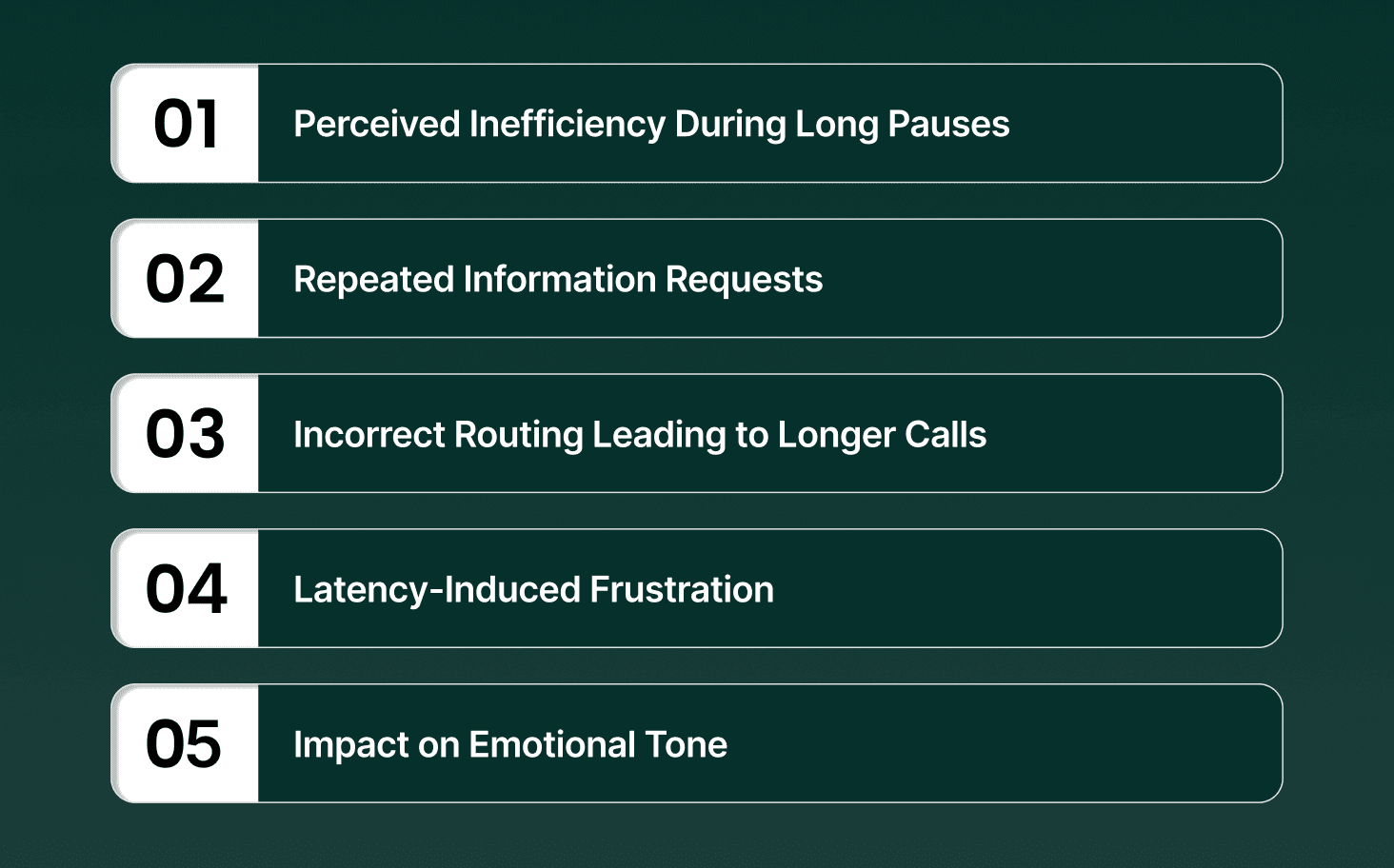
AHT affects customer satisfaction most clearly when long handle times reflect friction inside the interaction itself. Customers respond to the quality of the experience, not the metric. The relationship between AHT and satisfaction is measurable, but only when delays stem from slow systems, repeated questioning, or unclear workflows that the customer directly feels.
Perceived Inefficiency During Long Pauses: Extended silence or repeated holds signal to customers that the agent does not have the right tools or information. This correlates strongly with lower CSAT scores, particularly in industries with high verification requirements.
Repeated Information Requests: When agents re-collect data already entered in the IVR or earlier in the call, customers interpret it as disorganization. This creates a measurable drop in satisfaction even if the final resolution is correct.
Incorrect Routing Leading to Longer Calls: A customer routed to an agent without the required permissions or system access will experience extra steps, transfers, or restatements. CSAT consistently declines when the customer realizes the call could not have been resolved from the start.
Latency-Induced Frustration: Delays caused by slow CRM loading, long lookup times, or repeated navigation add seconds that the customer can clearly detect. These delays often generate more dissatisfaction than the final AHT number itself.
Impact on Emotional Tone: Longer calls do not inherently lower CSAT, but calls that feel “stalled,” “uncertain,” or “repetitive” do. High AHT caused by agent hesitation or policy clarification creates an experience that customers perceive as a lack of expertise.
AHT influences satisfaction when the customer feels the delay, not when the call simply takes longer. Reducing friction inside the interaction has a more direct impact on CSAT than reducing minutes from the metric.
If you want deeper insight into automating key workflows that influence customer experience, explore Call Center Automation for Improved Customer Satisfaction: Strategies & Tools.
How Smallest.ai Improves AHT in Real Time
Smallest.ai improves AHT by removing the exact workflow delays that extend talk time, lookup time, and ACW. Instead of coaching agents to move faster, it eliminates the operational steps that slow them down. The platform does this through real-time voice models, instant context retrieval, and automated post-call actions that directly reduce measurable seconds inside the interaction cycle.
Sub-100 ms Real-Time Responses: The agent receives instant prompts, next-step guidance, and policy instructions without delays. This removes the pauses typically caused by searching knowledge bases or waiting for supervisor clarification.
Automatic Context Retrieval From Customer Speech: The system detects intent, policy keywords, and issue category during the live call. It surfaces the exact workflow or rule set the agent needs, reducing time spent navigating documents or cross-checking policies.
Dynamic Step-Level Instructions Instead of Long Articles: Rather than showing a full troubleshooting guide, Smallest.ai displays only the next required step based on the customer’s words. This prevents agents from scanning multi-step documents and cuts hold time.
Automated After-Call Work via Real-Time Transcription: Summaries, disposition codes, and structured notes are generated while the call is happening. This reduces ACW because the agent edits the system-generated content instead of typing from scratch.
Context-Driven Disposition Mapping: Call classification is inferred from detected phrases, customer metadata, and workflow patterns. Agents do not manually search for category codes, which reduces wrap-up friction.
Routing Intelligence Through Real-Time Signal Detection: When Smallest.ai runs in pre-call or IVR environments, it identifies the customer issue from spoken phrases and routes the call to the correct skill group. This prevents misrouting, which is one of the largest drivers of elevated AHT.
Smallest.ai improves AHT by eliminating the operational delays that customers feel most, reducing the time agents spend searching, typing, escalating, or revalidating steps, without compromising accuracy or compliance.
Conclusion
Managing Average Handle Time well is less about chasing a target and more about uncovering the small operational delays that shape how a customer experiences the interaction. When teams look past surface-level metrics and examine system behavior, workflow friction, and real-time agent challenges, they gain a clearer picture of what truly influences Average Handle Time across different call types and customer intents. The result is a support operation that feels more predictable for customers and more manageable for agents.
This is where Smallest.ai makes a measurable difference. By detecting intent from live speech, surfacing next-step guidance instantly, and generating structured summaries as the call unfolds, it removes the exact moments where time is lost, without changing your existing workflows or routing rules.
If you want to see how real-time voice intelligence can improve handle times without compromising quality, try Smallest.ai and experience the impact in a live demo. Get in touch with us!
Frequently asked questions
Does improving data visibility actually help reduce AHT, or is it overrated?
What is the most overlooked factor when trying to lower AHT across skill groups?
Can calibration sessions help lower AHT, or do they only affect quality scoring?
Why do some centers decrease AHT quickly after fixing routing accuracy?
What is the most reliable starting point when leaders ask how to reduce AHT in call centers with complex products?