Fish Audio Pricing: Plans, API Billing & Commercial Use in 2026

Complete guide to Fish Audio pricing in 2026. Compare Free, Plus, and Pro plans, understand API costs per byte, and find the right tier for your use case.
Choosing a text-to-speech (TTS) platform for a production workflow involves more than just finding the lowest price. You need predictable costs, reliable performance, and confidence that the tool can handle your specific use case, whether it is for creative content, multilingual applications, or low-latency voice agents. Fish Audio pricing offers one model for this, with subscription plans and a credit system. But understanding its structure is key to seeing if it aligns with your actual production needs. This guide examines the Fish Audio pricing model, where it works well, and where its value might break down.
The Three Fish Audio Plans at a Glance
Fish Audio structures its consumer-facing offering around three tiers: Free, Plus, and Pro. According to Fish Audio's official pricing page, the undiscounted list price for the Plus plan is $20 per month, and the Pro plan is $150 per month. However, the company frequently offers promotional pricing; as of early 2026, the Plus plan is available for $5.50 per month and the Pro plan for $37.50 per month, both billed annually. The free tier costs nothing but carries restrictions that become material the moment you try to use it professionally.
Free Plan: What 8,000 Credits Actually Gets You
The free tier is genuinely useful for experimentation. You get 8,000 monthly credits, access to the voice library, and basic voice cloning capability. What you do not get is commercial rights. Fish Audio's terms of service explicitly restrict the free plan to personal, non-commercial use. Publishing free-tier audio to a monetized YouTube channel, a sponsored podcast, or any client-facing deliverable puts you outside the terms of service.
For content creators evaluating Fish Audio as part of a production stack, that restriction is not a minor footnote. The free tier is a trial environment. The moment revenue enters the picture, you need a paid plan.
Plus Plan ($5.50/month): The Mid-Tier Reality
200 minutes per month sounds generous until you run a production workflow through it. A single long-form dubbing project or a week of daily podcast episodes will test that ceiling fast. The question is whether the credit system delivers that capacity consistently across the models you actually need.
The promotional starting price is a real cost advantage, though 'starting price' comparisons can mislead if the feature set at that tier does not match what you actually need. API access on the Plus plan may be limited or structured differently compared to the Pro plan or direct API usage.
Pro Plan ($37.50/month): Built for Volume
The Pro plan is where Fish Audio becomes viable for production-scale work. It includes up to 1,620 minutes of high-quality generation per month using the S1/S2 models, according to Fish Audio's official plan page. That is more than 27 hours of audio output monthly, enough to support audiobook chapters, large-scale dubbing projects, or high-frequency content pipelines. If you are exploring text-to-speech for audiobooks, this is the tier where Fish Audio starts to function as a dedicated tool rather than a supplementary one.
How the Fish Audio API Is Priced
API billing operates on entirely separate logic from the subscription plans. Fish Audio charges on a pay-as-you-go basis, and the rate depends on which model you run. The flagship 's2-pro' text-to-speech model is priced at $15.00 per million UTF-8 bytes, according to Fish Audio's API documentation.
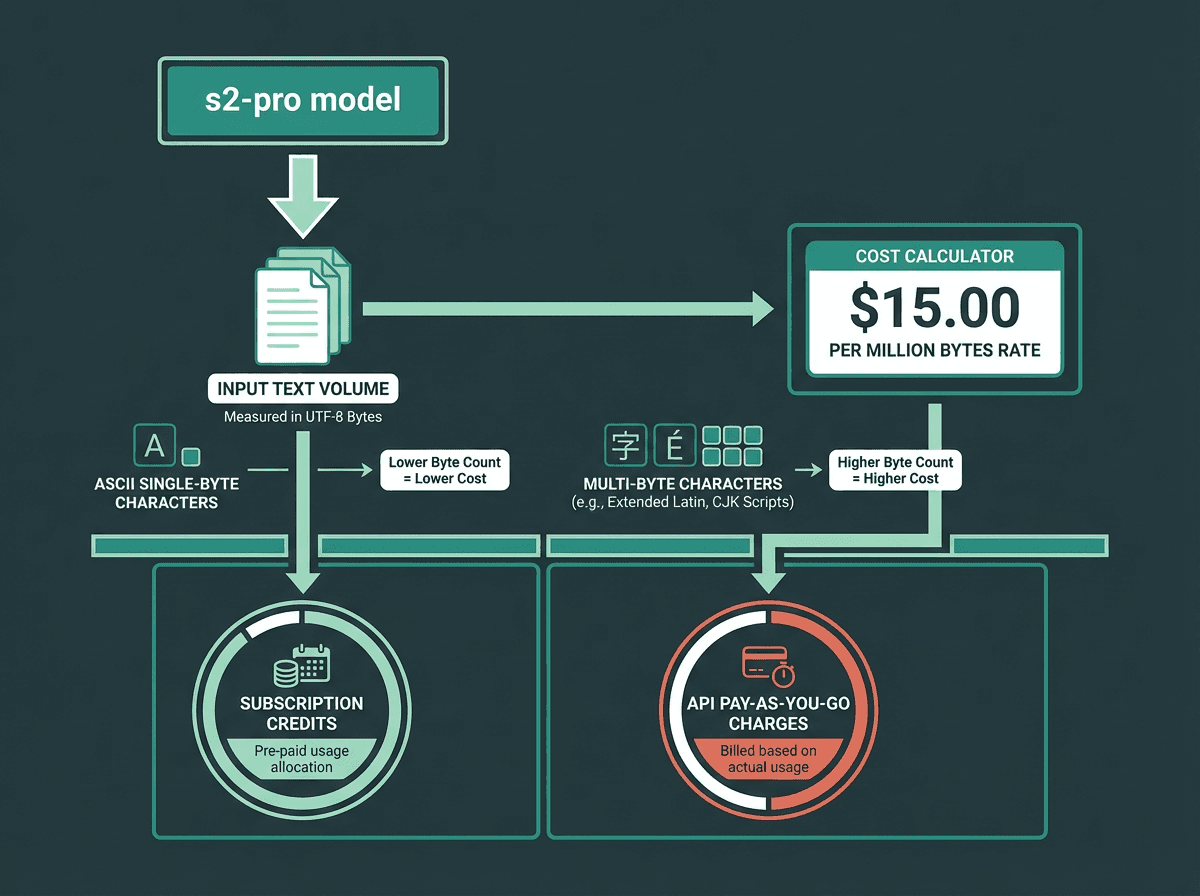
Fish Audio's API billing is separate from subscription credits and priced per million UTF-8 bytes.
UTF-8 byte pricing deserves more attention than most buyers give it. A single ASCII character (standard English letters, numbers, basic punctuation) is 1 byte. Accented or extended Latin characters typically run 2 bytes. Characters from non-Latin writing systems such as Chinese, Japanese, Korean, Arabic, or Hindi are generally 3 to 4 bytes each. The practical consequence: the same word count in Japanese will cost significantly more to process than the equivalent in English. Any multilingual use case needs cost estimates that account for this, not just character or word counts.
The per-byte model is not inherently worse than per-character or per-minute pricing, but it does require more careful upfront estimation. For developers comparing providers, understanding how API pricing models work across the market is essential before committing to a platform.
Commercial Rights: The Detail Most Buyers Miss
The free plan's non-commercial restriction is not buried in fine print. Fish Audio's terms of service explicitly limit free-tier output to personal use. For anyone building a product, monetizing content, or delivering work to clients, this makes the free tier a testing environment by definition, not a production one.
Both Plus and Pro include commercial rights, but the specifics matter. The rights attached to cloned voices in particular sit in a legally nuanced space across jurisdictions, and Fish Audio's terms around cloned voice commercial use are worth reading carefully before deploying at scale. Verify directly against the current terms of service rather than assuming the headline 'commercial rights included' covers every scenario you have in mind.
Choosing the Right Plan: A Practical Framework
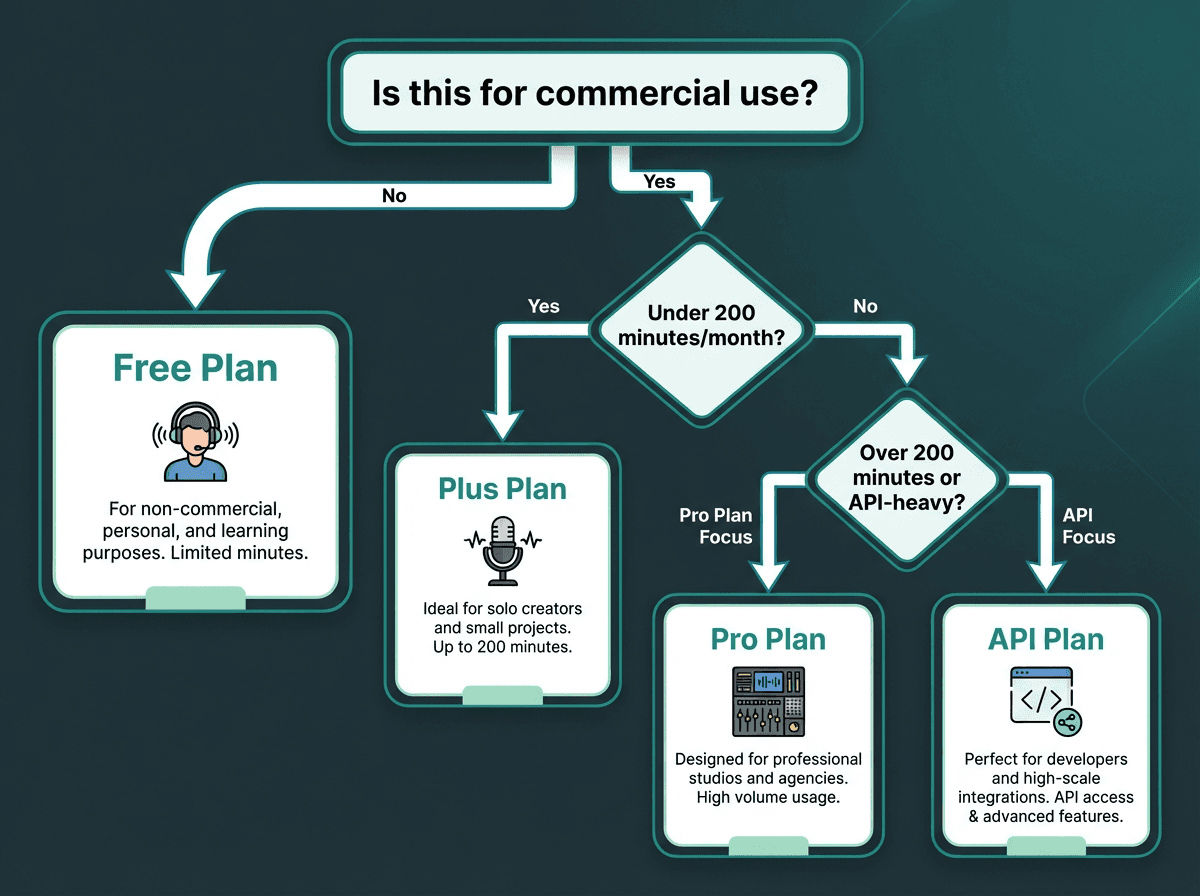
Use this decision path to match your use case to the right Fish Audio tier.
Most people evaluating Fish Audio fall into one of four categories. The right plan is fairly predictable once you know which one applies to you:
Match your situation to the appropriate tier:
Personal experimentation or learning: The Free plan covers this. 8,000 monthly credits is enough to explore the voice library, test cloning, and get a real feel for output quality before spending anything.
Solo content creator with commercial output: Plus at $5.50/month (promotional price) is the entry point. 200 minutes of high-quality generation per month handles most individual creators producing regular content.
Production pipeline, agency work, or audiobook production: Pro at $37.50/month (promotional price) or direct API access. At this scale, the 1,620-minute monthly allocation and API flexibility are not optional.
Developer building a voice-enabled product: API-first, pay-as-you-go. Subscription credits become largely irrelevant; your cost scales directly with usage volume, so model your actual traffic before assuming Fish Audio is the most cost-effective option.
Teams comparing multiple providers should look at latency, voice quality, language coverage, and API reliability alongside price. Evaluating any single platform in isolation tends to produce optimistic estimates. The top alternatives to ElevenLabs post covers how Fish Audio and several other providers position themselves in the current market, which is a useful reference if you are still in the research phase.
What Most Buyers Get Wrong About Fish Audio's Credit System
Credits are not interchangeable across all models. The 200-minute and 1,620-minute figures for Plus and Pro specifically refer to high-quality S1/S2 generation. Standard model usage yields more output from the same credit pool. If you are running premium models exclusively, you hit the ceiling faster than the headline minute count implies.
The only reliable way to plan around this is to test your specific combination of model, language, and content type against actual credit consumption before committing to a tier. A week of real usage data will tell you more than any estimate built from headline numbers. This is especially true for multilingual workflows, where byte-based billing and model-specific credit rates compound in ways that are hard to predict without empirical data.
Where Fish Audio's Value Proposition Breaks Down
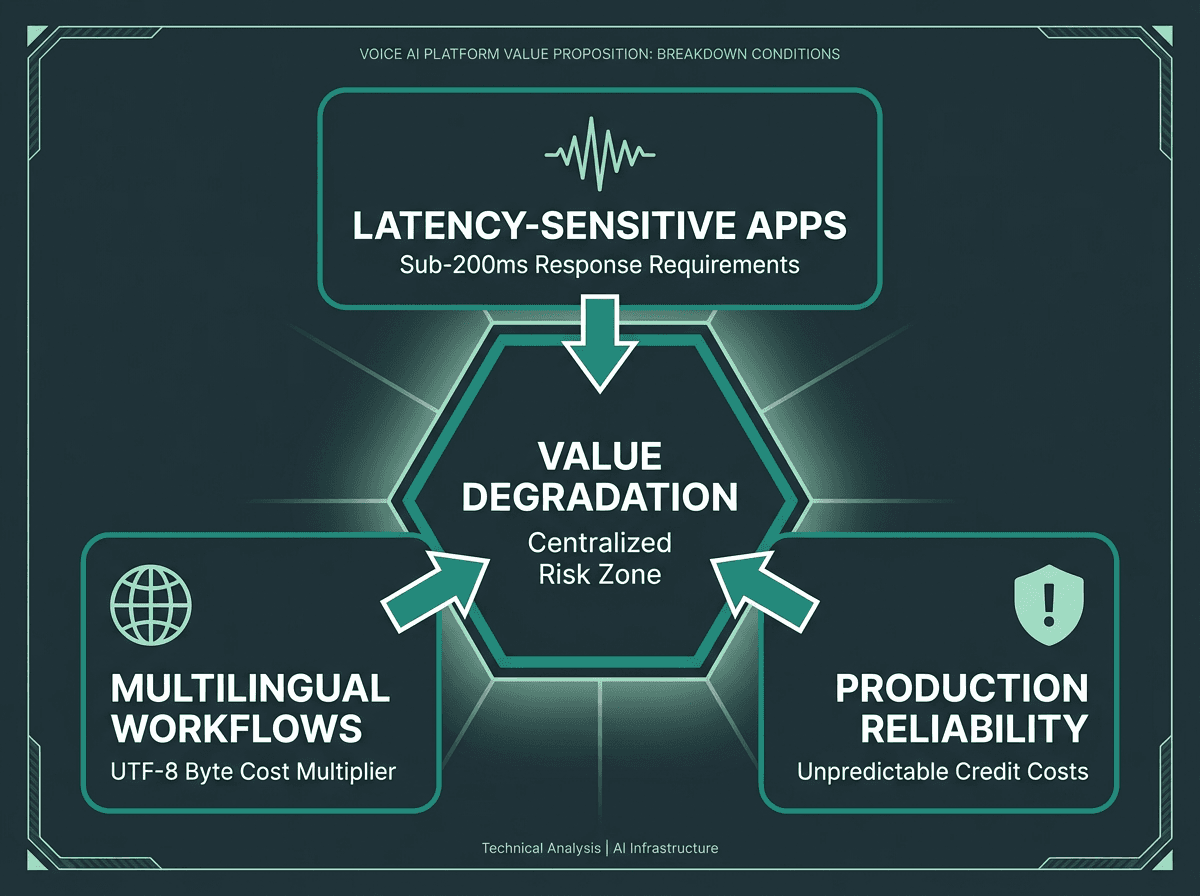
The value of Fish Audio's pricing model depends on use cases that are not sensitive to latency, multilingual cost variations, or production reliability.
The promotional pricing for Fish Audio's plans is attractive for content creators, but the value diminishes under specific production conditions. For developers and teams with strict technical requirements, the platform's structure can introduce significant friction.
The model's value is most stressed by multilingual workflows due to its UTF-8 byte-based API pricing, which makes non-Latin scripts more expensive. Latency-sensitive applications, like real-time voice agents, may also pose a challenge, as a platform optimized for creative content may not meet the sub-200ms response times needed for conversational interactions. Production reliability can also be a concern if costs become unpredictable due to the complex credit system. For teams that require predictable costs, low latency, and straightforward API pricing for production-grade voice generation, Smallest.ai's Lightning V3.1 model offers a clear alternative.
Key Takeaways and Next Steps
The essential facts about Fish Audio pricing in 2026:
Free plan: 8,000 monthly credits, personal use only, no commercial rights.
Plus plan: $5.50/month (annual billing, promotional price); list price is $20/month. Includes 200 minutes of high-quality S1/S2 generation and commercial rights.
Pro plan: $37.50/month (annual billing, promotional price); list price is $150/month. Includes 1,620 minutes of high-quality generation and full commercial rights.
API pricing: Pay-as-you-go at $15.00 per million UTF-8 bytes for the s2-pro model.
Non-Latin scripts cost more per word due to multi-byte character encoding.
For production-grade, low-latency TTS without credit-system complexity, Smallest.ai's Lightning V3.1 is built for exactly that use case.
If you are comparing Fish Audio against other providers before deciding, Smallest.ai pricing is worth reviewing directly. Smallest.ai's Lightning V3.1 TTS model is built for production-grade voice generation with a focus on low latency and natural prosody, and its pricing is structured to be transparent for both developers and content teams. The Smallest.ai blog covers the broader TTS landscape with technical depth if you want more context before committing to any platform.
The problem most buyers run into with Fish Audio is not the price itself. It is the gap between what the headline plan features suggest and what the credit system actually delivers at their specific usage pattern. Test with real content before upgrading, model the byte-based API billing carefully if you are building on top of it, and verify commercial rights terms before publishing anything monetized. For teams that need production-ready TTS with predictable costs and low latency from day one, Smallest.ai's Lightning V3.1 model offers a direct path without the credit-system complexity.
Frequently asked questions
Can I use Fish Audio's free plan for commercial projects?
How many minutes of audio does Fish Audio's Plus plan actually give you?
What does 'per million UTF-8 bytes' mean for my API costs?
Is Fish Audio a good choice for audiobook production?
How does Fish Audio's pricing compare to other TTS platforms?