Conversational AI in Customer Service: 4 Use Cases And Steps

Learn how conversational AI in customer service shapes user reactions, speeds call flow, supports cleaner handoffs, and strengthens voice and chat interactions.
Your support team has likely seen this call play out many times.
A customer opens with a quick question, the agent scrambles across tools to collect history, the caller repeats details already shared, and the clock keeps ticking while the queue grows. Leaders in high-volume operations know this pattern well, especially when voice is the primary channel and every second matters.
This is where conversational AI in customer service creates a meaningful shift. Voice AI, voice agents, and voice cloning capture details, gather context, and help calls move with a steady rhythm. When conversational AI in customer service handles early steps, agents focus on the parts of the call that need human reasoning rather than repeated lookup work.
In this guide, you will see how use cases, channel behavior, and setup steps come together to improve call handling inside real teams.
Key Takeaways
AI Cuts Repeat Work Across Channels: Automation absorbs routine requests in chat, email, and voice, giving agents more time for context-heavy conversations that need human reasoning.
Voice Agents Improve Call Starts: Voice AI collects details, verifies inputs, and sets context before transfer, allowing agents to begin with clear information rather than restarting discovery.
Customers Respond Well to Accurate AI: Studies show strong satisfaction and loyalty when AI resolves straightforward tasks with steady reasoning and precise answers.
Successful Rollouts Depend on Structure: Early wins come from clear task limits, verified data sources, channel-specific rules, and daily checks that catch phrasing drift or routing gaps.
Smallest.ai Strengthens Real-Time Operations: Lightning Voice AI, Electron SLMs, voice agents, and voice cloning support accurate responses, fast turns, multilingual needs, and high-volume calls inside enterprise teams.
Where Customer Service Teams Lose Time and Momentum Today
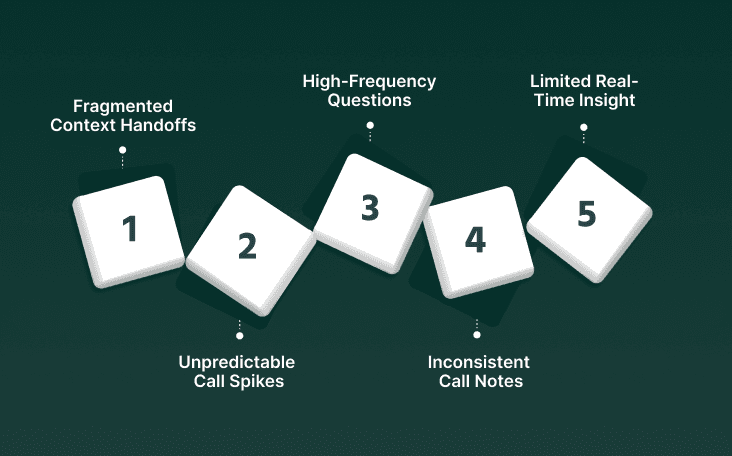
Customer-facing groups carry heavy interaction loads across voice and chat, and conversational AI in customer service often enters environments already stretched by complex data flows. Leaders want systems that cut repeat work without creating new friction. The gap usually appears in places where context, volume, and timing collide.
Fragmented Context Handoffs: Agents switch tools to piece together caller history, slowing conversational AI customer support workflows and increasing follow-up cycles.
Unpredictable Call Spikes: Volume surges overload routing paths, creating long wait times even when requests are simple and suited for conversational AI for customer service.
Repetitive High-Frequency Questions: Teams spend hours answering the same policy, billing, and status queries that conversational customer support systems handle well.
Inconsistent Call Notes: Human-entered summaries vary widely, which affects downstream routing accuracy for any future conversational AI agent customer service deployment.
Limited Real-Time Insight: Supervisors lack moment-by-moment visibility into caller intent trends, sentiment shifts, and request patterns, slowing operational action.
These patterns reveal why teams seek systems that organize information cleanly and maintain steady flow across channels, especially when volume and timing shift without warning.
How Conversational AI Reduces Workload Across Support Channels
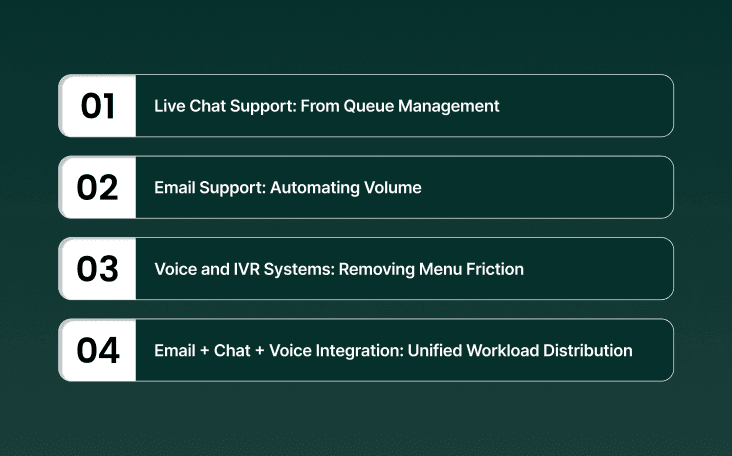
Support teams often focus on keeping channels steady rather than increasing volume capacity. The real shift appears when repeated steps across chat, email, and voice move to automated systems that hold context without agent involvement. With the conversational AI market projected to grow from 12.82 billion dollars in 2024 to 136.41 billion dollars by 2035, more leaders are investing in voice AI and agent systems that distribute work cleanly across every channel.
1. Live Chat Support: From Queue Management to Genuine Problem-Solving
Live chat teams frequently deal with high message volume across password resets, account verification, billing clarifications, order status checks, and form-based updates. Conversational AI in customer service reduces this load by absorbing repetitive categories and giving agents space to handle situations where context, tone shifts, and multi-step reasoning matter.
AI Handles First-Level Triage Across Common Request Types: The system manages frequent requests such as refund status, delivery ETA, subscription renewals, and simple account edits, passing only context-heavy cases to agents.
AI Drafts Replies for Complex Threads: For situations involving multi-step context, such as claim corrections, technical troubleshooting, or detailed policy questions, AI produces draft responses that agents refine instead of typing long explanations manually.
Clear Routing Based on Intent and Message Depth: Incoming messages are tagged by topic (billing, account, order, access, technical) and tone to determine whether they go to automation or a human agent with the correct specialization.
Consistent Wording Across Large Teams: AI-generated suggestions reflect the organization’s approved phrasing, policy references, and compliance language, preventing mismatched message styles across agents.
Example: A housing operator evaluated several voice systems while planning upgrades for guest support. Smallest.ai stood out during early tests, handling property queries with steady latency and clear speech quality. The team plans to roll it out across all locations after positive internal trials.
2. Email Support: Automating Volume Without Sacrificing Accuracy
Email is the slowest channel due to long text, mixed requests, and attachment review. Conversational AI customer support reads these messages end-to-end, extracts the main request, secondary requests, and metadata such as order numbers or claim IDs, and prepares a structured reply.
Automation for High-Volume Email Categories: The system resolves categories such as shipment tracking updates, billing summaries, return instructions, password resets, and basic technical guidance.
Recognition of Multiple Tasks in a Single Email: When a customer includes several needs, such as refund status, address change, and invoice download, the system separates them and routes each item correctly.
Drafting that Reflects Customer History: Email replies reference past tickets, prior attempts, product usage, or plan tier so agents do not reconstruct context manually.
3. Voice and IVR Systems: Removing Menu Friction and Improving Call Flow
Voice channels carry requests that often require identity verification, account lookups, and quick information retrieval. Traditional IVR menus struggle with this. Conversational AI for customer service lets callers speak naturally, interpret intent quickly, and complete tasks inside one uninterrupted flow.
Natural Speech Understanding Across Detailed Use Cases: Callers can request actions such as replacing a debit card, updating an appointment, checking lab report availability, modifying a reservation, or changing flight details in a single sentence.
AI Captures Context Before Transfer: When a call requires human attention, agents receive caller identity, past attempts, verified data, and the exact request path, allowing them to start resolving immediately.
Support for Large Voice Volumes During Peak Periods: AI processes thousands of concurrent interactions, handling needs like prescription refill status, loan application questions, outage reports, or claim updates without queues ballooning.
Example: A wellness brand noticed that callers often dropped off before completing basic steps. After shifting intake calls to Smallest.ai voice agents, the team saw smoother conversations and stronger follow-through across multiple product lines. The natural delivery helped callers stay engaged, and the brand reported higher repeat usage within weeks.
4. Email + Chat + Voice Integration: Unified Workload Distribution
When conversational AI agent customer service works across all channels, customers maintain continuity while automation absorbs routine work. This prevents agents from re-asking identity questions or searching across systems to rebuild history.
Context Stays Intact Across All Channels: A customer who emails for a replacement card, chats for shipping details, then calls to confirm delivery sees one continuous thread that includes timestamps, previous recommendations, and prior system actions.
Routing Based on Complexity and Preferred Channel: Routine tasks move to automated chat or email replies, while high-stakes topics, such as billing disputes, claim escalations, or medical appointment adjustments, go directly to trained agents.
Multilingual Contact Handling Across 50+ Languages: Systems can manage initial messages in languages such as Spanish, Hindi, Arabic, Mandarin, Tamil, French, Vietnamese, Korean, and others, covering global support without relying on language-specialized agent hiring for each market.
Experience voice AI built for fast turns, high accuracy, and natural delivery across support channels. Book a demo.
Customer Reactions When AI Handles Questions and Requests
Recent studies show a clearer picture of how customers judge conversational AI in customer service. Reactions depend on precision in responses, the system’s ability to track context, and whether the AI stays within tasks it can complete reliably.
High Satisfaction With AI-Handled Interactions: 83.8% of customers reported positive satisfaction when AI resolved their request without extra clarification steps.
Loyalty Gains Through Repeated AI Use: 75.3% of customers showed stronger loyalty when AI delivered consistent outcomes across follow-up interactions.
Trust and Competence Drive Customer Approval: Research shows customers respond positively when AI displays steady reasoning and consistent accuracy across back-to-back queries.
Empathy Signals Raise Customer Comfort: Studies found that small tone adjustments, acknowledging frustration or confusion, improve customer comfort during text-based support.
Complex Requests Change Customer Expectations: Customers accept AI for simple tasks, but trust dips when multi-step issues are handled without a clear structure or verification.
For teams looking to steady daily call flow and reduce repeat tasks, learn where these systems create the clearest lift in AI Tools In Customer Support: Top 10 Ways To Use Them
Steps That Help Conversational AI Launch Smoothly Inside Support Operations
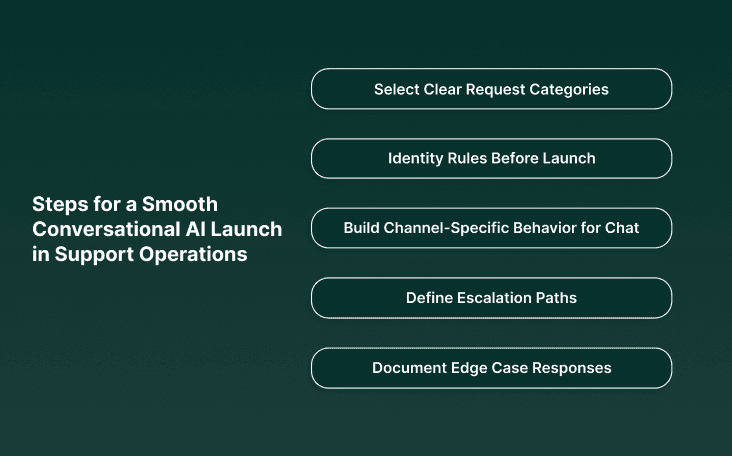
A successful rollout depends on how well teams define the AI’s operational limits, prepare structured data inputs, and design routing flows that hold up under real customer volume. The goal is to prevent guesswork during live traffic and give the AI stable guardrails from day one.
Select Clear Request Categories for Early Deployment: Start with tasks such as order updates, billing summaries, appointment checks, and simple profile edits where outcomes follow predictable steps.
Set Verified Prompts and Identity Rules Before Launch: Define phrasing for verification, multi-factor checks, and required disclosures so the AI follows consistent patterns during sensitive interactions.
Build Channel-Specific Behavior for Chat, Email, and Voice: Give each channel its own timing rules, phrasing patterns, and allowable pauses to match how customers naturally communicate.
Define Escalation Paths and Agent Context Bundles: Route payment issues, claim adjustments, and sensitive account changes to agents, and include history, identifiers, and prior attempts in one package.
Test Under Peak Load and Document Edge Case Responses: Simulate high chat concurrency, dense email batches, and fast voice prompts, and record how the AI should act when data is missing or conflicting.
If you want to compare how other operations apply real-time voice systems, read 6 of the Best AI Answering Services You Must Check Out in 2026
How Smallest.ai Strengthens Call Handling and Response Quality
Smallest.ai improves conversational AI in customer service by giving support teams real-time voice agents, fast speech models, and channel-aware controls built for high-volume operations. The system focuses on accuracy, latency, and context delivery so every call moves with clarity from start to finish.
Sub-100-ms Speech Generation: Lightning Voice AI produces natural responses fast enough for live two-way conversations.
Precise Transcription for Noisy Environments: Electron SLMs interpret accents, mixed languages, and fast speech during real calls.
Context-Aware Voice Agents: Agents track caller intent shifts across policy questions, order updates, and booking changes without losing the thread.
Structured Call Summaries for Agents: The system creates compact summaries with caller intent, past attempts, and final actions.
Reliable Identity and Detail Capture: Voice agents collect names, numbers, order IDs, and appointment details with high accuracy.
Support Across 16 Spoken Languages: English, Hindi, Tamil, Marathi, Spanish, Bengali, Gujarati, Kannada, French, Hebrew, Italian, Arabic, Russian, German, Dutch, and Polish.
Tight Integration With Enterprise Tools: Built-in connectors allow calls to trigger updates in Salesforce, Zendesk, Gmail, WhatsApp, and internal CRMs.
Flexible Deployment With On-Prem Options: Supports regulated teams that need conversational AI customer support without cloud dependence.
Low Fall-Back Rates for Complex Flows: Voice agents handle multi-step tasks such as appointment edits, address corrections, or item replacements with high reliability.
Enterprise-Grade Security Layers: SOC 2 Type II, HIPAA, PCI, ISO, and strict internal audit controls support sensitive use cases in finance and healthcare.
Together, these capabilities give support teams faster calls, clearer responses, and a dependable conversational AI in customer service layer that works reliably at enterprise scale.
Conclusion
A support operation changes its rhythm once teams see how callers respond when conversations start with clear context and end without unnecessary backtracking. This is where conversational AI in customer service shifts from a channel add-on to a structural change in how daily work moves.
Leaders using these systems notice that improvement shows up not only in response time but in how neatly information travels between channels. The next wave of conversational AI in customer service will focus on precision, caller comfort, and real-time actions that reduce the need for manual cleanup after each shift.
Smallest.ai supports this direction with voice AI built for live interactions, voice agents that handle multi-step tasks, and voice cloning that maintains brand clarity across every call. These systems carry context, collect verified details, and keep conversations steady without adding pressure to support teams.
To see how this works inside real operations, book a demo.
FAQs About Conversational AI in Customer Service
1. How does conversational AI in customer service handle situations where customers switch between voice and chat in the same inquiry?
Most systems keep a shared thread across channels, allowing the AI to carry caller history, extracted details, and prior steps without restarting the interaction.
2. Can conversational AI customer support detect when a customer is providing incomplete or conflicting information?
Yes. These systems flag missing fields, mismatched identifiers, or unclear phrasing and guide the customer with targeted follow-up questions.
3. What role does data residency play in conversational AI for customer service?
Enterprises often require region-specific storage rules. Modern platforms support local processing or on-prem options for regulated workloads.
4. How does conversational customer support manage long calls with multiple request types?
AI separates each request, labels intent segments, and processes them in order, reducing confusion during booking changes, billing checks, or account updates.
5. What happens when a conversational AI agent customer service system encounters tasks outside its allowed scope?
The AI hands off to a human agent with a summary that includes caller intent, captured details, and any earlier attempts.