Best ElevenLabs Alternatives in 2026: Top TTS Tools Compared

Discover the best ElevenLabs alternatives for 2026. See how Smallest.ai, Deepgram, OpenAI, Cartesia, and Resemble.ai compare for real-world TTS use cases.
ElevenLabs is widely recognized for voice quality, but it is not the only serious option in 2026. Whether you are building a real-time voice agent, a podcast automation pipeline, or a customer support IVR system, the right TTS platform depends on factors that ElevenLabs does not always win on: latency, pricing at scale, API flexibility, and commercial licensing terms. The market for ElevenLabs alternatives has matured considerably, and several platforms now match or exceed it in specific dimensions.
This article compares five strong alternatives across the criteria that actually matter for developers and product teams: voice naturalness, latency, pricing structure, API quality, language support, and commercial licensing. The goal is to give you a clear recommendation for each use case, not a hedge.
How We Evaluated Each Platform
Every platform in this comparison was evaluated against six criteria. Voice naturalness covers prosody, expressiveness, and how human the output sounds under real listening conditions. Latency refers to time-to-first-audio, which is critical for conversational AI. Pricing is assessed at both low and high usage volumes because the economics shift dramatically at scale. API quality covers documentation, SDK support, streaming capabilities, and reliability. Language and voice coverage reflects how many languages and distinct voice personas are available. Finally, commercial licensing addresses whether you can use generated audio in products, ads, or public-facing applications without additional legal exposure.
Smallest.ai: Built for Real-Time Voice Applications
Smallest.ai is purpose-built for low-latency, production-grade voice AI.
Smallest.ai is not trying to be a general-purpose TTS tool. It is built specifically for latency-critical applications: voice agents, IVR systems, real-time conversational AI, and any pipeline where waiting 800ms for audio to start is a dealbreaker. Its Lightning model delivers sub-100ms time-to-first-audio, which puts it in a different performance category from most alternatives when it comes to live interactions. For a detailed latency benchmark, the fastest text-to-speech APIs in 2026 breakdown is worth reading.
Lightning V3.1 is available on a pay-as-you-go model at approximately $0.25 per 10,000 characters (see the Smallest.ai pricing page for current volume tiers), with no upfront commitments or expiring credits. The API is developer-first, with streaming support, WebSocket integration, and clean documentation. Voice quality on the Lightning model is optimized for clarity and naturalness in spoken dialogue rather than long-form narration. If you are building a voice agent stack and need to compare the full picture, the 2026 voice agent stack comparison covers Smallest.ai against Deepgram and OpenAI TTS in detail.
Where Smallest.ai stands out:
Sub-100ms time-to-first-audio on the Lightning model, purpose-built for real-time use cases
Lightning V3.1 is priced pay-as-you-go at approximately $0.25 per 10,000 characters (see pricing page for current tiers) with no seat licenses, no minimums, and no expiring credits
WebSocket streaming and REST API with strong developer documentation
Commercial licensing included without additional legal overhead
The honest limitation: if your primary use case is audiobook narration or long-form content where latency does not matter and expressive range is paramount, ElevenLabs may offer more stylistic variety. Smallest.ai is the right call when speed and reliability in production are non-negotiable.
Deepgram: Strong on Speech-to-Text, Growing on TTS
Deepgram is best known for ASR but has expanded its TTS offering significantly.
Deepgram built its reputation on automatic speech recognition (ASR), and its Nova-2 model remains one of the most accurate transcription engines available. Its TTS offering, Aura, is newer and competent but not yet at the expressive ceiling of ElevenLabs. Where Deepgram genuinely wins is in the full-stack play: if your application needs both speech-to-text and text-to-speech, using Deepgram for both simplifies your architecture, reduces vendor surface area, and keeps latency low because you are not routing audio between two different APIs.
Deepgram's Aura TTS is priced at $0.015 per 1,000 characters for Aura-1 and $0.030 per 1,000 characters for Aura-2, with volume discounts bringing the Aura-2 rate to approximately $0.027 per 1,000 characters at higher usage, according to Deepgram's published pricing. That tiered structure means the cost calculus depends on which model tier your use case requires. At the higher-quality tier, Deepgram sits in the mid-range of the market rather than the low-cost end, so it is worth factoring that in before assuming it is the cheapest option. The real value proposition remains the unified platform: for teams already using Deepgram for transcription, adding Aura TTS is a natural extension rather than a new evaluation.
OpenAI TTS: Reliable, Familiar, but Limited in Voice Range
OpenAI TTS is part of the broader OpenAI API ecosystem, making it easy to integrate for teams already using GPT models.
OpenAI TTS offers six preset voices (Alloy, Echo, Fable, Onyx, Nova, Shimmer) and two model tiers: tts-1 (optimized for speed) and tts-1-hd (optimized for quality). Pricing is $15 per 1 million characters for tts-1 and $30 per 1 million characters for tts-1-hd, per OpenAI's published API pricing as of early 2026. That is straightforward and predictable.
The limitation is obvious: six voices with no cloning, no custom voice creation, and no fine-grained style control. For teams building on the OpenAI stack who need basic narration or assistant voices, it is a convenient choice. For anyone who needs voice variety, emotional range, or low-latency streaming for voice agents, it falls short. It is not a bad product; it is a narrow one.
Cartesia: Low Latency with a Focus on Voice Cloning
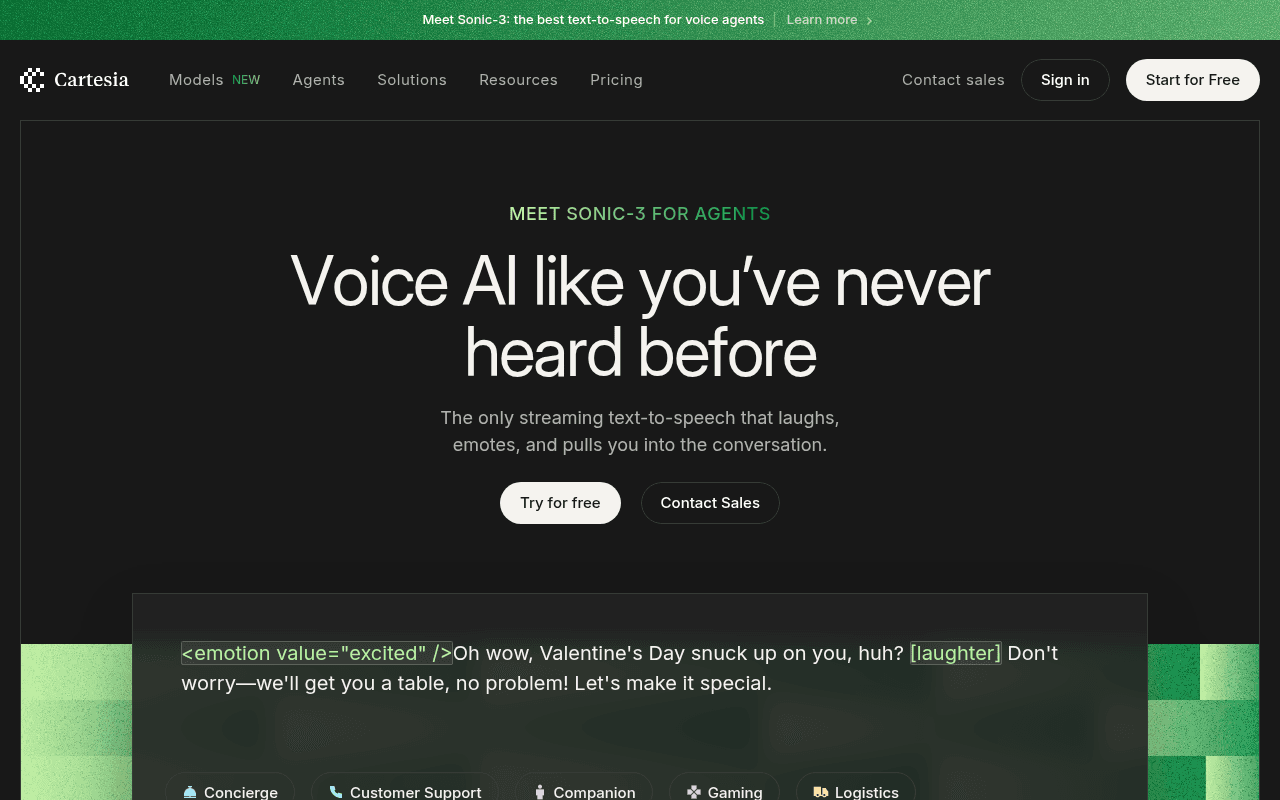
Cartesia has gained attention for its Sonic model's speed and voice cloning capabilities.
Cartesia's Sonic model is one of the more interesting entries in the low-latency TTS space. It was designed from the ground up for streaming, and the time-to-first-audio figures are competitive. Voice cloning is a core feature rather than an add-on, and the cloning quality from short audio samples is notably good. For applications where a branded or personalized voice matters, Cartesia is worth evaluating seriously.
On pricing, Cartesia uses a credit-based system rather than direct per-character billing. Plans start at approximately $5 per month for around 100,000 credits, with credits approximately mapping to character usage depending on inference type (the ratio is not guaranteed to be strictly 1:1 across all operations). This structure is not directly comparable to per-character pricing from providers like Deepgram or OpenAI, so cost modeling requires mapping your expected character volume to Cartesia's credit tiers.
Resemble.ai: Enterprise Voice Cloning with Localization Depth
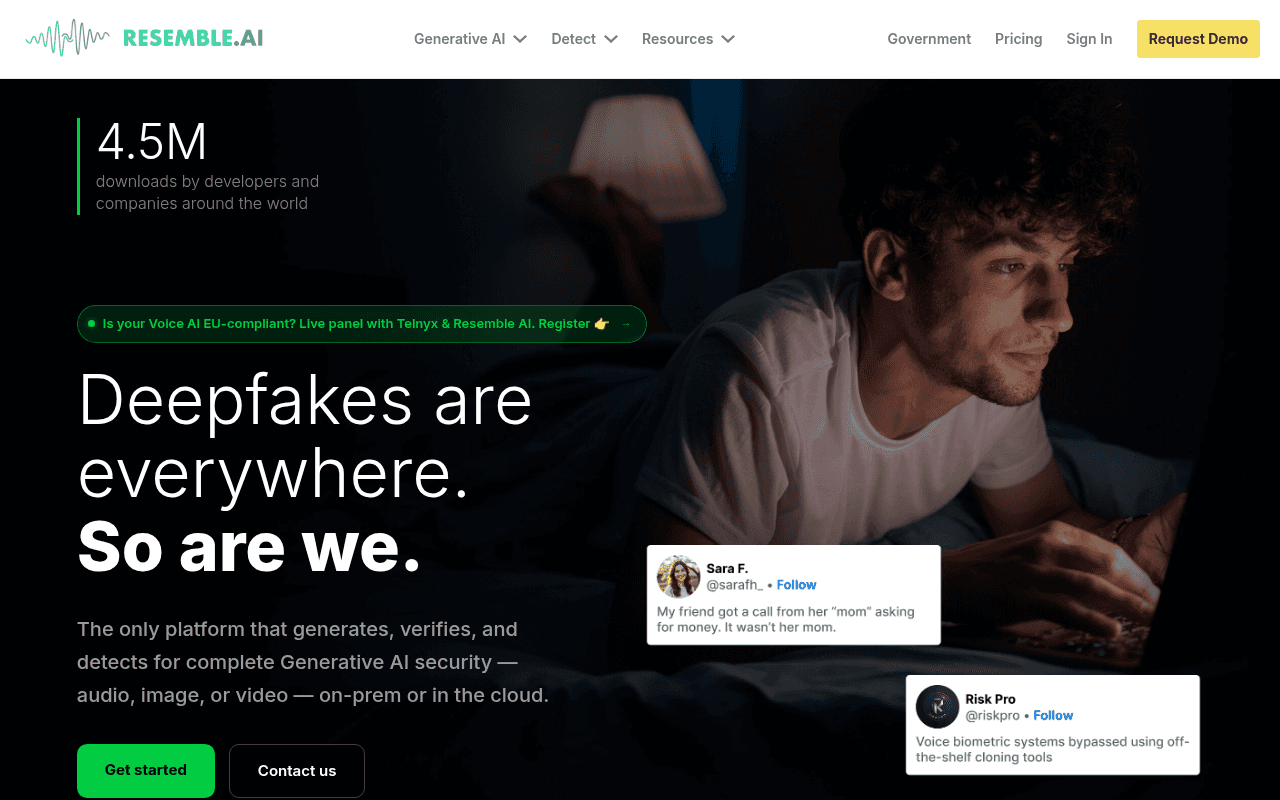
Resemble.ai targets enterprise teams with voice cloning, localization, and content moderation tools.
Resemble.ai occupies a specific niche: enterprise-grade voice cloning with a strong emphasis on localization and brand voice consistency. Its Localize feature allows teams to clone a voice in one language and adapt it to others while preserving speaker identity, which is a genuine differentiator for global brands. It also includes a content moderation layer called Resemble Detect, which flags synthetic audio, addressing a concern that is increasingly relevant for enterprise legal and compliance teams.
The tradeoff is complexity and cost. Resemble.ai is not a quick-start API for solo developers. It is priced and structured for teams with procurement processes, legal review, and dedicated integration resources. For those teams, the localization depth and compliance tooling justify the investment. For everyone else, simpler alternatives will get you further faster.
Head-to-Head Comparison Table
Platform | Latency (TTFA) | Voice Library | Pricing Model | Best For | Commercial License |
|---|---|---|---|---|---|
Smallest.ai | Sub-100ms (Lightning) | Growing, dialogue-optimized | Starts at approximately $0.25 per 10,000 chars, pay-as-you-go (see pricing page for current tiers) | Real-time voice agents, IVR | Yes, included |
Deepgram (Aura) | Low, optimized for streaming | Limited voices | Aura-1: $0.015/1K chars; Aura-2: $0.030/1K chars (volume discount to ~$0.027/1K) | Full-stack ASR + TTS teams | Yes |
OpenAI TTS | Moderate (tts-1 faster) | 6 preset voices | $15/1M chars (tts-1); $30/1M chars (tts-1-hd) | GPT-integrated apps, basic narration | Yes |
Cartesia (Sonic) | Sub-100ms range | Cloneable, growing library | Credit-based: ~$5/mo for ~100K credits (credits approximately map to character usage; ratio varies by inference type) | Voice cloning, startup products | Yes |
Resemble.ai | Moderate | Cloneable, localization-ready | Enterprise contracts | Global brand voice, compliance | Yes, with audit tools |
Verdict: Which Alternative Is Right for Your Use Case?
The honest answer is that no single platform wins across all dimensions, but the use-case fit is clearer than most comparison articles admit. If you are building a real-time voice agent, conversational AI, or any application where latency directly affects user experience, Smallest.ai is the most purpose-built option in this list. Its Lightning model delivers sub-100ms TTFA and reflects an architectural decision to prioritize streaming performance over feature breadth.
If you are evaluating free ElevenLabs alternatives before committing to a paid plan, or need a broader view of text-to-speech APIs for developers in 2026, those resources cover the lower-cost entry points in more detail.
Understanding Where ElevenLabs Fits
ElevenLabs is genuinely good at what it does. The voice quality on its Multilingual v2 model is among the best available for expressive, long-form audio. ElevenLabs is optimized for a different cost profile: subscription-based plans that suit studio and content workflows rather than high-volume API usage. For real-time applications, the latency profile is not tuned for sub-100ms performance in the way that purpose-built streaming APIs are. These are not reasons to avoid ElevenLabs entirely; they are reasons to be clear-eyed about where it fits and where it does not.
The teams that tend to move on from ElevenLabs are those who started with it for prototyping and found a mismatch when moving to production: either on cost at scale, on latency, or on the realization that their use case (voice agents, IVR, real-time dialogue) was never what ElevenLabs was optimized for. That is the gap that platforms like Smallest.ai were built to fill. If you are at that decision point, the most realistic TTS AI comparison in 2026 puts the Lightning model directly against ElevenLabs on audio quality metrics.
Frequently asked questions
What is the best ElevenLabs alternative for real-time voice agents?
Is there a free ElevenLabs alternative for developers?
Which ElevenLabs alternative has the best voice library?
Can I use ElevenLabs alternatives for commercial projects?
How does Smallest.ai compare to ElevenLabs on voice quality?