AI voice generation for video dubbing

Learn how AI video dubbing works, from transcription to voice synthesis. Discover costs, quality factors, and how to localize video audio at scale.
AI video dubbing replaces (or recreates) the spoken track of a video with AI-generated speech, typically in a new language or a different voice, without booking voice actors or a recording studio. In practice, it is a chained workflow: transcribe the original, translate it, then synthesize new audio that stays in sync with the source timing and, increasingly, the speaker's emotional delivery.
Why AI Video Dubbing Has Become Essential
Viewers want to watch in their own language, not squint at subtitles while trying to follow what is happening on screen. Subtitles also change the viewing posture: you are reading, not just watching. Good dubbing removes that tax, but traditional dubbing has always been gated by logistics and cost: casting, scheduling, studio time, and post-production can drag on for weeks and run tens of thousands of dollars per language.
AI dubbing can reduce both localization time and production costs compared to traditional studio workflows. If you publish weekly and want five languages, those numbers are the difference between "nice idea" and a workflow you can actually keep up with.
The reason is simple: the same tooling that makes one video easier to localize makes a whole channel scalable across languages, which lines up neatly with the global reach of short-form and long-form platforms. Enterprises run the same math on training, demos, and marketing. Multilingual voice dubbing for product videos is no longer a premium add-on; it is increasingly becoming part of standard localization workflows.
How the Technology Actually Works
AI video dubbing is often described as a feature, but it behaves more like a pipeline. No single model does the whole job end to end. You are orchestrating a series of systems that each transform the media in a specific way, and the final quality is only as strong as the weakest handoff between stages.
It starts with speech-to-text transcription, converting the source audio into a transcript. That step carries more weight than most teams expect. A primary challenge in AI dubbing is that errors in the initial transcription stage propagate through the entire pipeline, making transcription accuracy the most critical factor for overall quality. If the model mishears a term, translation faithfully translates the wrong thing, and synthesis confidently speaks it aloud. "Garbage in, garbage out" is not a cliche here; it is the failure mode.
With a clean transcript, machine translation renders the text in the target language. Neural translation is strong on common language pairs, but idioms, domain-specific terms, and culturally loaded references still benefit from human review when the content is high stakes. Next comes text-to-speech synthesis, where a voice model generates the new spoken track. Many production setups add a fourth component: lip-sync technology that nudges timing so the synthesized speech better matches mouth movements on screen.
If you want the production-level details that tend to bite teams (timing, TTS parameters, synchronization), the AI dubbing pipelines piece breaks down how these stages connect in real workflows.
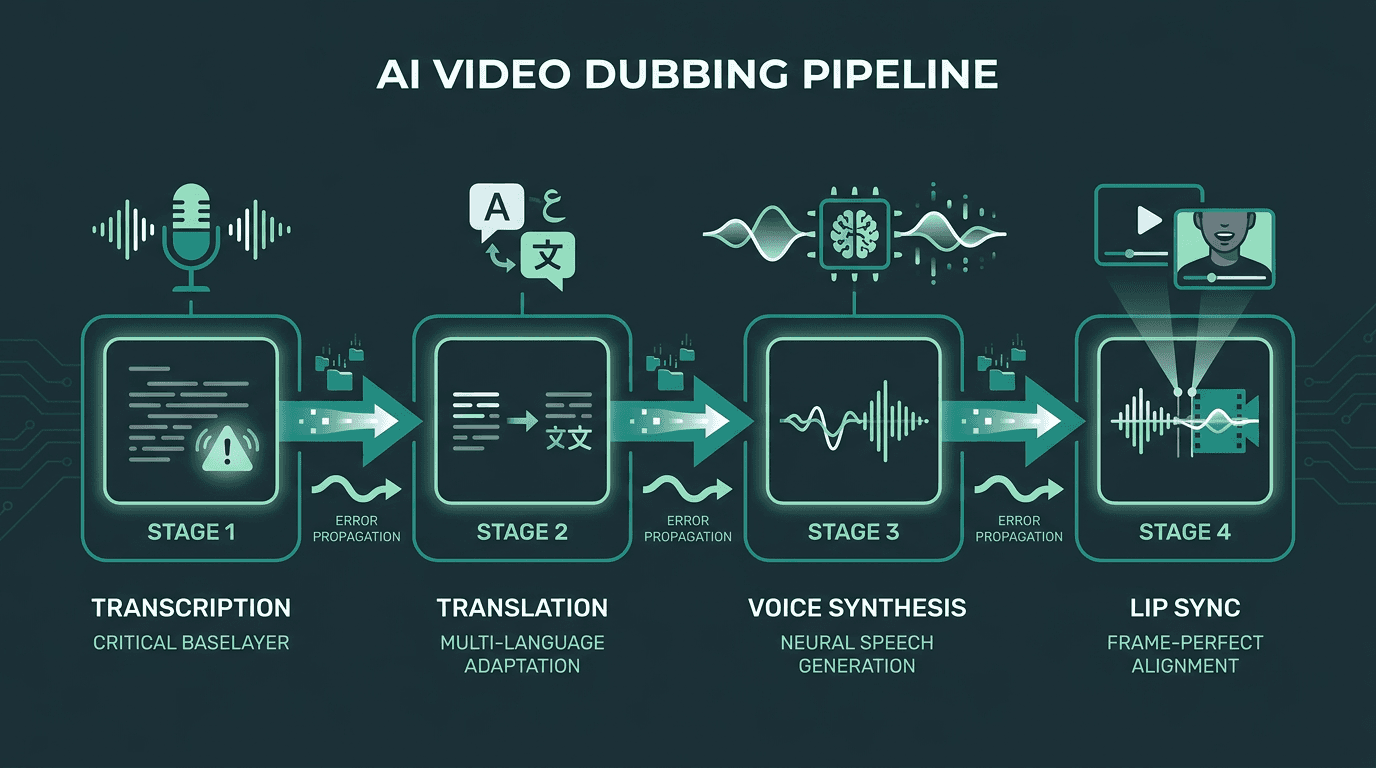
AI video dubbing runs as a sequential pipeline — errors at transcription ripple through every stage that follows.
Voice Cloning and Emotional Fidelity: The Quality Differentiators
The first wave of AI dubbing was "correct" in the narrowest sense: the words were there, but the result sounded synthetic and interchangeable. The dubbed voice rarely resembled the speaker, and the delivery landed flat. Two developments have moved the bar: voice cloning and more expressive speech synthesis.
Voice cloning lets a model learn a speaker's vocal signature from a short sample and carry those traits into the synthesized track. Done well, the dubbed version sounds like the same person speaking the target language, with recognizable timbre, pacing, and mannerisms intact. That continuity matters for documentaries, branded series, and any format where the audience's trust is tied to who is speaking, not just what is being said.
Emotional fidelity is trickier than identity. Urgency in English has to feel urgent in Japanese or Portuguese; a literal translation that loses the energy still fails the viewer. Emotional speech synthesis tackles this by modeling affective cues and reproducing them, aiming to match tone to intent rather than merely outputting accurate phonemes. For marketing and narrative work, that is often the line between "serviceable" and "convincing."
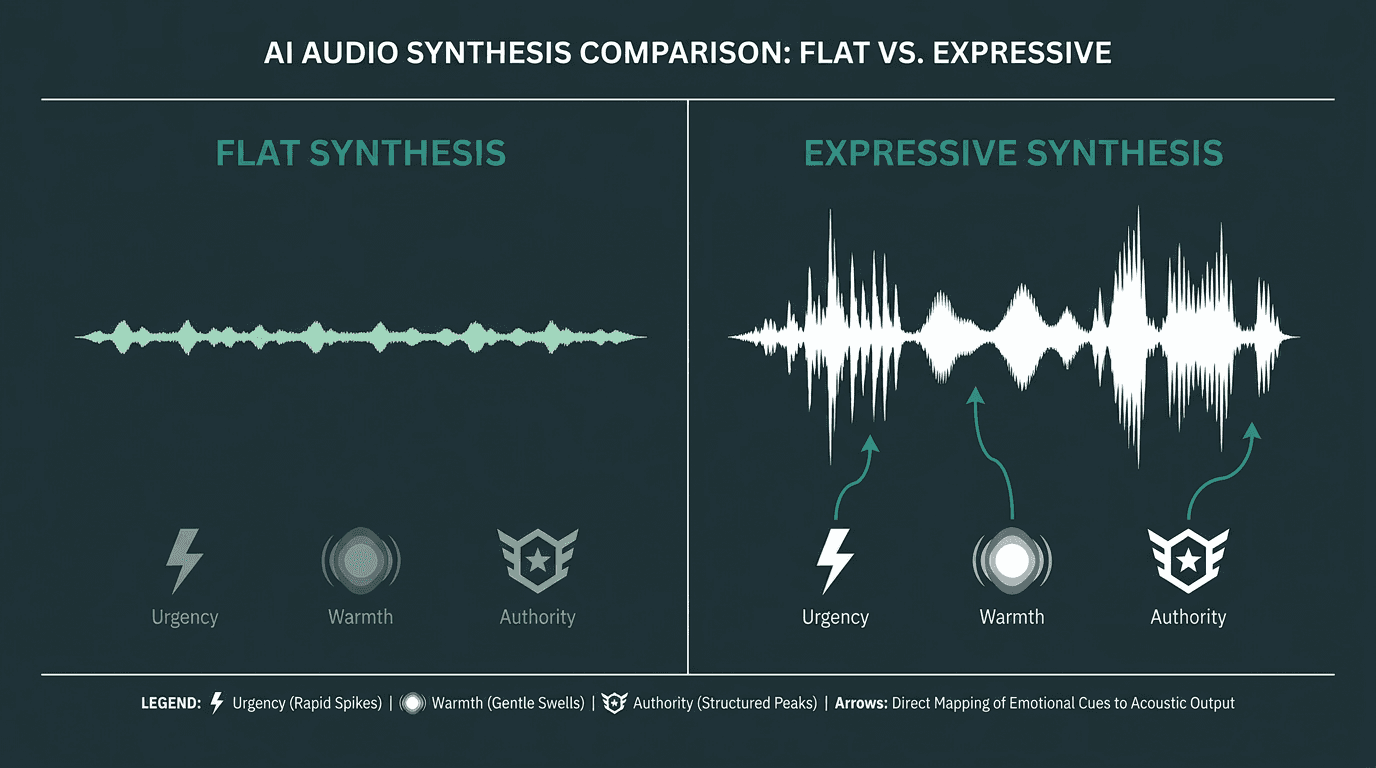
Expressive speech synthesis preserves emotional intent across languages, not just word accuracy.
AI Dubbing vs. Voice-Over vs. Narration: Clearing Up the Confusion
These labels get tossed around as if they are interchangeable. They are not, and the differences show up immediately in budgets, timelines, and what "done" means for a localization deliverable.
Characteristic | AI Dubbing | Voice-Over | Narration |
|---|---|---|---|
Speaker visibility | Speaker is on screen with visible lip movement | Speaker may be on screen or off screen | Speaker is typically off screen |
Sync requirement | Tight lip-sync is expected | Loose timing or no sync requirement | No sync requirement |
Original audio | Original track is fully replaced | Original audio remains, mixed lower under the new track | New audio is added as a separate track |
Primary use case | Films, series, video localization | Documentaries, interviews, ads | E-learning, explainers, audiobooks |
AI complexity | Highest: transcription + translation + TTS + sync | Moderate: translation + TTS | Lower: often TTS only |
Three Misconceptions That Lead Projects Astray
Misconception 1: AI dubbing is a one-click process. Even the cleanest pipeline involves choices at every stage: transcription language and diarization settings, translation memory or glossary integration, voice selection, and timing tweaks. Treat it like a push-button magic trick and you will usually get output that still needs real cleanup.
Misconception 2: Translation quality is the main variable. Translation matters, but transcription is the upstream constraint. Even small transcription errors can propagate through translation and synthesis, which is why high-quality speech-to-text is a prerequisite for professional dubbing workflows.
Misconception 3: AI dubbing works equally well for all content types. It shines with clear, single-speaker dialogue, low background noise, and standard vocabulary. Heavy accents, crosstalk, dense technical jargon, or loud ambient audio push you into preprocessing and more rigorous post-production review. Knowing where the system is reliable, and where it needs human support, is what keeps deployments from turning into rework factories.
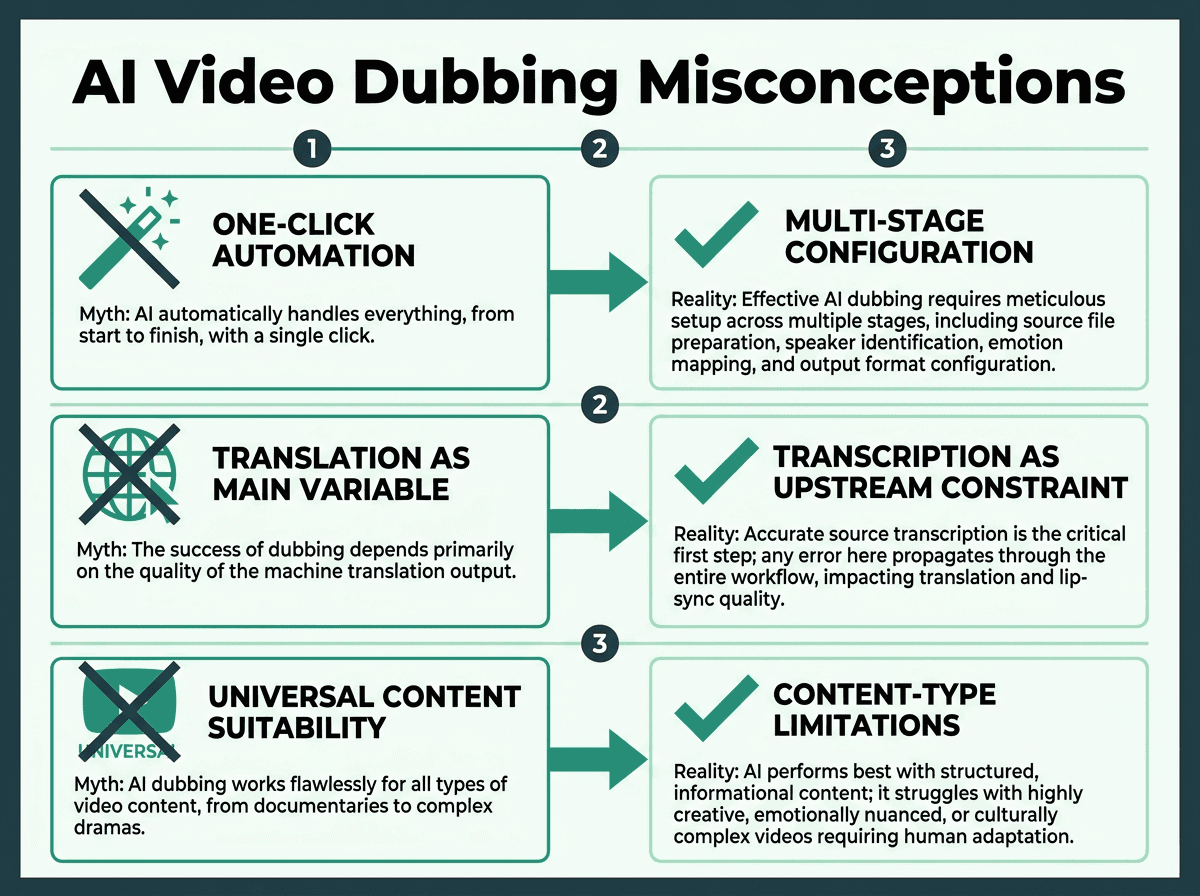
Correcting these misconceptions before starting a project saves significant rework downstream.
Where AI Video Dubbing Is Being Used Right Now
Streaming platforms were early adopters, using AI dubbing to broaden language availability without paying full studio localization costs for every title. Edtech companies use it to ship the same course catalog in many languages without re-recording instructors. Corporate learning teams use it for compliance, onboarding, and product tutorials that have to land with a distributed workforce.
Independent creators are accelerating the category. An English-language YouTuber can publish Spanish, Hindi, and Portuguese versions alongside the original and reach significantly larger global audiences without hiring a voice cast. In other words, the economics that used to belong to studios now show up in a solo creator's toolkit.
Key Takeaways
What to carry forward from this overview of AI video dubbing:
AI video dubbing replaces a video's original spoken track with synthesized speech in a target language, typically via a transcription translation voice synthesis pipeline.
Transcription accuracy drives everything downstream; small errors here turn into obvious mistakes after translation and synthesis.
Voice cloning keeps the speaker's identity intact across languages, while expressive synthesis carries emotional intent. Together, they separate professional output from generic "robot voice" results.
AI dubbing is not the same as voice-over or narration: it replaces the original audio and usually demands tight lip-sync.
Not all source material is equal. Clean, single-speaker dialogue with standard vocabulary tends to produce the best results with minimal post work.

From pipeline accuracy to voice cloning, seven principles define effective AI video dubbing.
The Problem-Solution Bridge
AI video dubbing is often sold as a cost and speed story, but the bigger unlock is distribution. A video that exists in only one language is effectively invisible to most of the world. Traditional localization created a two-tier reality: well-funded productions went global, and everyone else stayed local. AI dubbing is starting to flatten that gap.
Smallest.ai is designed around that production constraint. The Lightning TTS API focuses on low-latency, high-fidelity speech synthesis with voice cloning, so developers and content teams can build a dubbing pipeline without juggling a stack of third-party services. It works for a single localized product video and for teams running multilingual publishing at scale.
Frequently asked questions
What is AI video dubbing, and how does it differ from subtitling?
How accurate is AI dubbing compared to human dubbing?
Can AI dubbing preserve the original speaker's voice?
What languages does AI dubbing support?
How do I get started with AI dubbing for my videos?