AI voice generation for SaaS apps and product demos

AI voice generation for SaaS: how it works, where it fits in demos and onboarding, and what to look for in a voice API (latency, quality, languages, pricing).
AI voice generation for SaaS turns product text into natural-sounding speech inside a software-as-a-service app. Instead of relying on pre-recorded voice assets, teams call a machine-learning model on demand and get human-like audio back. Done well, it gives SaaS products spoken walkthroughs, onboarding narration, and interactive demos through a programmable API layer that scales with the product.
Why SaaS Products Are Adopting Voice Generation Now
Until recently, shipping voice in a SaaS product meant the usual production grind: hire talent, schedule studio time, and redo recordings whenever the UI changed. That overhead kept voice confined to companies with enterprise budgets and plenty of patience. AI voice generation flips the economics. One API call can produce a clean voiceover for a new feature, a localized walkthrough in another language, or a tailored demo narration without stepping into a booth.
Voice tends to pay off at two points in the funnel: product discovery and onboarding. In discovery, a voiced product demo can communicate complexity faster than a text-heavy landing page, especially when the UI is doing the real explaining. AI-powered demos can personalize narration and walkthroughs based on user context, making the experience feel more relevant than a one-size-fits-all presentation. In onboarding, narration reduces cognitive load for new users who are trying to orient themselves in an unfamiliar interface while also parsing instructions.
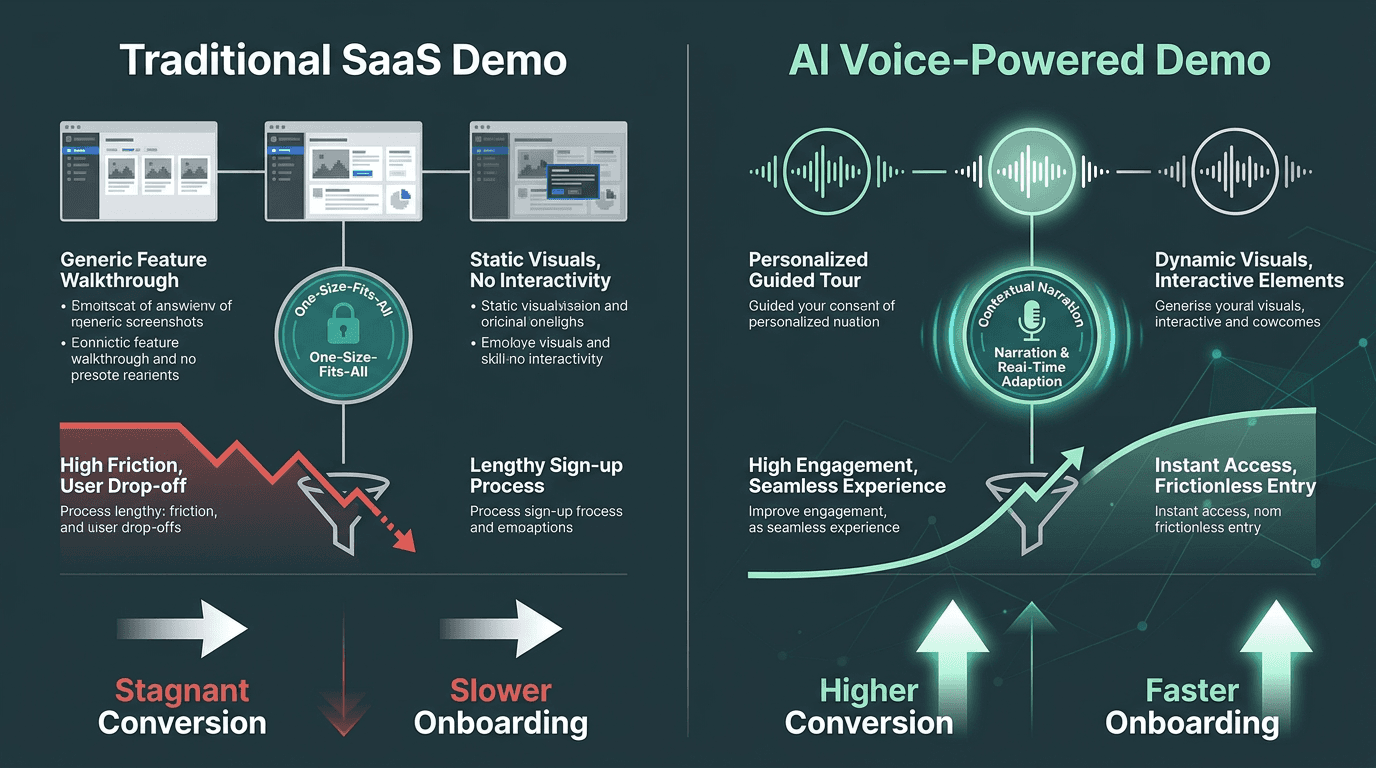
Voice-powered demos reduce friction at discovery and onboarding — the two highest-stakes moments in the SaaS funnel.
How AI Voice Generation Actually Works in a SaaS Context
Modern AI voice generation has little in common with the stiff, robotic text-to-speech many people still picture. Today, systems are typically built on neural network architectures, including transformer-based and diffusion-based models, trained on large corpora of human speech. The point of that training is straightforward: learn the acoustic patterns, prosody, pacing, and inflection that make speech sound like a person, not a synthesizer.
When a SaaS app calls a voice generation API, it sends text plus a set of controls: voice identity, speaking rate, emotional tone, and language. The model returns either an audio file or a real-time stream, depending on what the product needs. For real-time voice apps, the number to watch is time-to-first-audio: the gap between the request and the first syllable. For async work like pre-rendered demo videos, throughput and audio quality usually matter more than shaving off milliseconds. A text-to-speech API is the core of this process.
SaaS integration is fundamentally an API story: connecting systems, automating workflows, and keeping services reliable. Voice generation fits naturally into that model because the same API can power product demos, onboarding, customer support, and other product experiences. demand, whether that is a marketing demo builder, an in-app help surface, or a customer success automation tool.
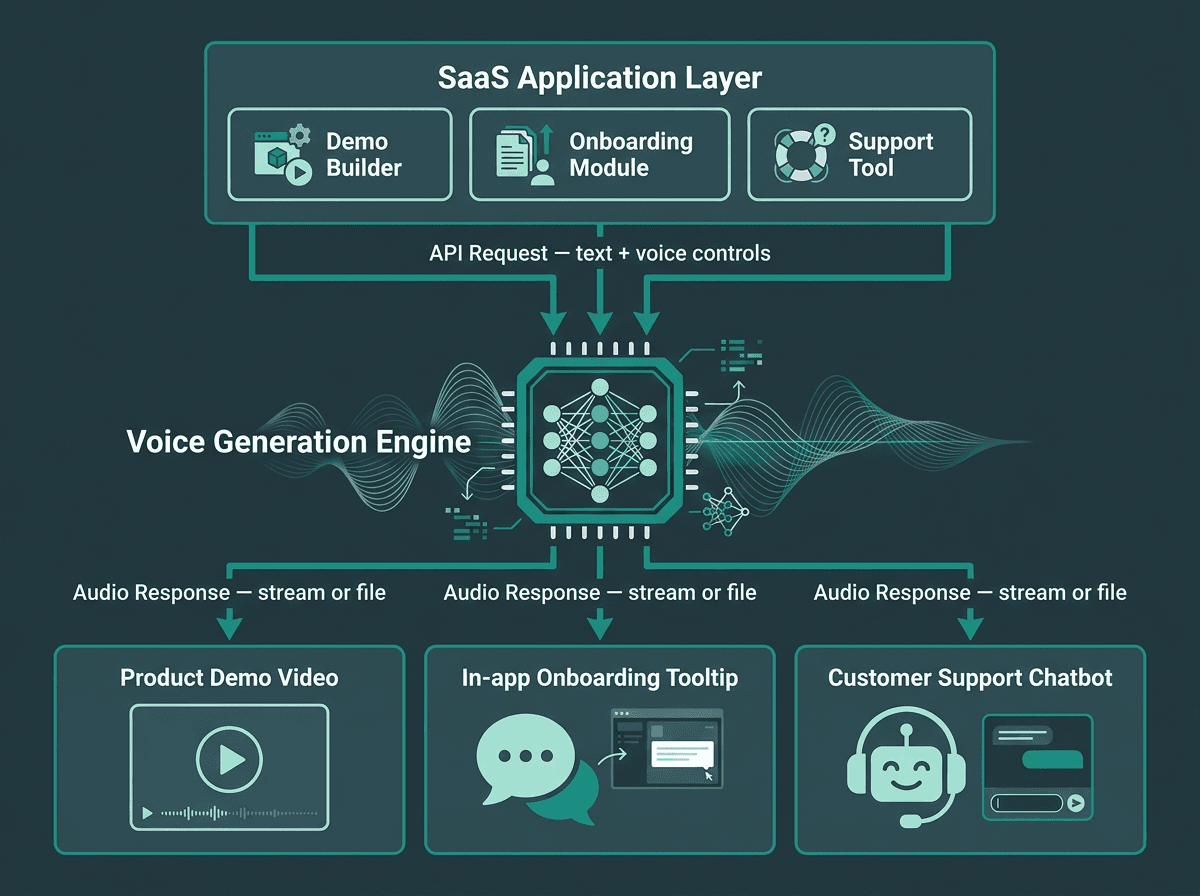
A voice generation API acts as a shared infrastructure layer multiple SaaS surfaces can call independently.
The Distinct Use Cases: Demos vs. Live Product Experiences
Voice generation inside SaaS is not one monolithic feature. The requirements swing dramatically depending on where the audio shows up and how interactive it needs to be. In practice, most teams end up with two buckets.
**Async voice for product demos and content:**
Pre-rendered demo videos with narrated walkthroughs that update automatically when product copy changes
Explainer content and feature announcements where a consistent brand voice matters more than real-time delivery
Localized versions of the same demo in multiple languages, generated from a single source script
Sales enablement materials where personalization by prospect segment increases relevance
**Real-time voice for live product experiences:**
In-app voice assistants that respond to user queries during product use
Conversational onboarding flows where the product speaks instructions as the user completes steps
Customer support bots that handle tier-one queries with spoken responses rather than text
Accessibility features that read interface elements aloud for users with visual impairments
That split drives the engineering choices. Async generation can tolerate higher latency, so teams tend to optimize for fidelity and consistency. Real-time generation places a much greater emphasis on low latency and streaming performance so conversations feel responsive and natural under production workloads. Teams building voice AI apps commonly start with async demos and content, then move into real-time once the product and user expectations demand more interactivity.
What Good Voice Generation Looks Like in a Product Demo
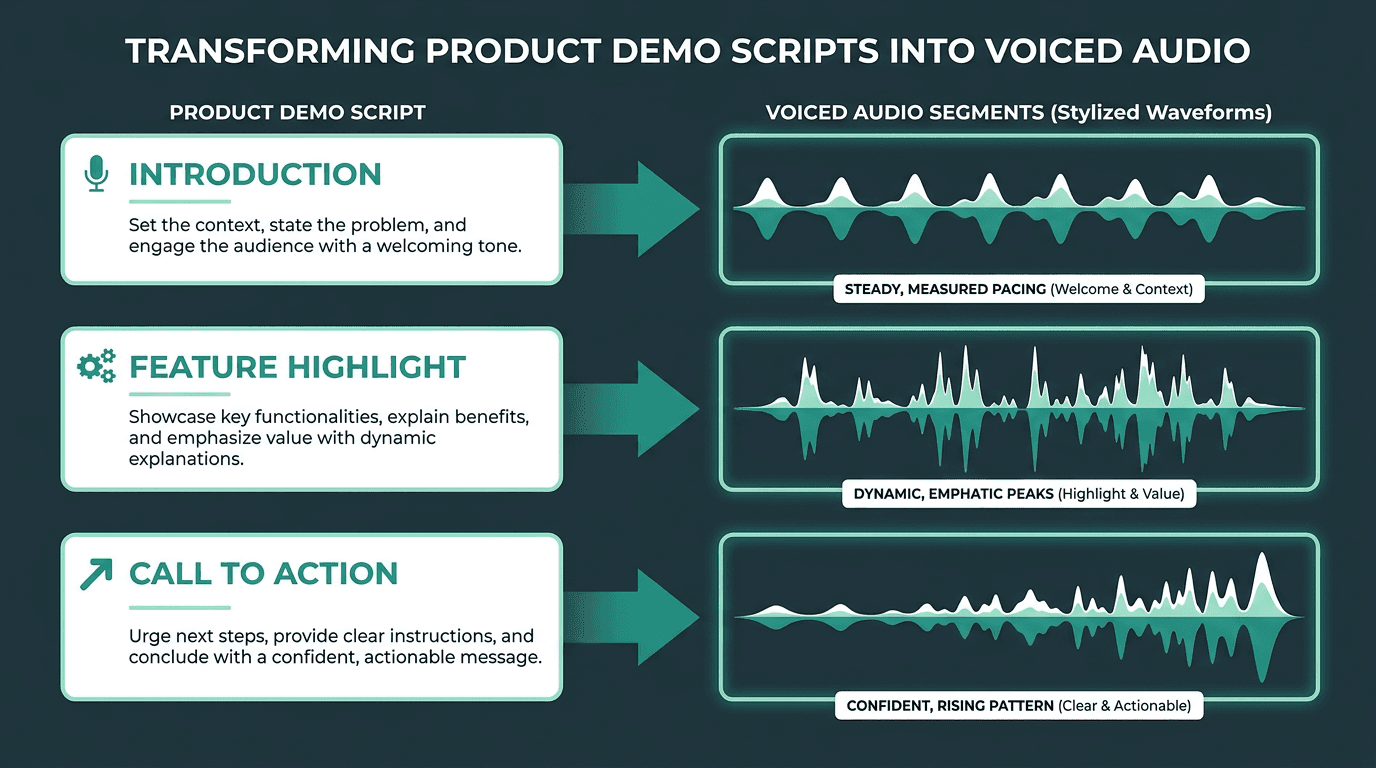
Each demo stage — from introduction to call to action — maps to a distinct voiced segment with natural pacing and emphasis.
AI-generated narration works in a product demo when it sounds like a guide, not a transcript being read into a microphone. The strongest demos treat speech as part of the pacing: pauses land where the viewer needs a beat to look at the UI, emphasis rises on the moment a feature clicks, and the tone shifts naturally from problem framing to the reveal. If the audio rushes, the demo feels pushy. If it drags, the demo feels unsure.
For SaaS companies, the operational win is speed. Demo narration can be refreshed in minutes instead of days. When the product ships a UI change or renames a feature, the script updates in the content layer and the API regenerates the audio without reopening a production timeline. This removes the bottleneck that traditionally made voice content expensive and slow to keep updated.
Common Misconceptions About AI Voice in SaaS
Misconception 1: AI voice is only useful for accessibility. Accessibility is a legitimate use case, but it is rarely the main reason teams start. Most SaaS products adopt voice generation for sales enablement, onboarding efficiency, and demo personalization.
Misconception 2: You need a large engineering team to integrate voice generation. Voice APIs are built to be integrated, not researched. A developer can wire up a text-to-speech endpoint, handle the audio response, and ship it in a product surface within a sprint. Platforms like Smallest.ai pricing plans are set up so teams can start with modest usage and scale as the feature proves itself, without staffing a dedicated AI infrastructure group.
Misconception 3: AI voices all sound the same. That was a fair critique five years ago. Today, modern neural voice models can produce highly natural-sounding speech. In practice, the differences between providers are more likely to appear in latency, consistency, voice controls, and deployment capabilities than in basic speech quality. The practical differences now show up elsewhere: how well a model handles domain vocabulary, whether it stays consistent over long-form narration, and how much control you get over prosody and emotion.
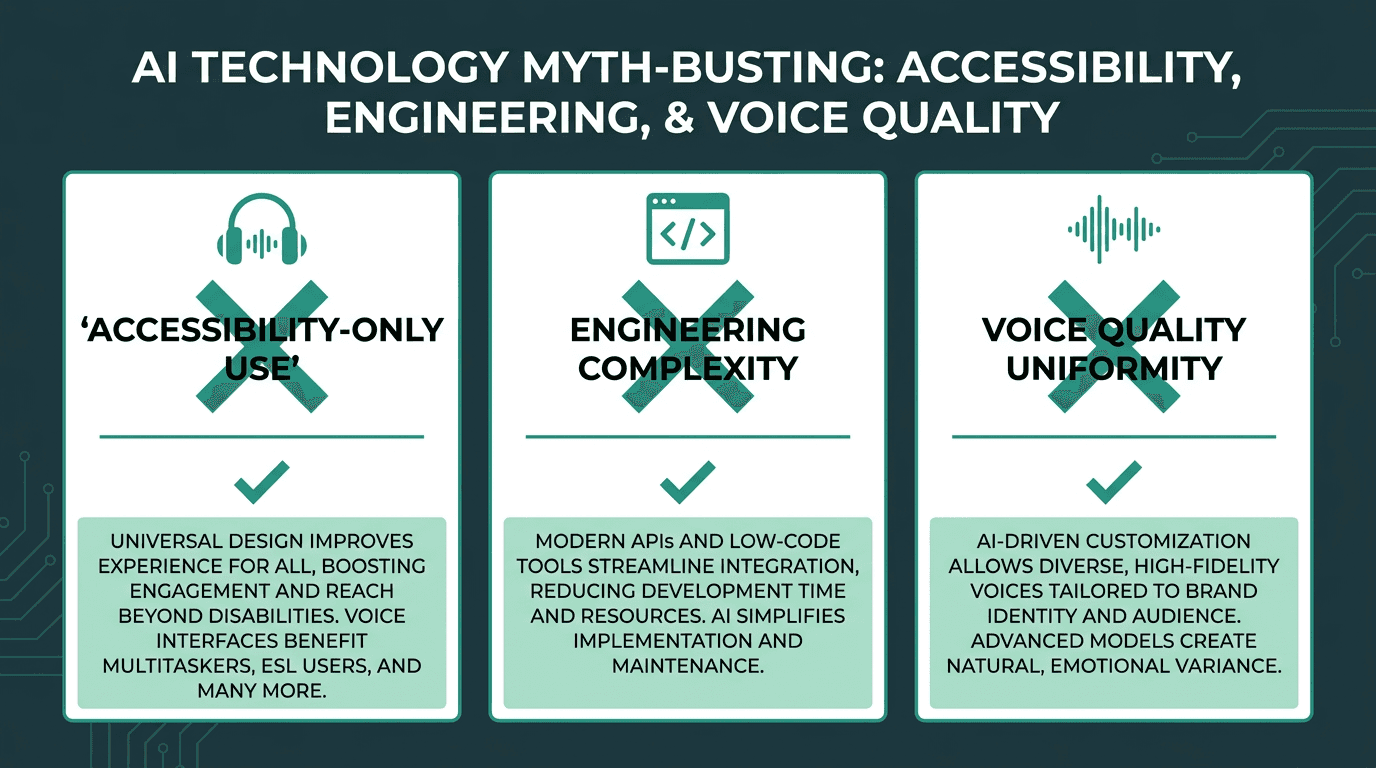
From accessibility myths to engineering fears — AI voice in SaaS is more accessible than most teams assume.
Evaluating a Voice Generation API for Your SaaS Stack
Picking a voice generation API comes down to four checks. First is latency: can it power real-time product experiences, or is it better suited to async content? Second is voice quality and naturalness, which directly affects whether the feature feels premium or tacked on. Third is language and accent coverage, especially if you serve a global user base and do not want separate pipelines per region. Fourth is pricing model fit: per-character pricing often matches low-volume demo narration, while usage tiers tend to map better to products with high daily voice interactions.
If you have spent time designing conversational voice interfaces for SaaS, you already know the API is only half the story. Adoption hinges on interaction design: when voice triggers, how interruptions are handled, and what happens when audio is unavailable. Those details decide whether voice becomes a default behavior or a novelty users try once and forget.
Some teams also look for voice cloning: training a custom voice from a small audio sample and using it consistently across every product surface. For SaaS brands with a distinct identity, a cloned brand voice can keep marketing videos and in-product narration aligned, even as scripts change week to week.
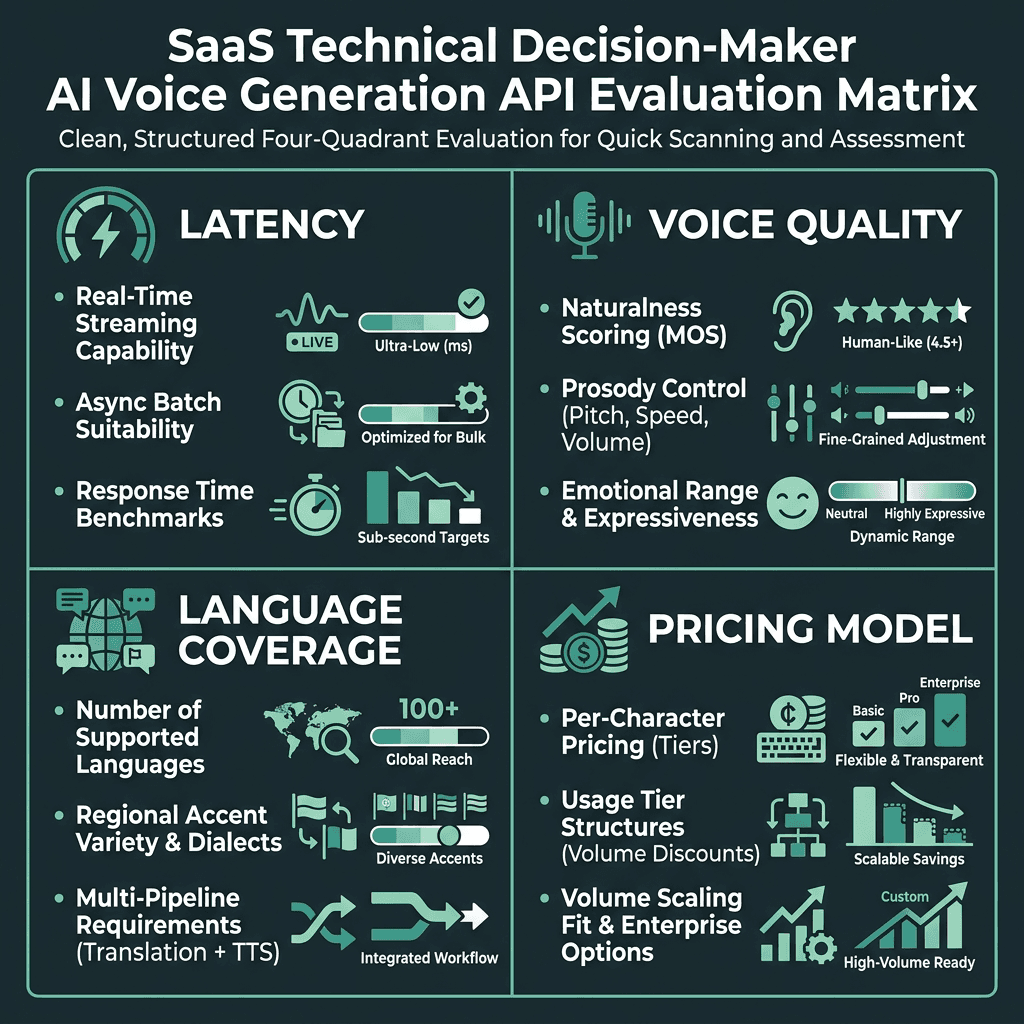
Four dimensions SaaS teams should assess before committing to a voice generation API.
Key Takeaways
What SaaS teams should carry forward from this overview:
AI voice generation for SaaS converts text to natural speech via API, removing the need for pre-recorded audio assets and enabling dynamic, scalable voice content.
SaaS voice typically falls into two buckets: async voice for demos and content, and real-time voice for live product interactions. Each comes with different latency and quality requirements.
Modern neural voice models can produce speech that is difficult to distinguish from human recordings, making studio-quality narration achievable without studio logistics for most SaaS use cases.
Integration complexity is low. A developer can connect a voice generation API and surface audio in a product interface within days, not months.
Voice cloning supports brand voice consistency across demos, onboarding, and in-app experiences, tying marketing identity to product behavior.
When evaluating vendors, focus on latency, voice naturalness, language coverage, and whether the pricing model matches your usage patterns.
The Problem This Solves, and Where Smallest.ai Fits
The blocker for most SaaS teams is not conviction; it is operations. Traditional voice content is expensive to produce and even more expensive to keep updated. Every UI tweak that changes copy, feature names, or onboarding flows sends you back to a studio schedule or a voice contractor queue. Voice ends up frozen in time, disconnected from a product that ships every week.
Generating voice from text via API breaks that loop. When the script changes, the audio can change with it, turning demo narration, onboarding audio, and in-app responses into dynamic assets instead of static files.
Smallest.ai is designed for SaaS teams that need voice to move at product speed. Lightning provides low-latency text-to-speech for both async and real-time experiences, while voice cloning helps maintain a consistent brand voice across product surfaces. If you're evaluating AI voice generation for your SaaS product, book a demo to see how Smallest.ai fits your application and deployment requirements.
Frequently asked questions
What is AI voice generation for SaaS, and how is it different from standard text-to-speech?
Can AI-generated voice be used in real-time SaaS features, or only for pre-recorded content?
How does voice cloning work for SaaS brand consistency?
What languages and accents do AI voice generation APIs typically support?
How should a SaaS team get started with AI voice generation without a large AI team?


