Emotional Speech Synthesis for Marketing Videos: How to Match Voice Tone to Message Intent

Emotional speech synthesis helps match AI voice tone to video intent. Use an intent-to-tone framework, avoid mismatches, and handle disclosure without drama.
Emotional speech synthesis has moved out of the lab and into the edit bay. It is changing how marketing teams ship video, and the gap between brands that treat voice as a craft and brands that treat it as a box to tick is starting to show up in performance. This shift tracks a real change in how audiences react to voice-led creative.
This is for marketing producers, content strategists, and voice AI practitioners who are tired of generic narration and want tone that actually matches intent. The goal is a usable framework for choosing emotional registers, a practical view of how modern synthesis engines represent affect, and a clear line on where human judgment still does the heavy lifting. If you want the broader technical groundwork first, a complete guide to human-like AI voices is a solid primer before you go further.
What Emotional Speech Synthesis Actually Does
Standard text-to-speech turns written words into spoken audio. Emotional speech synthesis narrows in on delivery: it adjusts prosodic and acoustic cues so the output carries a specific affect. Prosody is the stuff editors hear immediately: pitch contour, speaking rate, rhythm, and where pauses land. Acoustic cues are subtler but just as decisive, including breathiness, tension, and resonance. Together, they separate “warm” from “clinical,” “urgent” from “relaxed,” and “authoritative” from “approachable.”
This work sits inside affective computing, the branch of computing focused on recognizing, interpreting, and simulating human emotional states. In speech, the hard part is that emotion is not a single dial. A line like “We need to talk” can read as anxiety, excitement, warmth, or threat, depending on dozens of micro-choices in delivery. Modern deep learning approaches let synthesis models learn those patterns from large datasets of emotionally labeled speech instead of relying on hand-built rules.
In marketing video, tone matters because viewers process voice alongside visuals, not after them. The narrator’s emotional signal either supports what’s on screen or fights it. When voice and picture disagree, credibility takes the hit. When they line up, the message feels cleaner, sharper, and easier to believe.
The Tone-Intent Mismatch Problem
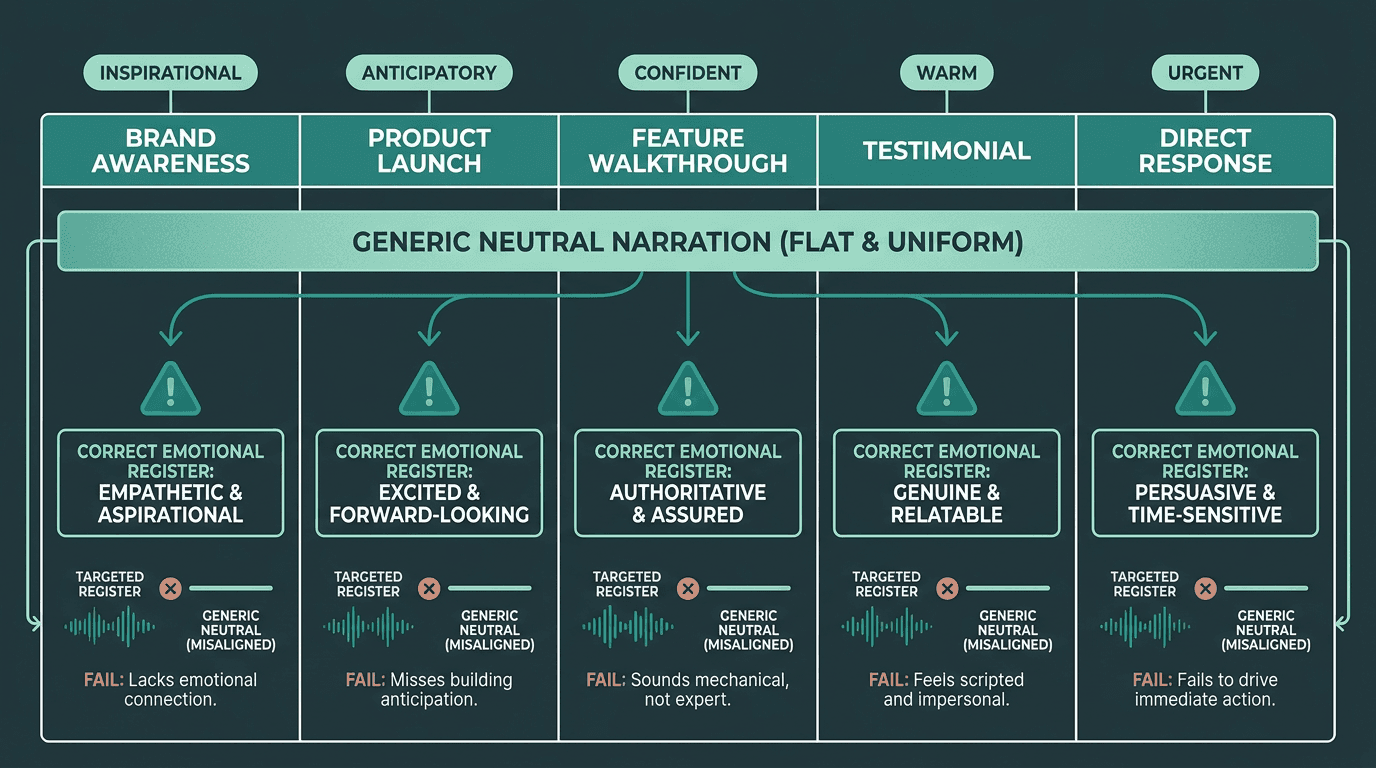
Generic narration applied across different video intents creates systematic tone-intent mismatches.
Most teams making marketing videos at scale fall into the same trap: pick a voice, record or synthesize the script, publish. The narration sounds “professional.” The copy is fine. Then the video quietly underdelivers. More often than teams want to admit, the issue is emotional: the narration’s register doesn’t match what that moment in the video is trying to do.
Take a product launch video. The first thirty seconds should build anticipation and momentum. The feature walk-through needs clarity and steady confidence. The close should add urgency without turning into pressure. That is three different emotional jobs inside a two-minute runtime. A single flat delivery can’t do all of them.
A Framework for Matching Tone to Message Intent
Before you touch a synthesis tool, do the unglamorous work: map intent. Every segment of a marketing video is trying to accomplish something specific. Put a precise name on that goal, and tone selection stops being vibes-based and starts being a repeatable decision.
The five most common intent categories in marketing video narration, and the emotional registers that serve them:
Brand awareness / storytelling: Warmth, sincerity, measured pacing. The goal is connection, not conversion. Avoid urgency or high energy here.
Problem articulation: Empathy with a slight undercurrent of tension. The viewer needs to feel understood before they will listen to a solution.
Feature explanation / demonstration: Calm authority and clarity. Confidence without enthusiasm. This is where over-emoting loses credibility.
Social proof / testimonial framing: Conversational warmth. The narration should feel like a peer recommendation, not a broadcast.
Call-to-action: Measured urgency. Not aggressive, not flat. The voice should signal that acting now is the right move without manufacturing pressure.
Once intent is mapped to an emotional register at the segment level, you finally have a brief a synthesis engine can execute. Hand-wavy direction like “make it more engaging” tends to produce random variation. Direction that names the levers, “increase pitch variability by 15%, reduce speaking rate by 8%, add slight breathiness at sentence endings”, is what gets you repeatable output. Most current synthesis platforms expose these levers either as direct controls or as emotion presets that translate into parameter shifts.
How Modern Synthesis Engines Handle Affect
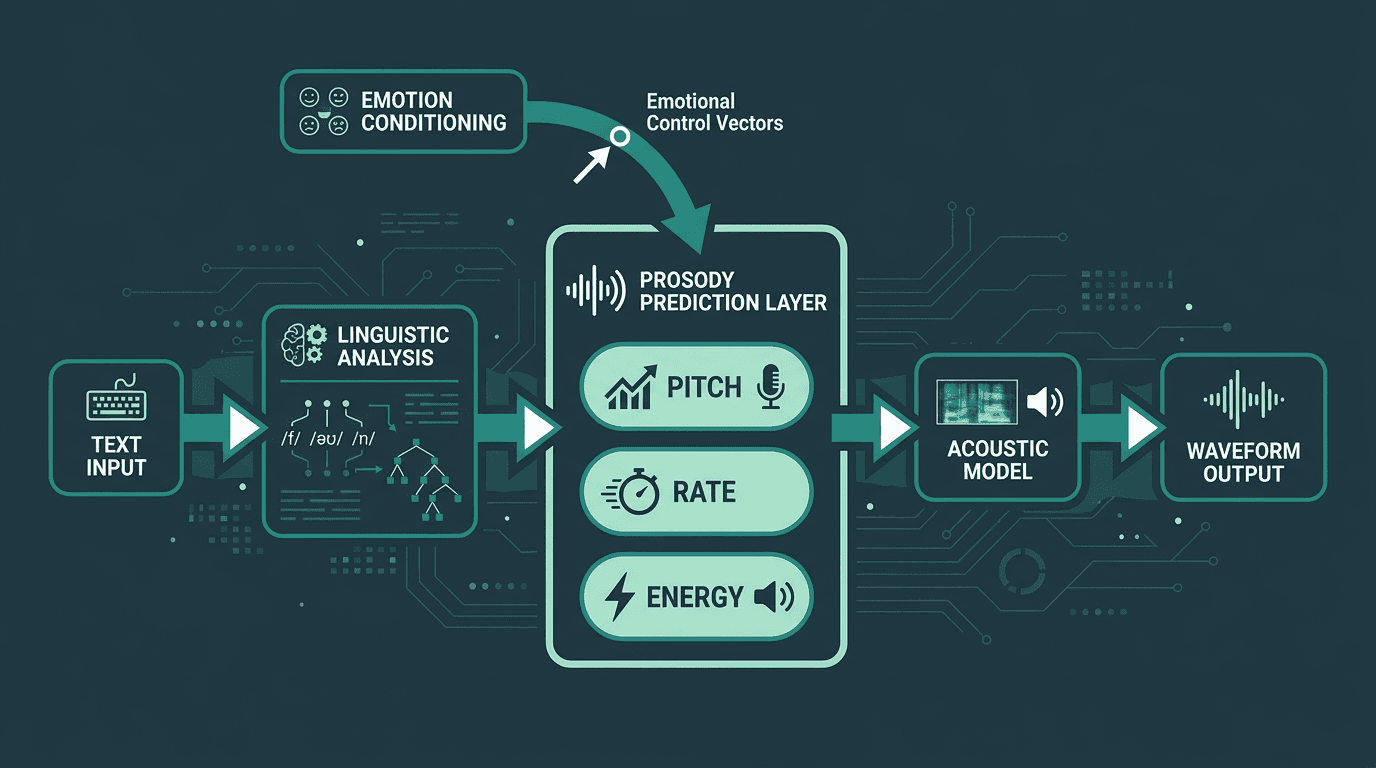
Modern synthesis pipelines condition prosody and acoustics on explicit emotional control vectors.
Most neural TTS systems handle emotion in one of two ways: discrete emotion conditioning or continuous style transfer. With discrete conditioning, the model is trained on labeled emotional speech and gives you selectable categories like “cheerful,” “sad,” “angry,” or “calm.” With continuous style transfer, the system takes a reference clip or a style embedding vector and tries to reproduce the affective quality of that reference in the synthesized voice.
For marketing video, discrete conditioning is usually the best place to start. It’s predictable, easier to audit, and quick to iterate. The tradeoff is obvious: emotion labels are blunt instruments. “Excited” in one model can sound nothing like “excited” in another, and neither may match the exact shade of enthusiasm your brand can credibly carry. That’s where voice cloning fits in. If you condition synthesis on a cloned voice that already matches your brand’s baseline character, those discrete emotion controls become adjustments on top of something familiar, not a leap from a generic default.
Practical Application: Building an Emotionally Layered Video Narration
Once the tone decisions are made, getting synthesized audio into your edit is the easy part. If you want the nuts-and-bolts steps, how to add a voice-over to a video lays out the workflow clearly. The real challenge is editorial: keeping emotional continuity across the piece while still letting the narration shift on purpose when the intent changes.
A workflow that holds up: write the script in segments that align to intent categories, synthesize each segment with its own emotional settings, then listen to the stitched audio as one continuous track before you lock anything. That last step matters because emotional transitions can snap if the parameter changes are too abrupt. Sometimes the fix is simple, insert a short neutral bridge, even a single sentence, between a high-energy open and a measured feature section.
One detail that gets overlooked: in many synthesis systems, speaking rate is a stronger cue for perceived authenticity than pitch. People naturally slow down when they’re being sincere and speed up when they’re excited. If your engine outputs “warm and sincere” at the same tempo as “energetic and upbeat,” it will feel wrong even if the pitch curve is doing the right thing. When an emotional read doesn’t land, check rate first.
The Transparency Question
Audiences have a right to know when they are hearing an AI-generated voice in advertising. The Federal Trade Commission's (FTC) guidance requires that the use of AI be disclosed when it is material to an ad, a stance reinforced through recent enforcement actions and policy statements in 2025 and 2026. While rules are still evolving, the direction from the FTC is clear: do not mislead consumers about whether they are interacting with a human or an AI. For AI-generated voices, this means disclosure is the expected practice.
That leaves marketing teams in a squeeze. Emotional synthesis can produce narration that’s genuinely persuasive and on-brand. But if audiences feel tricked once they realize it’s synthetic, the emotional lift turns into brand damage. The practical move isn’t to avoid the tech; it’s to be plain about using it. Disclosure doesn’t need a flashing banner. A short note in the credits or a standard line in metadata usually meets the expectation consumers are signaling. Treating disclosure as a compliance chore misses what it really is: a trust cue.
Advanced Considerations: Where Emotional Synthesis Gets Complicated
Cross-cultural emotional norms are the most underestimated risk in this space. The prosody that reads as warmth in North American English doesn’t translate cleanly into Japanese, Arabic, or Brazilian Portuguese. Pitch range, “normal” speaking rate, and even the acoustic markers that signal authority vary by language and culture. If an engine is trained mostly on English emotional speech, it can produce output that’s linguistically correct but emotionally miscalibrated in other markets. For global campaigns, emotional settings need sign-off from native speakers in each target region, not just a translation pass.
Long-form content introduces a different kind of problem: drift. A thirty-second ad is a closed system. A ten-minute explainer or a serialized branded podcast can subtly shift tone across sessions or synthesis runs, and the inconsistency becomes obvious when people listen back-to-back. Voice cloning with locked style embeddings is the most dependable way to reduce that variability. Anchoring to a specific voice profile narrows the parameter space and makes output more stable across time. Exploring online text-to-speech AI voices gives a useful overview of how platforms approach consistency.
Then there’s the difference between emotion at the segment level and emotion at the sentence level. If a system slaps one emotion label across an entire paragraph, you often get a uniform “emotional wash”, and that uniformity is a tell. Real speakers vary within an emotional register: they flatten slightly on technical terms, change pause timing before a key claim, and modulate energy across the arc of a sentence. The strongest synthesis outputs reproduce that texture. When you’re evaluating a voice for marketing use, listen for micro-variation inside the segment. If everything is equally excited (or equally sincere) from start to finish, the system is likely applying affect like post-processing rather than conditioning it during generation. For a deeper look at how to judge platforms on this dimension, how to choose expressive AI voices is worth a careful read.
Key Takeaways and Next Steps
Emotional speech synthesis for marketing video rewards teams that treat tone as craft, not decoration. The winners aren’t necessarily the ones with the fanciest model. They’re the ones who do intent mapping before touching controls, who make emotional settings editorial decisions (not “audio tweaks”), and who validate performance with real audience response instead of relying on internal taste tests.
The core principles to carry forward:
Map message intent at the segment level before selecting any emotional parameters.
Use speaking rate as your first diagnostic when synthesized emotion sounds unconvincing.
Anchor long-form content to a cloned voice profile to prevent emotional drift across sessions.
Validate emotional output with native speakers for any non-English language market.
Be transparent about AI voice use. Disclosure builds, not erodes, audience trust.
Review assembled audio as a continuous piece to catch jarring emotional transitions between segments.
The underlying pain point is simple: marketing videos underperform when the voice carrying the message doesn’t match the content’s emotional intent. Flat narration on a high-stakes product launch, overly energetic delivery on a trust-building explainer, or the wrong kind of warmth on a call-to-action all create friction between what viewers see and what they hear. Smallest.ai's Lightning TTS API is designed for that exact mismatch. It gives teams granular control over prosody and emotional register, supports voice cloning for brand-consistent output across long-form content, and is available through the Waves API for teams that want synthesis wired directly into production pipelines. If you’re producing marketing video at any meaningful scale and tone is still an afterthought, Lightning is the straightest line to fixing it.
Frequently asked questions
What is emotional speech synthesis, and how does it differ from standard TTS?
How do I choose the right emotional tone for different types of marketing videos?
Can AI-generated voice sound emotionally authentic enough for professional marketing use?
Do I need to disclose that my marketing video uses AI-generated voice?
What should I look for when evaluating a text-to-speech platform for emotional synthesis in marketing videos?