AI Voice Agent: What It Is & Best Platforms in 2026

AI voice agent platform comparison for 2026, covering latency, voice quality, pricing, and full-stack fit across Smallest.ai, ElevenLabs, Deepgram, OpenAI.
An AI voice agent is software that can carry a real-time spoken conversation, figure out what the person actually wants, and then do something about it, without a human hovering over the call. Under the hood, it stitches together automatic speech recognition (ASR), a language model that handles reasoning and dialog, and text-to-speech (TTS) into a single low-latency loop. When that loop is tuned well, the interaction sounds like a conversation, not a phone tree with better branding.
Choosing a platform has gotten harder, not easier, over the last 18 months. Users have less patience for lag, vendors have split into wildly different pricing schemes, and the difference between a voice agent people tolerate and one they hang up on is often the infrastructure you picked on day one. Below is a comparison of six platforms, examined through factors such as latency, voice quality, platform scope, pricing structure, and deployment considerations.
How This Comparison Is Structured
This comparison focuses on the factors teams most commonly evaluate when choosing a voice agent platform: latency, voice quality, platform scope, developer experience, pricing structure, and deployment flexibility. Different teams prioritize different tradeoffs, so the goal is to understand how each platform approaches the voice agent stack rather than assign a universal ranking.
Smallest.ai: Built for Speed Without Sacrificing Quality
Smallest.ai is built around one job: production-grade conversational voice AI. The lineup covers the full pipeline: Lightning (a TTS API designed for very low latency), Pulse (speech-to-text), Hydra (speech-to-speech for ultra-low-latency interactions), and Atoms (a no-code/low-code platform for voice and text agents). If you want the primitives instead of the platform, the Waves API packages Lightning and related speech building blocks behind a single endpoint.
Where Smallest.ai feels different is the way it treats latency as a product constraint, not a nice-to-have. Lightning is engineered to stream the first audio chunk in under 100ms, right around the point where humans stop perceiving the pause as “system lag” and start hearing it as turn-taking. Low latency can have a noticeable impact on conversational responsiveness in real-time voice applications. The platform also ships multilingual voice agent capabilities as a default, with broad language coverage that does not require teams to stand up separate deployments per language.
Pricing is usage-based and, importantly, legible. Waves API is sold on per-character and per-minute rates, with enterprise tiers that add SLA guarantees and dedicated support. Voice cloning is a first-party feature in the TTS API, which makes it practical to roll out a consistent branded voice instead of settling for a generic preset. If you build on Atoms, you get orchestration handled for you, but the lower-level APIs are still there when you need tighter control. For a clearer mental model of how these pieces fit together, the Smallest.ai write-up on AI voice agent architecture patterns is the right reference point.
Where Smallest.ai stands out:
Very low latency streaming TTS via Lightning, which is designed for very low-latency streaming speech synthesis.
Hydra enables speech-to-speech pipelines that skip the TTS step entirely for even lower latency.
Atoms provides a full agent platform without forcing teams to stitch together separate ASR, LLM, and TTS vendors.
Voice cloning ships as a first-party feature, not a third-party add-on.
The main caveat: Smallest.ai is newer than the incumbents, and its third-party integration marketplace is still catching up. If you depend on a very specific CRM connector or have legacy telephony constraints, you should assume some custom integration work. Still, the BFSI voice agent deployments already running on Smallest.ai demonstrate the platform’s use in enterprise deployment scenarios.
ElevenLabs: High-Quality Voice Generation
ElevenLabs is known for its voice quality and offers a Conversational AI product that bundles ASR, an LLM, and TTS into a managed pipeline. The platform supports multimodality (voice and text), integrated language detection, and the ability for an agent to use different personas. A built-in Retrieval-Augmented Generation (RAG) system allows the agent to pull information from external knowledge bases.
The pricing structure can be a limitation for high-volume use cases, as its per-character rates are on the higher end of the market. While the platform supports streaming, its primary focus is on voice quality rather than minimizing latency. This makes it a fit for use cases where voice expressiveness is the main priority and call volumes are moderate, as opposed to high-throughput scenarios where cost and speed are the primary constraints.
Deepgram: ASR Specialist with a Voice Layer
Deepgram’s primary focus is Automatic Speech Recognition (ASR). Its Nova-2 model is designed for transcription accuracy, particularly in noisy telephony environments, and offers fast streaming capabilities. The company later added a text-to-speech model, Aura, to provide voice output capabilities.
The main limitation is that Deepgram does not offer a native LLM or a complete agent orchestration platform. It provides the ASR and TTS components, but teams must integrate their own language model and build the surrounding agent logic. This makes it suitable for developers who want to build a custom stack centered around transcription capabilities and have already selected an LLM provider. The Smallest.ai post on the 2026 voice agent stack comparison lays out where Deepgram fits when you are intentionally building a multi-vendor pipeline.
OpenAI: LLM-First with an End-to-End Voice API
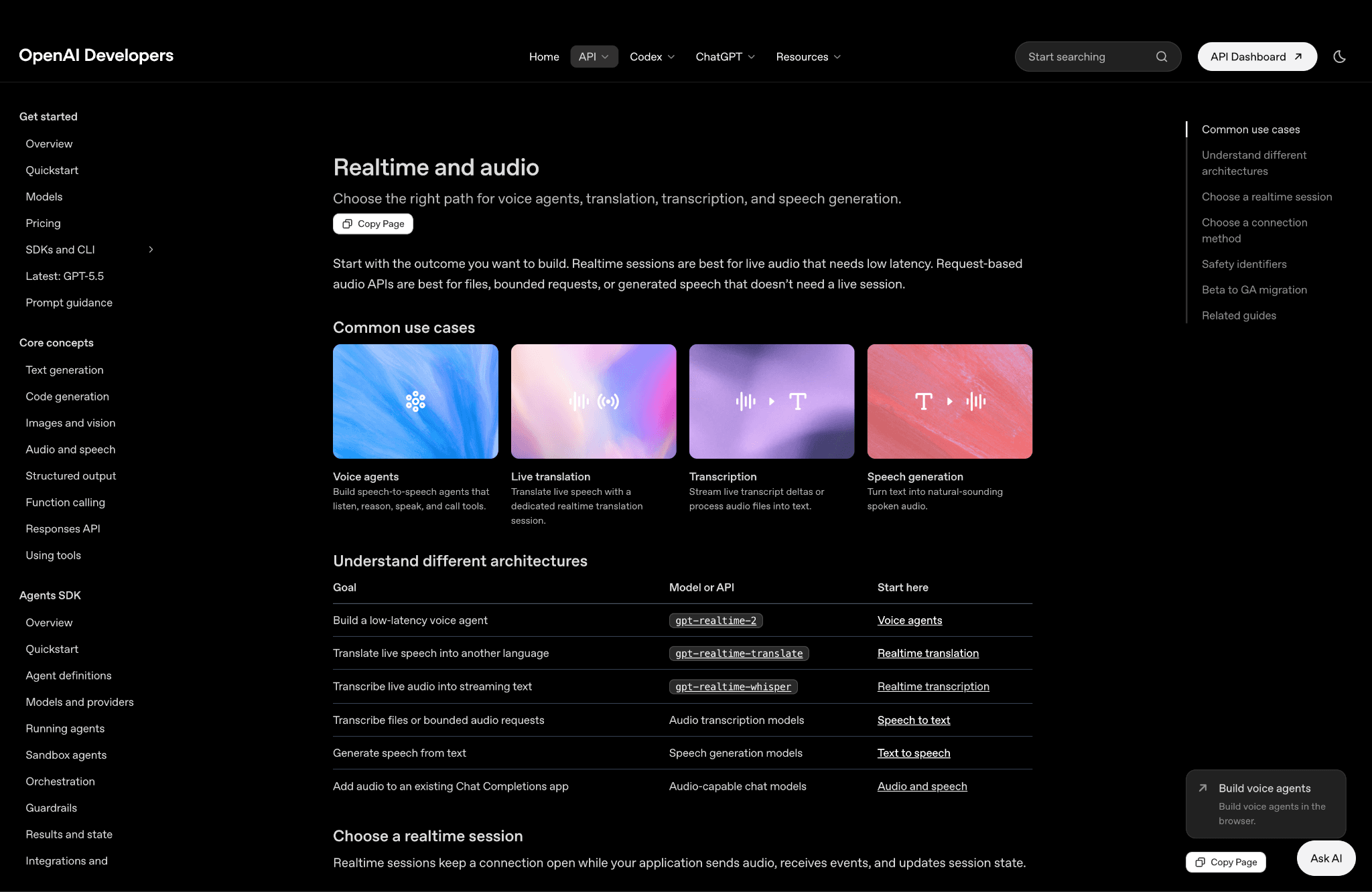
OpenAI’s Realtime API is designed for low-latency, speech-to-speech conversations. It uses a single model (like GPT-4o) to handle audio input and output directly, which avoids the compound latency of a traditional ASR-LLM-TTS chain. This approach allows the model to work directly from audio signals, potentially capturing more nuance than a text transcript alone.
The primary limitations are cost and lack of modularity. The per-minute pricing is higher than many specialized voice agent platforms, which can be a constraint for scaled deployments. Because the entire process is bundled into a single API call, users cannot swap in different ASR models or TTS voices. This makes it well-suited for prototyping and internal tools where speed of development is key, but less so for production systems that require more customization and cost control.
AssemblyAI: Transcription-First With Growing Agent Features
AssemblyAI’s platform is built around speech intelligence, with core features for transcription, speaker diarization, sentiment analysis, and audio-based queries via its LeMUR framework. Its main use cases are asynchronous, such as analyzing call recordings, generating meeting summaries, and running compliance checks. While the company offers a real-time streaming API, the platform’s architecture is primarily optimized for post-call analytics and extracting insights from recorded audio.
Cartesia: Low-Latency TTS for Custom Voice Stacks
Cartesia specializes in low-latency, streaming text-to-speech with its Sonic model. The API is developer-focused and engineered for speed. The key limitation is its scope: Cartesia is a TTS provider, not a full-stack voice agent platform. It does not offer a native ASR model or an agent orchestration layer. This makes it a good choice for teams that have already built or sourced their own ASR and LLM components and need a fast, specialized synthesis layer to complete their stack.
Head-to-Head: Platform Comparison Table
Provider | Primary Focus | Platform Scope | Voice Cloning | Deployment Style | Common Use Cases |
|---|---|---|---|---|---|
Smallest.ai | Production voice agents | Full Stack (ASR, LLM, TTS, Agent Platform) | Yes | Cloud API & On-Premise | Contact center automation, real-time sales agents, proactive notifications |
ElevenLabs | High-quality voice generation | Partial (ASR, LLM, TTS) | Yes | Cloud API | Branded content, voice assistants, moderate-volume customer support |
Deepgram | ASR & transcription | Partial (ASR, TTS) | No | Cloud API & On-Premise | Real-time transcription, voice data analysis, custom voice agent stacks |
OpenAI | End-to-end audio reasoning | Full Stack (single model) | Limited | Cloud API | Prototyping, internal tools, multimodal applications |
AssemblyAI | Speech intelligence & analytics | Partial (ASR, LLM) | No | Cloud API | Post-call analytics, compliance monitoring, meeting summarization |
Cartesia | Low-latency TTS | Component (TTS only) | Yes | Cloud API & On-Premise | Custom-built voice agents requiring a fast synthesis layer |
Verdict: Which AI Voice Agent Platform Is Right for You?
Different platforms prioritize different tradeoffs. Some focus on voice customization, some on transcription and speech analytics, while others focus on end-to-end conversational infrastructure. Teams should evaluate platform scope, deployment requirements, operational complexity, and latency expectations before selecting a platform. For teams building production voice agents, Smallest.ai combines speech recognition, speech synthesis, speech-to-speech capabilities, and agent orchestration within a single platform. In practice, that means fewer vendors to manage, fewer failure points, and a latency budget that is not consumed by glue code between services.
If you are comparing against other voice agent frameworks, the Smallest.ai breakdown of best Retell AI alternatives for 2026 and the enterprise voice agent framework comparison add useful context on where the broader ecosystem is heading.
The Problem This Comparison Was Built to Solve
The hard part of building AI voice agents in 2026 is not finding a vendor. The hard part is avoiding the wrong stack: latency that makes the agent feel slow and synthetic, pricing that looks fine in a pilot and collapses under real volume, and integration sprawl that drags shipping into the mud. Most platforms are optimized for one axis and ask you to compromise on the rest. Smallest.ai approaches the problem by bringing TTS, ASR, the language model layer, and orchestration together within a single platform. If you are ready to build a voice agent that sounds like it belongs in production, start by exploring what Smallest.ai’s Atoms platform can do and map the stack to your use case.
Frequently asked questions
What is an AI voice agent, and what is happening under the hood?
What technical factor matters most when picking a voice agent platform?
Can AI voice agents support multiple languages?
How are AI voice agents different from traditional IVR?
Can you use a custom-branded voice with an AI voice agent platform?