AI Phone Calls: How Businesses Are Automating Calls in 2026

AI phone calls in 2026: where businesses use them, the numbers behind adoption, rollout pitfalls, and how to evaluate platforms for real operations.
AI phone calls have moved past the "only big companies" phase. In 2026, teams of all sizes are putting voice AI on the front line: answering inbound calls, running outbound outreach, qualifying leads, and clearing routine support questions without a human ever touching the handset. The technology has improved significantly, making AI phone calls practical for a wider range of business workflows.
This piece breaks down how automated phone calls function in practice, where companies are using them right now, what tends to go wrong during rollout, and how to decide if your operation is actually ready. You should come away with a concrete view of the stack, the use cases that are commonly deployed, and the first steps that keep pilots from stalling out.
What AI Phone Calls Actually Are (And What They Are Not)
The terminology gets sloppy fast, so precision matters. An AI phone call is a voice conversation where at least one side of the line is run by an AI system. It listens, turns speech into text, infers intent, generates a response with context, and speaks back in real time. When it is done well, it feels less like "talking to a bot" and more like talking to a competent agent who happens to be software.
AI phone calls are not the IVR maze everyone has been stuck in for the last twenty years. "Press 1 for billing, press 2 for support" is a menu system, not a conversation. Those flows are rigid and brittle: no natural language, no follow-up questions, no recovering when the caller changes direction. Modern voice agents work off what the caller says, handle interruptions, and can pivot mid-call without forcing the person back to the top of a script.
Most stacks still boil down to three pieces: speech-to-text to capture the caller's words, a language model to decide what to do next, and text-to-speech to deliver the response as audio. That loop runs continuously during the conversation, and responsiveness plays an important role in how natural the interaction feels.
Where Businesses Are Actually Deploying AI Calls Right Now
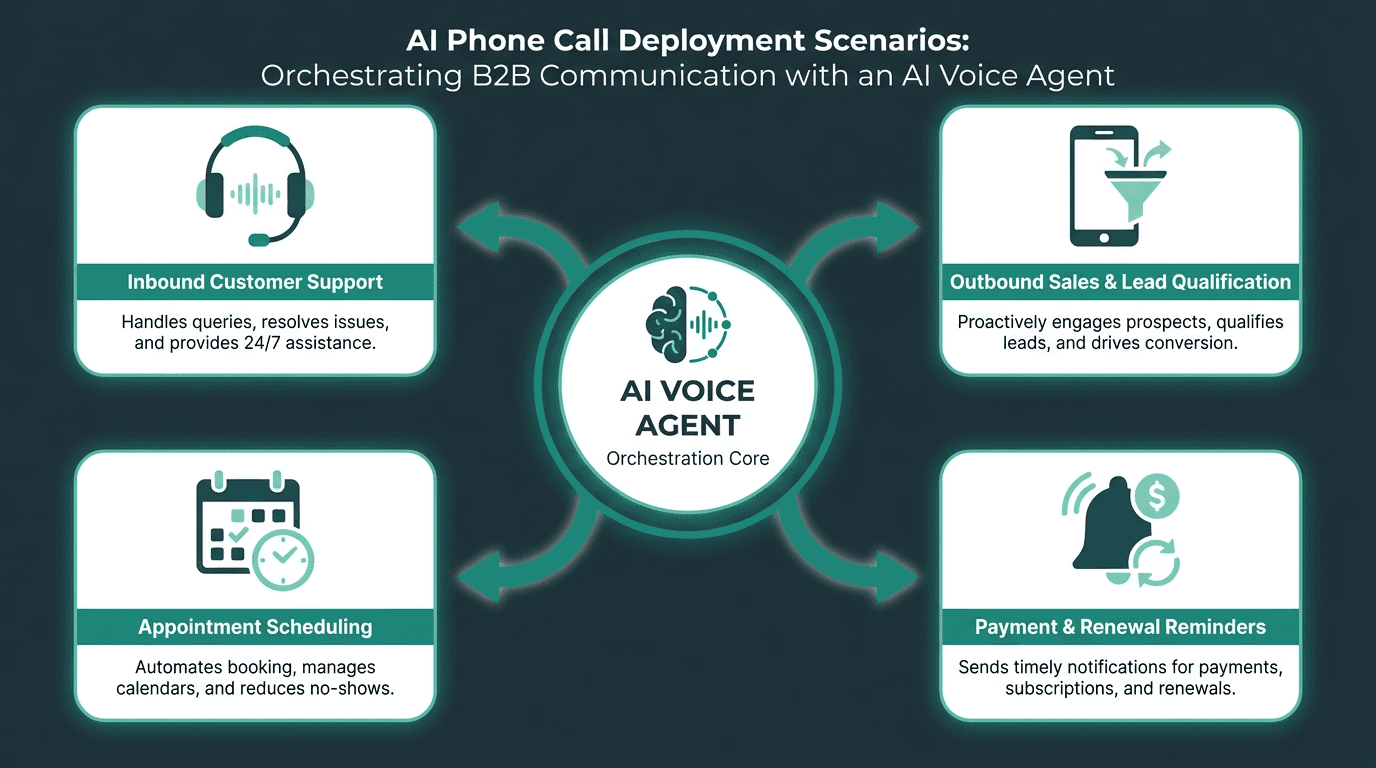
AI voice agents are deployed across four core business scenarios, from support to collections.
AI call deployments in 2026 commonly cluster into a handful of patterns. Inbound customer support is the usual entry point: FAQs, order status, account questions, and basic troubleshooting are all well within scope for a properly grounded agent. When the call crosses a boundary, it hands off to a human with a transcript and context already attached. Teams that handle inbound calls automatically in this model typically see shorter handle times and fewer callers dropping out of the queue.
Outbound introduces a different operational model. Collections, appointment reminders, post-purchase check-ins, and re-engagement campaigns can run continuously, and they scale in a way human teams simply cannot. A human agent might place 50 to 80 calls in a day; an AI system can run thousands in parallel. For businesses revolutionizing outbound calls with AI, the cost structure shifts dramatically, especially in healthcare, real estate, and financial services where follow-up volume is relentless.
Other deployment patterns gaining traction across industries:
Lead qualification: Calls new inquiries immediately, scores them based on the conversation, and routes warm leads to sales reps
Appointment scheduling: Books, reschedules, and sends reminders without adding calendar-management work for staff
Payment and renewal reminders: Places outbound calls for overdue invoices or expiring subscriptions using a natural conversational flow
Post-service surveys: Captures structured feedback by voice right after a service interaction, when details are fresh
Home services dispatch: Coordinates technician scheduling and customer confirmations for AI phone agent home services operations
The Deployment Gap: Why Most Businesses Stall After Launch
Many organizations successfully test AI phone agents in pilot programs but encounter challenges when expanding them into day-to-day operations.
The most common failure mode is a weak knowledge base. A phone agent can only be as reliable as the information it is allowed to pull from. Launch with missing product details, stale FAQs, or fuzzy escalation rules and you get an agent that confidently wastes the caller's time. The fix is rarely a new model or a clever prompt. It is operational work: clean the knowledge base, define answers, and map escalation paths before the agent ever takes a live call.
The next stall point is voice quality. Early systems sounded obviously synthetic, and many callers checked out as soon as they clocked the cadence. That has improved a lot: current text-to-speech can deliver natural prosody, better pacing, and a wider emotional range. Still, implementations vary, and mediocre voice output is a tax on every conversation. When you are comparing platforms, treat voice quality as a product requirement, not a nice-to-have.
As AI systems become more capable, organizations also need stronger controls around compliance, escalation handling, auditability, and operational oversight.
How to Evaluate an AI Phone Call Platform
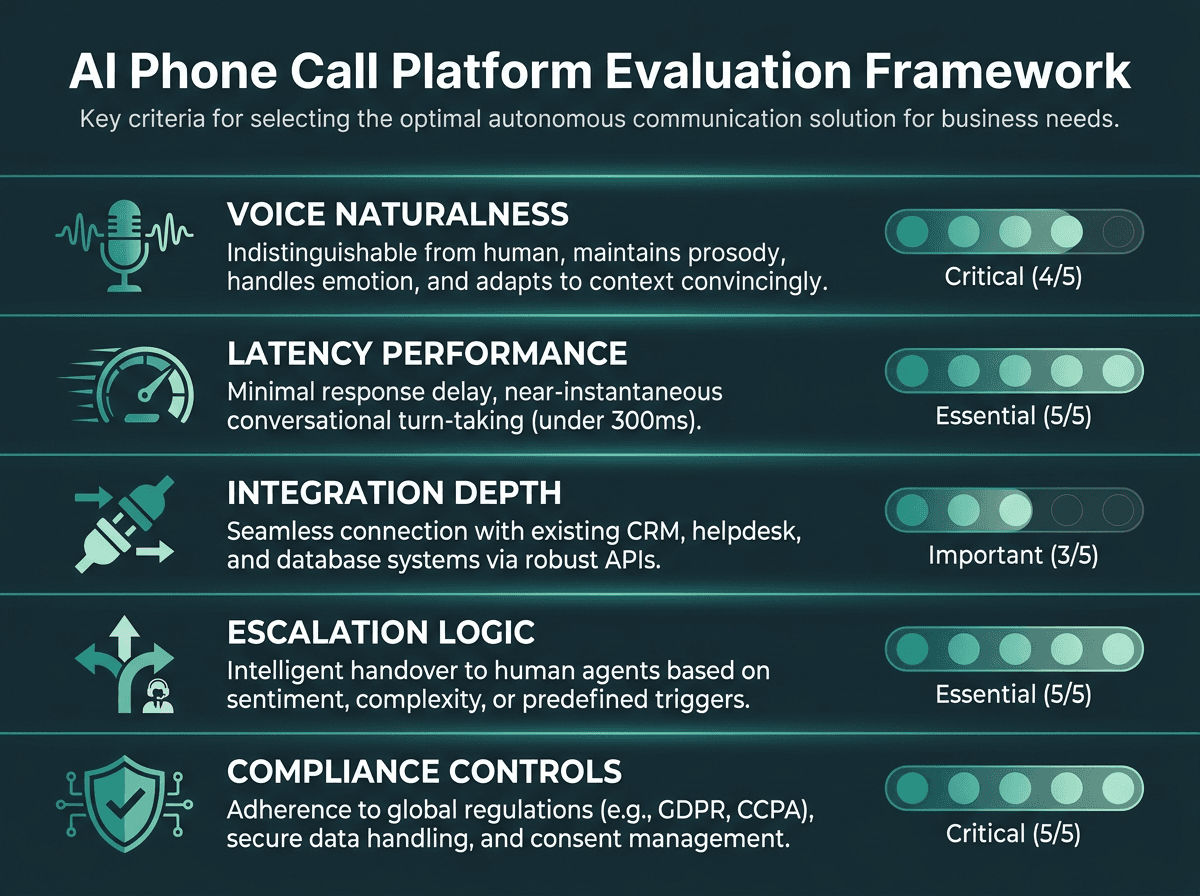
A structured rubric helps teams move beyond polished demos when selecting an AI phone call platform.
Platform selection is where many teams underinvest. Demos are engineered to sound smooth; production is where you meet the edge cases, the weird caller behavior, and the moments when a handoff has to be perfect. A few criteria reliably separate solid platforms from the ones you can trust at scale:
Low-latency response times: A response inside half a second keeps the rhythm of a real conversation. Longer delays can interrupt conversational flow.
Interruption handling: People talk over each other. The agent needs to recover cleanly instead of freezing, restarting, or talking through the caller
CRM and telephony integration: If the agent cannot write back to your CRM or plug into your phone stack, it creates busywork instead of removing it
Escalation controls: You should be able to specify exactly when a call transfers to a human, and ensure the human receives full context
Voice customization: Branded voices or approved voice clones matter when brand consistency is part of the customer experience
Compliance tooling: Recording consent, TCPA compliance for outbound, and data handling controls are table stakes in most industries
If you are early in the buying process, the AI answering service options market looks very different in 2026 than it did even a year or two ago. You can choose between vertical-specific products, general platforms, and developer-first APIs. The deciding factor is usually build-versus-buy: do you need a turnkey workflow, or do you want to assemble something custom around your own systems? The AI receptionist buyer's guide lays out features, costs, and deployment considerations for teams doing that comparison.
Implementation: A Practical Starting Point
The deployments that stick tend to follow the same playbook: start narrow, then earn the right to expand. Pick one call type and one workflow, make it reliable, and only then add complexity. After-hours inbound coverage is a common first win. The agent answers when the team is offline, captures details, handles the predictable questions, and books callbacks. The risk is low because the baseline alternative is often voicemail or missed calls.
Expansion usually follows a straightforward sequence. After after-hours comes peak-hour overflow, then broader inbound coverage, then outbound programs once you trust the agent's behavior. Each step exposes what callers actually say, where your knowledge base is thin, and which escalation triggers you should tighten. The complete guide on AI phone agents maps that progression, including the technical choices that show up at each stage.
For AI phone calls for small businesses, the priority is usually coverage and responsiveness, not raw scale. A five-person shop cannot staff phones 24/7, and hiring just to avoid missed calls is rarely attractive. A voice agent fills the gap immediately without adding headcount. For many small businesses, the primary benefits are improved coverage, faster response times, and fewer missed calls.
Advanced Considerations: Voice Cloning, Multilingual Support, and Agentic Workflows
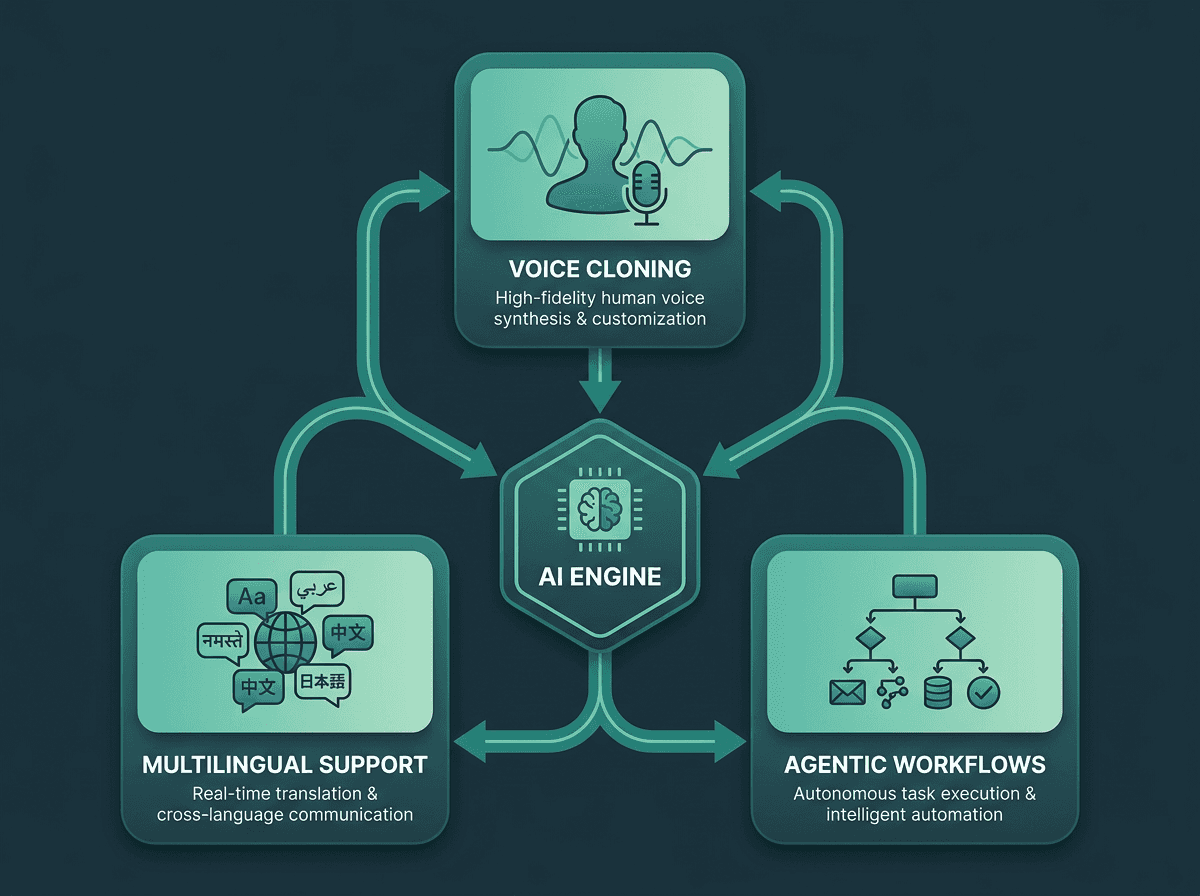
Three advanced AI phone call capabilities converging into a single enterprise-grade platform engine.
After the baseline is stable, three capability areas are worth a serious look, mostly because many teams leave them on the table.
Voice cloning gives you a custom voice that matches brand identity, or can replicate a specific person's voice with consent. In categories where brand tone is part of trust, a generic synthetic voice is a missed opportunity. A familiar, consistent voice can reduce friction and keep callers engaged long enough to get the job done.
Multilingual support is becoming a default requirement for businesses serving mixed-language markets. Modern systems can run conversations across dozens of languages without spinning up separate deployments for each one. That changes the staffing equation and can open regions that previously required dedicated multilingual agents. In domains like conversational AI in banking, where regional rules differ and linguistic accuracy matters, this capability carries real operational weight.
Agentic workflows push AI phone calls beyond Q&A. Instead of only responding, an agent can take actions during the call: fetch an order, update a record, send a confirmation email, or trigger a downstream workflow. In that model, the voice layer is just the interface; the agent is doing work. Platforms that support tool use and API integrations inside the call flow are the ones that map cleanly to real business operations.
The Problem This Technology Solves, and Where Smallest.ai Fits
AI phone calls address a basic mismatch: customers call when it is convenient for them, not when your staffing model happens to be online. Phones ring at midnight. Leads arrive on weekends. Peak hours overload queues. Human agents are expensive, variable, and limited by time. Missed calls are missed opportunities, and in competitive markets those misses add up quickly.
Smallest.ai is designed to close that gap. The Atoms platform powers voice and text agents that can handle end-to-end conversations, backed by Lightning (a low-latency text-to-speech API), Pulse (speech-to-text), and Hydra (speech-to-speech for real-time voice interaction). Together, that stack is aimed at production deployments where latency, accuracy, and voice quality are important considerations.
Organizations evaluating AI phone calls should consider how speech recognition, speech synthesis, orchestration, deployment requirements, and operational controls fit their specific workflows.
Frequently asked questions
How realistic do AI phone calls sound in 2026?
What types of businesses benefit most from automated phone calls?
Is it legal to use AI for outbound phone calls?
How does an AI phone agent handle calls it cannot resolve?
What is the typical cost of deploying an AI phone call system?