White label voice AI solutions: How agencies can launch branded AI phone agents

White label voice AI solutions for agencies: launch branded AI phone agents fast, price for outcomes, and scale deployments with the right platform criteria.
AI phone agents are becoming a practical service offering for agencies because clients increasingly want automated call handling without building internal AI teams. White-label platforms allow agencies to package and deploy these capabilities under their own brand.
This is for digital agencies, marketing consultancies, and technology resellers that want to package AI phone agents for clients without standing up the underlying stack themselves. The goal is practical: what white-labeling voice AI actually includes, what "rebrandable" means in real deployments, how to package and price the offer, and how to avoid turning a promising product line into a costly distraction.
What White Label Voice AI Actually Means
A white-label product is built by one company and sold under another company's brand. In voice AI, the pattern is simple: an agency starts with a production-ready AI phone agent platform, applies the client's branding, configures how the agent behaves, and ships it as if it were the agency's own product. The client experiences a branded agent. The agency keeps the margin. The platform provider stays out of the spotlight.
Voice AI is especially well-suited to white-labeling because the build-from-scratch path is brutally multi-disciplinary. A production AI phone agent needs speech recognition, low-latency text-to-speech, a conversational language model, telephony integration, and a deployment pipeline that does not fall apart in production. Most agencies do not have that bench. A white-label platform compresses the hard parts into configuration, so you can ship in days instead of spending quarters assembling infrastructure.
White-label software has been a common distribution model in SaaS for years, and voice AI is following a similar path.
The Business Case for Agencies: Margins, Speed, and Stickiness
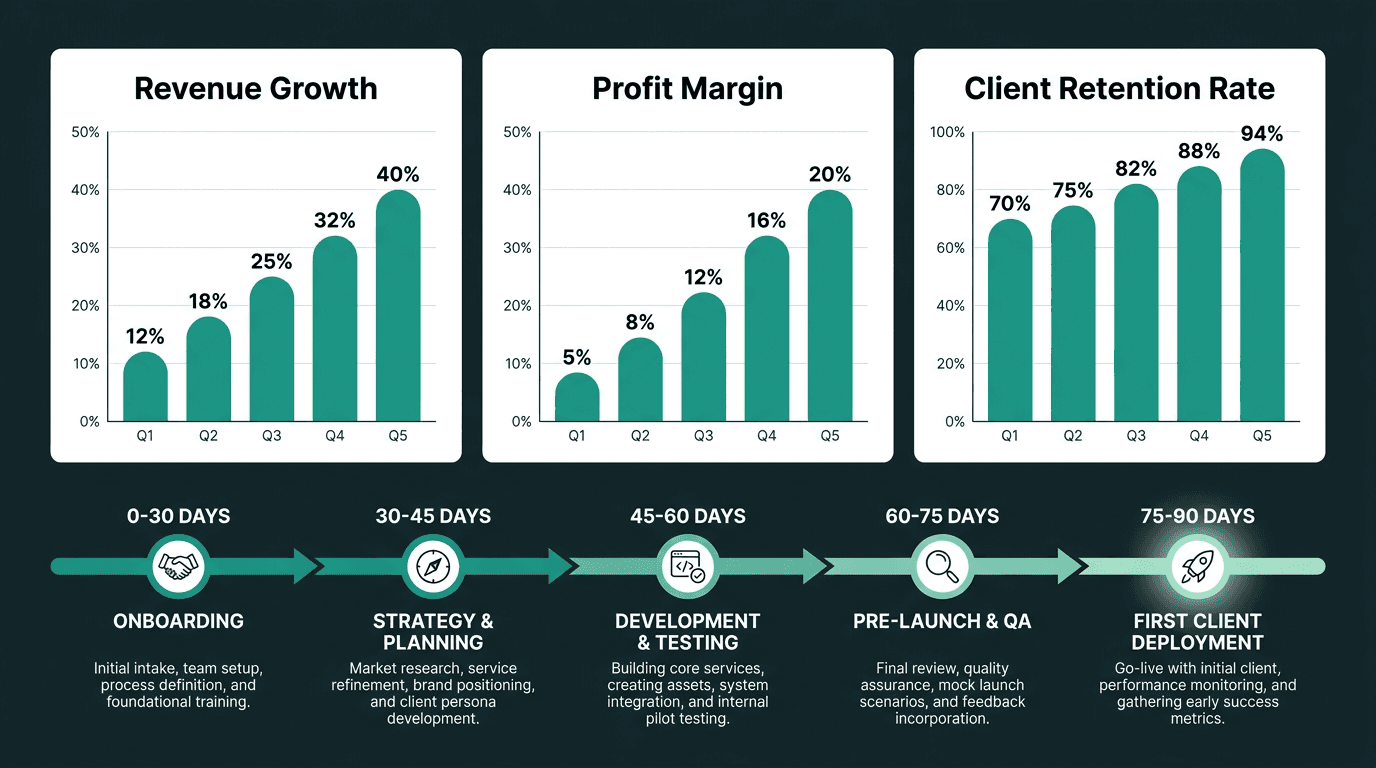
Productized white label voice AI drives measurable margin gains and long-term client retention for agencies.
White-label offerings often improve margins because agencies can standardize delivery and avoid rebuilding the same infrastructure for every client. You are selling a productized service with a predictable cost base, not an open-ended build where hours balloon and scope keeps moving.
Then there is retention. Once an AI phone agent sits inside call routing, the CRM, and the support workflow, it stops being a "project" the client can casually drop. It becomes part of operations. That shift changes the relationship from one-off delivery to ongoing platform dependency, which is a much more defensible place for an agency to be.
Clients are already being pushed to automate, either by cost pressure or staffing constraints. Agencies that show up with a branded, deployable agent are meeting a demand the client already feels, not trying to create one.
What to Look for in a White-Labelable Voice AI Platform
Not every voice AI platform that claims "white label" actually holds up under scrutiny. Some vendors let you swap a logo, then leave their name stamped into call metadata, API responses, billing screens, or client dashboards. Before you sign anything, pressure-test the platform across a few practical dimensions:
Capability | Why It Matters for Agencies | Red Flags to Watch |
|---|---|---|
Custom voice and persona | Clients expect the agent to sound like their brand, not a generic AI | Only preset voices; no cloning or meaningful customization |
Branded client dashboard | Clients should log in to your product, not the vendor's portal | Vendor branding visible anywhere in the client-facing UI |
API-first architecture | Makes it possible to integrate with CRMs, ticketing, and telephony | Closed system, limited webhooks, or no real API access |
Low conversational latency | Delays make voice interactions feel less natural | Vendor cannot provide real-world latency expectations |
Predictable usage model | Agencies need reliable forecasting and client packaging | Hidden limits, unclear quotas, or unexpected usage restrictions |
Escalation and handoff logic | The agent must know when to transfer to a human and how | No first-class escalation path or brittle fallback behavior |
Voice identity is the one that agencies routinely underprice. An AI brand voice strategy is not window dressing for enterprise buyers; it is the difference between "we added a bot" and "this feels like us." If the platform supports voice cloning or deep persona configuration, you are not just reselling automation. You are selling a branded experience that clients can actually defend internally.
Building the Branded Agent: From Configuration to Deployment
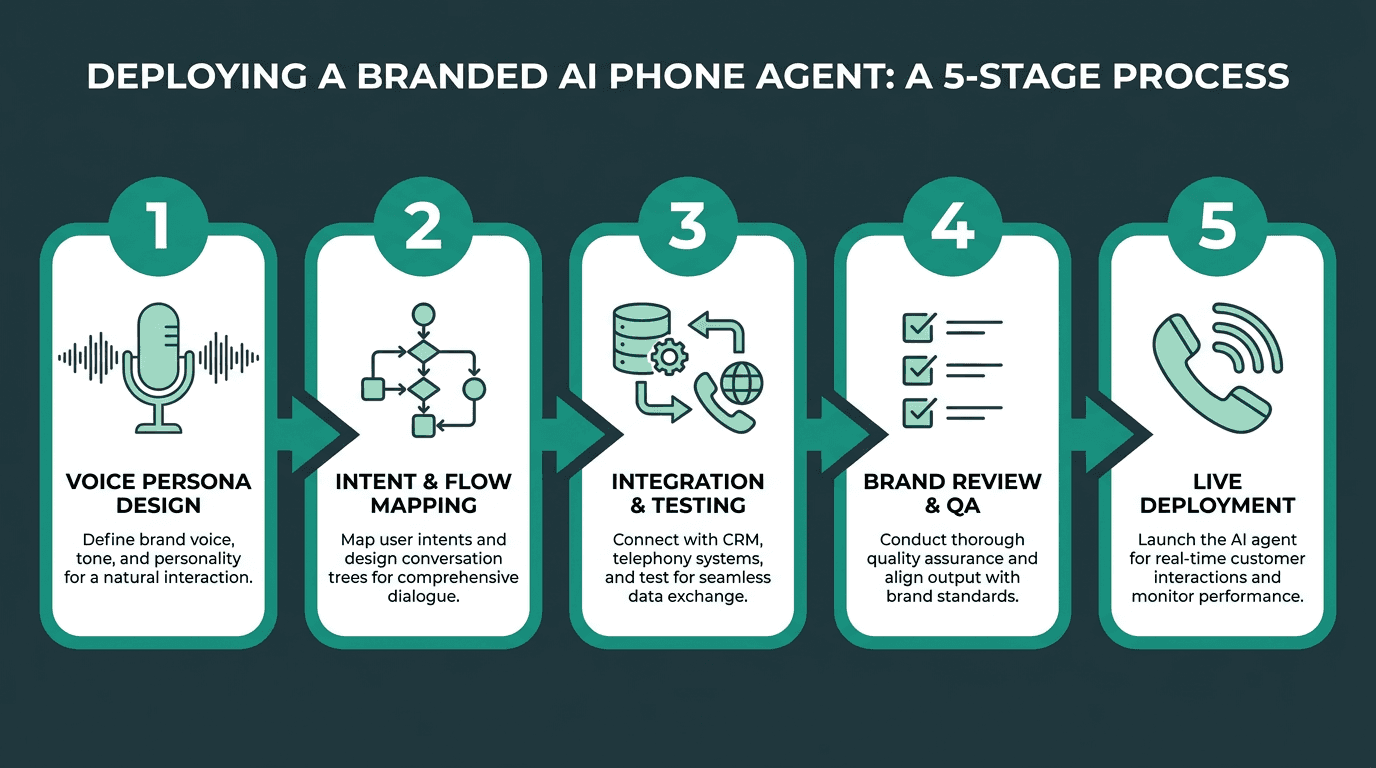
Five structured stages take a white-label AI agent from voice persona to live client deployment.
Stage 1: Define the Voice Persona
Before you touch intents or integrations, lock down what the agent sounds like and how it behaves in conversation. This goes well beyond tone-of-voice copy. You are choosing (or cloning) a voice that fits the client's identity, naming the agent, setting boundaries for what it will and will not do, and deciding how it should respond when a caller is unclear. For many enterprise teams, Voice cloning for brand consistency is quickly becoming table stakes because it makes the agent feel like an extension of the brand instead of a generic add-on.
Stage 2: Map Intents and Build Conversation Flows
Most clients arrive with a short list of obvious jobs: book appointments, answer FAQs, route calls, handle basic support. Your job is to turn those into intent maps and conversation flows the system can execute reliably under real call pressure. The most common failure mode here is ambition: teams try to ship a "do everything" agent on day one. Start with two or three high-volume, well-bounded call types and get them right. An agent that nails 80% of inbound calls is worth far more than one that attempts 100% and fumbles half of them.
Stage 3: Integrate, Test, and Hand Off
Integration typically means wiring the agent into the phone system, the CRM, and whatever data sources it needs to do its job. Testing should be adversarial, not theatrical: callers who interrupt, background noise, non-native accents, and the weird edge cases that demos never include. When QA passes, the handoff should look and feel like a real product: a branded dashboard login, a reporting template the client can use internally, and an escalation protocol everyone agrees on. If you want the operational checklist for inbound calls, FAQs, and escalation behavior, the AI phone agent for customer support guide lays out the mechanics.
Pricing Your White Label Voice AI Service
This is where agencies routinely undercharge. A common approach is platform cost plus markup: take your vendor bill, add a percentage, and call it pricing. It is easy to explain, but it also trains the client to negotiate on inputs instead of paying for outcomes.
Clients typically evaluate voice AI against labor costs, call volume, and service availability. Pricing discussions are easier when tied to measurable operational outcomes. Anchor your pricing to the value of deflection, not the size of your API invoice.
Common pricing structures agencies use for white-label voice AI products:
Monthly retainer per agent: A flat fee for a defined call volume, ongoing configuration updates, and reporting. Easy for procurement and predictable for you.
Per-minute or per-call billing: Usage passes through with a margin layer. A clean fit for clients with spiky or seasonal call volume.
Setup fee plus monthly SaaS: One-time onboarding covers persona design and integration. The monthly fee covers platform access and ongoing support.
Outcome-based pricing: Pricing tied to measurable results like calls deflected or appointments booked. Higher risk for the agency, but it can justify premium rates.
Advanced Considerations: Where Most Agencies Get Tripped Up
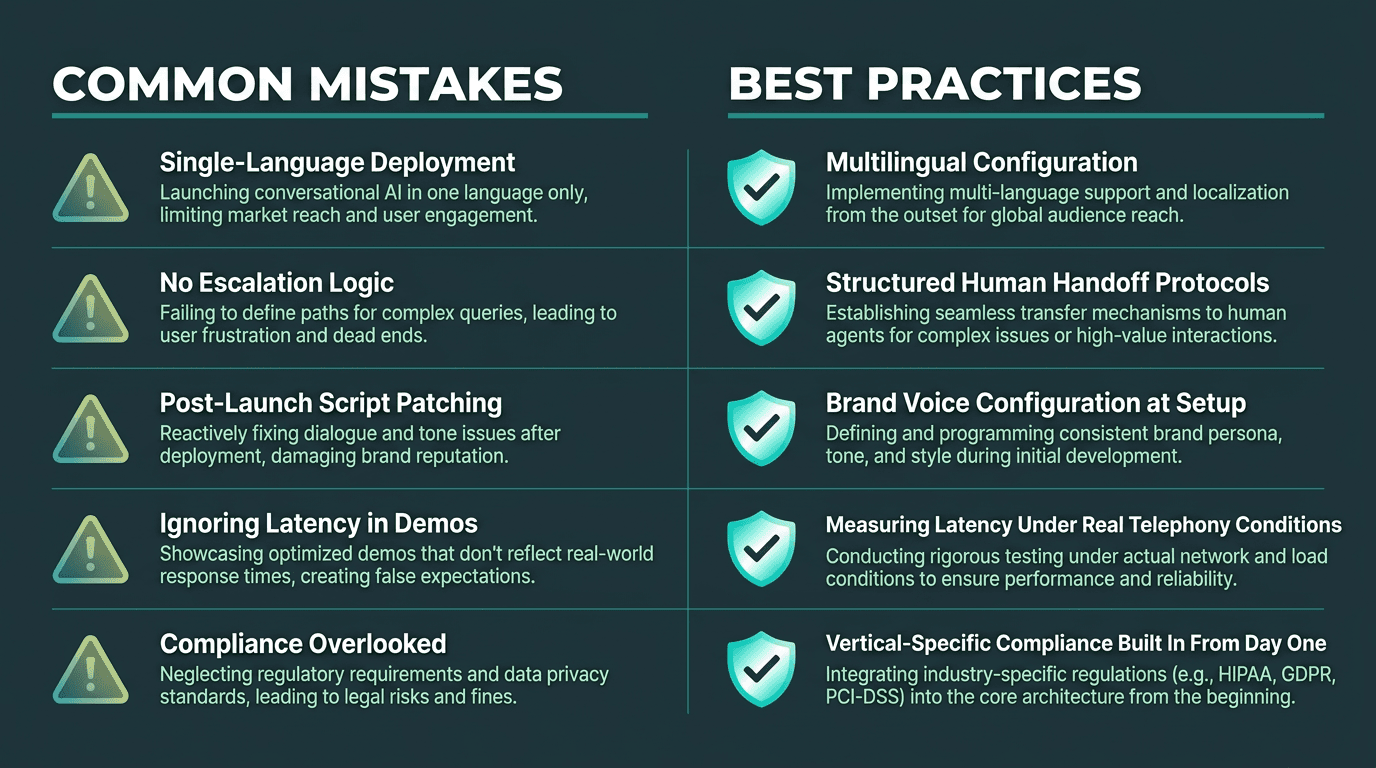
Avoiding these deployment mistakes separates profitable *white label voice AI solutions* from costly ones.
Deployment is the easy milestone. The problems that cost agencies money show up after the first week of real calls.
Latency is product quality, not trivia. As latency increases, conversations begin to feel less natural and interruption handling becomes more difficult. When you evaluate platforms, measure latency in real telephony conditions, not a browser demo. The gap between a natural-feeling agent and one that sounds like a bad connection can be a matter of milliseconds.
Brand drift is what happens when you scale. Managing ten or twenty client agents means tiny decisions become a system: how the agent responds to angry callers, what it says when it cannot understand, when it apologizes, when it escalates. Those details add up quickly, and without a standard you end up with inconsistency across deployments. Agencies that learn to adapt AI agents to a brand voice during configuration, instead of patching scripts after launch, ship a noticeably tighter experience.
Compliance starts as the client's concern and can end as yours. Depending on the vertical, AI phone agents can touch TCPA, GDPR, and industry-specific rules for call recording and data retention. If you sell into healthcare, financial services, or legal, you need to understand the constraints before you promise timelines and features. Choose a platform that supports compliant data handling by default, rather than one that treats it as a paid add-on later.
The deployments that work balance modern AI capabilities with contact center fundamentals like data security, no-code tooling, and reliable human handoff. The Smallest.ai Voice Agents platform is designed for agencies that need configurable voice agents, branded deployments, and integration flexibility without managing the underlying voice infrastructure.
Structuring Your Agency's Voice AI Practice
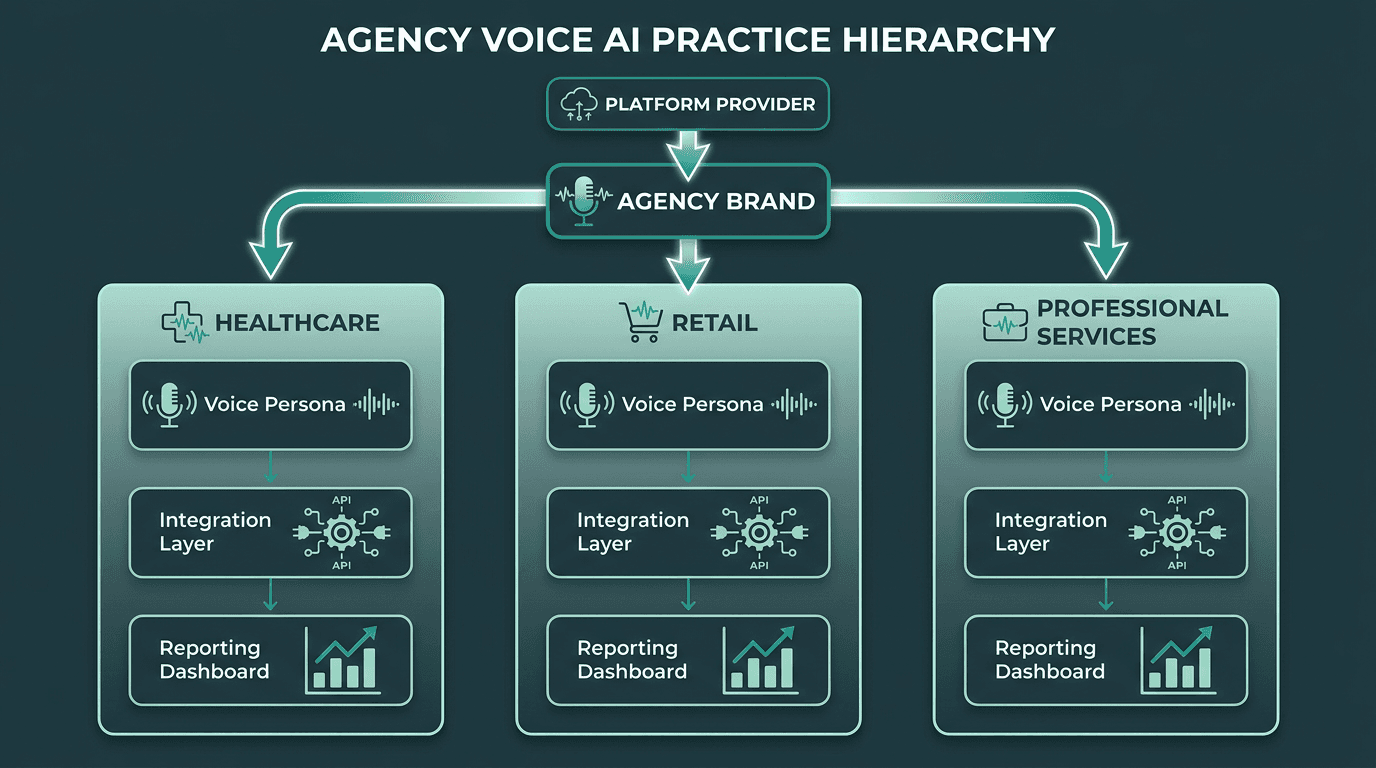
A three-vertical agency structure makes white label voice AI deployments repeatable and scalable across client industries.
Agencies that treat voice AI as an occasional project rarely get the recurring revenue they are aiming for. The agencies that scale treat it like a practice: defined roles, repeatable delivery, and a catalog of products you can sell and implement the same way every time.
A minimal structure is surprisingly small. One person owns the platform relationship and tracks new capabilities; one person runs onboarding and configuration; account managers are trained to spot voice AI opportunities inside existing client conversations. With that three-person core, you can typically support ten to fifteen active deployments before you need to expand the team.
The catalog is the sales engine. Clients do not buy "voice AI" as a concept. They buy "an AI receptionist that books appointments" or "an outbound reminder system for overdue accounts." When you package the tech into named, scoped offerings with clear deliverables and pricing, it becomes easier to sell, easier to implement, and easier to support without reinventing the process for every account.
Key Takeaways and Next Steps
What this guide has covered:
White label voice AI lets agencies ship branded AI phone agents without building the underlying infrastructure, capturing margin in a fast-growing category.
The business case is clear: faster growth, higher margins, and stickier client relationships built on operational infrastructure instead of one-off projects.
Platform selection should emphasize real white-label branding, voice customization, API access, and latency performance, not cosmetic logo swaps.
Delivery is a five-stage process: voice persona design, intent mapping, integration, QA, and a handoff that feels like a branded product.
Pricing works best when it maps to client outcomes, especially labor offsets and call deflection, rather than platform cost plus a simple markup.
At scale, the details matter: latency, brand consistency across deployments, and industry-specific compliance requirements.
Agencies are stuck in a familiar gap: clients feel pressure to automate phone communication, the technology is finally good enough to deploy, and yet turning a raw platform into a branded, reliable product still takes real work. That gap is where agency value sits. Smallest.ai is built to close it. The Smallest.ai Voice Agents platform gives agencies the infrastructure to deploy low-latency, fully branded AI phone agents across client verticals, with voice cloning, configurable personas, and an API-first architecture that fits into the tools clients already run. To see what a white-label rollout looks like end to end, Schedule a Voice Agents Demo and walk through a live configuration with the team.
Launch Branded AI Phone Agents Without Building the InfrastructureAgencies don't need to assemble speech recognition, voice generation, telephony, and orchestration from scratch to deliver AI phone agents. Smallest.ai provides the infrastructure needed to deploy branded voice experiences with configurable personas, voice cloning, and real-time call handling across client accounts.
Frequently asked questions
Do agencies need deep technical expertise to launch a white label voice AI product?
How do I make sure the AI phone agent sounds like my client's brand, not a generic bot?
Which industries are the best fit for agency-deployed AI phone agents?
How is white label voice AI priced, and what margins can agencies expect?
What happens when an AI phone agent cannot handle a caller's request?