How agencies can sell AI receptionist services to local businesses

White label AI receptionist services: how agencies package, price, pitch, and onboard local businesses for recurring revenue and fewer missed calls.
White label AI receptionist services are sitting in plain sight as one of the cleanest revenue lines a digital agency can add. Local operators, such as dental clinics, HVAC shops, and law offices, keep bleeding money through missed calls, after-hours questions, and the steadily rising cost of front-desk coverage. An agency that shows up with a branded, ready-to-launch AI receptionist is not selling hype; it is plugging an expensive leak.
Local businesses are under pressure to answer more calls, respond faster, and maintain customer availability without continuously increasing staffing costs. That creates an opportunity for agencies to offer AI receptionist services as a practical solution rather than a technology experiment.
Why Local Businesses Are Ready for This Right Now
Most local business owners are not resistant to AI, they are just exhausted by the problems it can solve. For a plumber, a salon, or a real estate agent, many of the highest-intent calls arrive after standard business hours. Every missed ring is a potential sale that goes to a competitor. While paying a human to cover nights and weekends is often not financially viable, an AI receptionist can handle these calls effectively.
The cost comparison often makes the decision clear. An AI receptionist service provides consistent coverage at a fraction of the cost of a full-time human employee. When an owner is faced with the choice between paying for part-time coverage, letting calls go to voicemail, or implementing an affordable AI solution, the question quickly becomes not "is it worth it," but "when can we turn it on."
Customer expectations are changing. People increasingly expect businesses to answer calls quickly, provide immediate responses, and remain available outside standard business hours. For agencies, offering an AI receptionist is less about introducing new technology and more about helping clients meet those expectations.
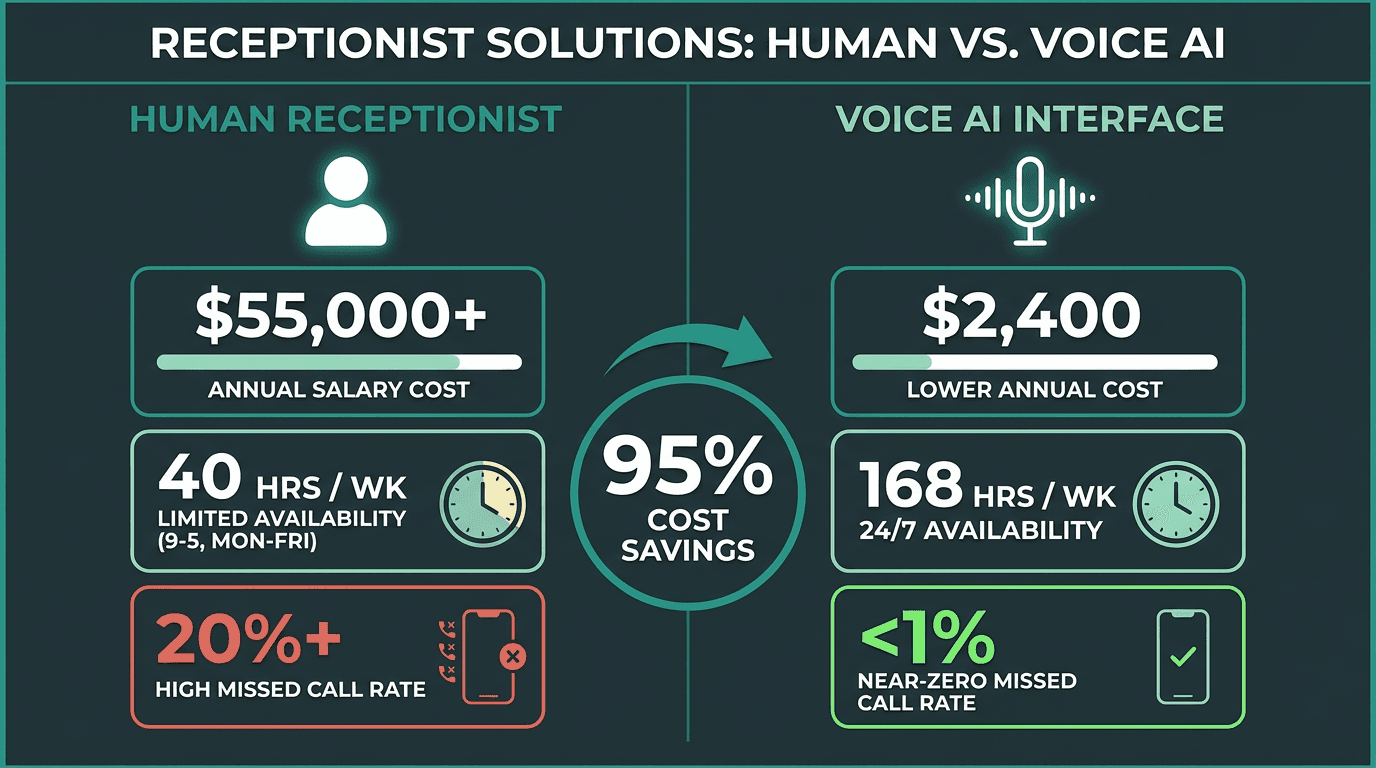
The cost gap between human and AI receptionists makes the decision straightforward for most local business owners.
Building Your White Label AI Receptionist Offer
A white-label product is made by one company and sold under another company's brand. For an agency, that means taking proven AI voice infrastructure and wrapping it in your own name: your pricing, your onboarding, your support expectations, and your client relationships. The platform handles the mechanics of calls. You keep the account and the trust.
Smallest.ai's AI receptionist is designed to cover the full call lifecycle: answer the phone, understand what the caller wants, book an appointment, transfer when needed, and log the interaction. Voice AI details matter here. Local business clients decide in the first few seconds whether the system feels legitimate. If there is noticeable lag or it sounds robotic, the product gets blamed, and so does the agency selling it.
What to Include in Your Service Package
A well-structured agency package typically includes:
Custom voice persona: A named, branded voice that fits the business (warm for a spa, formal for a law firm).
Call routing logic: Clear rules for when to transfer, take a message, or book directly into the calendar.
After-hours coverage: The fastest win for most local operators.
Call summaries and transcripts: Automatic notes sent to the owner or into the CRM after each call.
Monthly reporting: A lightweight dashboard with call volume, resolution rate, and missed-call recovery.
If you want to pressure-test what the system can do before you write your pitch deck, Smallest.ai's conversational AI customer service guide is a useful reference. It gets into intent recognition, interruptions, and multi-turn conversations, the exact mechanics that come up when a more sophisticated buyer starts asking how the receptionist will behave on real calls.
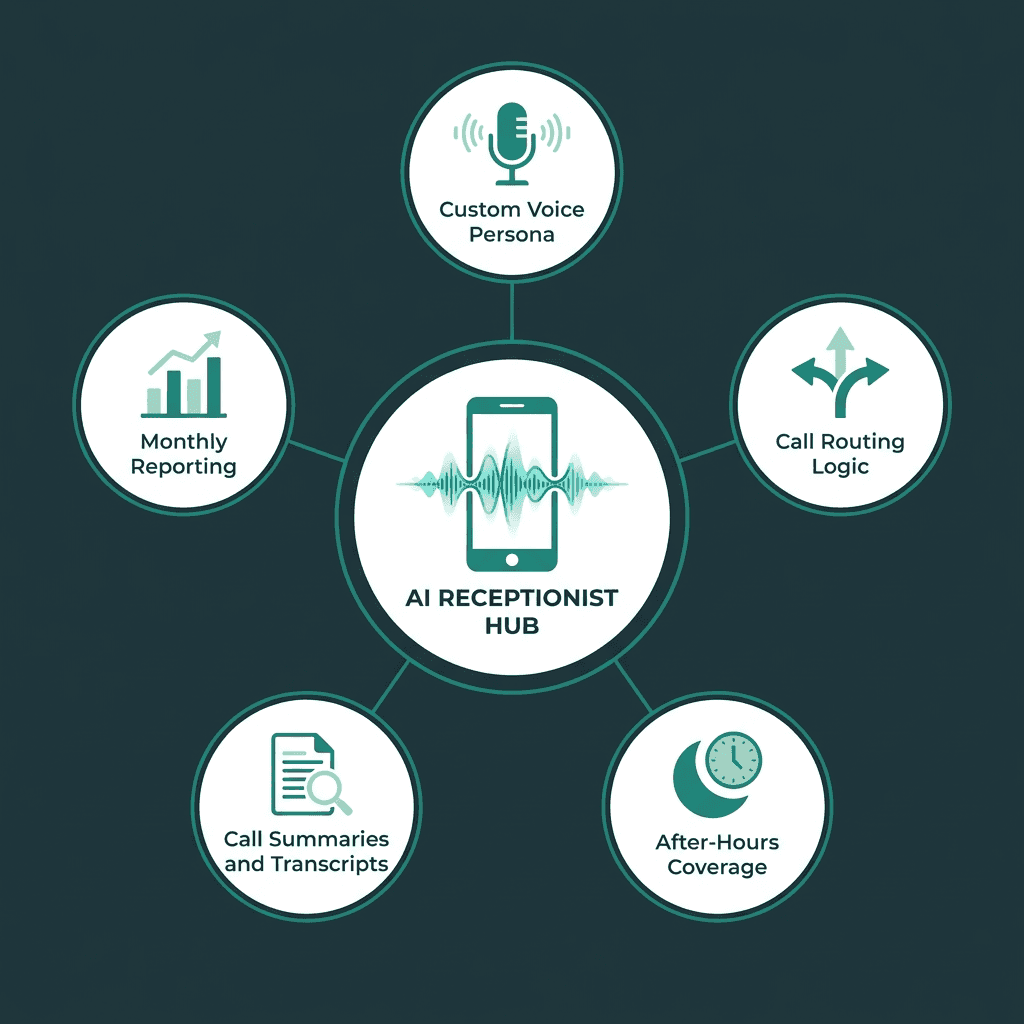
A complete agency package bundles voice persona, routing logic, and reporting into one resellable service.
Packaging Structure
Pricing is where agencies quietly sabotage their own margins. The default move is to take the platform fee and add a fixed markup. You will do better pricing against the cost of the problem you are removing. If a business regularly misses booked appointments or inbound inquiries, the resulting lost revenue can easily outweigh the monthly cost of an AI receptionist. Position the service against the business outcome it delivers and the cost of missed opportunities, rather than merely the software cost alone. By anchoring your pricing to the significant revenue lost from missed opportunities, you demonstrate the true value your agency provides.
Tier | Typical Inclusions | Best For |
|---|---|---|
Starter | After-hours answering, basic FAQs | Solo practitioners, single-location retail |
Growth | 24/7 coverage, booking, CRM sync | Medical offices, salons, service businesses |
Pro | Multi-location routing, analytics, custom voice | Multi-location SMBs, franchise units |
Before you set client rates, get clear on your costs with the Smallest.ai AI Receptionist. That spread between platform cost and what you charge is the business model. Done right, it is a meaningful recurring margin, not a token add-on you have to justify every month.
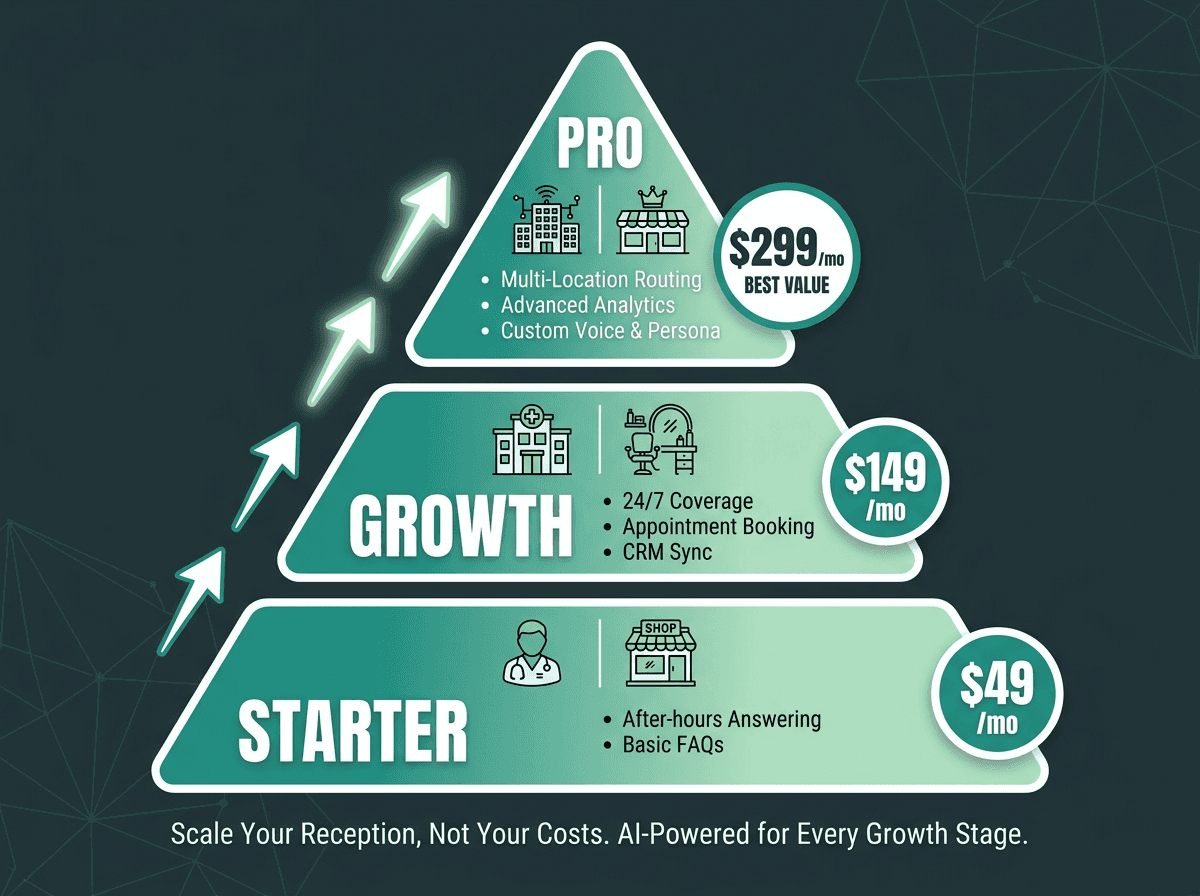
Tiered packaging lets agencies serve solo operators and multi-location businesses from one platform.
The Sales Conversation: How to Pitch Local Business Owners
Local owners buy specifics. "AI will transform your customer experience" is too vague to be useful. "You missed 23 calls last month after 6pm, and we can capture those for $199 a month" is concrete enough to act on. The strongest pitches start like a diagnosis: what is happening today, what it costs, and what changes when the receptionist answers every time.
Do a fast audit before you walk in. Look at the business's Google Business Profile and scan reviews for complaints about unanswered calls or slow responses. Call after hours and write down exactly what you hit: voicemail, an IVR tree, or a dead line. Bring receipts, not theory. If you want more context on what small-business buyers compare when they shop these tools, review the best AI answering service for small business breakdown before your first meeting.
Objections You Will Hear and How to Handle Them
These are the four objections that come up in nearly every local business sales conversation:
"My customers want to talk to a real person." Agree with the sentiment, then anchor it in reality: a real person is rarely available at 9pm on a Sunday. The AI is. Most callers will take a helpful answer over voicemail, even if the voice is synthetic.
"We already have voicemail." Many callers never leave a voicemail and simply move on to another provider. A receptionist that answers, books, and resolves questions in real time is not an upgrade to voicemail; it is a way to stop losing the call in the first place.
"What if it says something wrong?" You set the configuration. The receptionist only responds within what it has been trained to cover, and it escalates anything outside that scope to a human. Guardrails are part of the deployment, not an afterthought.
"We tried something like this before and it didn't work." Ask what failed. Most of the time they are describing a clunky IVR menu from years ago. Modern conversational AI behaves differently, and the quickest way through the objection is a live demo, not a long explanation.
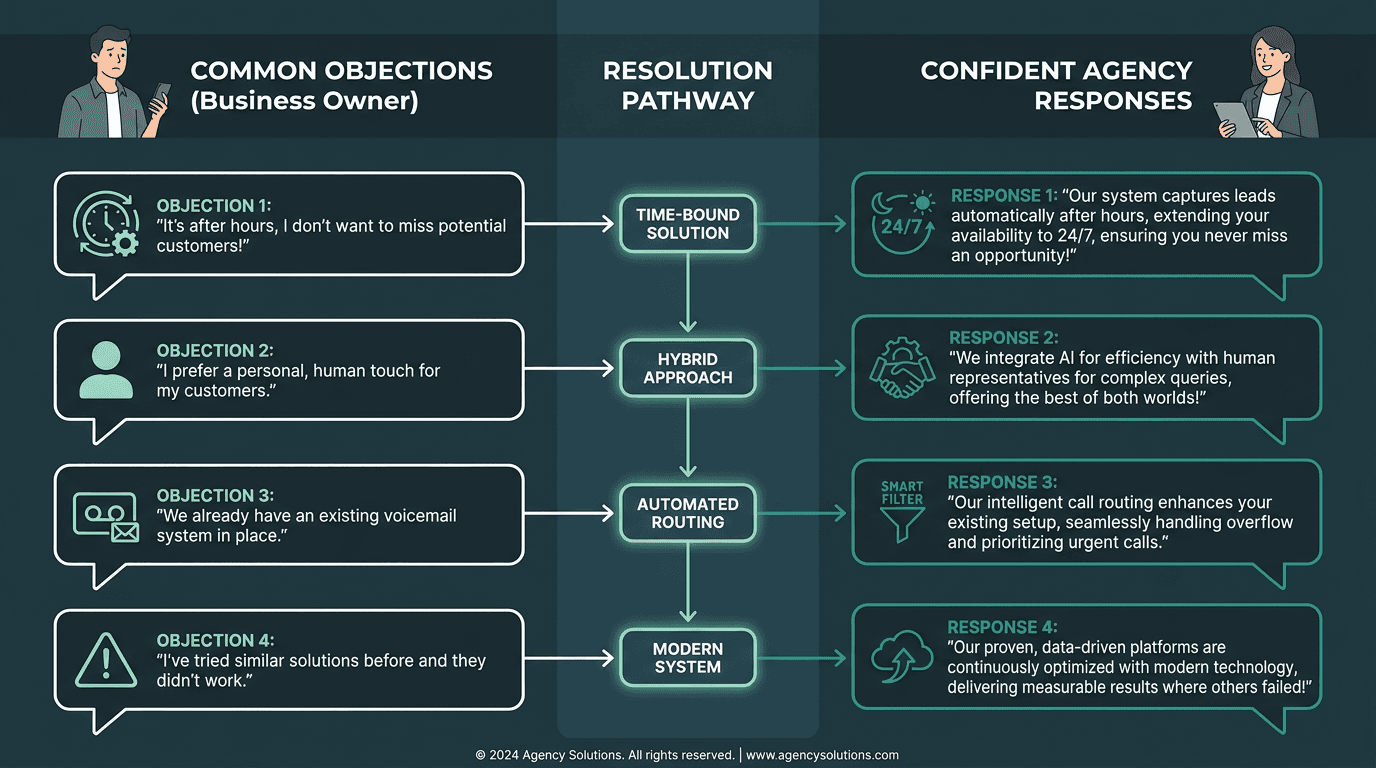
Map every objection to a confident response before pitching your *White Label AI Receptionist use case*.
Vertical Markets Where This Sells Fastest
Not every local business will convert at the same rate. The fastest wins tend to share the same shape: lots of inbound calls, revenue tied to appointments, and staffing that is already stretched thin. Appointment-driven businesses often see value quickly because missed calls can directly translate into missed revenue opportunities. That pattern translates well to other appointment-heavy, time-sensitive categories.
Industry | Primary Pain Point | AI Receptionist Value |
|---|---|---|
HVAC / Plumbing | Emergency calls after hours | 24/7 intake, dispatch routing |
Dental / Medical | Appointment booking overflow | Automated scheduling, reminders |
Legal (solo/small firm) | Intake calls missed during court | Qualified lead capture, callback scheduling |
Beauty / Wellness | Booking calls during service hours | Real-time appointment booking |
Real Estate | Listing inquiry calls at all hours | Lead qualification, agent routing |
Smallest.ai also has specific solutions for local businesses that line up with these use cases. When you build a vertical pitch, you do not need to invent positioning from scratch. You need to translate it into the vocabulary of the owner across the table: fewer missed calls, more booked appointments, less chaos at the front desk.
Onboarding Clients Without Friction
Onboarding is where retention is won or lost. If the first month feels organized, clients trust the service and your agency spends less time in reactive support. The workflow can stay simple; what matters is that it is repeatable and predictable across accounts.
Begin with a structured discovery session to collect common customer questions, booking workflows, escalation rules, and brand voice preferences. That single session is usually enough to configure a working prototype. Set expectations with a test-call review on day 7, a performance check on day 30, and a quarterly business review after that. The AI answering service infrastructure carries the technical load; your agency stays focused on configuration and client communication.
If you are still deciding which platform to standardize on, the choosing an AI answering service resource lays out what matters: latency, voice quality, integration depth, and pricing structure. Those are also the questions your clients will eventually ask, and having crisp answers is part of selling this as a managed service rather than a gadget.
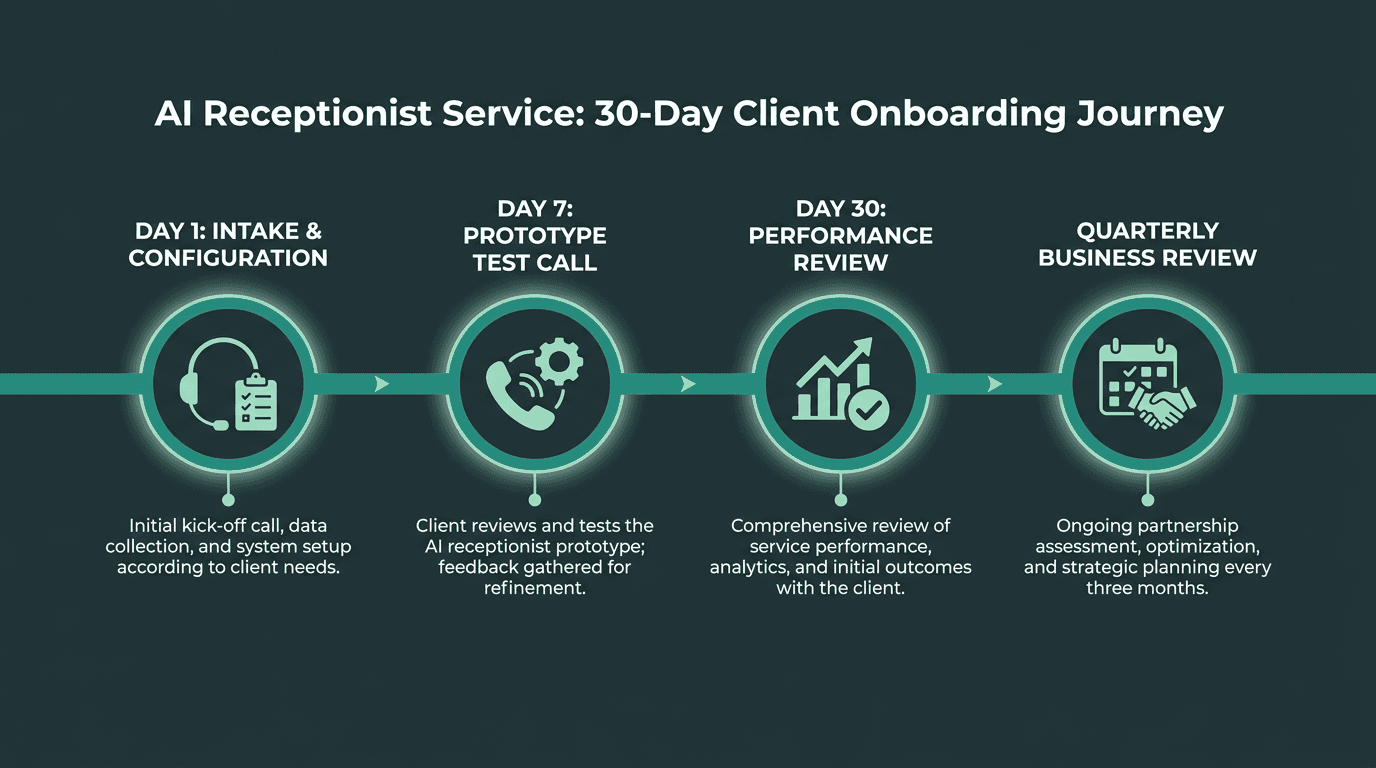
A repeatable onboarding structure builds client trust and reduces churn in the critical first 30 days.
Retaining Clients and Growing the Account
In practice, retention here lives and dies on reporting. When clients can see outcomes, they stay. When they cannot, the monthly fee starts to feel like a subscription they forgot to cancel. Send a simple monthly report that shows total calls handled, calls outside business hours, appointments booked, and estimated revenue recovered using the client's average transaction value. If a dental office can point to 14 appointments that would have gone to voicemail, the service just justified itself.
Account growth is mostly scope expansion. Many clients start with after-hours coverage, then ask for full-day coverage within a few months. From there, multi-location routing, CRM integrations, and outbound follow-up calls become straightforward upsells. Each add-on increases monthly recurring revenue without restarting the entire sales process. The AI answering service infrastructure scales with the account; your packaging and pricing should scale with it.
The Problem-Solution Bridge
Local businesses lose revenue to a problem that is both obvious and measurable: calls that no one answers, front desks that cannot keep up, and staffing economics that make full-time coverage impossible. These are not vague operational headaches. They show up in missed appointments, lost jobs, and customers who call the next listing. Agencies that quantify the gap and bring a working receptionist into the room end up in a sales conversation that is unusually easy to close.
This white label AI receptionist use case is already here, because it solves a visible operational problem that local businesses deal with every day. Smallest.ai's AI receptionist, built on the Atoms platform, gives agencies the infrastructure to deploy without building from scratch. Voice quality is natural, configuration is flexible, and the pricing model leaves room for real agency margins. If you're looking to add AI receptionist services to your agency, book a demo to see how Smallest.ai fits your client onboarding, deployment, and support workflow.
Frequently asked questions
What does a white label AI receptionist use case look like for agencies?
How much can an agency charge for an AI receptionist service?
Which local business types are the best fit for an AI receptionist?
Will local business clients accept an AI answering their calls?
How does Smallest.ai support agencies building this service?