What is a white label AI receptionist? Features, use cases, and pricing explained

White label AI receptionist explained: how it works, must-have features, common use cases, and 2026 pricing ranges for agencies and businesses.
A white label AI receptionist is a phone-answering and call-handling system built by one vendor, then rebranded by an agency, SaaS company, or service business and sold under their own name. The provider supplies the engine that answers inbound calls, books appointments, handles FAQs, and routes requests; the company deploying it presents the experience as if it is their own product.
AI receptionists are becoming a practical way for agencies, SaaS companies, and service businesses to automate inbound calls without building voice infrastructure internally. White-label platforms make it possible to launch branded AI receptionists quickly while maintaining ownership of the customer relationship.
The White-Label Model: What It Actually Means
White-labeling started in physical goods, but the software model is simple: one company produces a working system, and another rebrands it to appear as if they made it. In software terms, you buy a working system, remove the original branding, apply your own, and sell it to end clients as your offering.
With an AI receptionist, the white-label layer usually includes custom-domain hosting, branded admin dashboards, configurable voice personas, and client portals that show no trace of the original provider. The reseller decides packaging and pricing, owns the customer relationship, and controls the surface area the client touches. The vendor stays behind the curtain. For agencies looking to add a new service, this is one of the most direct paths to offering white label voice AI solutions.
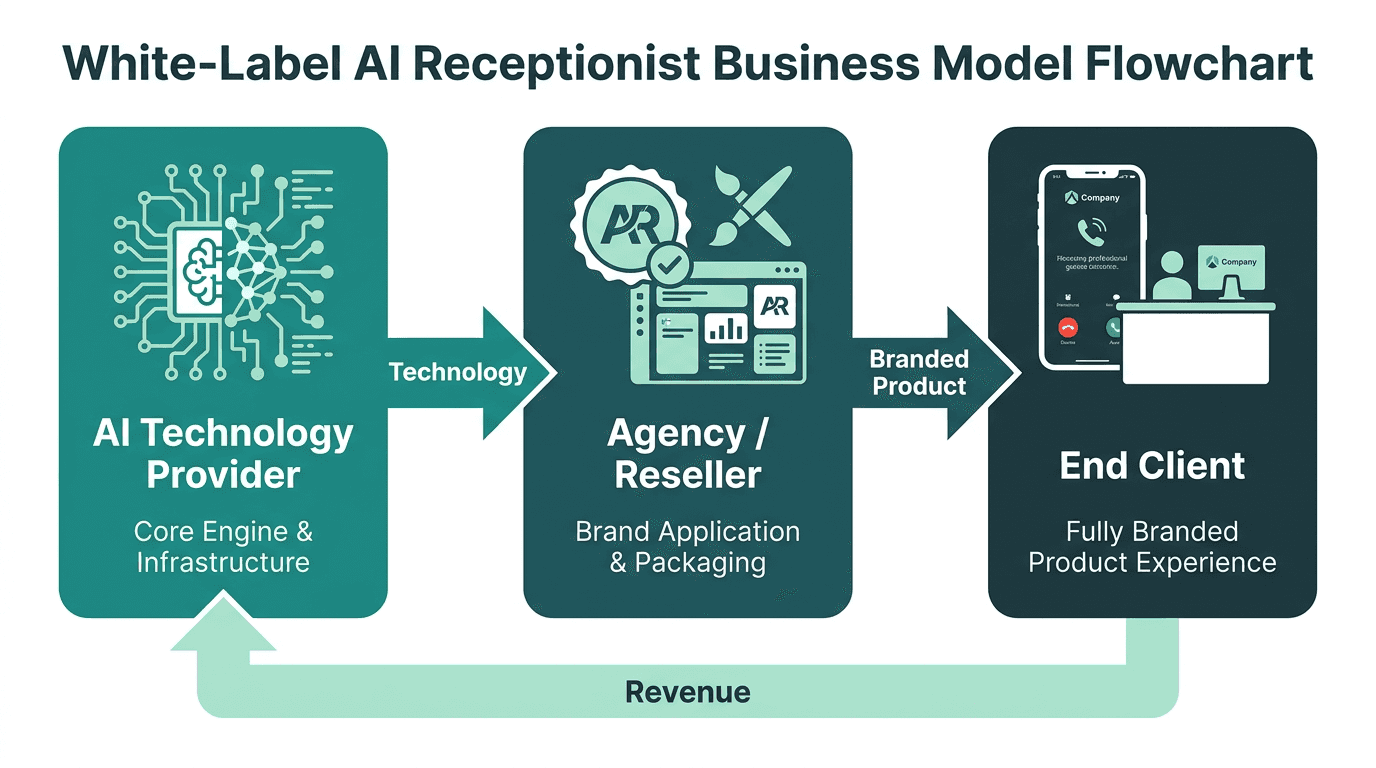
The three-party structure of a white-label AI product relationship
Core Features That Define a White Label AI Receptionist
Plenty of "AI answering" tools stop at a chatbot bolted onto telephony. A true white-label AI receptionist combines real conversational handling with the operational plumbing a reseller needs. In practice, mature platforms tend to include:
Standard feature set across mature white-label AI receptionist platforms:
24/7 inbound call handling with natural-sounding voice responses, not robotic IVR trees
Appointment scheduling and calendar sync integrated with tools like Google Calendar or practice management software
Custom voice personas built from text-to-speech engines that match a brand's tone and language
Live call transfer and escalation logic so complex queries reach a human without friction
Multi-channel support covering phone, SMS, and web chat from a single backend
White-label dashboards where end clients log in and see only the reseller's branding
Analytics and call reporting exportable under the reseller's brand identity
Webhook and API integrations for CRM, ticketing, and EHR systems
Voice quality is where these products either feel credible or fall apart. Low-latency, natural speech is the difference between a receptionist callers will talk to and one they will hang up on. That is why understanding how to build faster AI voice agents matters when you are evaluating the underlying engine. As latency increases, conversations begin to feel less natural and callers become more likely to interrupt or disengage.
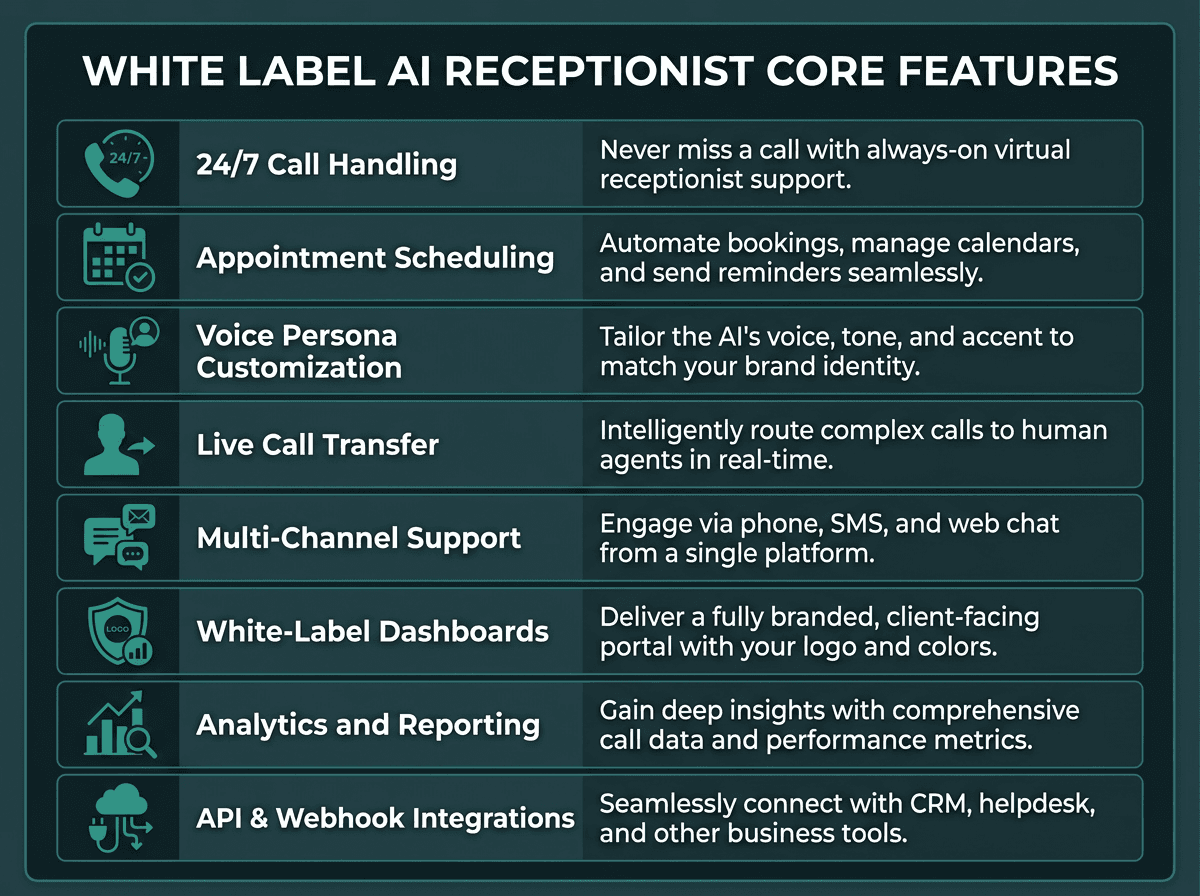
Eight capabilities that define a production-ready **white-label AI receptionist**, from voice personas to API integrations.
Who Actually Uses These Platforms and How
Most deployments fall into three buyer buckets, and each one buys for a different reason. Agencies resell the platform to SMBs as a managed service, charging a monthly fee while the AI carries the day-to-day call load. Vertical SaaS companies bake it in as a native feature, like a dental practice management product adding AI call handling without building voice AI internally. And some businesses, especially in healthcare, legal, and home services, deploy it directly to supplement or replace a human front desk.
Healthcare shows the economics most clearly because the call volume is high and the stakes are real. A solo medical practice might see 80 to 150 calls a day, and a lot of them are repetitive: appointment requests, basic questions, prescription refill checks. An AI receptionist can take those calls without a staff member glued to the phone, which frees clinical teams to focus on patients. You see the same playbook in legal intake, HVAC dispatch, and real estate showing coordination.
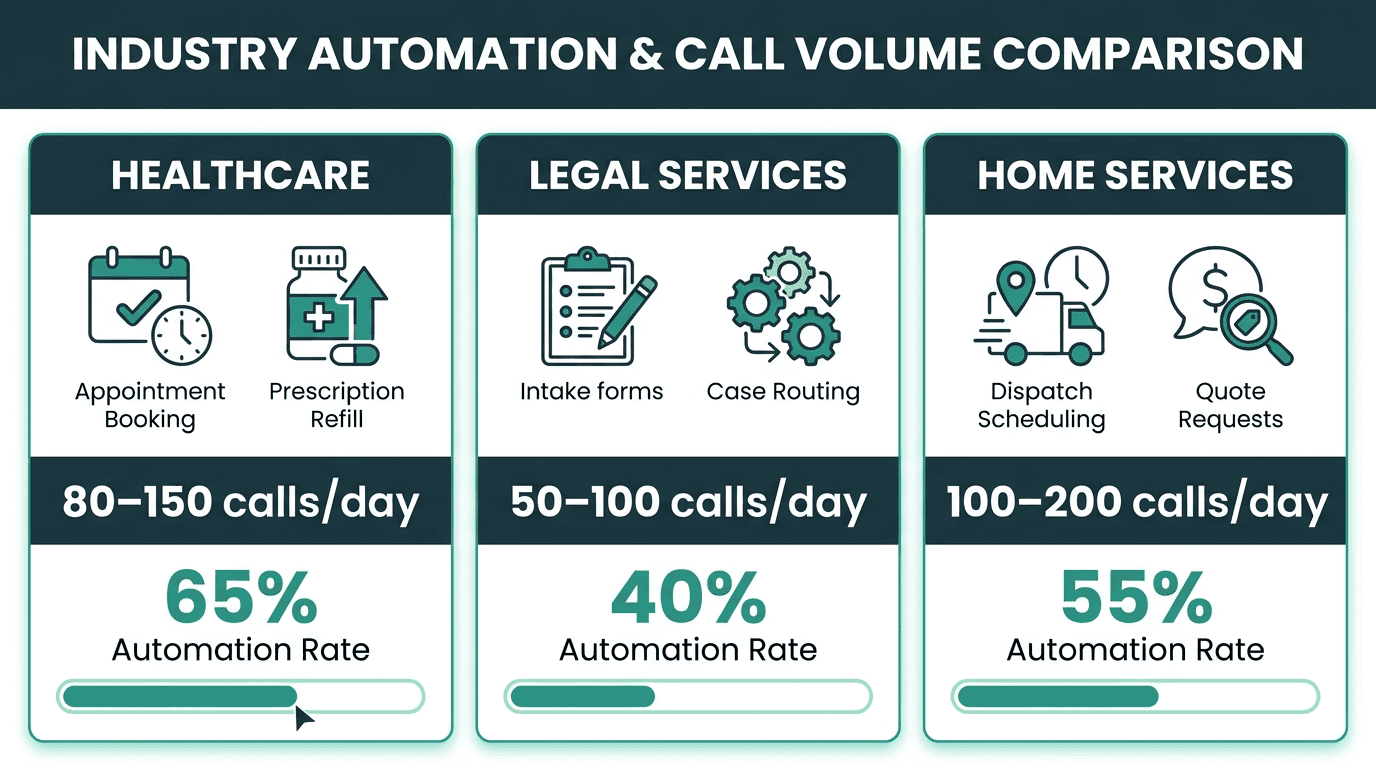
Healthcare, legal, and home services lead white-label AI receptionist adoption due to high call volumes.
Pricing: What Agencies and Businesses Actually Pay
White-label AI receptionist pricing is usually a two-line item, and you want to understand both before you sign anything. Most providers charge a fixed monthly platform fee plus a per-minute voice usage rate. The platform fee covers infrastructure, dashboard access, and reseller tooling; the per-minute charge tracks the real cost of running voice AI on live calls.
Tier | Monthly Platform Fee | Per-Minute Voice Charge | Best For |
|---|---|---|---|
Starter | $29 to $99 | $0.12 to $0.15 | Solo agencies, pilot deployments |
Growth | $100 to $400 | $0.10 to $0.13 | Agencies with 5 to 20 clients |
Scale | $400 to $1,400 | $0.08 to $0.11 | High-volume resellers, vertical SaaS |
If you are an agency working out resale margins, the calculation is simple: total cost = platform fee + (monthly call minutes x per-minute rate). A client generating 500 call minutes a month at $0.13 per minute comes out to $65 in usage, plus the platform fee.
A full-time receptionist represents a significant ongoing staffing cost, especially when coverage is needed beyond standard business hours. Even a mid-tier white-label AI receptionist at $300 per month plus usage is a small fraction of that, and it does not clock out at 5 p.m.
Three Things People Get Wrong About White Label AI Receptionists
Misconception 1: White-label means inferior technology. In practice, it is often the reverse. Vendors that live and die by voice AI put their budget into model quality, latency work, and telephony reliability because that is the product. Resellers get the benefit of that specialization without trying to recreate it themselves. White-labeling also lets businesses ship a new software offering quickly without the time and cost of building in-house, a point that shows up repeatedly in enterprise software adoption research.
Misconception 2: It replaces human staff entirely. A well-tuned AI receptionist is built for routine, high-volume work: scheduling, FAQs, basic intake, and routing. It is not meant to handle complex negotiation, emotional-support conversations, or genuinely novel situations outside its training scope. The real-world model is augmentation. Humans take escalations; the AI absorbs the calls that would otherwise turn into hold times and missed opportunities.
Misconception 3: Setup is a one-time event. Voice systems drift the moment the business changes and nobody updates the configuration. Hours, services, pricing, staff names, and escalation rules all need regular review. Agencies that treat the first setup as "done" often watch satisfaction slide within three to six months, because the AI starts giving stale answers. Ongoing prompt and knowledge-base maintenance is operational work, and it belongs in the service price.
How to Evaluate a White Label AI Receptionist Platform
What you should test depends on how you plan to use the platform. Agencies should weight reseller mechanics heavily: provisioning new client accounts, applying branding quickly, and managing billing across many deployments. Businesses buying for internal use should obsess over integration depth with the existing stack and how the voice model behaves on real calls, not just a polished demo flow.
For both groups, the AI receptionist buyer's guide lays out a fuller evaluation framework, including timelines, integration checklists, and provider questions. A few items that are easy to underweight early on: how the system handles simultaneous call spikes, what happens when the AI does not know an answer (graceful fallback vs. dead air), and whether onboarding includes real support or just a link to self-serve docs.
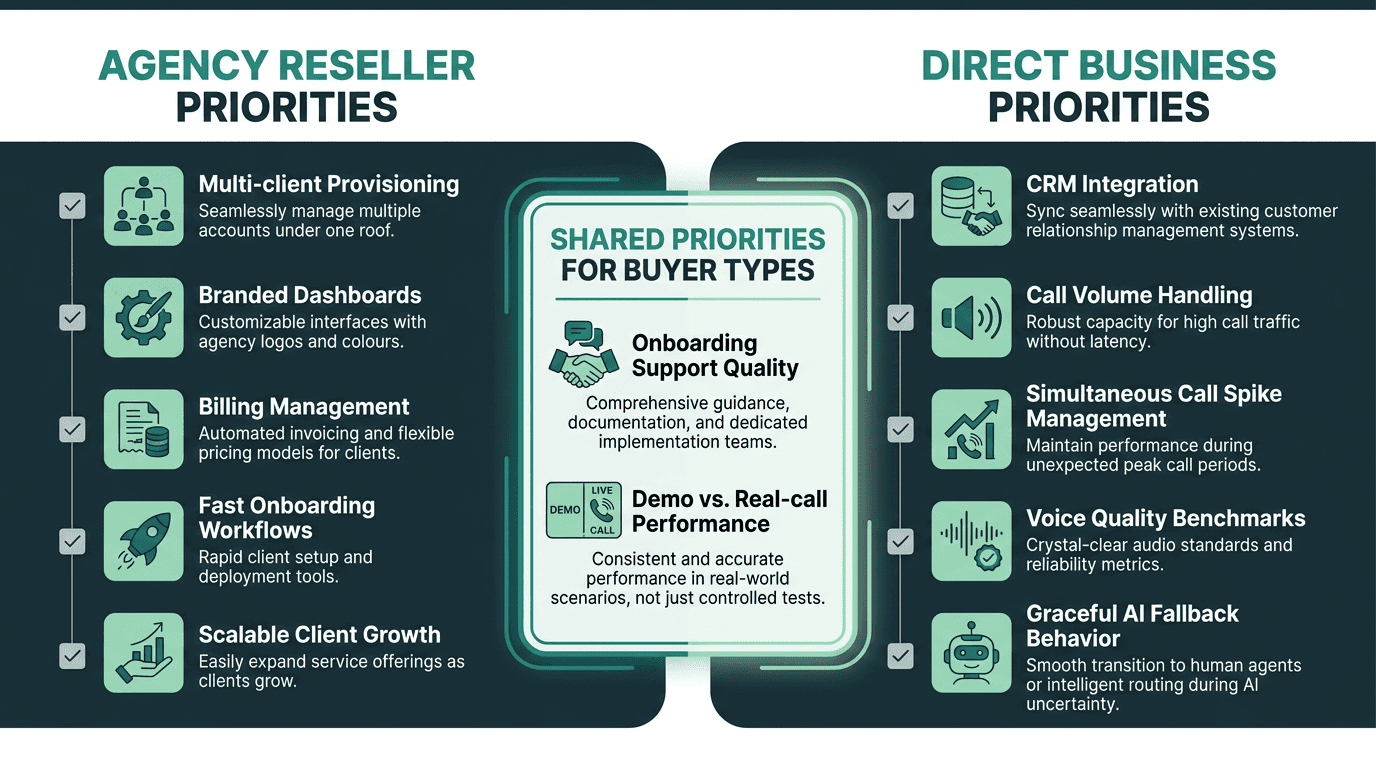
Evaluation criteria differ meaningfully between agency resellers and direct-use businesses.
Key Takeaways
What to remember about white label AI receptionists:
A white label AI receptionist is a fully rebrandable AI call-handling system built by a specialist provider and sold or deployed under another company's brand
Core capabilities include 24/7 call answering, appointment scheduling, live transfer, multi-channel support, and white-label client dashboards
Healthcare, legal, and home services lead adoption because they field high inbound call volume with lots of repeatable requests
Pricing is typically two-part: a fixed monthly platform fee ($29 to $1,400) plus per-minute voice usage charges ($0.08 to $0.15)
Agencies commonly package the receptionist inside a managed retainer, with pricing based on their service value
White-labeling is not a shortcut to weaker tech; specialist providers often outperform in-house builds on voice quality and reliability
Knowledge-base and call-flow maintenance is ongoing operational work, not optional cleanup
Evaluation should include concurrency behavior, fallback handling, and integration depth alongside the usual feature checklist
The Problem This Solves and Where Smallest.ai Fits
The problem is not abstract: every missed call is a chance to lose revenue and trust, and voicemail is rarely a real safety net. Hiring human receptionists at scale is expensive, inconsistent, and capped by business hours. Agencies run into the same wall from the other side: clients want an AI receptionist, but building one means months of engineering, telephony know-how, and ongoing model upkeep that most shops cannot justify.
White-label AI receptionists are built to close that gap: the provider runs the core system, while the agency or business brands it and owns the relationship. Smallest.ai's AI Receptionist runs on the same infrastructure behind Smallest.ai's Lightning text-to-speech engine, Pulse speech-to-text, and the Atoms voice and text agent platform, so voice quality, latency, and conversation handling come from production components rather than a thin demo wrapper. If you are weighing build vs. buy, the AI receptionist buyer's guide breaks down timelines, integration requirements, and the real cost comparison.
Launch a Branded AI Receptionist Without Building the Stack
Building an AI receptionist requires speech recognition, voice generation, telephony infrastructure, routing logic, and ongoing maintenance. Smallest.ai brings those components together into a single platform so agencies and businesses can deploy branded AI receptionists faster without managing the underlying complexity.
Frequently asked questions
What is a white label AI receptionist, in plain English?
What does a white label AI receptionist cost?
Which industries get the most value from an AI receptionist?
Can a white label AI receptionist support multiple clients at the same time?
How is a white label AI receptionist different from a standard AI answering service?