Why Voice AI Is Now Critical for Insurance Lead Qualification

Understand how voice AI for insurance lead qualification screens intent in live calls, filters non-buyers, and routes sales-ready leads at scale. Read more.
Insurance lead qualification has changed quietly but fundamentally over the last decade. What once depended on manual call lists, delayed callbacks, and agent availability has steadily shifted toward real-time engagement. As digital channels multiplied, insurers began generating far more leads than teams could realistically qualify.
Sales performance research now shows that only 1–6% of leads convert into customers, and the average conversion rate from prospects to qualified leads sits at around 10%. This gap explains why so much agent time is spent chasing prospects who were never likely to buy in the first place.
For operations, growth, and sales leaders searching for voice AI for insurance lead qualification, the intent is rarely academic. It is driven by missed calls, inconsistent screening, delayed follow-ups, and agents re-asking the same questions on every first call. Voice AI emerged to address these exact breakdowns by qualifying intent, eligibility, and readiness in real time, before human effort is applied.
In this guide, we break down how voice AI for insurance lead qualification actually works in production environments, the logic and workflows behind it, and the outcomes insurance teams should expect when qualification is handled correctly at scale.
Key Takeaways
Voice AI Turns Lead Qualification Into a Live Decision System: Insurance qualification happens inside the call itself, not across multiple follow-ups, handoffs, or post-call analysis cycles.
Conversation Control Determines Qualification Quality: Real-time call orchestration, failure detection, and latency control directly affect whether qualification signals are captured or lost.
Insurance Logic Must Be Applied During the Call, Not After: Policy differentiation, eligibility checks, risk flags, and purchase timing must resolve before routing to avoid misaligned sales conversations.
Sales Impact Comes From Deterministic Handoffs, Not Automation Volume: Consistent routing, context preservation, and resolved readiness states reduce agent rework and stabilize close performance.
Scalability Requires Predictable Behavior Under Load: High-volume insurance campaigns demand systems that maintain scoring accuracy, routing rules, and compliance controls during traffic surges.
Why Insurance Lead Qualification Breaks at Scale
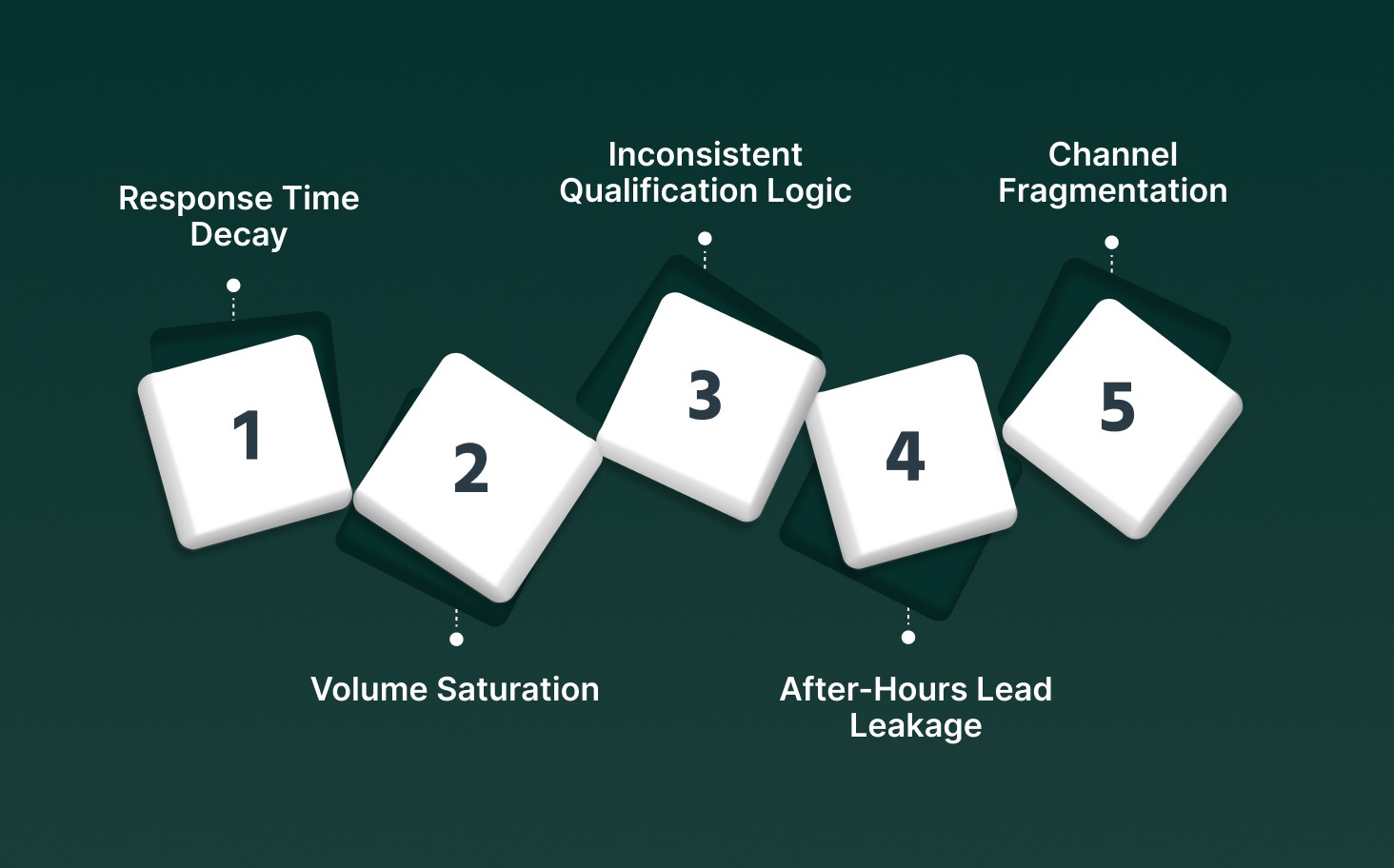
Insurance lead qualification fails at scale due to structural constraints in human-led workflows that cannot match lead velocity, channel fragmentation, and real-time intent decay.
Response Time Decay: Leads contacted after the first five minutes show a sharp drop in connection and conversion rates, yet manual calling queues often introduce delays measured in hours.
Volume Saturation: High-volume campaigns flood agents with raw leads, forcing surface-level screening and increasing false positives passed into the sales funnel.
Inconsistent Qualification Logic: Different agents apply different screening standards for eligibility, budget, and urgency, creating unpredictable lead quality and uneven conversion performance.
After-Hours Lead Leakage: Nights, weekends, and holidays generate high-intent insurance searches, but human coverage gaps leave these leads untouched until intent weakens.
Channel Fragmentation: Leads arrive from ads, aggregators, missed calls, chat, and referrals, yet qualification workflows remain siloed, breaking context and slowing prioritization.
At scale, manual insurance lead qualification introduces delay, inconsistency, and leakage. These failures compound as volume grows, directly eroding conversion efficiency.
If you are moving from scripted automation to live, context-aware voice interactions, Smallest.ai helps you run real-time, multilingual voice agents with low latency, full deployment control, and production-grade reliability across enterprise call volumes.
What Voice AI for Insurance Lead Qualification Actually Does
Voice AI for insurance lead qualification functions as a real-time execution layer that controls live calls, applies insurance-specific logic, and produces measurable sales outcomes within a single interaction. Every system behavior exists to reduce lead decay, improve qualification precision, and increase downstream conversion efficiency.
1. Real-Time Call Control and Conversation Orchestration
Voice AI operates as the active controller of the live insurance call, not a passive responder. It governs timing, turn ownership, error recovery, and exit conditions to keep the conversation usable under real network, accent, and caller-behavior variability.
Key benefits:
Low-Latency Speech Loop Management: Audio ingestion, speech recognition, intent resolution, and voice synthesis run in a continuous loop designed to stay below human interruption thresholds. This prevents overlaps, dead air, and unnatural pauses that cause callers to disengage.
Deterministic Turn Ownership: The system enforces clear speaking turns by detecting barge-ins, partial utterances, and trailing silence. It pauses, resumes, or reformulates prompts based on live speech signals rather than fixed timers.
Silence and Drop-Off Detection: Prolonged silence, non-responses, or repeated short answers trigger recovery prompts or controlled exits instead of allowing the call to stall or fail silently.
Impact: This control layer directly increases call completion, preserves qualification signal integrity, and prevents agent handoff failures caused by incomplete or corrupted conversations.
2. Insurance-Aware Qualification Logic Execution
Voice AI executes a deterministic insurance qualification framework that mirrors how experienced insurance agents think. Instead of conversational guessing, it applies rule-bound logic trees that separate intent, eligibility, and routing constraints during the call itself.
Key Benefits:
Intent-Led Coverage Classification: The system classifies coverage type using semantic intent signals rather than menu selections. Phrases indicating family dependency, age references, vehicle ownership, hospitalization concerns, or policy renewal cues dynamically route the conversation into the correct insurance logic branch.
Eligibility Gatekeeping Rules: Age bands, geography, policy tenure, risk indicators, and basic underwriting constraints are checked in line. Leads that violate hard eligibility thresholds are filtered before agent handoff, preventing wasted sales effort.
Progressive Disclosure Control: The system limits health and financial questioning to qualification-safe boundaries. Sensitive disclosures are flagged, not probed, guaranteeing regulatory compliance while still surfacing sales-critical context.
Impact: Sales queues receive leads that already satisfy product fit, eligibility constraints, and compliance boundaries, reducing misrouting, agent fatigue, and downstream drop-offs.
3. Live Intent Scoring and Readiness Determination
Voice AI computes lead readiness as a continuously updated state during the call. Scoring is recalculated after each response, allowing the system to converge on a final disposition before the conversation ends.
Key Benefits:
Sequential Signal Accumulation: Each response updates the readiness state using progression markers such as commitment language, answer specificity, and response latency. Early signals set a baseline, while later answers either reinforce or weaken readiness.
Confidence-Normalized Scoring: The system adjusts scores based on speech certainty indicators, including pauses, self-corrections, and vague phrasing. Clear, direct answers strengthen readiness, while ambiguity suppresses it without disqualifying prematurely.
Decision Threshold Resolution: Readiness states resolve against predefined thresholds that trigger outcomes such as live transfer, scheduled follow-up, or disqualification. Once a threshold is crossed, the call path locks to prevent oscillation.
Impact: Sales teams receive leads with a resolved readiness state rather than raw conversations, eliminating subjective re-scoring and reducing wasted follow-up effort.
4. Structured Data Extraction at Call Time
Voice AI performs inline information structuring during the conversation, converting free-form speech into normalized, system-ready fields before the call concludes.
Key Benefits:
Field-Level Extraction: Spoken responses are mapped to predefined insurance data schemas using entity resolution and context anchoring. Age ranges, city, policy interest, family size, and renewal timelines are captured only when confidence thresholds are met to avoid polluted CRM entries.
Intent-Tagged Transcripts: Conversation segments are labeled by function, such as eligibility, budget signal, urgency indicator, or objection. This tagging allows downstream systems and agents to isolate relevant sections without replaying the entire call.
Zero Post-Call Dependency: Extraction and validation occur during live interaction rather than after transcription processing. Any missing or low-confidence fields are resolved through follow-up prompts before the call ends.
Impact: Sales workflows receive immediately usable data rather than raw transcripts, reducing follow-up latency and preventing context loss between qualification and action.
5. Deterministic Routing and Human Handoff
Voice AI executes a fixed routing decision at call time using predefined constraints, guaranteeing that lead transfer is predictable, auditable, and context-safe.
Key Benefits:
Skill-Based Matching: Routing resolves against hard constraints, including policy line, language, regulatory region, call complexity, and agent authorization level. The system prevents fallback to generic queues when an exact match is unavailable.
Pre-Call Context Injection: Prior to agent pickup, the system injects a compressed handoff packet containing resolved fields, unresolved flags, and recommended next actions. This packet is immutable during the live transfer to avoid state drift.
Single-Conversation Continuity: Call state, caller intent, and conversation position persist across transfer boundaries. Agents enter the call at the exact conversational stage reached by the system, without resets or re-introductions.
Impact: Transfers complete without context loss or rework, preserving call momentum and preventing agent-side qualification restart.
6. Production-Scale Execution Under Load
Voice AI is engineered to sustain qualification accuracy and system determinism during traffic spikes, campaign bursts, and regional surges without altering conversation logic or lead outcomes.
Key Benefits:
Concurrent Call Handling: Call execution is isolated per session, with resource allocation managed at the call level rather than shared conversational state. This prevents cross-call interference, queue buildup, or response degradation as concurrency increases.
Predictable Scoring Under Load: Qualification and scoring logic execute within fixed compute budgets per call. Load conditions cannot alter scoring thresholds, weighting logic, or routing decisions, preserving lead quality consistency.
Operational Visibility: Live telemetry exposes call health, latency, failure rates, and qualification outcomes in real time. Anomalies are surfaced at the campaign and flow level, allowing quick intervention without stopping active calls.
Impact: Insurance teams sustain lead qualification performance during peak volume periods without adding agents or compromising conversion quality.
Voice AI for insurance lead qualification translates real-time conversation control into measurable sales outcomes. The value is not automation alone, but consistent lead quality, faster conversion, and controlled scale.
If you are evaluating how personalized voice conversations translate into regulated, high-volume environments, explore Why Insurance Companies Need Voice Agents in 2025: The Complete Analysis
Metrics That Matter for Insurance Teams
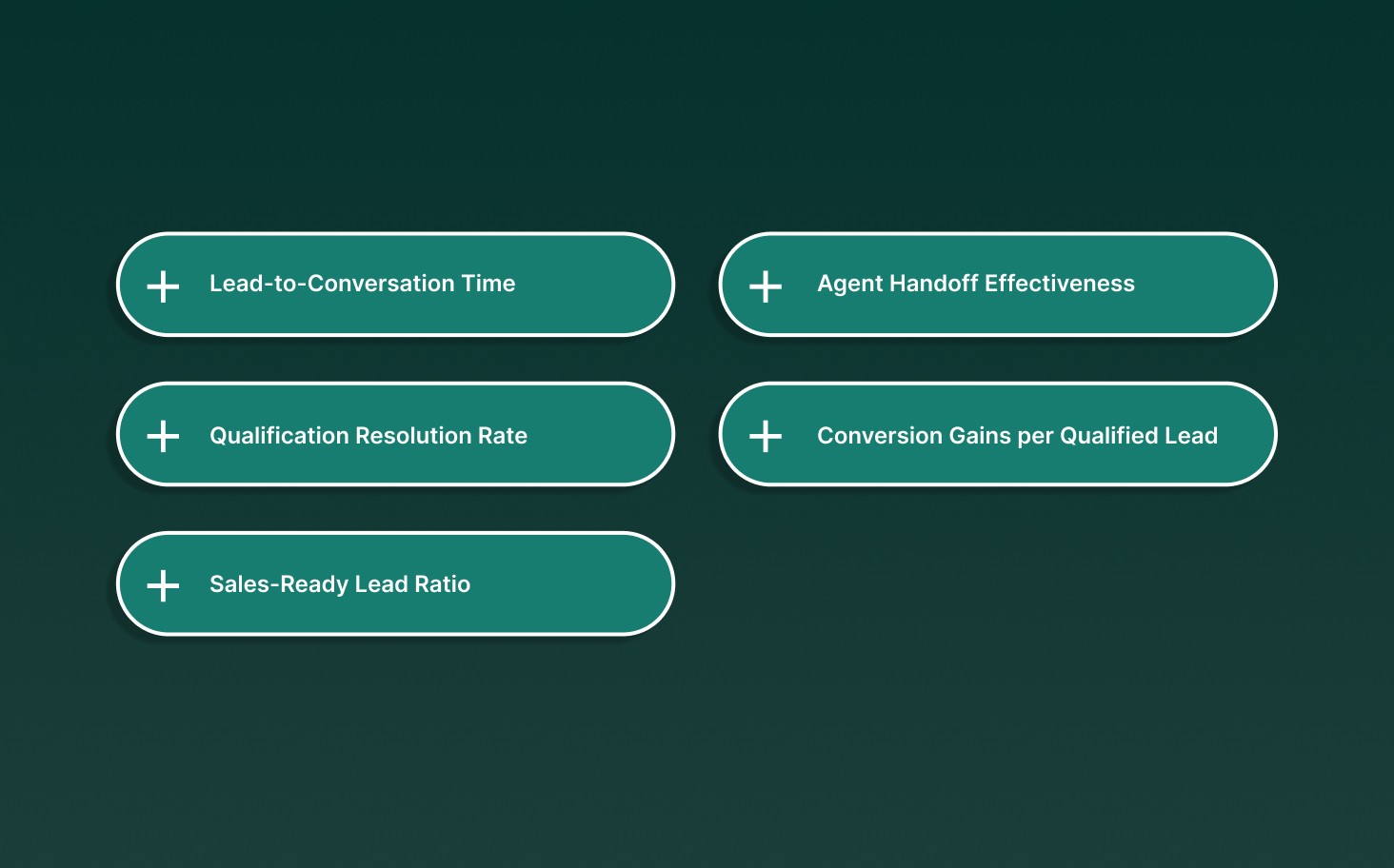
Voice AI effectiveness in insurance lead qualification is measured by how quickly intent is captured, how accurately leads are filtered, and how reliably qualified outcomes translate into revenue activity.
Lead-to-Conversation Time: Measures the delay between lead creation and first voice interaction, directly correlating with intent decay and connect probability.
Qualification Resolution Rate: Tracks the percentage of calls that end with a resolved outcome, such as sales-ready, nurture, or disqualified, rather than incomplete or abandoned.
Sales-Ready Lead Ratio: Indicates how many qualified leads meet predefined eligibility, intent, and readiness thresholds before reaching agents.
Agent Handoff Effectiveness: Measures agent acceptance, call continuation rates, and avoidance of re-qualification during transferred conversations.
Conversion Gains per Qualified Lead: Evaluates downstream impact by linking qualified leads to quote issuance, policy binding, or scheduled follow-ups.
These metrics reveal whether voice AI is reducing lead waste and improving sales focus, not simply increasing call volume.
Implementation Considerations Before You Deploy
Deploying voice AI for insurance lead qualification requires alignment across systems, teams, and operating rules. These considerations determine whether the system delivers reliable outcomes or creates downstream friction.
Qualification Logic Alignment: Define eligibility rules, disqualification thresholds, and routing criteria upfront so voice AI mirrors existing sales and underwriting boundaries.
CRM and Telephony Readiness: Guarantee bidirectional data flow between calling infrastructure and CRM systems to prevent data loss or duplicated qualification effort.
Agent Workflow Integration: Prepare agents to receive context-rich handoffs, understand qualification outcomes, and continue conversations without restarting discovery.
Language and Regional Coverage: Validate support for local languages, accents, and insurance terminology to avoid misinterpretation and caller drop-off.
Monitoring and Iteration Setup: Establish review loops using call outcomes, resolution rates, and agent feedback to continuously refine flows and thresholds.
Successful deployment depends on operational fit, not just model capability. Preparation determines whether voice AI scales qualification or amplifies existing gaps.
Common Misconceptions About Voice AI in Insurance
Voice AI in insurance is often misunderstood due to assumptions drawn from chatbots and legacy IVRs. These misconceptions lead teams to underestimate both the technical rigor and operational role of modern voice systems.
Misconception | What Actually Happens in Production |
Voice AI replaces human agents | Voice AI handles first-call qualification only. Agents remain responsible for advisory conversations, pricing, and policy binding. |
Voice AI follows rigid scripts | Qualification flows adapt dynamically based on live responses and confidence signals, not static decision trees. |
Customers do not trust AI voices | Trust is maintained through clear disclosure, natural pacing, and fast resolution without repeated questioning. |
Voice AI creates compliance risk | Compliance rules are enforced at runtime through question boundaries, consent capture, and data minimization. |
AI-qualified leads still need re-screening | Leads are delivered with resolved status, structured fields, and context, eliminating duplicate qualification. |
Most objections stem from outdated mental models. Modern voice AI functions as a controlled qualification layer, not an unstructured automation experiment.
For teams planning voice AI adoption across regulated financial workflows, explore Top AI voice agents for BFSI (Banking, Financial Services, and Insurance) in 2025?
How Smallest.ai Powers Voice AI for Insurance Lead Qualification
Smallest.ai provides real-time voice infrastructure designed for high-stakes insurance conversations. The platform focuses on low-latency execution, deterministic behavior, and production reliability across live qualification calls.
Real-Time Voice Execution Engine: Supports sub-second speech processing with stable turn-taking, allowing natural insurance conversations without call lag or overlap.
High-Concurrency Call Handling: Runs thousands of parallel qualification calls without shared-state interference, supporting campaign spikes and regional traffic surges.
On-Premise and Controlled Deployments: Offers deployment flexibility for insurers with strict data residency, compliance, or infrastructure requirements.
Structured Output for Sales Systems: Produces CRM-ready fields, tagged transcripts, and resolved lead states at call end, reducing downstream manual handling.
Deterministic Routing and Fallback Control: Applies fixed routing logic, escalation rules, and failure handling to keep lead outcomes predictable under load.
Smallest.ai fits teams that need production-grade voice AI for insurance qualification, not experimental automation.
Final Thoughts!
Insurance lead qualification now depends on fast judgment rather than lead volume. Voice AI resolves intent, fit, and readiness during the call, deciding in real time which conversations deserve human attention. This shifts the qualification from a queued task to a live control point, improving sales capacity use and outcome predictability. At scale, insurers require voice systems that operate reliably under load and route only sales-ready conversations to agents.
If you are evaluating how voice AI fits into your insurance qualification workflow, Smallest.ai provides real-time voice agents built for live conversations, high concurrency, and enterprise controls.
Book a demo to see how voice AI can qualify insurance leads before they reach your sales team.
Frequently asked questions
Can voice AI for insurance lead qualification distinguish between curiosity and purchase intent early in the call?
How does voice AI for insurance lead qualification handle incomplete or evasive answers?
Does voice AI for insurance lead qualification work with partially qualified leads from aggregators?
Can voice AI for insurance lead qualification adapt to different insurance products within the same call flow?
What happens if a lead’s qualification status changes during the call?