Speech-to-Text APIs with HIPAA, SOC 2, and Enterprise Compliance

Speech-to-text APIs compared for HIPAA and SOC 2 Type II: BAA support, retention and deletion controls, encryption, and enterprise-ready security tradeoffs.
Speech-to-text APIs are increasingly being evaluated inside healthcare, legal, financial, and enterprise support workflows where compliance requirements directly affect vendor selection. That growth is being pulled by industries that can’t treat audio like “just another payload.” Healthcare providers, legal teams, financial institutions, and enterprise contact centers are adopting transcription fast, and they all live under strict governance regimes. For teams evaluating the best transcription software in 2026, picking the wrong speech-to-text API isn't just a vendor swap; it’s a compliance incident.
This comparison looks at leading speech-to-text APIs through the lens that actually decides enterprise purchases: HIPAA readiness, SOC 2 posture, data handling, and the security controls that show up in a real vendor review. For a broader market scan, the best speech-to-text APIs in 2026 overview covers general-purpose use cases. The scope here is narrower and higher-stakes: which platforms belong anywhere near PHI, sensitive recordings, and enterprise workloads without turning your security team into the product’s compensating control?
What Compliance Actually Requires from a Speech-to-Text API
HIPAA (Health Insurance Portability and Accountability Act of 1996) is a US federal law that sets national standards for protecting sensitive patient health information, or PHI, from disclosure without patient consent. The HIPAA Security Rule focuses on electronic PHI (e-PHI) and requires covered entities to protect the confidentiality, integrity, and availability of any e-PHI they create, receive, maintain, or transmit. If your audio-to-text API is touching medical dictation or patient calls, that’s not a “compliance preference.” It’s a legal boundary condition.
SOC 2 is a voluntary standard from the American Institute of CPAs (AICPA) that evaluates how organizations handle customer data across five trust service criteria: security, availability, processing integrity, confidentiality, and privacy. In enterprise procurement, SOC 2 Type II is the report everyone asks for because it evaluates controls over time, not just on the day the auditor showed up. For API vendors, practical safeguards usually include unique user identification, strong authentication, role-based access controls, audit logging, encryption in transit, encryption at rest, and documented incident-response processes.
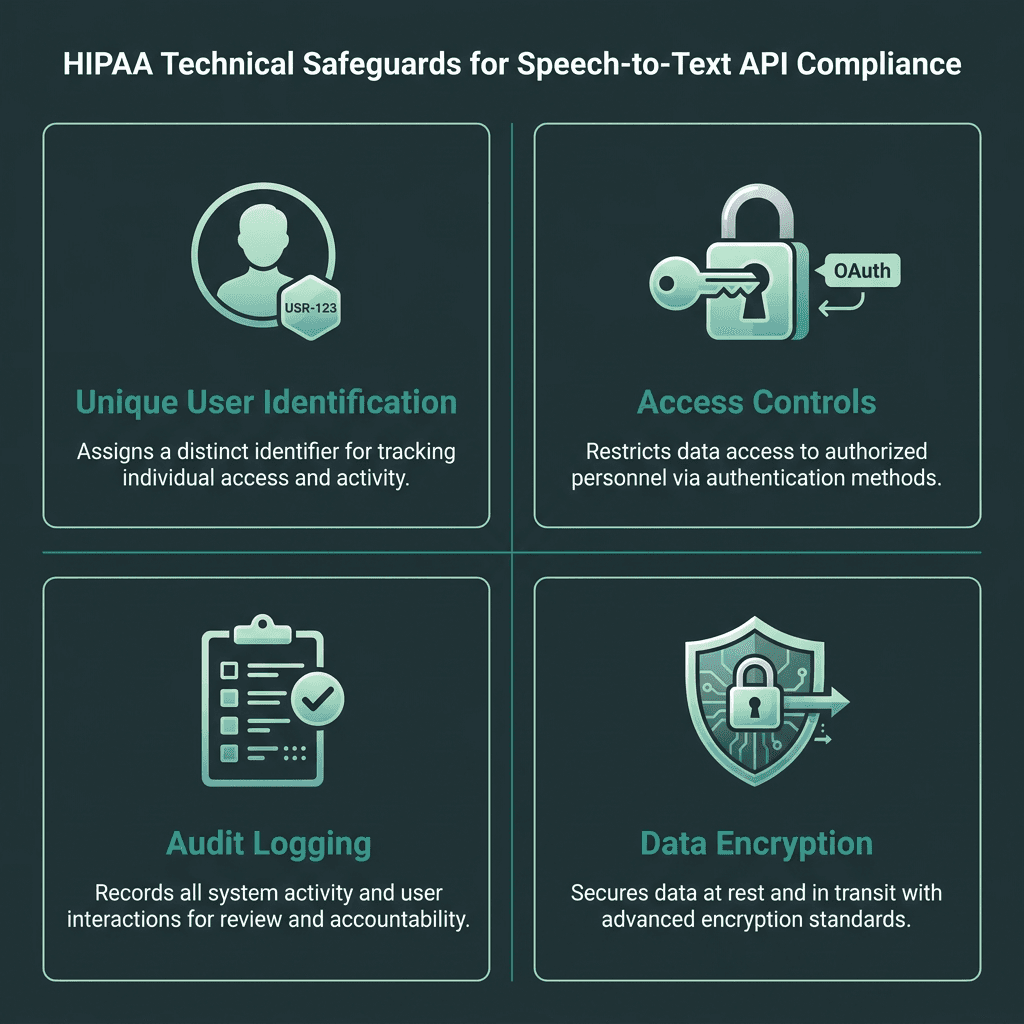
A graphic breaking down four key HIPAA technical safeguards for secure API integration.
Evaluation Criteria for This Comparison
Every platform in this comparison is assessed across six criteria, with a focus on speech-to-text AI performance:
HIPAA compliance: Does the vendor sign a Business Associate Agreement (BAA)? Is e-PHI handling documented?
SOC 2 certification: Type I or Type II? What trust service criteria are covered?
Data retention and deletion: How long is audio and transcript data stored? Can it be purged on request?
Encryption standards: Is data encrypted in transit (TLS 1.2+) and at rest (AES-256)?
Access controls and audit logs: Role-based access, API key scoping, and activity logging.
Enterprise pricing and support: SLA guarantees, dedicated support tiers, and contract flexibility.
Smallest.ai Pulse: Built for Compliance-First Deployments
Smallest.ai's Speech-to-Text API, Pulse, is built for production environments where latency and governance aren’t negotiable. Plenty of transcription vendors bolt compliance onto an “enterprise” tier; Pulse treats it as part of the base architecture, with security controls designed into the infrastructure. It supports BAA execution for HIPAA-covered entities, holds SOC 2 Type II certification, and uses AES-256 encryption at rest with TLS 1.3 in transit. Audio data is not retained for model training by default, which is exactly the kind of detail that decides whether a healthcare or legal deployment is viable. This approach is central to modern AI voice agent architectures.
Pulse’s enterprise story is also about time, not just policy. For voice agents and real-time clinical documentation, slow transcription isn’t a minor UX flaw; it changes how people work. Pulse targets low-latency real-time transcription performance, making it a credible option for best speech-to-text APIs for voice agents in contact centers and telehealth. This level of fast AI speech recognition is critical for live interactions. Pricing is consumption-based, with enterprise contracts available when procurement needs the usual paperwork and SLAs. If you’re evaluating Pulse for a regulated workload, you can book a demo and review the compliance documentation directly with the team.
Pulse compliance highlights:
BAA available for HIPAA-covered entities
SOC 2 Type II certified
No audio retention for model training by default
TLS 1.3 in transit, AES-256 at rest
Role-based access controls and API key scoping
Deepgram: Enterprise STT Compliance Positioning
Deepgram is positioned primarily around enterprise speech-recognition deployments. Its compliance positioning is oriented toward enterprise procurement environments. It has SOC 2 Type II certification, will sign BAAs for HIPAA use cases, and offers on-premises deployment for organizations that can’t ship audio to a third-party cloud. On-premises deployment is often required in air-gapped or tightly controlled environments. For a direct comparison, see the real-time speech-to-text showdown.
Deepgram positions Nova-3 around enterprise transcription workflows involving multi-speaker or operational audio. Enterprise pricing and deployment terms are typically handled through custom agreements. The enterprise compliance workflow is generally structured around sales-led procurement.
AssemblyAI: Transcript Processing and Compliance Controls
AssemblyAI focuses heavily on developer-oriented transcript processing workflows. It’s SOC 2 Type II certified and supports HIPAA-compliant processing, with BAA availability on enterprise plans. For regulated workloads, a compliance-oriented feature is built-in PII redaction that can remove sensitive identifiers from transcripts before they’re stored or returned. That reduces the amount of additional application-layer handling required for any audio-to-text API.
Deletion controls are exposed through API-level workflows, so developers can purge audio and transcripts programmatically. Advanced compliance and transcript-intelligence features are generally bundled into higher-tier enterprise workflows. Additional AI-processing features are generally layered separately from baseline transcription infrastructure.
OpenAI Whisper API: Multilingual Transcription with Additional Governance Requirements
Whisper is commonly associated with multilingual transcription workflows, but “good transcription” isn’t the same thing as “easy to approve.” OpenAI offers a HIPAA-eligible configuration via its enterprise tier, yet BAA availability isn’t a default across plans and typically requires an enterprise agreement. OpenAI also has SOC 2 Type II at the organizational level, but the Whisper API’s endpoint-specific data handling commitments are less explicit than what you’ll see from vendors that sell transcription as their core regulated product.
If you self-host the open-source Whisper model, your compliance posture becomes your responsibility end to end, which keeps governance responsibility inside the organization. Hosted deployment models vary depending on enterprise requirements and data governance needs. The operational challenge is reduced clarity around endpoint-level governance guarantees. Without clear, endpoint-level guarantees, it’s a tougher pitch to a hospital CIO or a financial services compliance officer unless you’re prepared for extra diligence. For internal tools where PHI isn’t in scope, it is more commonly used in lower-governance or internal transcription workflows.
ElevenLabs: Limited Compliance Positioning for STT Workloads
ElevenLabs is best known for text-to-speech and voice agents, but its enterprise documentation now references HIPAA-eligible configurations when Zero Retention Mode is enabled and a Business Associate Agreement is in place. For regulated STT workloads, buyers should still confirm whether the exact transcription endpoints, account configuration, retention settings, and BAA scope cover their intended PHI workflow before deployment.
Cartesia: Limited Compliance Documentation for Regulated STT Workloads
Cartesia has expanded beyond voice synthesis and now documents real-time and batch speech-to-text APIs. Its enterprise Zero Data Retention documentation says STT audio input and transcript output are not retained when ZDR is enabled. Because its STT offering is newer than its Sonic TTS positioning, regulated buyers should verify BAA coverage, Trust Center documentation, endpoint scope, and retention settings during procurement.
Head-to-Head Compliance Comparison
Provider | HIPAA BAA | SOC 2 Type II | Data Retention Control | PII Redaction | On-Premises Option | Enterprise Compliance Constraints |
|---|---|---|---|---|---|---|
Smallest.ai Pulse | Yes | Yes | No retention by default | Yes | Contact sales | Designed for regulated enterprise deployments with integrated governance controls. |
Deepgram | Yes (Enterprise) | Yes | Configurable | Yes | Yes | Enterprise procurement typically required for full compliance workflows. |
AssemblyAI | Yes (Enterprise) | Yes | API-level deletion | Yes (built-in) | Yes | Advanced transcript-processing workflows layered separately from baseline STT. |
OpenAI API / Whisper | Available for eligible customers | API Platform SOC 2 Type 2 | API data may be retained up to 30 days unless eligible ZDR/endpoint terms apply | No (native) | Open-source only | Additional governance review typically required. |
ElevenLabs | Limited public documentation | Yes | Zero Retention mode | No | No | Public HIPAA documentation for regulated STT workloads remains limited. |
Cartesia | Yes | Public documentation limited | Not documented | No | No | Public compliance documentation for regulated STT deployments remains limited. |
Enterprise Governance Tradeoffs Across Speech-to-Text APIs
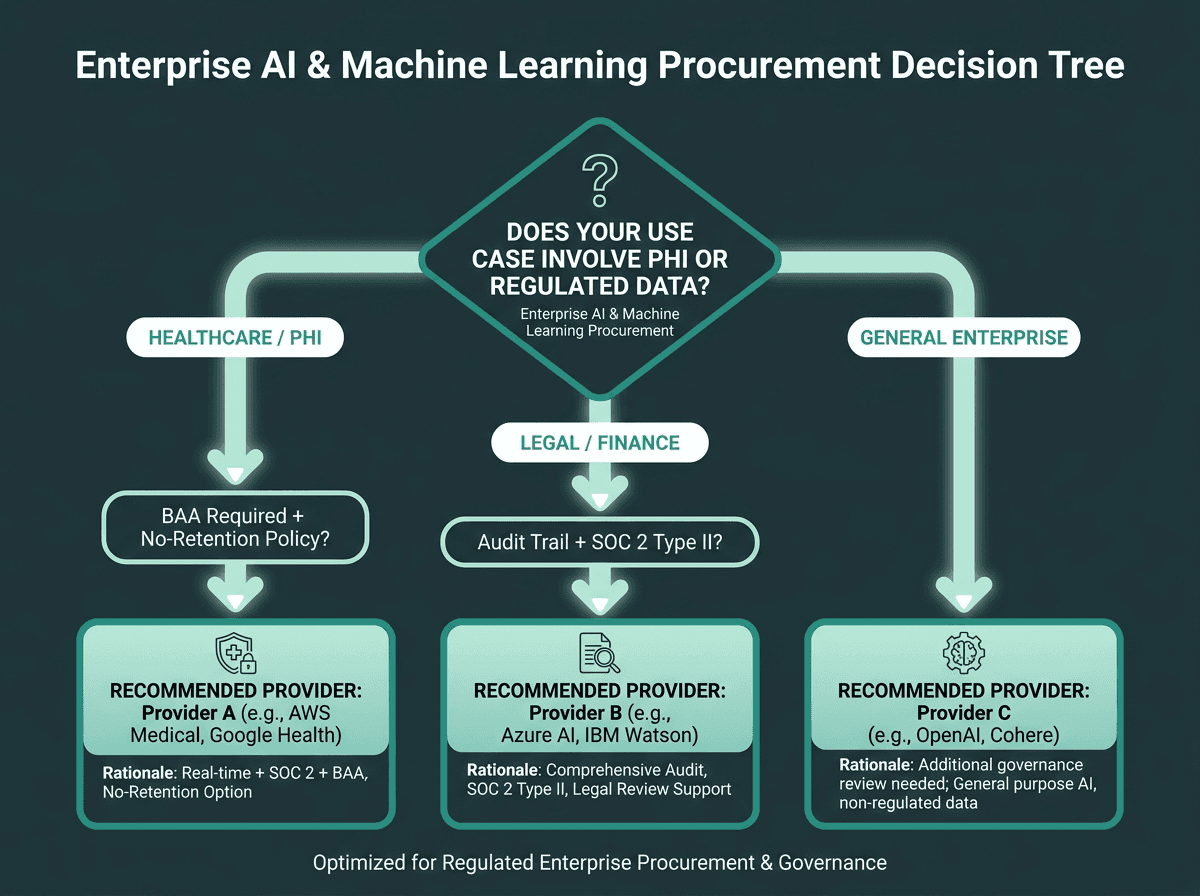
A procurement flowchart matching compliance needs to the appropriate speech-to-text API vendor.
Enterprise governance requirements vary significantly across speech-to-text vendors, especially around retention controls, BAA execution, and deployment flexibility. In regulated industries, those differences often determine whether a platform survives procurement review. Whisper typically requires additional governance review for regulated deployments involving PHI or sensitive enterprise data.
Smallest.ai Pulse combines governance controls and real-time transcription performance in a single production-oriented platform. No-retention-by-default audio handling, SOC 2 Type II, BAA availability, and low-latency real-time AI transcription rarely show up together in one offering. For AI transcription in legal and compliance teams, where auditability and speed both matter, Pulse combines real-time transcription performance with governance controls designed for regulated enterprise deployments. Public compliance documentation for ElevenLabs and Cartesia remains less mature for regulated STT procurement workflows in 2026.
The Problem This Comparison Solves
Enterprise buyers don’t struggle to find a speech-to-text API that transcribes audio. The hard part is finding one that transcribes well and passes security review, signs a BAA, doesn’t retain audio for model training, and still hits the latency target your product requires. A lot of comparisons stop at badge-spotting; the gaps show up later, when legal asks for contract language or security asks for retention guarantees. Smallest.ai Pulse is built for that intersection: production-grade transcription, real-time latency for voice agent deployments, and a compliance posture designed to stand up to procurement scrutiny. If you’re evaluating speech-to-text APIs for a regulated environment, book a demo to review the compliance documentation and run a latency benchmark on your own audio.
Frequently asked questions
What does a Business Associate Agreement (BAA) mean for a speech-to-text API?
Is SOC 2 Type I or Type II more important for enterprise procurement?
Can a speech-to-text API retain my audio data for model training without my knowledge?
What encryption standards should a compliant speech-to-text API use?
How do I evaluate a speech-to-text API for compliance if I am not a security expert?