AI Transcription for Legal and Compliance Teams: Accuracy, Security, and Audit Trails

AI transcription for legal teams, with a clear checklist for accuracy testing, security controls, consent, and audit trails that stand up to scrutiny.
For legal teams, AI transcription has moved past the “nice-to-have” phase. It’s starting to look a lot more like infrastructure. Depositions, client calls, regulatory hearings, internal investigations, compliance reviews: all of it produces audio that needs to be captured, checked, and stored in a way that survives scrutiny. The real decision point isn’t whether you’ll use AI transcription; it’s whether you can do it without introducing a new class of liability.
Legal teams are adopting AI transcription at a significant pace, driven by the volume of audio that compliance, litigation, and advisory work generates. That trajectory reflects real uptake, not a passing trend. Still, legal work has constraints that general-purpose transcription products weren’t built around. What matters is what AI transcription is and how it works in practice for legal teams: what “accuracy” means when transcripts touch compliance and proceedings, what security has to look like when privilege is on the line, and what qualifies as an audit trail you can actually defend.
Why Legal Transcription Has Different Stakes
If a podcast transcript drops a word, it’s annoying. If a deposition transcript, recorded client advisory, or regulatory compliance call drops a word, it can become a problem with real consequences. Legal professionals also don’t get to treat tooling as someone else’s responsibility; ethical duties attach to the systems that touch client information. The American Bar Association's Formal Opinion 512 (2024) is blunt on this point: competence, confidentiality, and supervision apply to AI tool usage, so attorneys can’t outsource accountability to a vendor and call it done.
Consent is another tripwire, and it’s easy to miss when transcription is bundled into “meeting tools.” In many U.S. states, wiretap laws require all-party consent before recording, which creates exposure for any AI transcription workflow that records by default without explicit participant acknowledgment. Adoption is moving quickly across legal markets; governance often isn't keeping pace.
What Accuracy Actually Means in a Legal Context
Word Error Rate (WER) is the default yardstick for transcription accuracy, and modern systems can post great numbers in lab-like conditions. Legal audio rarely cooperates. Depositions bring interruptions and cross-talk. Compliance calls are dense with domain vocabulary, acronyms, and proper nouns that a general model may barely recognize. Add accented speech, phone compression, and courtroom noise, and the performance you saw in a benchmark can slip in exactly the places that matter.
For legal use, “WER on clean audio” is basically trivia. What you need is performance on your own audio profile: the accents common in your jurisdiction, the terminology in your practice area, and the minimum quality your recording setup produces on a bad day. The best speech-to-text AI on a generic leaderboard may still be the wrong fit for a securities litigation team working through recorded trader calls. Domain adaptation, speaker diarization quality, and confidence scoring are the measurements that map to defensibility, not marketing-grade averages. Smallest.ai's speech-to-text platform is built for these high-stakes environments.
Speaker diarization is the quiet failure mode that deserves its own line item. A transcript can capture every word and still be unusable if it assigns those words to the wrong person. In a proceeding, that’s not just “inaccurate”; it can be actively misleading. NIST has run systematic speaker recognition evaluations that establish baseline benchmarks for this capability, and legal teams should press vendors on how diarization behaves with overlapping speech and multi-speaker recordings. If the answer is hand-wavy, treat that as a data point.
Security Architecture That Legal Teams Can Actually Defend
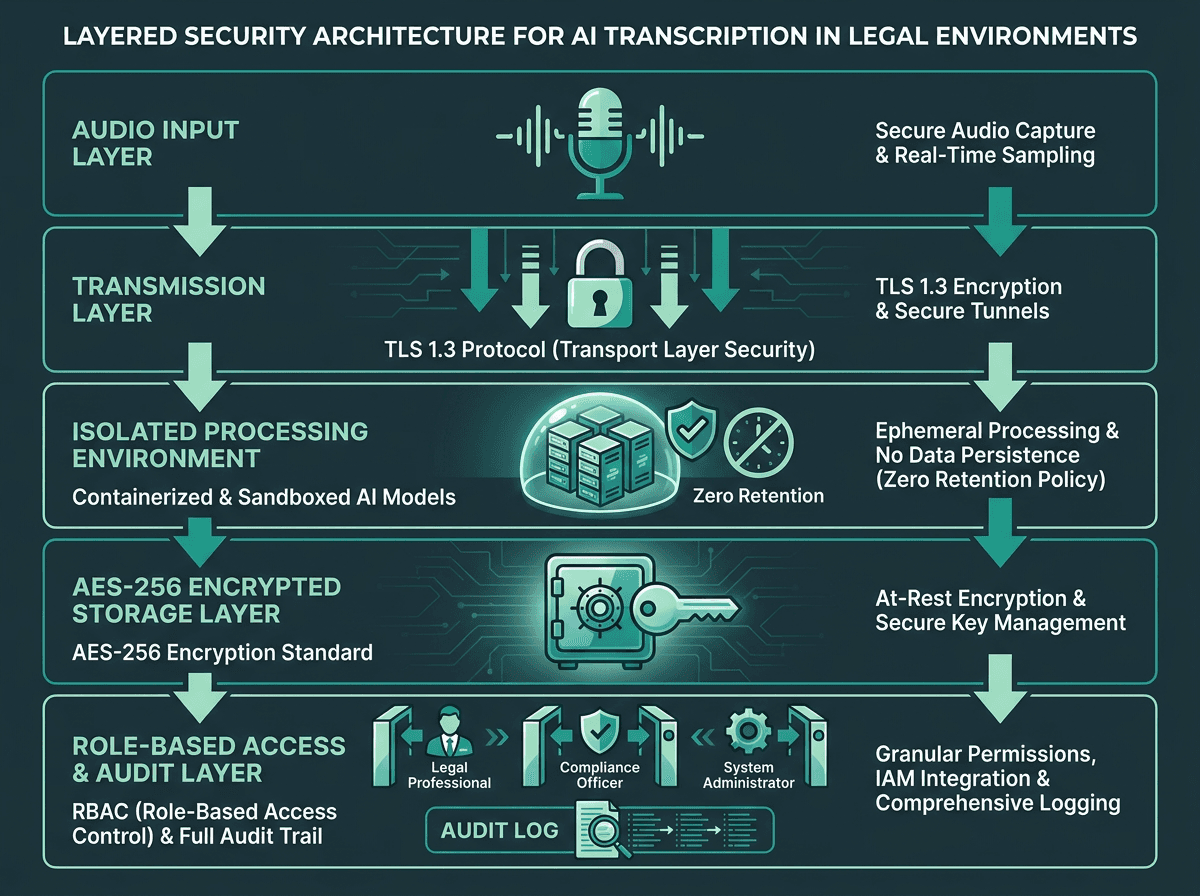
A defensible security architecture for legal AI transcription requires isolation, encryption, and access controls at every layer.
Security in legal transcription isn’t something you “check off.” It’s a design problem. The concerns usually fall into three buckets: data in transit, data at rest, and data access. The details vary by jurisdiction and regulatory regime, but the baseline expectations are consistent.
Security requirements legal teams should verify before deploying any AI transcription tool:
End-to-end encryption in transit: Use TLS 1.2 minimum, with TLS 1.3 preferred. Audio files containing privileged communications should never be transmitted over unencrypted channels. Audio files containing privileged communications must never travel unencrypted.
Encryption at rest: AES-256 for stored transcripts and audio files. Confirm whether encryption keys are managed by the vendor or customer-controlled.
Data residency controls: Confirm where processing occurs and where data is stored. Cross-border data transfers can trigger GDPR, CCPA, or sector-specific obligations.
Zero data retention options: Many legal use cases require that audio and transcripts are deleted after processing, not retained for model training. Verify this is contractually guaranteed.
Role-based access control: Transcripts of privileged communications should be accessible only to authorized personnel, with access logged.
Business Associate Agreements or Data Processing Agreements: Standard for any vendor handling regulated data. If a vendor resists signing one, that is a disqualifying signal.
Model training is where risk tends to get underestimated, because it’s often buried in “service improvement” language. Many transcription services upgrade their models by processing customer audio. For legal teams, that’s a non-starter. Client communications, witness statements, and internal compliance discussions can’t quietly become input for a vendor’s next release. Read the terms of service closely, and if the data-use language is fuzzy, get written clarification before you sign. It also helps to understand how vendors frame regulated data more broadly, including HIPAA and GDPR compliance.
Building Audit Trails That Hold Up
An audit trail is a chronological record of activities affecting a specific operation or event. In security and legal settings, that record is what lets you reconstruct what happened end-to-end: what was said, when it was processed, who touched it, and whether anything changed along the way.
Most transcription products will hand you text. Far fewer will give you a transcript with a chain of custody you can defend. That gap is huge. A legal-grade audit trail for AI transcription should include the original audio file plus a cryptographic hash at ingestion, the processing timestamp, the model version used, any human review or correction events (with reviewer identity and timestamps), and access events showing who viewed or exported the record. Without that metadata, you’re left with a document whose provenance is hard to prove.
Then there’s immutability. If a log can be edited after the fact, it’s not really an audit trail; it’s just another document. Defensible systems use append-only logging so entries can’t be altered once written. Some enterprise setups add cryptographic chaining (conceptually similar to blockchain ledger entries) so tampering becomes mathematically obvious. In high-stakes compliance environments, it’s worth asking vendors directly how they handle this.
Practical Implementation: From Pilot to Production
Rolling AI transcription into a legal workflow is rarely blocked by model quality. The tooling is mature. The hard part is the governance layer you wrap around it, and that’s where deployments tend to break down.
Run a scoped pilot around one use case, and pick something with real-world complexity but not maximum exposure. Internal compliance call transcription is a solid starting point: you get real audio, real vocabulary, multi-speaker dynamics, and meaningful sensitivity requirements, without immediately touching client-facing or court-related recordings. Use that pilot to measure baseline accuracy on your own audio rather than vendor benchmark clips. Before you scale, make sure you can evaluate a voice agent's accuracy against the conditions you actually operate in.
Moving from pilot to production is mostly a gating exercise. You need three pieces in place before expanding scope: (1) a documented consent protocol that satisfies all-party consent rules in every jurisdiction where you operate; (2) a data-handling policy that spells out retention periods, deletion procedures, and access controls for both audio and transcripts; and (3) a human review workflow for any transcript that could end up in a formal proceeding. AI transcription doesn’t replace certified court reporters where certification is legally required. Used correctly, it speeds review, surfaces discrepancies, and reduces the manual load on human reviewers.
What Most Teams Get Wrong About Compliance Readiness
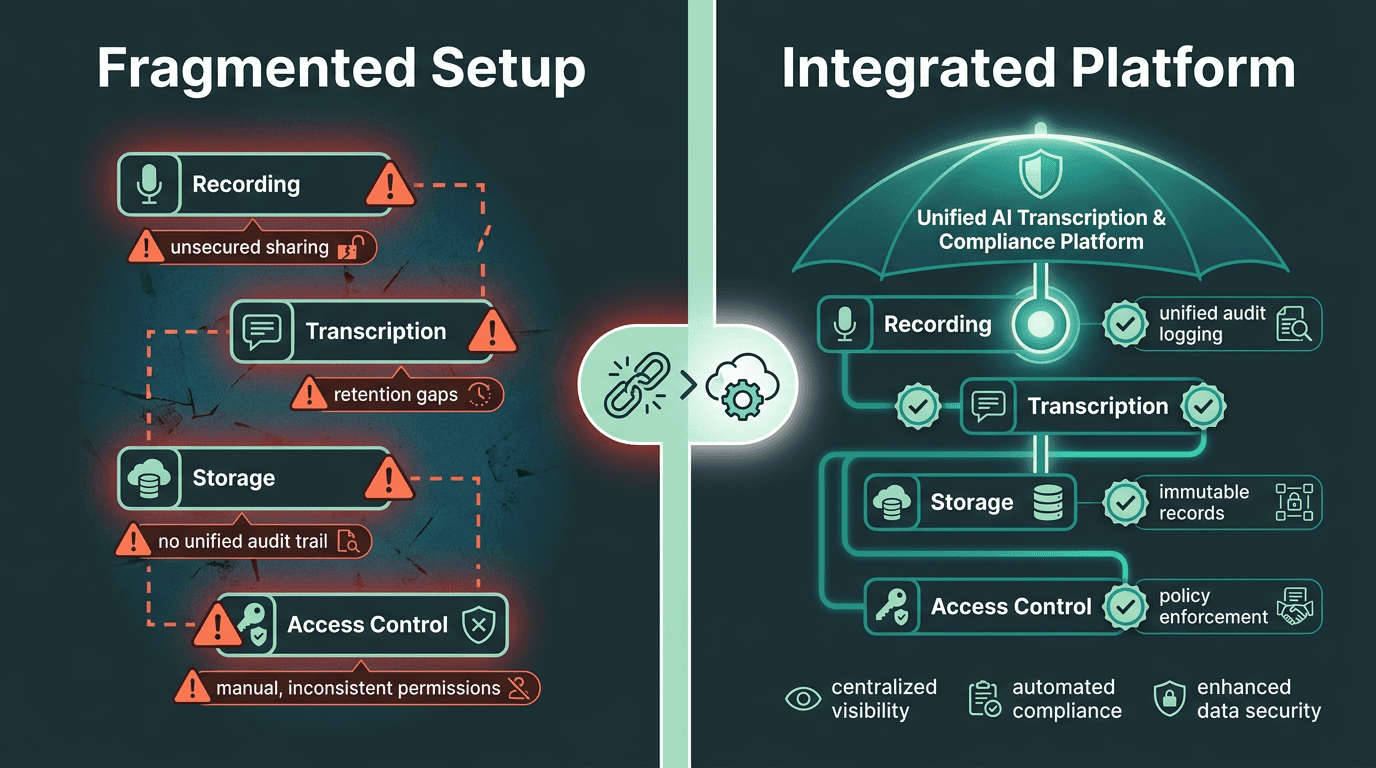
Fragmented tool stacks create compliance gaps. Integrated platforms with unified audit logging are significantly easier to defend.
The most common failure is treating compliance as something the vendor “handles.” A provider can bring SOC 2 Type II, GDPR-aligned processing, and immutable logs. None of that saves you if transcripts get shared over an unsecured channel, audio sits around longer than policy allows, or the team forgets to obtain consent before recording. Compliance posture is shared, and the weak link is usually operational.
The next mistake is confusing accuracy with reliability. A system that averages 95% accuracy can still drop to 80% on the recordings you care about most: the messy ones with poor audio, lots of speakers, and dense terminology. Reliability is about how the system behaves in worst-case conditions, not how it performs on a clean sample. When evaluating top speech-to-text transcription software, test with your hardest clips first, not your easiest.
Formal Opinion 512 also highlights a supervision duty that’s easy to ignore when a tool feels authoritative: attorneys must understand AI tools well enough to supervise their output. Treating AI transcription as a black box that produces “the record” is both ethically risky and operationally sloppy. In most legal workflows, the transcript is a draft, and the amount of human review should scale with the stakes.
Summary and Next Steps
AI transcription can deliver real value for legal and compliance teams: faster review cycles, searchable records, and less manual work. Those benefits show up only when the surrounding controls are solid. Validate accuracy on your own audio rather than vendor benchmarks. Verify security in contracts and architecture, not in marketing language. Require audit trails that are complete, immutable, and tied to a chain of custody you can defend under pressure.
Actionable next steps for legal and compliance teams:
Audit your current recording and transcription workflow for consent compliance in every jurisdiction you operate in.
Request a vendor's data processing agreement and confirm zero-retention options before any pilot begins.
Run accuracy tests on your hardest audio samples, multi-speaker, low-quality, domain-specific, before committing to a platform.
Define your audit trail requirements in writing and verify the vendor can meet them technically, not just contractually.
Establish a human review protocol before using any AI transcript in a formal proceeding.
Legal and compliance teams don’t lack transcription options; they lack options that clear the accuracy, security, and auditability bar without turning implementation into an engineering project. Smallest.ai's Pulse speech-to-text platform is positioned for that kind of high-stakes deployment: strong accuracy on domain-specific audio, security architecture built for regulated environments, and a transparent processing pipeline that makes audit trail construction manageable. If you’re comparing vendors and trying to move past general-purpose tools, Pulse is worth serious evaluation. If you already know the market leaders, it’s also useful to see Smallest.ai framed as an alternative to other transcription providers.
Frequently asked questions
Is AI transcription admissible as evidence in legal proceedings?
What should I look for in a speech-to-text platform for compliance use cases?
How does all-party consent work when using AI transcription tools?
What is the difference between a transcript and a legally defensible audit trail?
Can AI transcription tools be used for HIPAA or GDPR-regulated content?