Blogs

/

Top Vogent AI Alternative for 2025: Why Smallest AI Stands Out

Top 16+ RPA Use Cases Transforming the Banking Industry

Boost banking operations with RPA use cases. Enhance KYC automation, streamline loan processing, ensure compliance, and improve customer service. Explore now!

Prithvi Bharadwaj

Updated on

January 13, 2026 at 8:06 AM

Top 16+ RPA Use Cases Transforming the Banking Industry

Why are banks accelerating their shift toward automation? With mounting pressure to operate faster, reduce costs, and meet strict regulatory demands, industry data shows that 36% of tasks in banking and capital markets can be automated. In comparison, 79% of financial institutions report measurable time savings after implementing RPA, driving continued investment across financial services.

Despite ongoing digital initiatives, many core processes, such as onboarding, compliance checks, transaction processing, and reporting, still rely on manual work, resulting in delays, errors, and scalability challenges.

Robotic Process Automation (RPA) addresses these gaps by using software bots to automate rules-based tasks like data entry, reconciliation, loan processing, and regulatory reporting, improving efficiency, strengthening compliance, and delivering faster, more consistent customer experiences.

Key Highlights


  • RPA automates onboarding, KYC, loans, payments, and reconciliations, reducing processing time and errors.

  • Automated AML checks, regulatory reporting, and audit logs ensure consistent compliance.

  • Banks reduce operational costs and handle peak workloads without increasing headcount.

  • Faster approvals, fewer delays, and automated support lead to more reliable service.

  • Smallest.ai connects voice interactions to RPA workflows, enabling automated calls, reminders, and real-time backend actions.

What Is RPA (Robotic Process Automation) in Banking

Robotic Process Automation (RPA) is a technology that uses software bots to replicate human actions when interacting with digital systems. In banking, these bots log into applications, enter and extract data, validate information, trigger workflows, and generate reports, just as an employee would, but faster and without fatigue. RPA works on top of existing banking systems, which means banks can automate processes without replacing their core infrastructure.

Why RPA Is Essential in Financial Services

Banking operations are highly process-driven, rule-based, and compliance-heavy, making them ideal for RPA. Financial institutions handle large transaction volumes, strict regulatory requirements, and time-sensitive customer requests. RPA helps banks:

  • Reduce operational costs by minimizing manual effort

  • Improve accuracy and consistency in critical processes

  • Strengthen compliance through standardized execution and audit trails

  • Scale operations quickly during peak demand without adding headcount

By automating repetitive tasks, banks can redirect human teams toward higher-value activities such as risk analysis, customer relationship management, and strategic decision-making.

How RPA Differs from Traditional Automation

Traditional automation typically requires deep system integration, custom coding, and changes to underlying applications. RPA, on the other hand, operates at the user interface level and interacts with systems the same way a human user does. This makes RPA:

  • Faster to deploy

  • Less disruptive to legacy systems

  • More flexible when processes or regulations change

While traditional automation focuses on system-to-system integration, RPA focuses on process execution across multiple systems, making it especially effective in complex banking environments where legacy platforms are still in use.

Why Banks Are Investing in RPA
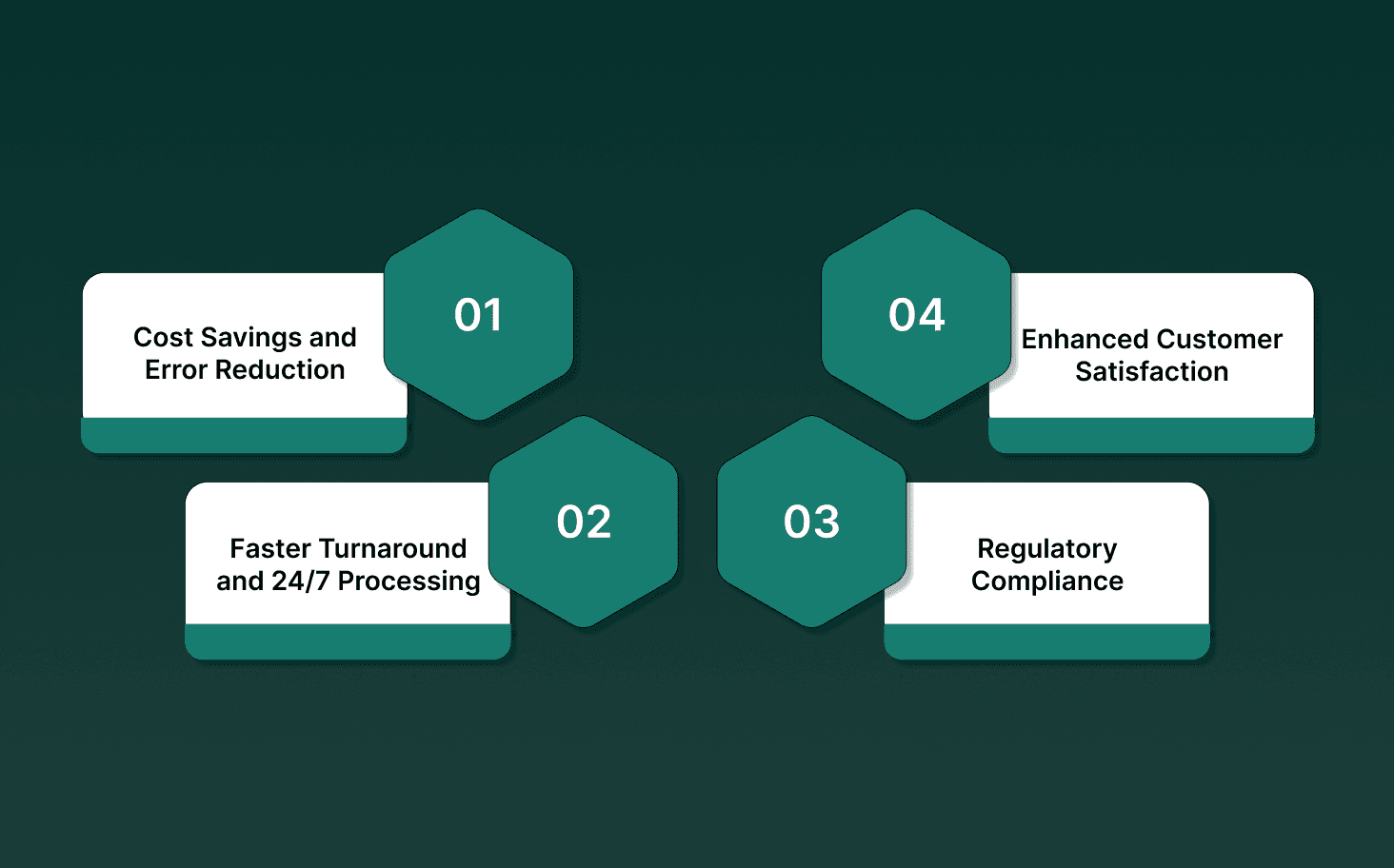

Why Banks Are Investing in RPA

Banks are adopting RPA to improve efficiency, reduce risk, and deliver faster customer experiences, without overhauling existing systems.

  • Cost Savings and Error Reduction: RPA automates repetitive, rules-based tasks with consistent accuracy, reducing manual effort, operational costs, and human errors that lead to rework and delays.

  • Faster Turnaround and 24/7 Processing: Software bots operate continuously, enabling round-the-clock processing of transactions, applications, and reports. This significantly shortens turnaround times and improves operational responsiveness.

  • Regulatory Compliance and Audit Readiness: RPA enforces standardized execution and maintains detailed activity logs, helping banks meet regulatory requirements and prepare audits with greater speed and transparency.

  • Enhanced Customer Satisfaction: By accelerating processes and reducing errors, RPA enables faster service delivery, from account setup to loan approvals, resulting in more reliable and consistent customer experiences.

Also read: Call Center Automation for Improved Customer Satisfaction: Strategies & Tools.

Top 16+ RPA Use Cases in Banking
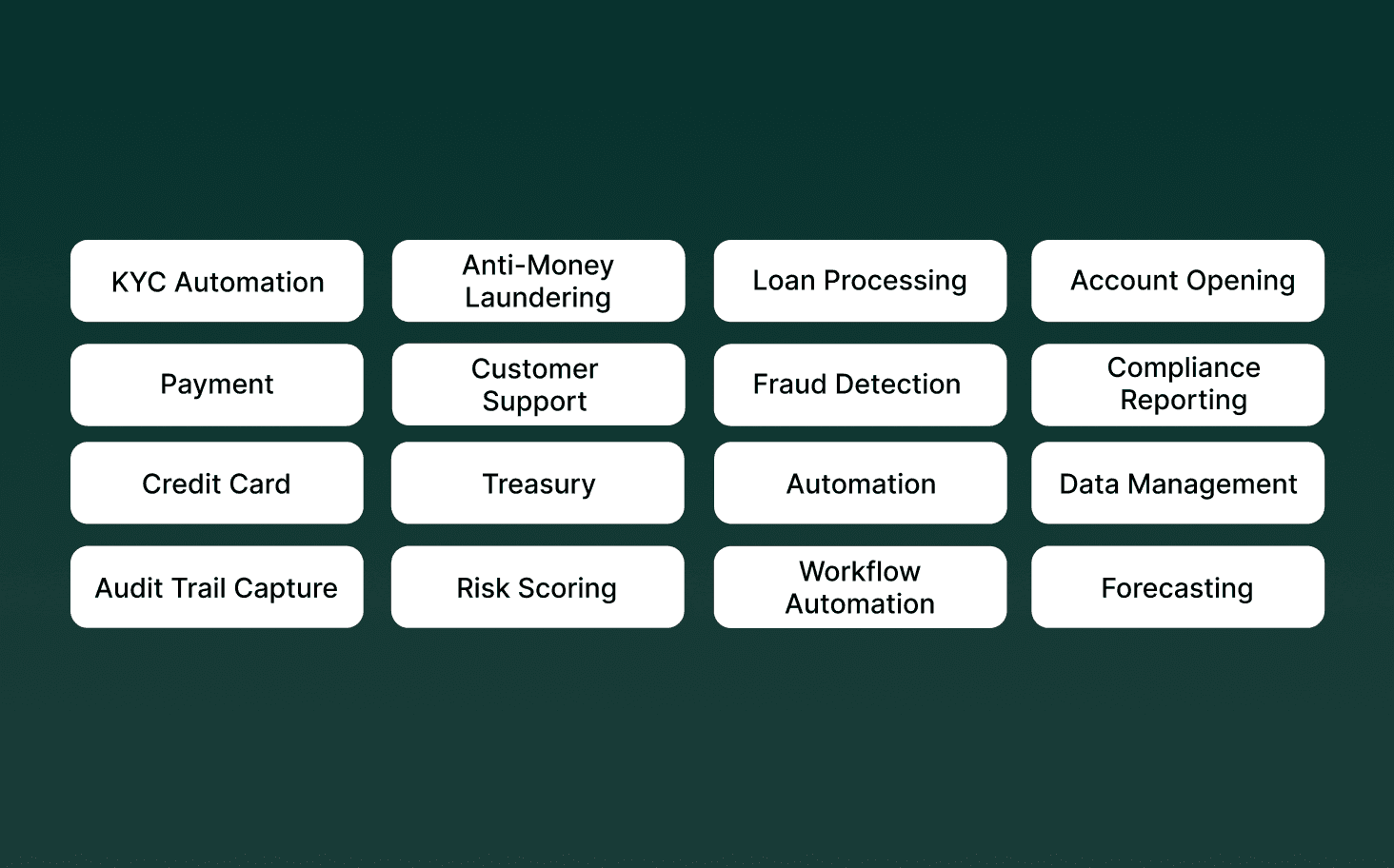

Top 16+ RPA Use Cases in Banking

Robotic Process Automation (RPA) is transforming how banks operate by automating high-volume, rule-based tasks across core functions. Below are thehat are driving efficiency, accuracy, and scalability in modern banking.

1. Customer Onboarding & KYC Automation

Customer onboarding is the first major interaction a customer has with a bank, and delays at this stage directly impact conversion and trust. RPA helps banks accelerate onboarding while ensuring regulatory compliance.

  • Automating Identity Verification: Identity verification involves multiple checks across documents, databases, and regulatory systems. RPA bots automate data extraction, validation, and cross-verification, ensuring KYC rules are applied consistently while reducing manual effort and errors.

  • Reducing Time for New Customer Setup: Account setup often requires repetitive data entry across several banking systems. RPA automates these steps, enabling faster account creation, quicker service activation, and a smoother onboarding experience with minimal customer drop-off.

2. Anti-Money Laundering (AML) Monitoring

AML monitoring is a continuous and compliance-critical function for banks, requiring real-time visibility into transaction behavior. RPA helps standardize and scale AML operations without increasing manual workload.

  • Rule-Based Transaction Screening: RPA bots screen transactions against predefined AML rules and watchlists by automatically extracting, validating, and comparing data across systems. This ensures consistent application of compliance rules and reduces the reliance on manual reviews.

  • Auto-Flagging Suspicious Patterns: When transactions deviate from expected behavior or exceed defined thresholds, RPA automatically flags them for investigation. Bots can generate alerts, compile supporting data, and route cases to compliance teams, improving response speed and audit readiness.

3. Loan Processing & Approval

Loan processing involves multiple checks, documents, and decision points, making it one of the most automation-ready banking processes. RPA accelerates loan lifecycles while maintaining accuracy and control.

  • Extraction of Documents: RPA automates the extraction of data from loan applications and supporting documents, consolidating information into core systems. This reduces manual data entry and minimizes errors during document handling.

  • Automated Eligibility Checks: Bots apply predefined eligibility criteria, such as income thresholds, credit scores, and risk rules, to assess applications. This speeds up preliminary approvals and ensures consistent decision-making across loan portfolios.

4. Account Opening & Maintenance

Account management processes are high-volume and repetitive, often spanning multiple internal systems. RPA enables banks to manage these workflows efficiently and accurately.

  • Automated Form Processing: RPA bots capture and validate customer-submitted forms, automatically updating relevant systems. This eliminates manual handling and ensures faster account activation.

  • Ongoing Account Updates: From address changes to account status updates, RPA automates routine maintenance tasks. Bots ensure changes are reflected consistently across systems, reducing delays and data inconsistencies.

5. Payment & Reconciliation Automation

Payment processing and reconciliation are time-sensitive functions that demand high accuracy. RPA reduces operational strain by automating end-to-end reconciliation workflows.

  • Matching Transactions: RPA bots automatically match incoming and outgoing transactions across payment systems, ledgers, and statements. This improves accuracy and speeds up reconciliation cycles.

  • Reducing Manual Review: Exceptions and mismatches are automatically flagged for review, allowing teams to focus only on anomalies. This significantly cuts down manual effort while improving financial control and transparency.

6. Customer Support Automation

Customer support teams handle large volumes of repetitive inquiries that can slow response times and increase costs. RPA helps banks streamline support operations while maintaining service quality.

  • Chatbots and Ticket Routing: RPA works alongside chatbots to automatically log customer requests, categorize issues, and route tickets to the appropriate teams. This reduces response times and ensures queries are handled efficiently.

  • FAQs and Repetitive Inquiries: Routine questions related to balances, statements, or account status can be handled through automated workflows. RPA enables faster resolution of common inquiries, allowing support agents to focus on complex customer needs.

7. Fraud Detection and Alerts

Fraud detection requires constant monitoring and rapid response to minimize financial risk. RPA enhances fraud operations by automating detection and escalation processes.

  • Behavior-Based Pattern Recognition: RPA monitors transaction data and compares activity against predefined behavioral patterns. When anomalies are detected, bots trigger alerts based on established fraud rules.

  • Faster Investigation Workflows: Once suspicious activity is identified, RPA gathers relevant transaction details and routes cases to investigation teams. This reduces response time and improves fraud containment.

8. Compliance Reporting

Regulatory reporting is time-sensitive and highly structured, making it well-suited for automation. RPA helps banks meet reporting obligations with accuracy and consistency.

  • Generating Regulatory Reports Automatically: RPA bots collect data from multiple systems, compile it into required formats, and generate reports according to regulatory standards. This reduces manual effort and reporting errors.

  • Versioning and Audit Logs: Every automated action is logged, creating clear audit trails and report version histories. This improves transparency and simplifies both internal and external audits.

9. Credit Card Lifecycle Management

Credit card operations involve multiple stages, from application to dispute resolution. RPA helps banks manage this lifecycle efficiently at scale.

  • Application Processing and Dispute Management: RPA automates credit card application reviews, data validation, and dispute handling workflows. This speeds up approvals and ensures consistent handling of customer disputes.

10. Treasury & Liquidity Monitoring

Treasury operations require accurate, real-time financial visibility. RPA enables banks to automate monitoring and reporting across liquidity functions.

  • Daily Cash Balance Checks: RPA bots automatically retrieve and consolidate cash balances from multiple systems, ensuring up-to-date visibility into liquidity positions.

  • Automated Notifications: When predefined thresholds are breached, RPA triggers alerts and notifications for treasury teams. This supports faster decision-making and improved financial control.

11. Back-Office Process Automation

Back-office operations form the operational backbone of banks but are often highly manual and time-consuming. RPA helps eliminate inefficiencies and improve processing accuracy across internal workflows.

  • Document Processing: RPA automates the capture, classification, and routing of documents across banking systems. This reduces manual handling, speeds up processing, and ensures consistent data entry.

  • Batch Record Updates: Bots can execute bulk updates across multiple systems, such as customer records or transaction logs. This improves efficiency and ensures data consistency without manual intervention.

12. Data Cleansing & Data Management

Accurate data is essential for compliance, reporting, and decision-making. RPA supports data quality initiatives by automating standardization and maintenance tasks.

  • Standardizing Customer and Financial Data: RPA bots identify inconsistencies, duplicates, and missing information across datasets. They apply predefined rules to cleanse and standardize data, improving reliability across banking systems.

13. Audit Trail Capture

Audit readiness is critical in regulated financial environments. RPA strengthens audit processes by automatically recording operational activity.

  • Automatic Activity Logging: Every bot action is logged with timestamps and execution details, creating complete and traceable audit trails. This improves transparency and simplifies regulatory and internal audits.

14. Risk Scoring & Alerts

Risk assessment relies on consistent evaluation of customer and transaction data. RPA enables faster and more standardized risk analysis.

  • Integrating Rule-Based Scoring Systems: RPA automates the application of predefined risk scoring models and triggers alerts when thresholds are exceeded. This ensures the timely identification of potential risks.

15. Collections Workflow Automation

Collections processes require timely follow-ups and consistent communication. RPA helps banks manage collections efficiently while maintaining compliance.

  • Follow-Up Reminders: RPA bots automatically schedule and send payment reminders based on predefined timelines, reducing manual tracking and delays.

  • Automated Letter or Call Triggers: When accounts reach specific delinquency stages, RPA triggers predefined communication actions such as letters or outbound calls, ensuring consistent and timely outreach.

16. Predictive Reporting & Forecasting

Banks are moving beyond reactive reporting toward data-driven decision-making. RPA plays a key role by automating data preparation for predictive insights.

  • Applying Predictive Analytics to RPA: RPA automates data collection and reporting workflows that feed predictive models, enabling faster forecasting and trend analysis. This bridges traditional RPA with AI-augmented intelligence for more proactive banking operations.

17. Voice-Enabled Process Automation

As customer interactions increasingly shift to voice channels, automation is extending beyond screens and forms. Voice-enabled RPA introduces conversational automation into banking workflows.

  • Using AI Voice Agents to Automate Spoken Workflows: AI voice agents can handle customer calls, verify information, trigger backend RPA processes, and provide real-time responses. This enables automated execution of voice-based tasks such as account inquiries and service requests.

  • Calls, Reminders, and Customer Inquiries: Voice-enabled automation supports outbound reminders, inbound support calls, and routine customer inquiries. When integrated with RPA, voice agents ensure spoken interactions directly trigger accurate backend actions, improving efficiency and customer experience.

Challenges and Impact of RPA in Banking

While RPA drives efficiency and accuracy in banking, implementing it comes with its own set of challenges. Understanding these hurdles is crucial to maximizing RPA’s impact on operations and customer experience.

Area

Challenge

Impact on Banking Operations

Legacy Systems

Older core banking platforms are not designed for automation, causing integration and stability issues.

Slower automation rollout and increased maintenance effort if not managed properly.

Change Management

Employee resistance and lack of automation readiness can hinder adoption.

Delayed ROI and underutilization of RPA capabilities.

Security & Governance

Inadequate bot access control and monitoring can create compliance risks.

Potential data exposure and regulatory penalties without strong governance frameworks.

Scaling Automation

Pilots succeed but fail to scale due to a lack of standards and oversight.

Fragmented automation initiatives and inconsistent business outcomes.

Process Complexity

Poorly defined or unstable processes are difficult to automate.

Reduced automation effectiveness and frequent bot failures.

Operational Impact

Managing bots alongside human workflows requires coordination.

When done right, enables faster processing, lower costs, and improved service quality.

How Smallest.ai Voice AI Enhances RPA in Banking

Smallest.ai is an enterprise Voice AI platform that extends RPA beyond backend workflows into real-time customer conversations. Its relevance to banking automation includes:

  • End-to-end Voice AI capabilities, including real-time voice agents, text-to-speech, speech-to-text, and voice cloning, enabling natural, human-like conversations at scale.

  • Real-time, low-latency interactions designed for live customer calls, making it suitable for high-volume banking and financial services use cases.

  • Multilingual support across 16+ languages, allowing banks to deliver localized customer experiences without expanding support teams.

  • Enterprise-grade security and compliance, including SOC 2, HIPAA, and PCI, align with the regulatory requirements of financial institutions.

  • Seamless integration with RPA and enterprise systems via APIs and telephony/CRM integrations, connecting voice interactions directly to automated backend workflows.

By combining RPA’s strength in rule-based process execution with Smallest.ai’s voice-driven interactions, banks can build a complete automation stack that connects customer conversations with automated action.

Conclusion

RPA has proven its value across banking operations, from onboarding and AML monitoring to loan processing, payments, compliance, and back-office functions. By automating repetitive, rules-based tasks, banks achieve faster processing, lower costs, improved accuracy, and stronger regulatory control.

The next stage of transformation lies in intelligent automation, where RPA combines with AI to create end-to-end, responsive workflows. Voice-enabled systems like Smallest.ai take this further by bringing automation into real-time customer conversations. Together, RPA and Voice AI help banks build scalable, customer-centric automation that goes beyond backend efficiency.

Book a demo with Smallest.ai to see it in action.

FAQ

1. Can RPA and Voice AI scale across large banking operations?
Yes. With proper architecture and governance, RPA and Voice AI can scale across departments and regions, supporting high transaction volumes and multilingual customer interactions.

2. How does RPA improve compliance in banking?
RPA enforces standardized process execution and maintains detailed audit logs for every action. This reduces human error, improves traceability, and simplifies regulatory audits.

3. Is RPA secure for financial institutions?
Yes. When implemented with proper governance, access controls, and monitoring, RPA operates within strict security frameworks and aligns with banking compliance requirements.

4. How is RPA different from AI in banking?
RPA automates rule-based tasks, while AI handles unstructured data and decision-making. Together, they form intelligent automation, enabling more advanced and adaptive banking workflows.

5. How does Voice AI complement RPA in banking?
Voice AI automates spoken customer interactions such as calls and inquiries, while RPA executes backend processes. Combined, they connect customer conversations directly to automated actions.


Why are banks accelerating their shift toward automation? With mounting pressure to operate faster, reduce costs, and meet strict regulatory demands, industry data shows that 36% of tasks in banking and capital markets can be automated. In comparison, 79% of financial institutions report measurable time savings after implementing RPA, driving continued investment across financial services.

Despite ongoing digital initiatives, many core processes, such as onboarding, compliance checks, transaction processing, and reporting, still rely on manual work, resulting in delays, errors, and scalability challenges.

Robotic Process Automation (RPA) addresses these gaps by using software bots to automate rules-based tasks like data entry, reconciliation, loan processing, and regulatory reporting, improving efficiency, strengthening compliance, and delivering faster, more consistent customer experiences.

Key Highlights


  • RPA automates onboarding, KYC, loans, payments, and reconciliations, reducing processing time and errors.

  • Automated AML checks, regulatory reporting, and audit logs ensure consistent compliance.

  • Banks reduce operational costs and handle peak workloads without increasing headcount.

  • Faster approvals, fewer delays, and automated support lead to more reliable service.

  • Smallest.ai connects voice interactions to RPA workflows, enabling automated calls, reminders, and real-time backend actions.

What Is RPA (Robotic Process Automation) in Banking

Robotic Process Automation (RPA) is a technology that uses software bots to replicate human actions when interacting with digital systems. In banking, these bots log into applications, enter and extract data, validate information, trigger workflows, and generate reports, just as an employee would, but faster and without fatigue. RPA works on top of existing banking systems, which means banks can automate processes without replacing their core infrastructure.

Why RPA Is Essential in Financial Services

Banking operations are highly process-driven, rule-based, and compliance-heavy, making them ideal for RPA. Financial institutions handle large transaction volumes, strict regulatory requirements, and time-sensitive customer requests. RPA helps banks:

  • Reduce operational costs by minimizing manual effort

  • Improve accuracy and consistency in critical processes

  • Strengthen compliance through standardized execution and audit trails

  • Scale operations quickly during peak demand without adding headcount

By automating repetitive tasks, banks can redirect human teams toward higher-value activities such as risk analysis, customer relationship management, and strategic decision-making.

How RPA Differs from Traditional Automation

Traditional automation typically requires deep system integration, custom coding, and changes to underlying applications. RPA, on the other hand, operates at the user interface level and interacts with systems the same way a human user does. This makes RPA:

  • Faster to deploy

  • Less disruptive to legacy systems

  • More flexible when processes or regulations change

While traditional automation focuses on system-to-system integration, RPA focuses on process execution across multiple systems, making it especially effective in complex banking environments where legacy platforms are still in use.

Why Banks Are Investing in RPA


Why Banks Are Investing in RPA

Banks are adopting RPA to improve efficiency, reduce risk, and deliver faster customer experiences, without overhauling existing systems.

  • Cost Savings and Error Reduction: RPA automates repetitive, rules-based tasks with consistent accuracy, reducing manual effort, operational costs, and human errors that lead to rework and delays.

  • Faster Turnaround and 24/7 Processing: Software bots operate continuously, enabling round-the-clock processing of transactions, applications, and reports. This significantly shortens turnaround times and improves operational responsiveness.

  • Regulatory Compliance and Audit Readiness: RPA enforces standardized execution and maintains detailed activity logs, helping banks meet regulatory requirements and prepare audits with greater speed and transparency.

  • Enhanced Customer Satisfaction: By accelerating processes and reducing errors, RPA enables faster service delivery, from account setup to loan approvals, resulting in more reliable and consistent customer experiences.

Also read: Call Center Automation for Improved Customer Satisfaction: Strategies & Tools.

Top 16+ RPA Use Cases in Banking


Top 16+ RPA Use Cases in Banking

Robotic Process Automation (RPA) is transforming how banks operate by automating high-volume, rule-based tasks across core functions. Below are thehat are driving efficiency, accuracy, and scalability in modern banking.

1. Customer Onboarding & KYC Automation

Customer onboarding is the first major interaction a customer has with a bank, and delays at this stage directly impact conversion and trust. RPA helps banks accelerate onboarding while ensuring regulatory compliance.

  • Automating Identity Verification: Identity verification involves multiple checks across documents, databases, and regulatory systems. RPA bots automate data extraction, validation, and cross-verification, ensuring KYC rules are applied consistently while reducing manual effort and errors.

  • Reducing Time for New Customer Setup: Account setup often requires repetitive data entry across several banking systems. RPA automates these steps, enabling faster account creation, quicker service activation, and a smoother onboarding experience with minimal customer drop-off.

2. Anti-Money Laundering (AML) Monitoring

AML monitoring is a continuous and compliance-critical function for banks, requiring real-time visibility into transaction behavior. RPA helps standardize and scale AML operations without increasing manual workload.

  • Rule-Based Transaction Screening: RPA bots screen transactions against predefined AML rules and watchlists by automatically extracting, validating, and comparing data across systems. This ensures consistent application of compliance rules and reduces the reliance on manual reviews.

  • Auto-Flagging Suspicious Patterns: When transactions deviate from expected behavior or exceed defined thresholds, RPA automatically flags them for investigation. Bots can generate alerts, compile supporting data, and route cases to compliance teams, improving response speed and audit readiness.

3. Loan Processing & Approval

Loan processing involves multiple checks, documents, and decision points, making it one of the most automation-ready banking processes. RPA accelerates loan lifecycles while maintaining accuracy and control.

  • Extraction of Documents: RPA automates the extraction of data from loan applications and supporting documents, consolidating information into core systems. This reduces manual data entry and minimizes errors during document handling.

  • Automated Eligibility Checks: Bots apply predefined eligibility criteria, such as income thresholds, credit scores, and risk rules, to assess applications. This speeds up preliminary approvals and ensures consistent decision-making across loan portfolios.

4. Account Opening & Maintenance

Account management processes are high-volume and repetitive, often spanning multiple internal systems. RPA enables banks to manage these workflows efficiently and accurately.

  • Automated Form Processing: RPA bots capture and validate customer-submitted forms, automatically updating relevant systems. This eliminates manual handling and ensures faster account activation.

  • Ongoing Account Updates: From address changes to account status updates, RPA automates routine maintenance tasks. Bots ensure changes are reflected consistently across systems, reducing delays and data inconsistencies.

5. Payment & Reconciliation Automation

Payment processing and reconciliation are time-sensitive functions that demand high accuracy. RPA reduces operational strain by automating end-to-end reconciliation workflows.

  • Matching Transactions: RPA bots automatically match incoming and outgoing transactions across payment systems, ledgers, and statements. This improves accuracy and speeds up reconciliation cycles.

  • Reducing Manual Review: Exceptions and mismatches are automatically flagged for review, allowing teams to focus only on anomalies. This significantly cuts down manual effort while improving financial control and transparency.

6. Customer Support Automation

Customer support teams handle large volumes of repetitive inquiries that can slow response times and increase costs. RPA helps banks streamline support operations while maintaining service quality.

  • Chatbots and Ticket Routing: RPA works alongside chatbots to automatically log customer requests, categorize issues, and route tickets to the appropriate teams. This reduces response times and ensures queries are handled efficiently.

  • FAQs and Repetitive Inquiries: Routine questions related to balances, statements, or account status can be handled through automated workflows. RPA enables faster resolution of common inquiries, allowing support agents to focus on complex customer needs.

7. Fraud Detection and Alerts

Fraud detection requires constant monitoring and rapid response to minimize financial risk. RPA enhances fraud operations by automating detection and escalation processes.

  • Behavior-Based Pattern Recognition: RPA monitors transaction data and compares activity against predefined behavioral patterns. When anomalies are detected, bots trigger alerts based on established fraud rules.

  • Faster Investigation Workflows: Once suspicious activity is identified, RPA gathers relevant transaction details and routes cases to investigation teams. This reduces response time and improves fraud containment.

8. Compliance Reporting

Regulatory reporting is time-sensitive and highly structured, making it well-suited for automation. RPA helps banks meet reporting obligations with accuracy and consistency.

  • Generating Regulatory Reports Automatically: RPA bots collect data from multiple systems, compile it into required formats, and generate reports according to regulatory standards. This reduces manual effort and reporting errors.

  • Versioning and Audit Logs: Every automated action is logged, creating clear audit trails and report version histories. This improves transparency and simplifies both internal and external audits.

9. Credit Card Lifecycle Management

Credit card operations involve multiple stages, from application to dispute resolution. RPA helps banks manage this lifecycle efficiently at scale.

  • Application Processing and Dispute Management: RPA automates credit card application reviews, data validation, and dispute handling workflows. This speeds up approvals and ensures consistent handling of customer disputes.

10. Treasury & Liquidity Monitoring

Treasury operations require accurate, real-time financial visibility. RPA enables banks to automate monitoring and reporting across liquidity functions.

  • Daily Cash Balance Checks: RPA bots automatically retrieve and consolidate cash balances from multiple systems, ensuring up-to-date visibility into liquidity positions.

  • Automated Notifications: When predefined thresholds are breached, RPA triggers alerts and notifications for treasury teams. This supports faster decision-making and improved financial control.

11. Back-Office Process Automation

Back-office operations form the operational backbone of banks but are often highly manual and time-consuming. RPA helps eliminate inefficiencies and improve processing accuracy across internal workflows.

  • Document Processing: RPA automates the capture, classification, and routing of documents across banking systems. This reduces manual handling, speeds up processing, and ensures consistent data entry.

  • Batch Record Updates: Bots can execute bulk updates across multiple systems, such as customer records or transaction logs. This improves efficiency and ensures data consistency without manual intervention.

12. Data Cleansing & Data Management

Accurate data is essential for compliance, reporting, and decision-making. RPA supports data quality initiatives by automating standardization and maintenance tasks.

  • Standardizing Customer and Financial Data: RPA bots identify inconsistencies, duplicates, and missing information across datasets. They apply predefined rules to cleanse and standardize data, improving reliability across banking systems.

13. Audit Trail Capture

Audit readiness is critical in regulated financial environments. RPA strengthens audit processes by automatically recording operational activity.

  • Automatic Activity Logging: Every bot action is logged with timestamps and execution details, creating complete and traceable audit trails. This improves transparency and simplifies regulatory and internal audits.

14. Risk Scoring & Alerts

Risk assessment relies on consistent evaluation of customer and transaction data. RPA enables faster and more standardized risk analysis.

  • Integrating Rule-Based Scoring Systems: RPA automates the application of predefined risk scoring models and triggers alerts when thresholds are exceeded. This ensures the timely identification of potential risks.

15. Collections Workflow Automation

Collections processes require timely follow-ups and consistent communication. RPA helps banks manage collections efficiently while maintaining compliance.

  • Follow-Up Reminders: RPA bots automatically schedule and send payment reminders based on predefined timelines, reducing manual tracking and delays.

  • Automated Letter or Call Triggers: When accounts reach specific delinquency stages, RPA triggers predefined communication actions such as letters or outbound calls, ensuring consistent and timely outreach.

16. Predictive Reporting & Forecasting

Banks are moving beyond reactive reporting toward data-driven decision-making. RPA plays a key role by automating data preparation for predictive insights.

  • Applying Predictive Analytics to RPA: RPA automates data collection and reporting workflows that feed predictive models, enabling faster forecasting and trend analysis. This bridges traditional RPA with AI-augmented intelligence for more proactive banking operations.

17. Voice-Enabled Process Automation

As customer interactions increasingly shift to voice channels, automation is extending beyond screens and forms. Voice-enabled RPA introduces conversational automation into banking workflows.

  • Using AI Voice Agents to Automate Spoken Workflows: AI voice agents can handle customer calls, verify information, trigger backend RPA processes, and provide real-time responses. This enables automated execution of voice-based tasks such as account inquiries and service requests.

  • Calls, Reminders, and Customer Inquiries: Voice-enabled automation supports outbound reminders, inbound support calls, and routine customer inquiries. When integrated with RPA, voice agents ensure spoken interactions directly trigger accurate backend actions, improving efficiency and customer experience.

Challenges and Impact of RPA in Banking

While RPA drives efficiency and accuracy in banking, implementing it comes with its own set of challenges. Understanding these hurdles is crucial to maximizing RPA’s impact on operations and customer experience.

Area

Challenge

Impact on Banking Operations

Legacy Systems

Older core banking platforms are not designed for automation, causing integration and stability issues.

Slower automation rollout and increased maintenance effort if not managed properly.

Change Management

Employee resistance and lack of automation readiness can hinder adoption.

Delayed ROI and underutilization of RPA capabilities.

Security & Governance

Inadequate bot access control and monitoring can create compliance risks.

Potential data exposure and regulatory penalties without strong governance frameworks.

Scaling Automation

Pilots succeed but fail to scale due to a lack of standards and oversight.

Fragmented automation initiatives and inconsistent business outcomes.

Process Complexity

Poorly defined or unstable processes are difficult to automate.

Reduced automation effectiveness and frequent bot failures.

Operational Impact

Managing bots alongside human workflows requires coordination.

When done right, enables faster processing, lower costs, and improved service quality.

How Smallest.ai Voice AI Enhances RPA in Banking

Smallest.ai is an enterprise Voice AI platform that extends RPA beyond backend workflows into real-time customer conversations. Its relevance to banking automation includes:

  • End-to-end Voice AI capabilities, including real-time voice agents, text-to-speech, speech-to-text, and voice cloning, enabling natural, human-like conversations at scale.

  • Real-time, low-latency interactions designed for live customer calls, making it suitable for high-volume banking and financial services use cases.

  • Multilingual support across 16+ languages, allowing banks to deliver localized customer experiences without expanding support teams.

  • Enterprise-grade security and compliance, including SOC 2, HIPAA, and PCI, align with the regulatory requirements of financial institutions.

  • Seamless integration with RPA and enterprise systems via APIs and telephony/CRM integrations, connecting voice interactions directly to automated backend workflows.

By combining RPA’s strength in rule-based process execution with Smallest.ai’s voice-driven interactions, banks can build a complete automation stack that connects customer conversations with automated action.

Conclusion

RPA has proven its value across banking operations, from onboarding and AML monitoring to loan processing, payments, compliance, and back-office functions. By automating repetitive, rules-based tasks, banks achieve faster processing, lower costs, improved accuracy, and stronger regulatory control.

The next stage of transformation lies in intelligent automation, where RPA combines with AI to create end-to-end, responsive workflows. Voice-enabled systems like Smallest.ai take this further by bringing automation into real-time customer conversations. Together, RPA and Voice AI help banks build scalable, customer-centric automation that goes beyond backend efficiency.

Book a demo with Smallest.ai to see it in action.

FAQ

1. Can RPA and Voice AI scale across large banking operations?
Yes. With proper architecture and governance, RPA and Voice AI can scale across departments and regions, supporting high transaction volumes and multilingual customer interactions.

2. How does RPA improve compliance in banking?
RPA enforces standardized process execution and maintains detailed audit logs for every action. This reduces human error, improves traceability, and simplifies regulatory audits.

3. Is RPA secure for financial institutions?
Yes. When implemented with proper governance, access controls, and monitoring, RPA operates within strict security frameworks and aligns with banking compliance requirements.

4. How is RPA different from AI in banking?
RPA automates rule-based tasks, while AI handles unstructured data and decision-making. Together, they form intelligent automation, enabling more advanced and adaptive banking workflows.

5. How does Voice AI complement RPA in banking?
Voice AI automates spoken customer interactions such as calls and inquiries, while RPA executes backend processes. Combined, they connect customer conversations directly to automated actions.

Automate your Contact Centers with Us

Experience fast latency, strong security, and unlimited speech generation.

Automate Now

Automate your Contact Centers with Us

Experience fast latency, strong security, and unlimited speech generation.

Automate Now

Related Blogs

How Insurance AI Chatbots Help Teams Serve Customers Better

Jan 13, 2026

Top 16+ RPA Use Cases Transforming the Banking Industry

Jan 13, 2026

Breaking Down AI in AML Transaction Monitoring From Detection to Voice

Jan 13, 2026

How AI Credit Risk Assessment Is Transforming Risk Management

Jan 13, 2026

6 Generative AI Use Cases Reshaping Insurance Ops

Jan 13, 2026

Talk to a voice expert

Experience the fastest voice ai, book a demo now!

1160 Battery Street East, San Francisco, CA, 94111

Products

Coming Soon

Coming Soon

Coming Soon

Speech to Text

Coming Soon

Voice Library

Coming Soon

Industries

Coming Soon

Coming Soon

Coming Soon

Coming Soon

Coming Soon

Coming Soon

Coming Soon

Others

Coming Soon

Coming Soon

Legal

Coming Soon

Coming Soon

Coming Soon

Coming Soon

Coming Soon

Coming Soon

1160 Battery Street East, San Francisco, CA, 94111

Products

Coming Soon

Coming Soon

Coming Soon

Speech to Text

Coming Soon

Voice Library

Coming Soon

Industries

Coming Soon

Coming Soon

Coming Soon

Coming Soon

Coming Soon

Coming Soon

Coming Soon

Others

Coming Soon

Coming Soon

Legal

Coming Soon

Coming Soon

Coming Soon

Coming Soon

Coming Soon

Coming Soon

Deep dive in Hydra White Paper

Why cascaded systems can't achieve true speech-to-speech performance and how Hydra's unified architecture solves it.

Researchers from Top Labs across the World

1160 Battery Street East, San Francisco, CA, 94111

Products

Coming Soon

Coming Soon

Coming Soon

Speech to Text

Coming Soon

Voice Library

Coming Soon

Industries

Coming Soon

Coming Soon

Coming Soon

Coming Soon

Coming Soon

Coming Soon

Coming Soon

Others

Coming Soon

Coming Soon

Legal

Coming Soon

Coming Soon

Coming Soon

Coming Soon

Coming Soon

Coming Soon

Deep dive in Hydra White Paper

Why cascaded systems can't achieve true speech-to-speech performance and how Hydra's unified architecture solves it.

Researchers from Top Labs across the World