Murf AI Pricing: Plans, Cost & What You Get in 2026

A complete breakdown of Murf AI pricing in 2026: Free, Creator, Business, and Enterprise plans, API costs, and which tier fits your use case.
Murf AI pricing is one of the first things people search before committing to a text-to-speech platform. Solo content creators, product teams building voiceovers into a workflow, developers evaluating API costs: the underlying question is the same. What do you actually get for your money, and where do the limits bite? This breakdown covers every plan, the specific constraints that matter for different use cases, and how the API pricing works as a completely separate cost structure from the Studio product.
If you are evaluating Murf alongside other tools, the top text-to-speech tools for content creators roundup on the Smallest.ai blog is a useful companion read for broader context.
The Four Murf AI Studio Plans at a Glance
Murf AI structures its Studio product around four tiers: Free, Creator, Business, and Enterprise. Each is aimed at a progressively more demanding user, and the capability jump between tiers is not always proportional to the price jump. The table below gives you the direct comparison before getting into the specifics.
Quick reference: Murf AI Studio plan pricing (sourced from Murf’s official pricing page):
Free: $0/month. 10 minutes of voice generation, no downloads, no commercial rights. Useful for testing the interface, nothing more.
Creator: $29/month (monthly) or $19/month (annual). 24 hours of voice generation per year, 1 user seat, commercial rights included.
Business: $99/month (monthly) or $66/month (annual). 96 hours of voice generation per year on the annual plan, 1 editor seat, priority support.
Enterprise: Custom pricing. Unlimited voice generation, SOC 2 and ISO 27001 compliance, dedicated account manager, voice cloning.
One number worth pausing on: the annual billing discount on the Creator plan drops the monthly equivalent from $29 to $19, a 34% saving for committing to a year. The Business plan carries a proportionally similar discount. If Murf already fits your workflow, annual billing is the straightforward financial choice.
What the Free Plan Actually Lets You Do
Ten minutes of voice generation with no export capability and no commercial usage rights. That is the Free plan in full. It functions as a product demo rather than a working tier: you can hear the voices, run a few test scripts, and get a feel for the interface, but nothing you generate can leave the platform or appear in any published project.
This is not unique to Murf. Most professional TTS platforms structure free access this way to prevent abuse, and the logic is sound. What it does mean, practically, is that anyone evaluating Murf for real production use needs to commit to at least the Creator plan to get a genuine read on the product. If you want to understand what free access looks like across the broader market before paying anything, the guide to free text-to-speech API options covers the alternatives worth knowing about.
Creator Plan: Who It Is Actually Built For
At $19/month on annual billing, the Creator plan is Murf's entry point for real work. The 24 hours of annual voice generation sounds generous until you break it down: 2 hours per month, or roughly 120 minutes. For a solo podcaster producing weekly episodes or a YouTuber turning out regular voiceover content, that ceiling arrives faster than expected.
Commercial rights are included, which matters more than it might seem. You can use generated audio in client work, monetized videos, and published content without additional licensing concerns. The single user seat makes this strictly a solo tool; teams cannot share a Creator account across multiple editors without bumping into access conflicts.
The Creator plan fits: independent content creators with moderate output, educators building course materials, marketers producing occasional ad copy or explainer narration, and freelancers who need professional voiceover without hiring voice talent. High-volume production pipelines and anyone needing collaboration features will outgrow it quickly.

The Creator plan is designed for individual producers with consistent but moderate voiceover needs.
Business Plan: The Collaboration Tier
The Business plan, at $99/month or $66/month on annual billing, is where Murf starts to make sense for small teams. It includes one editor seat, 96 hours of annual voice generation on the annual plan (8 hours per month), and priority support. The jump from Creator to Business is substantial in both price and practical capability.
Eight hours of monthly generation gives a small team producing marketing videos, training content, or product demos meaningful room to work. Priority support also matters in a professional context where a broken export or billing issue cannot sit in a queue for days.
Enterprise Plan: Custom Pricing and What It Covers
Murf's Enterprise tier is negotiated directly with their sales team, priced according to your organization's scale and requirements. The published feature set includes unlimited voice generation, voice cloning, SOC 2 Type II and ISO 27001 compliance, a dedicated account manager, and custom invoicing.
The compliance certifications are the real differentiator for regulated industries. Healthcare, finance, and government procurement processes routinely require documented security certifications before approving a vendor. A technically capable tool that cannot clear that hurdle gets blocked regardless of its quality.
Voice cloning at this tier lets organizations build a consistent branded voice, which has real value for large-scale content operations or customer-facing audio products. Unlimited generation removes the ceiling that constrains every lower tier, which matters for e-learning platforms, automated content pipelines, or any operation where audio output volume is genuinely high.
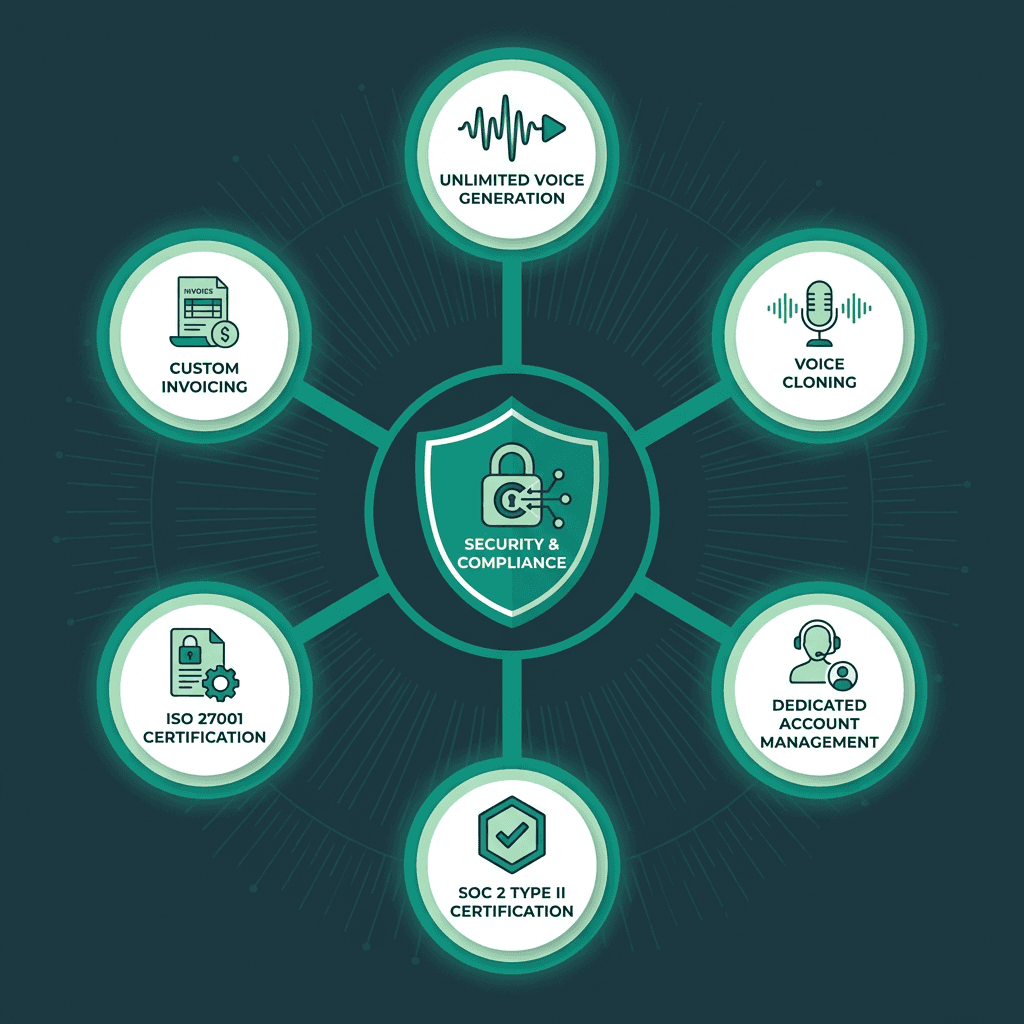
Enterprise features go beyond generation limits to include security compliance and dedicated support.
Murf API Pricing: A Separate Cost Structure
This is where many evaluations go wrong. Murf's Studio plans and its API are priced entirely separately. If you are a developer building TTS into an application, a Studio subscription is largely beside the point. The API runs on a pay-as-you-go model based on character usage, with the standard TTS API priced at $0.03 per 1,000 characters.
To put that in practical terms: a 500-word script averages roughly 3,000 characters, costing $0.09 per generation. For low-volume applications, that is affordable. For high-throughput systems generating thousands of audio files daily, the costs compound quickly and the per-character model becomes a significant budget line item.
Developers evaluating API costs should think beyond price per character. Latency, reliability, and different billing models (character-based, minute-based, request-based) all affect total cost of ownership in ways that a headline rate does not reveal.
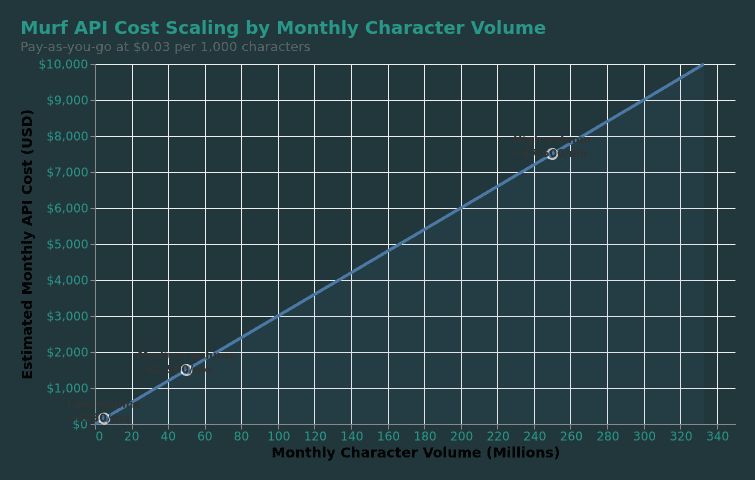
Pay-as-you-go API pricing scales predictably at low volumes but accelerates significantly at high throughput.
What Most Evaluations Get Wrong About Murf's Pricing
Most pricing comparisons stop at the headline monthly cost. The more revealing analysis is cost per hour of generated audio. On the Creator annual plan, you are paying $228 per year for 24 hours of generation: $9.50 per finished hour. On the Business annual plan, $792 per year for 96 hours works out to approximately $8.25 per hour.
Framed that way, Business is the more cost-efficient plan per hour of output, but only if your team actually uses the full allocation. A team that collectively needs 30 hours of annual generation would be better served by the Creator plan with careful usage management, or potentially the API if their workflow is script-driven and predictable. Paying for capacity that goes unused is the most common mistake in SaaS procurement.
Voice quality is the other variable that pricing tables cannot capture. A cheaper plan on a platform with mediocre output is not a saving if the audio sounds noticeably synthetic or requires re-recording. For a calibrated look at where different platforms land on the realism spectrum, the comparison of most realistic text-to-speech AI in 2026 covers this in detail.
Key Takeaways and Next Steps
Murf's pricing structure is logical for its target audience. The Free plan is a demo. Creator suits solo producers with moderate output. Business makes sense for small teams that need collaboration and higher volume. Enterprise covers organizations with compliance requirements, voice cloning needs, or genuinely high-volume pipelines. The API is a separate cost center entirely, billed at $0.03 per 1,000 characters independent of any Studio subscription.
The honest read: Murf is a capable Studio product for non-technical users who want a polished interface and a broad voice library. Its constraints show up at the developer and high-volume end, where the separation between Studio and API access, combined with per-character billing, creates friction that compounds at scale. Teams building voice into products rather than producing one-off audio files will feel that friction sooner than they expect.
If you are evaluating top alternatives to major TTS providers for developer-focused or high-throughput use cases, understanding what the broader market offers before committing is worth the time. For teams integrating voice AI directly into products and pipelines, Smallest.ai's pricing is built around exactly that use case, with the Lightning speech model designed for low-latency, high-quality synthesis at scale. Where Murf optimizes for the Studio content creator, Smallest.ai's infrastructure is built for production integration.
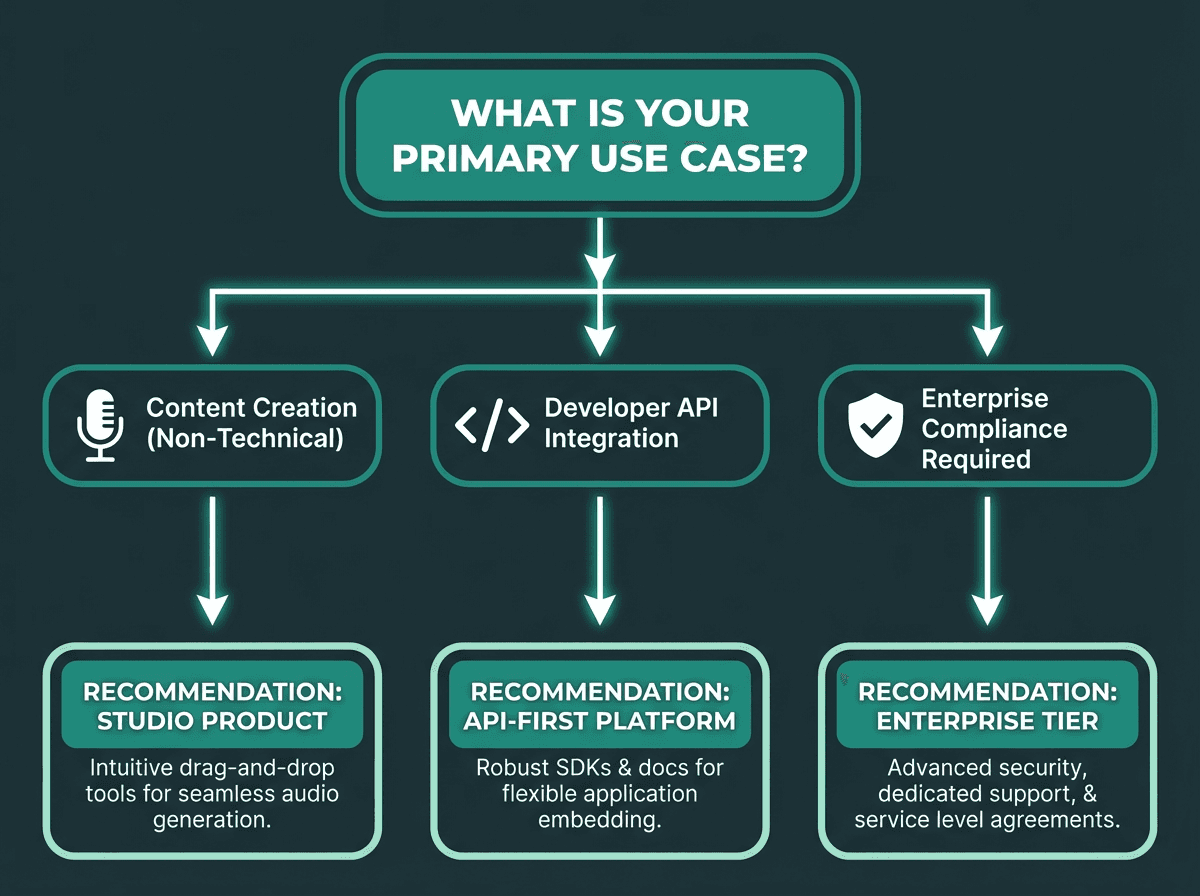
Matching your use case to the right pricing tier and platform type saves significant time and cost.
Frequently asked questions
Does Murf AI offer a free trial for paid plans?
Is the Murf AI API included in Studio plans?
What is the most cost-effective TTS option for high-volume developer use cases?
Does Murf AI support voice cloning on standard plans?