How to build a multilingual voice assistant

Build a multilingual voice assistant with a practical pipeline: language detection, STT, LLM, TTS, orchestration, plus testing and latency budgets.
As voice interfaces expand globally, supporting multiple languages has become a practical requirement for many products rather than an optional feature. Speakers of Portuguese, Hindi, Arabic, Japanese, and dozens of other languages expect voice interfaces to meet them on their terms. Multilingual support is no longer a stretch goal for ambitious teams. It is quickly turning into table stakes.
The flow here is deliberately end-to-end: core architecture first, then language detection and model choices, then the engineering traps that tend to surface only after you ship. If you already have the basics of designing voice assistants, the focus is on what changes once you cross language boundaries and have to keep the whole pipeline coherent.
The Core Architecture: Four Components Working Together
A multilingual voice agent is really four systems moving in lockstep: speech-to-text (STT), language models (LMs), text-to-speech (TTS), and orchestration software that keeps the real-time pipeline from falling apart. Each piece has to work across your supported languages, and the handoffs have to stay snappy enough that the assistant still feels conversational. If one stage drifts, the user experiences it as the assistant "not understanding" them, even when the bug lives somewhere else in the stack.
STT turns audio into text. The language model takes that text, interprets intent, and produces a response. TTS turns the response into speech. Orchestration glues those steps together by routing requests, tracking session state, and dealing with errors and retries. In a monolingual setup you can often tune these components in isolation. In a multilingual setup, they need a shared, up-to-date answer to a deceptively simple question: what language are we in right now?
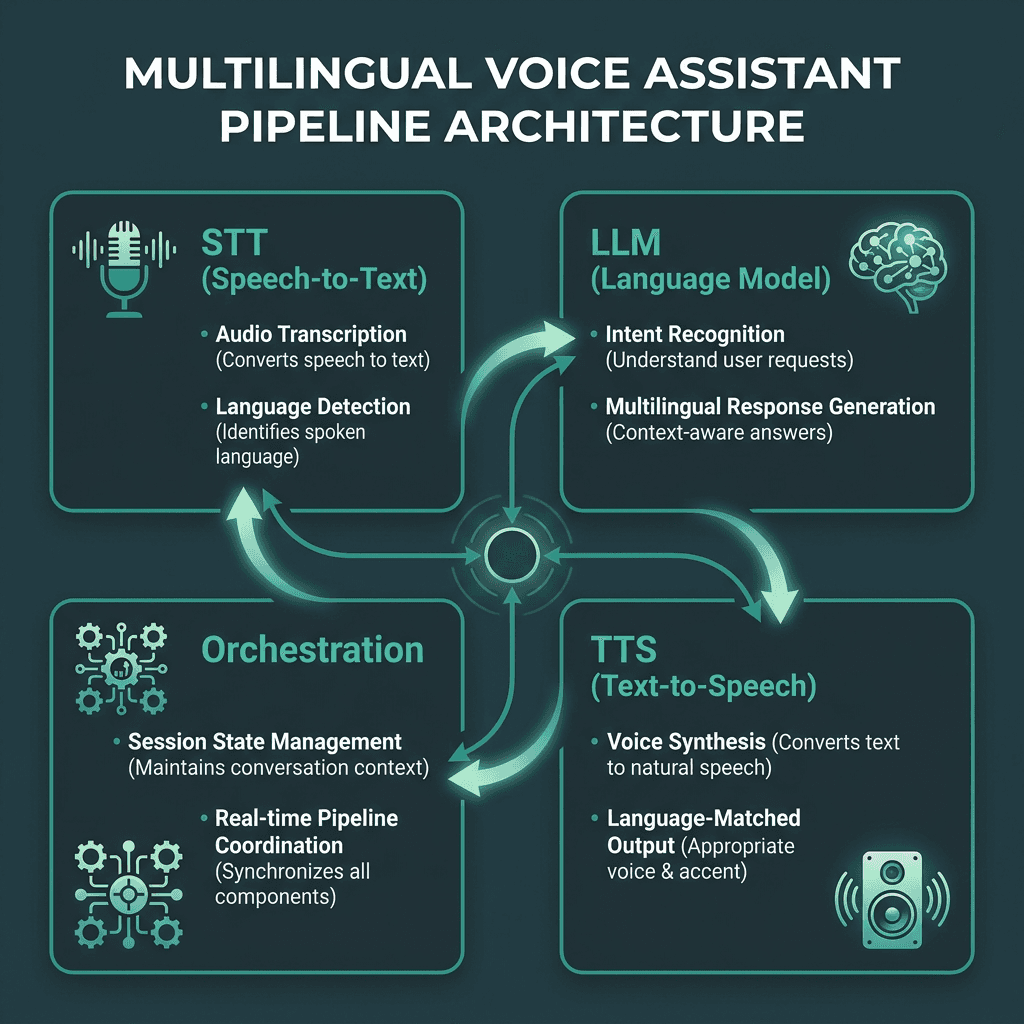
Each component must be independently multilingual and tightly coordinated for a seamless pipeline.
Step 1: Language Detection Before Everything Else
Language identification is the first real bet your system makes, and a wrong call tends to poison everything downstream. You generally have two options: detect language from the audio before transcription, or transcribe first and infer language from the text. Audio-level detection is quicker and can prevent an STT model from "snapping" to the wrong language. Text-level detection usually wins on accuracy, but it costs you an extra step on the critical path.
Most production assistants land on a hybrid. Use audio-level language ID as an early signal, then validate (or override) it once you have a transcript. This matters most when you run into code-switching, where a user blends languages in a single utterance. Code-switching is a common challenge in multilingual voice systems and tends to appear far more often in real conversations than in controlled evaluation datasets. Someone might start with "Hey, can you tell me" and then pivot into their native language mid-sentence. Your detection layer should expose that uncertainty and let the rest of the system respond appropriately, rather than quietly committing to the wrong language and dragging the whole turn off course.
Step 2: Selecting and Configuring Your STT Layer

A structured framework helps developers evaluate STT providers across language coverage, accuracy, and production readiness.
Performance often becomes less consistent as you move into lower-resource languages, making language-specific testing especially important. When you evaluate an STT provider, test the accents and dialects your users actually speak, not just the textbook version of a language.
Key criteria when selecting a multilingual STT layer:
Language coverage breadth: Does the model support all languages in your target market, including regional variants?
Word error rate (WER) per language: Aggregate accuracy scores hide per-language degradation. Request language-specific benchmarks.
Code-switching support: Can the model handle mid-sentence language switches, or does it require a clean language boundary?
Latency at scale: Multilingual models are often larger. Measure time-to-first-token under realistic concurrent load.
Streaming vs. batch: Real-time assistants need streaming transcription. Confirm the API supports it before committing.
Smallest.ai's Pulse is designed for real-time speech-to-text with multilingual support, low-latency streaming, and features such as speaker and emotion detection, making it suitable for multilingual voice pipelines. If you want the nuts-and-bolts implementation path, the Build Voice AI in Python guide goes step-by-step through the developer setup.
Step 3: Building a Language-Aware LLM Layer
Once you have a transcript and a confirmed language tag, the language model has to stay in that language turn after turn without you babysitting it with explicit prompts every time. Architecturally, you have two common paths: run a single multilingual model that can handle everything, or add a routing layer that hands requests to language-specific models. Both work. Both come with sharp edges.
A single multilingual model is easier to operate and tends to handle code-switching with fewer surprises. One widely used benchmark for multilingual language understanding is the MASSIVE dataset, which evaluates intent classification and slot filling across more than 50 languages and is commonly used when assessing multilingual virtual assistant performance. introduced at the MMNLU-22 workshop. It spans 52 languages and evaluates intent classification and slot-filling, which map closely to the behaviors voice assistants rely on (MMNLU-22, arXiv, 2022). Strong MASSIVE performance is often a decent signal that a model will generalize to messy multilingual input. Routing, on the other hand, lets you pick highly tuned models per language, but it adds latency and creates a brittle failure mode: if language detection is wrong, you are now confidently calling the wrong model.
For most teams early on, a capable multilingual model plus a disciplined system prompt is the quickest way to ship something that holds up. Your system prompt should be explicit: respond in the language of the user's last message, and include a clear fallback instruction for ambiguous or mixed-language turns.
Step 4: Multilingual TTS That Sounds Native
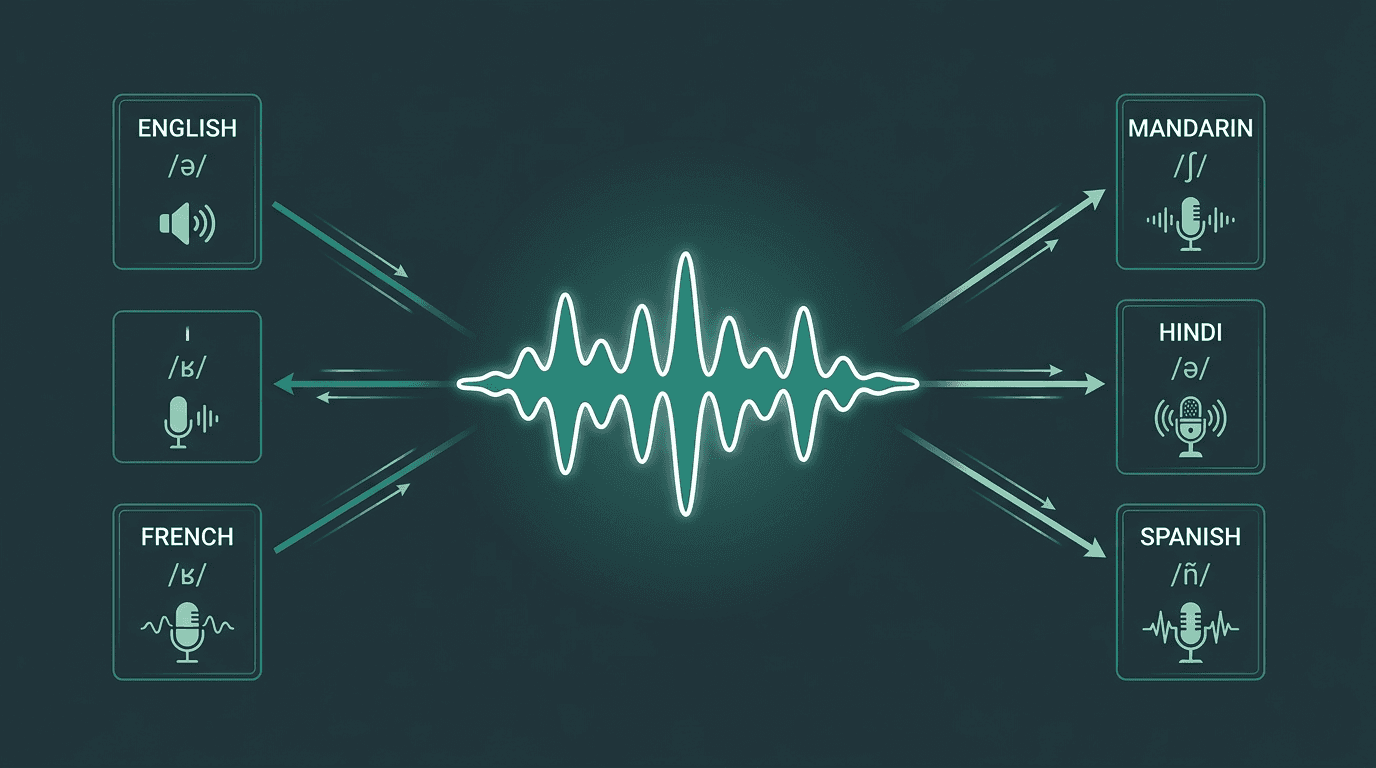
A single waveform branches into five native-quality voice personas — each tuned to its language's prosody and phoneme inventory.
Text-to-speech is where multilingual assistants most obviously betray themselves. You can have flawless English synthesis and still ship an experience that feels cheap if French comes out flat, or Hindi comes out with the wrong rhythm and stress. Prosody, phoneme inventories, and cadence vary wildly across languages, and a TTS system trained mostly on one language family will often drag those patterns into everything else.
That delta is not a marketing gap; it is the day-to-day reality of building right now. When you evaluate multilingual TTS, listen in every target language and, if possible, do it with native speakers. Automated naturalness metrics are useful, but they are not a reliable proxy for how real listeners judge "does this sound like it belongs in my language?"
Smallest.ai's Lightning TTS API is built for high-quality, low-latency speech synthesis and supports voice cloning, which is useful when you want a consistent brand voice across languages. If your use case sits closer to localization than live conversation, the workflow in multilingual voice dubbing is a good reference point for how synthesis quality holds up (or fails) when you cross language boundaries.
Step 5: Orchestration and the Latency Problem
Orchestration is the part users never see, and the part that determines whether your assistant feels instant or exhausting. It runs the sequence: ingest audio, run STT, detect language, call the LLM with the right context, synthesize speech, then stream audio back. Even in a monolingual assistant, that pipeline lives and dies by latency. Go multilingual and you add language detection, possible model routing, and the overhead that comes with larger models at multiple stages.
Practical orchestration decisions that affect multilingual latency:
Stream STT output to the LLM: Do not wait for full transcription before starting language model inference. Partial transcripts with high confidence can be forwarded immediately.
Cache language context per session: Once a user establishes a language in a session, store it. Re-running full language detection on every turn adds unnecessary overhead.
Pre-warm TTS voices per language: If your system supports multiple language voices, loading them on demand adds latency. Keep the most common ones resident in memory.
Set hard latency budgets per stage: Define latency budgets for each stage of the pipeline and validate them under realistic production workloads. The exact targets will vary by application, but measuring each stage separately helps identify bottlenecks before deployment.
If you are layering this onto an existing system, building multi-agent voice AI is a useful blueprint for structuring orchestration when multiple agents or language paths are in play. And the latency tactics in build low-latency voice conversations map cleanly to multilingual pipelines, where every extra hop has a way of multiplying the delay you thought you could afford.
The Data Problem for Low-Resource Languages
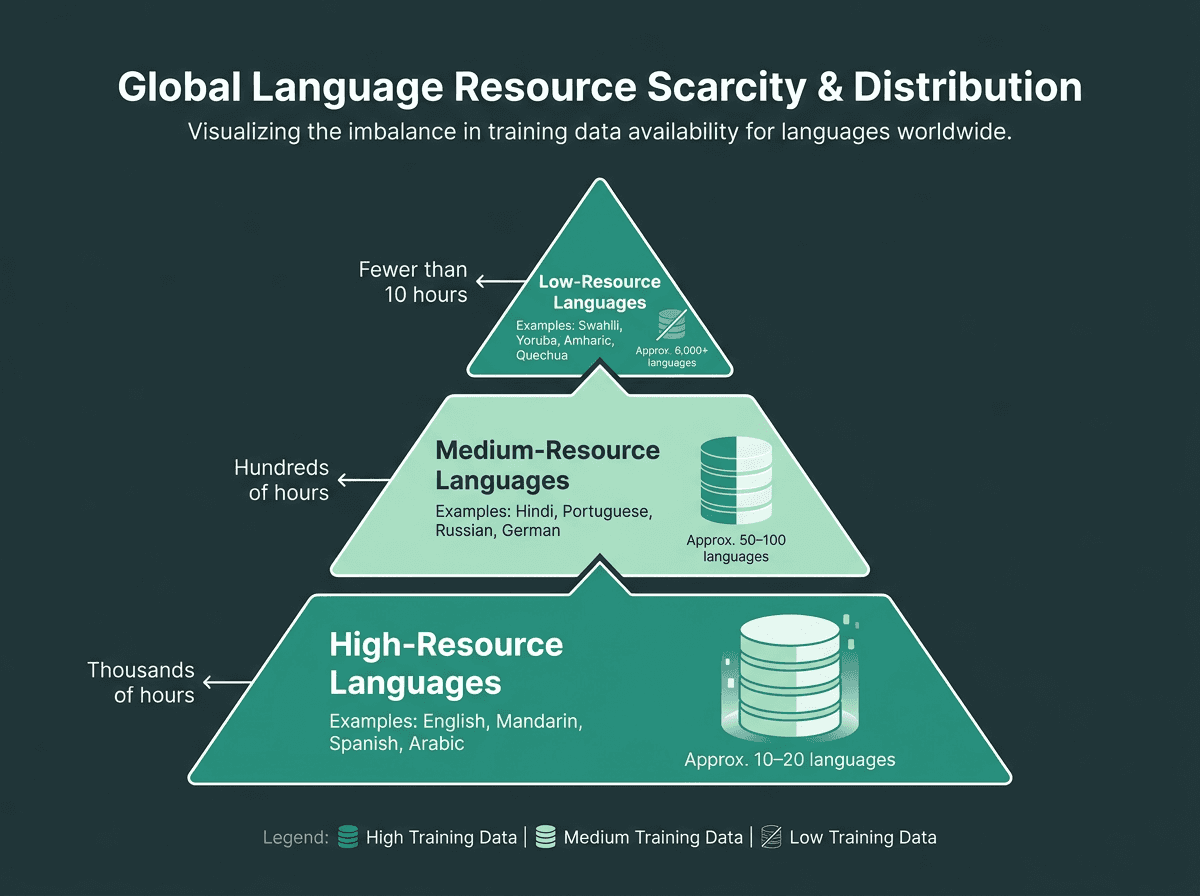
Training data scarcity for low-resource languages is a primary constraint in multilingual voice projects.
Data scarcity is the constraint that keeps showing up once you move past the usual top-tier languages. Data scarcity becomes more noticeable as you move beyond the most widely supported languages, which can affect transcription accuracy and speech quality. If your roadmap includes Swahili, Bengali, or Tagalog, expect higher transcription error rates and less natural synthesis than you would see in many European languages. You can still ship, but you need to plan for mitigation rather than hoping the models will magically catch up.
Transfer learning from high-resource to low-resource languages has improved a lot, and fine-tuning on even modest amounts of domain-specific audio can close meaningful accuracy gaps. If you can work with native speakers, recording a few hours of domain-relevant speech for fine-tuning is often worth it. On the TTS side, voice cloning from a small reference sample is now viable for many languages, which reduces your dependence on large, language-specific training corpora.
Testing a Multilingual Voice Assistant Before Launch
Multilingual testing is not just monolingual QA repeated in more locales. You also have to test the seams: what happens at language boundaries, and what happens when the system guesses wrong. Does the assistant switch cleanly when the user switches? Does it survive code-switching without producing mush? Does it preserve context when the user changes languages mid-session?
Your test suite should cover monolingual conversations in every supported language, deliberate code-switching turns, edge cases with rare dialects or heavy accents, and recovery flows for language detection failures. Automated metrics like WER and BLEU are useful for regressions, but they miss the human side of the experience: naturalness and trust. Plan regular listening sessions with native speakers for each supported language, especially after model or prompt updates.
Bringing It All Together
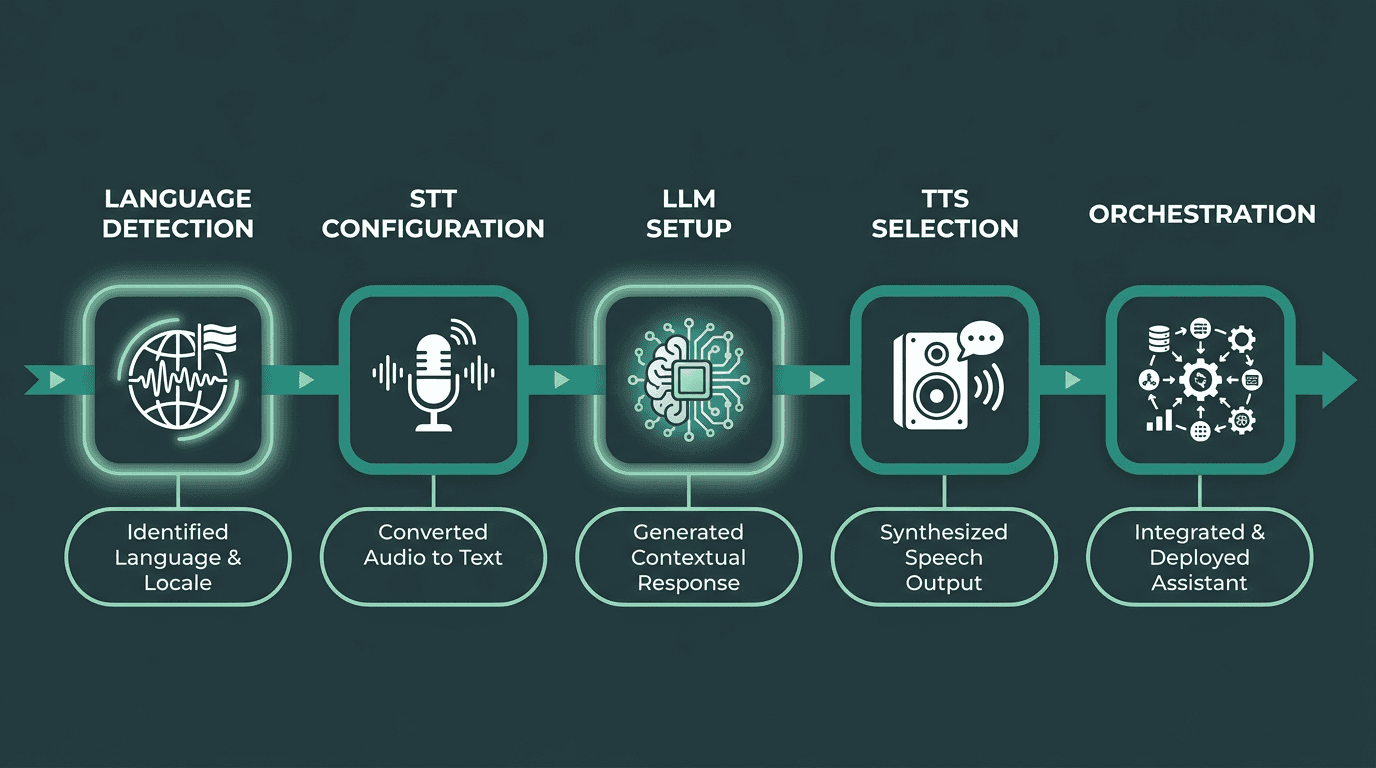
From language detection to orchestration — the five stages of a production-ready multilingual voice pipeline.
The hard part of a multilingual voice assistant is rarely a single catastrophic failure. It is the accumulation of small misses: a shaky language guess, slightly worse transcription, a response that slips into the wrong language, synthesis that sounds off to native ears. Each stage has its own error surface, and multilingual systems give those errors more ways to interact, which makes debugging materially harder than in a monolingual pipeline. Teams that treat multilingual support as a post-launch bolt-on tend to discover that complexity when it is most expensive to fix.
Smallest.ai provides the speech infrastructure needed for multilingual voice applications through the Waves platform, including Lightning for text-to-speech and Pulse for speech-to-text. These components can be combined into a production-ready multilingual voice pipeline alongside your orchestration and language model of choice. If you're building multilingual voice assistants for production, book a demo to see how Smallest.ai fits your architecture and deployment requirements.
Frequently asked questions
How many languages should I support at launch for a multilingual voice assistant?
What is code-switching and why does it matter for voice assistants?
Can I use a single TTS voice across all languages?
How do I handle a user whose language the assistant does not support?
What is the fastest way to get started building a multilingual voice assistant?


