English to Hindi Text to Speech: How to Choose a Bilingual TTS Tool

Compare the best English to Hindi text to speech platforms in 2026. Understand Hinglish code-switching, evaluate bilingual AI voice tools.
English to Hindi text to speech has moved well past niche territory. With Hindi being one of the most spoken languages in the world, the demand for AI voice tools that handle both languages accurately has grown across content, education, enterprise, and developer contexts. The problem is structural: most TTS platforms were architected around English, with Hindi bolted on afterward. The result is robotic pronunciation, wrong stress patterns, and outright failure on code-switched speech.
What Makes Hindi TTS Genuinely Hard
Hindi's Devanagari script is phonetically rich and morphologically complex. Vowel matras, conjunct consonants, and schwa deletion rules all shape how text is actually pronounced. A TTS engine that maps graphemes to phonemes without internalizing these rules produces speech that sounds foreign to any native Hindi listener. Schwa deletion alone, where the inherent 'a' vowel is dropped in certain positions, trips up most systems that weren't trained specifically on Hindi phonology. Say 'Ramesh' with the schwa retained and you've already lost the listener.
Then there is code-switching. Real Hindi speakers, particularly in urban India, don't speak 'pure' Hindi. They speak Hinglish, fluidly mixing English words, phrases, and sometimes full sentences into Hindi conversation. A TTS system that processes each language in isolation will either mispronounce the English fragments with a Hindi accent or break entirely when it hits a mid-sentence language switch. Research groups such as AI4Bharat have helped show how challenging Indian-language TTS remains, especially when real-world inputs include mixed scripts, out-of-vocabulary terms, and multilingual usage.
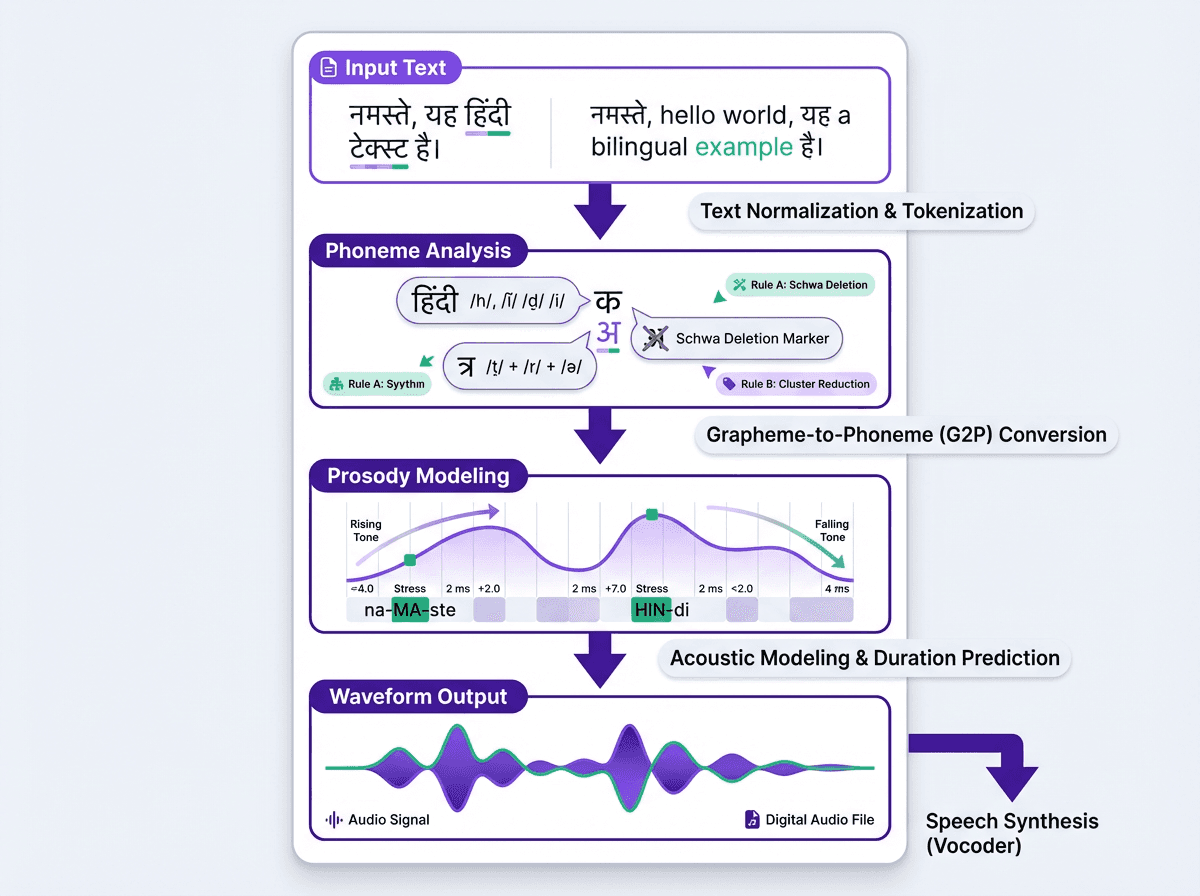
A proper Hindi TTS pipeline must handle script normalization, schwa deletion, and prosody modeling
How to Evaluate a Bilingual English-Hindi TTS Tool
Before comparing specific platforms, a consistent evaluation framework saves a lot of wasted testing time. The criteria below are what separate production-grade bilingual TTS from demo-quality output.
Criterion | What to Test | Why It Matters |
|---|---|---|
Schwa deletion accuracy | Read aloud words like 'Ramesh', 'Ganesh', 'Prakash' | Incorrect schwa retention sounds unnatural to native speakers |
Code-switching fluency | Input a Hinglish sentence mid-paragraph | Most real-world content mixes both languages |
Prosody and intonation | Compare question vs. statement delivery in Hindi | Flat prosody makes long-form audio unlistenable |
Latency (for real-time use) | Measure time-to-first-audio-byte via API | Critical for IVR, voice assistants, live dubbing |
Voice naturalness (MOS score) | Use a native Hindi speaker panel | Automated metrics miss cultural naturalness cues |
Script input flexibility | Test both Devanagari and Roman transliteration | Developers often input Hindi in Roman script |
The Best Bilingual AI Voice Tools in 2026
The market has matured enough that several platforms now offer credible Hindi support. Credible, though, is not the same as excellent.
Smallest.ai: Native Hinglish and Low-Latency API
Smallest.ai's Text to Speech technology is built for applications requiring high-naturalness voice synthesis, with benchmarks showing time-to-first-byte (TTFB) as low as 100ms. Its Lightning V3.1 model handles Hinglish code-switching natively, not as an afterthought. The model was trained to manage mid-sentence language transitions without a perceptible accent shift or pronunciation break, which is exactly what production Hinglish content demands. For developers building real-time applications, IVR systems, or conversational agents, this level of API performance is a genuine differentiator. Waiting on audio in a live voice interaction is not an option. For broader context on where this fits in the market, the best text-to-speech tools overview is worth a read.
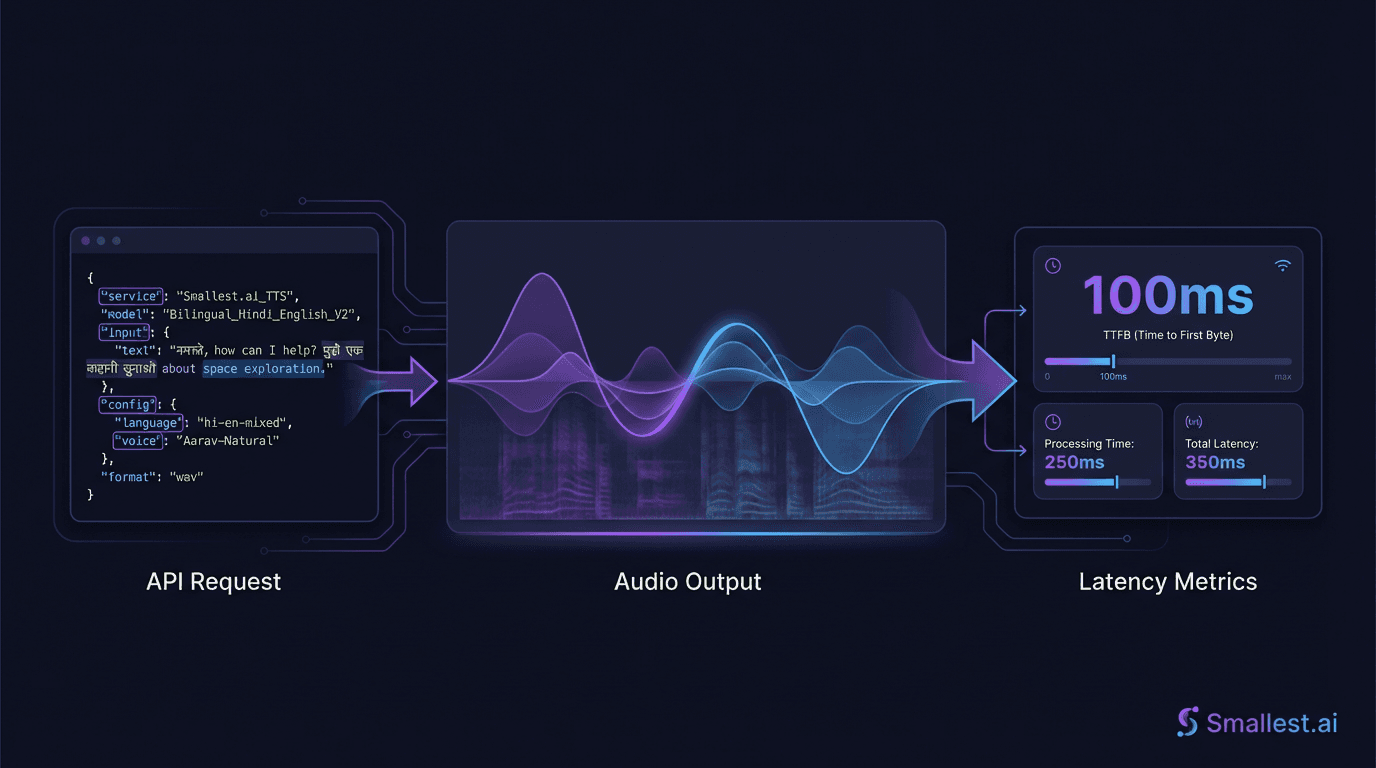
Smallest.ai's Lightning V3.1 model handles Hinglish code-switching at production-grade latency.
Other Bilingual TTS Platforms: A Comparison
Several cloud providers and AI platforms offer Hindi TTS as part of their broader multilingual portfolios. These include major infrastructure providers with established Hindi voices and AI-focused platforms with voice cloning capabilities. Many multilingual TTS platforms handle standard Hindi reasonably well, but performance on real-time, code-switched Hinglish varies significantly and should be tested directly.
Practical Applications: Where Bilingual TTS Actually Gets Used
Theory only gets you so far. Here is where English to Hindi TTS is actually being deployed, and what each context demands from the underlying system.
Real-world bilingual TTS deployment scenarios:
IVR and customer support automation: Telecom and fintech companies serving Hindi-speaking users require natural-sounding voices that can handle account numbers, dates, and English brand names within Hindi sentences, with latency benchmarks as low as 100ms to first audio byte often being a hard requirement.
Content dubbing and localization: YouTube creators and OTT platforms converting English video into Hindi need voice quality that matches the emotional register of the original. This is where human-like AI voices with emotion become critical rather than optional.
E-learning and accessibility: EdTech platforms serving Tier 2 and Tier 3 cities in India frequently need to deliver content in both Hindi and English within the same lesson. Consistent voice quality across both languages reduces cognitive load for learners.
Voice translation apps: Real-time translation between English and Hindi is a growing use case. voice translation and dubbing tools that pair a strong translation model with a bilingual TTS engine can deliver genuinely useful spoken output.
Podcast and audio content generation: Publishers creating Hindi-language audio at scale need TTS that sounds like a native speaker, not a transliteration engine reading phonemes off a chart.
The Code-Switching Problem: What Most Guides Skip
Most TTS comparison articles test Hindi and English in isolation, then declare a winner based on each language separately. That approach misses the actual use case entirely. In practice, a Hindi speaker discussing technology, finance, or entertainment will use English terms constantly. 'Mujhe ek meeting attend karni hai' is a perfectly normal Hindi sentence. A TTS system that reads 'meeting' and 'attend' with a Hindi accent, or that shifts to a different voice profile mid-sentence, immediately sounds wrong to any native listener.
The technical requirement is a unified acoustic model that treats both languages as part of the same phonological space, rather than two separate models stitched together at the seams. Smallest.ai's Lightning V3.1 was developed with this architecture, treating Hinglish as a first-class input rather than an edge case. For teams evaluating tools specifically for this requirement, testing with real Hinglish sentences is non-negotiable. The low-latency TTS API comparison also offers useful context on how other low-latency models approach multilingual synthesis.
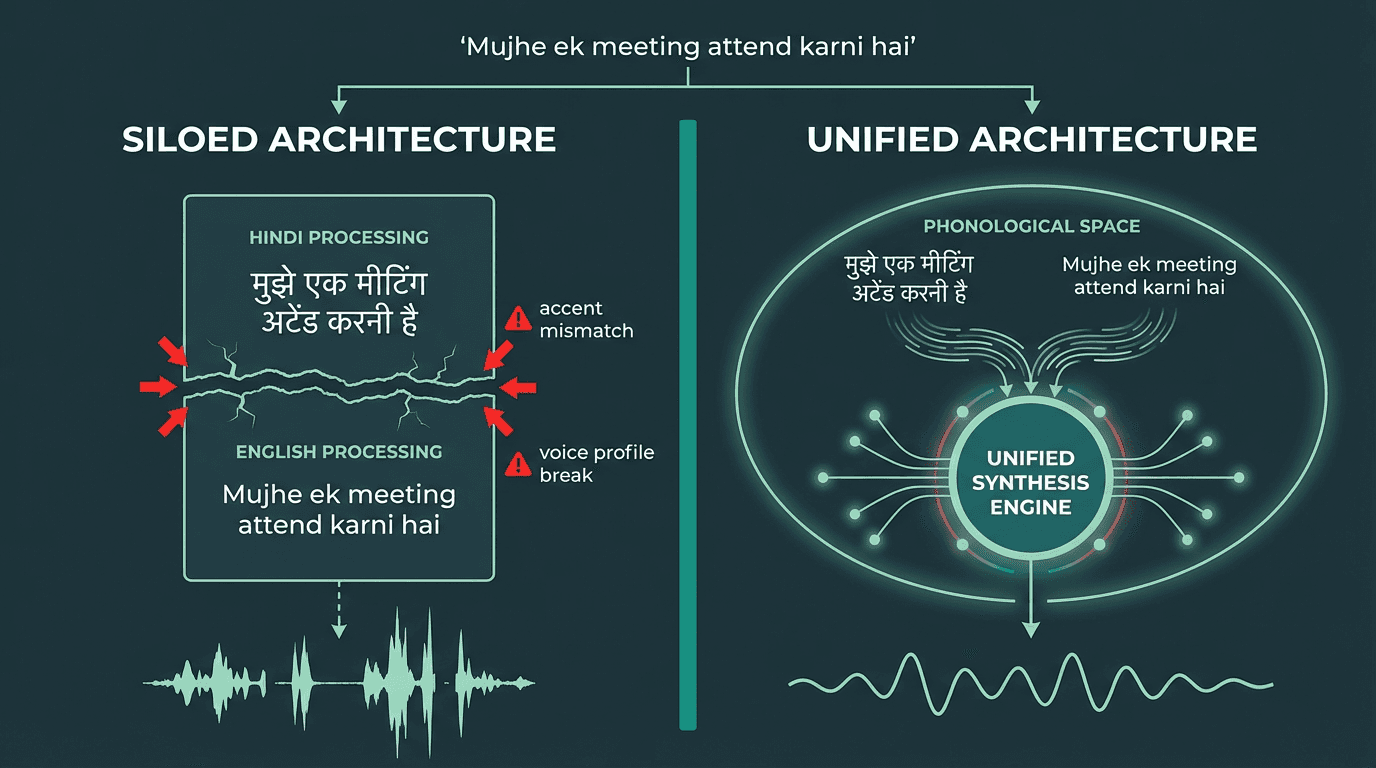
Unified acoustic models handle Hinglish code-switching far more naturally than siloed architectures
Advanced Considerations for Developers
Script Input: Devanagari vs. Roman Transliteration
Many developers working with Hindi TTS don't have Devanagari keyboards or input pipelines. They write Hindi phonetically in Roman script, a practice called transliteration. A production-grade bilingual TTS API should accept both input forms and normalize them correctly before synthesis. If your pipeline generates text programmatically, verify whether the API handles Unicode Devanagari natively or requires a preprocessing step on your end.
SSML Support for Hindi
Speech Synthesis Markup Language (SSML) tags let developers control pronunciation, pauses, emphasis, and speaking rate. For Hindi, this matters most with numbers, dates, and proper nouns that are ambiguous without explicit guidance. The question to ask any vendor: does their SSML implementation cover Hindi-specific phoneme tags, or is it English-centric by default? Platforms that expose phoneme-level control for Devanagari give developers meaningfully more precision over the final output.
Evaluating with Real Users, Not Just Automated Metrics
Word Error Rate and Mean Opinion Score (MOS) are useful starting points, but they don't capture cultural naturalness. A sentence that scores well on a standard MOS evaluation can still sound off to a native Hindi speaker from Delhi versus one from Mumbai, because regional accent expectations differ. If you're deploying at scale, run a small listener panel with native speakers before locking in a platform. This matters especially when assessing top text-to-speech tools that claim broad Indian language support but haven't been tested against regional variation.
Key Takeaways
Hindi TTS isn't a solved problem, but the gap between the best and worst tools has narrowed considerably in 2026. The platforms that handle it well share a few traits: trained on large, diverse Hindi corpora; treating code-switching as a core requirement rather than an edge case; and exposing enough API control for developers to tune output for specific domains. For realistic free AI voice generators that also support Hindi, the options are narrower, but they do exist.
The biggest mistake teams make is evaluating Hindi TTS with clean, formal sentences that no real user would ever speak. Test with Hinglish. Test with brand names, English technical terms, and mixed-script inputs. That is where the real differences between platforms surface, and where choosing the wrong tool will cost you in user experience and re-engineering time.
For use cases involving real-time voice applications, customer-facing audio in Hindi, or content that naturally mixes both languages, the problem is clear: most platforms weren't built for this. Smallest.ai's Lightning V3.1 addresses it directly, with native Hinglish support, time-to-first-byte (TTFB) as low as 100ms, and an API designed for production integration. For teams that have already tested generic TTS platforms and found them lacking on Hindi naturalness or code-switching, Smallest.ai's Text to Speech technology is the most focused solution currently available for this specific requirement.
Frequently asked questions
What is the best AI tool for English to Hindi text to speech in 2026?
Can AI TTS tools handle Hinglish, where Hindi and English are mixed in the same sentence?
Does the input script matter for Hindi TTS? Can I use Roman transliteration instead of Devanagari?
How do I evaluate the quality of a Hindi TTS voice for my specific use case?
Is there an open-source option for English to Hindi text to speech?