Conversational AI for Customer Service: What You Need to Know

Learn how conversational AI for customer service enhances customer experiences and provides personalized support, transforming modern support strategies.
In industries like e-commerce, finance, and healthcare, customer service teams often struggle with high-volume inquiries, long wait times, and the need for personalized support. These challenges are only growing as customer expectations rise.
For businesses looking to scale without compromising on service quality, conversational AI for customer service is a key player. According to recent trends, chatbots were expected to account for 62.5% of conversational AI revenue in 2025, driven by the increasing automation of routine customer interactions.
This blog will explore how conversational AI can boost efficiency, enhance customer satisfaction, and reduce operational costs, along with practical insights for implementing it effectively.
Quick Recap
Conversational AI: Uses NLP and machine learning to enable real-time, human-like interactions for more efficient customer service.
Real-World Benefits: Offers 24/7 support, multilingual capabilities, and personalized experiences, reducing wait times and improving customer satisfaction.
Use Cases Across Industries: From AI chatbots to agent-assist solutions, conversational AI streamlines operations and enhances interactions across sectors.
Choosing the Right Solution: Ensure seamless integration, strong data security, and continuous updates for optimal performance.
What is Conversational AI for Customer Service?
Conversational AI refers to technology that enables machines to understand and respond to human language, using natural language processing (NLP) and machine learning (ML). It’s used in customer service to deliver more personalized, efficient, and responsive interactions.
Customer service teams rely on conversational AI to enhance communication by automating repetitive tasks and providing instant responses while maintaining a human-like touch. This allows companies to improve the customer experience without overloading their support teams.
Now that we understand what conversational AI is, let's explore how it actually works to improve customer service.
How Does Conversational AI Work in Customer Service?
Conversational AI is designed to understand and respond to customer inquiries, whether in text or voice. It works in two key phases: training and interpretation.
1. The Training Phase
The AI learns by analyzing vast amounts of language data, including words, phrases, and documents. This helps the AI understand what constitutes accurate language and context.
2. The Interpretation Phase
The system compares a user's input to its training data. Machine learning algorithms predict users' intent and generate appropriate responses.
A Typical Conversational AI Interaction:
User Input: The user enters a statement or question.
Analysis: The AI processes this input using a large language model trained to understand context.
Pattern Matching: The AI compares the input to its training data and uses statistical models to predict intent.
Response Generation: The system delivers a relevant reply based on the analysis.
Continuous Learning: Feedback helps the AI improve its predictions over time, becoming more accurate.
As the AI interacts more, it learns from each conversation, refining its responses and becoming more accurate. The best conversational AI systems anticipate user needs, guiding the conversation naturally.
With the basics in mind, let's move on to the key benefits conversational AI brings to customer service operations.
What Are the Benefits of Conversational AI for Customer Service?
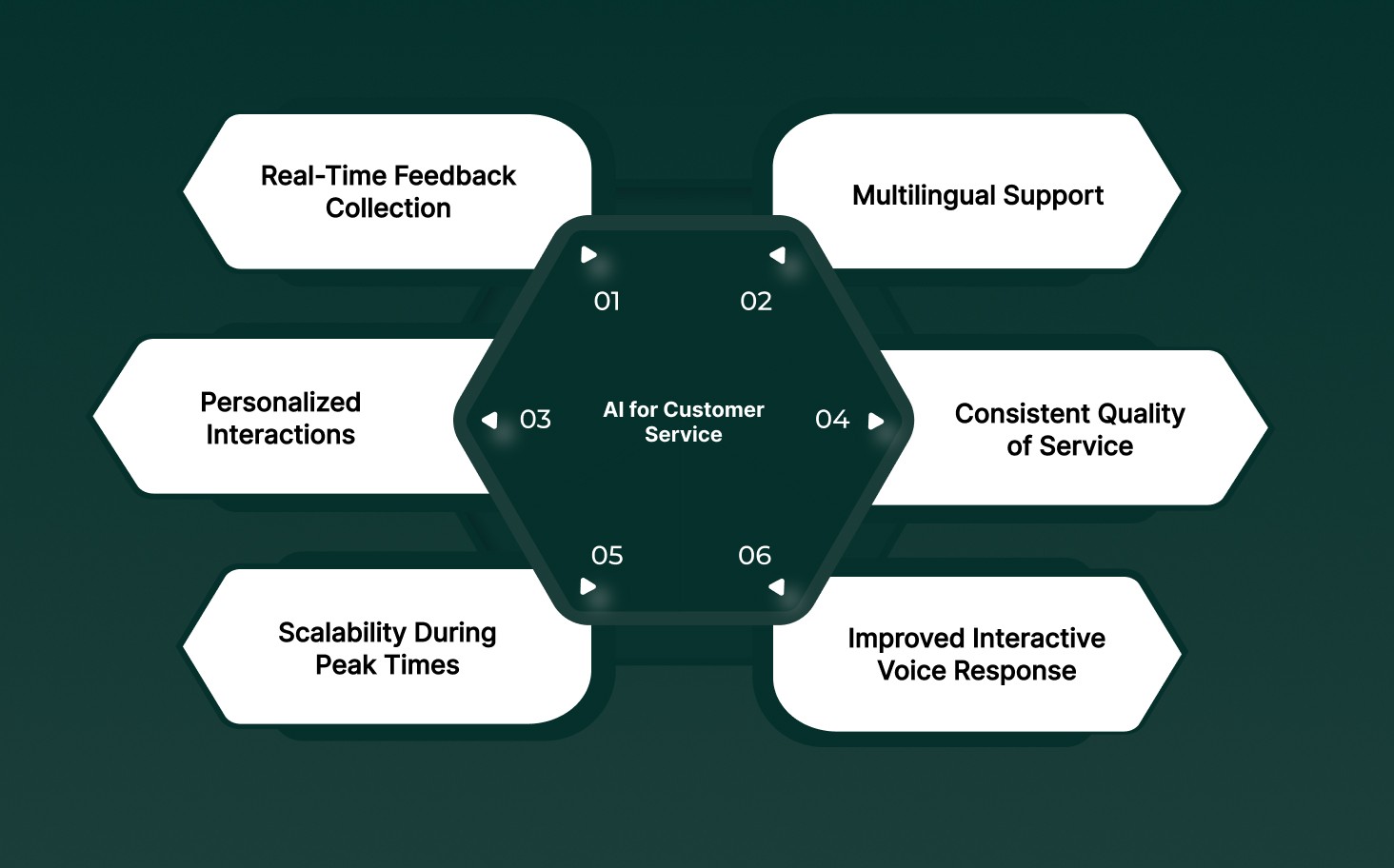
Conversational AI brings more than just 24/7 support and fast responses. Here’s a deeper look at the additional advantages it offers for customer service:
Real-Time Feedback Collection: Conversational AI provides instant insights into customer sentiment and concerns, helping service leaders understand what matters most to their customers at any given moment.
Multilingual Support: AI can be programmed to support multiple languages, breaking down language barriers and enabling businesses to assist customers from diverse linguistic backgrounds without additional resources.
Personalized Interactions: By tracking customer history and preferences, conversational AI can tailor conversations, making each interaction feel more personal and relevant to the individual’s past behaviors.
Consistent Quality of Service: AI ensures that all customers receive the same high-quality service, maintaining a consistent tone and providing accurate information every time, regardless of inquiry volume.
Scalability During Peak Times: AI can handle a large number of simultaneous conversations, preventing customer service from becoming overwhelmed during busy periods, and ensuring no customer has to wait long.
Improved Interactive Voice Response (IVR): Beyond text chats, conversational AI enhances IVR systems, enabling them to ask smarter questions, provide better self-service, and route calls more efficiently to human agents when necessary.
With these benefits, conversational AI is transforming customer service and providing tools to engage customers effectively across various touchpoints.
Knowing the benefits, it’s important to see how conversational AI is being used in real-world customer service applications.
Top Use Cases for Conversational AI in Customer Service
Conversational AI has transformed customer service by delivering effective, scalable solutions. Here are the top use cases where this technology is widely used:
1. AI-Powered Chatbots
Chatbots now provide 24/7 support, answering FAQs, guiding customers to resolutions, and processing transactions. They handle simple inquiries, freeing up human agents for more complex issues. Many businesses, including e-commerce companies, use AI chatbots to improve service efficiency.
2. AI Voice Bots
Voice assistants can engage customers in natural-sounding conversations and handle routine inquiries without human intervention. For example, voice bots in call centers can handle simple queries, troubleshoot basic issues, and seamlessly hand off more complex cases to human agents.
3. AI Agent Assist Solutions
AI agent assist tools provide real-time support to customer service agents. These tools suggest responses, retrieve customer data, and summarize conversations, allowing agents to resolve issues faster, reduce hold times, and improve customer satisfaction scores.
4. Intent Detection & Call Routing
Conversational AI can automatically identify the purpose of a call and route it to the correct department, improving call center efficiency. It can also collect key customer information and transfer that data to the agent, speeding up the resolution process.
5. Bookings and Reservations
Conversational AI simplifies the booking process by handling reservations via chat or voice. By integrating with booking systems, AI bots can schedule appointments and even offer personalized services, enhancing the overall customer experience.
6. Customer Authentication
Using conversational AI, voice assistants can authenticate customers through natural conversation, saving time for both agents and customers. This process is more efficient than traditional methods and safer than voice biometrics.
7. Troubleshooting
Conversational AI can assist in troubleshooting common problems by diagnosing issues, offering solutions, and guiding customers through the process. If the bot can't resolve the issue, it escalates the case to a human agent, ensuring a seamless transition.
By leveraging conversational AI, businesses can streamline customer service operations, increase efficiency, and deliver a personalized experience.
Also Read: Everything You Need to Know About AI Voice Assistants
These use cases highlight just a few ways conversational AI is transforming customer service. But how do you create a system that works for your business?
How to Create a Customer Service Conversational AI
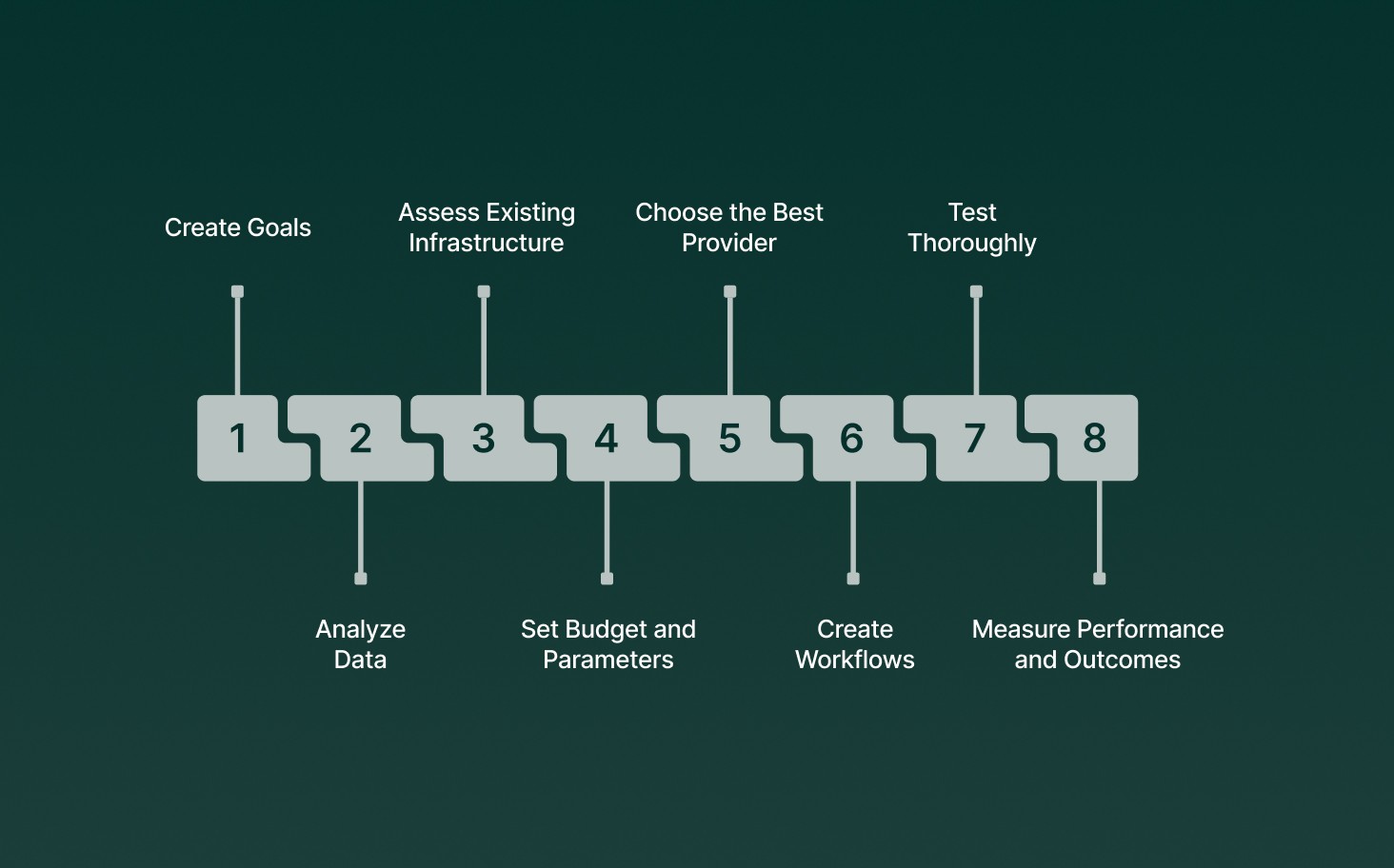
Building a conversational AI solution for your customer service operations involves a structured approach. Here’s a detailed breakdown:
1. Create Goals
Before getting into the tools, understand what you want the AI to achieve. Whether it’s improving efficiency, reducing costs, or automating basic inquiries, your goals should be specific. For instance, if the aim is to reduce operational costs, an AI that handles simple queries quickly might be ideal.
2. Analyze Data
Look for areas where repetitive, high-volume questions take up too much time and resources. This insight will help you decide where conversational AI can add the most value, whether it’s automating certain tasks or improving response times.
3. Assess Existing Infrastructure
Review your current systems and communication channels. The conversational AI you choose should integrate smoothly with these, whether it’s your CRM, help desk, or messaging platforms.
4. Set Budget and Parameters
Once you have stakeholder support, establish a clear budget for implementation. Smaller businesses might go for off-the-shelf, no-code solutions, while larger businesses could invest in more complex, customizable systems.
5. Choose the Best Provider
When selecting a conversational AI provider, Smallest.ai excels in creating customizable, real-time voice agents tailored to your business needs. Our AI solutions offer secure, scalable integration with multilingual support and advanced data security.
6. Create Workflows
Build the AI conversations in stages. Start with a clear introduction, followed by intermediate interactions, and finally, a smooth conclusion. Each stage should flow naturally to ensure a seamless customer experience.
7. Test Thoroughly
Before going live, test the workflows in a controlled environment. Use feedback from internal teams or test users to identify any bugs or areas for improvement. It’s also helpful to incorporate feedback forms into the chatbot experience for continuous improvement.
8. Measure Performance and Outcomes
After launching, keep a close eye on the AI’s performance. Track data, gather customer feedback, and evaluate KPIs like customer satisfaction and resolution time. This will help you understand how well the system is working and identify areas for enhancement.
Building a customer service conversational AI requires strategic planning, data-driven decisions, and careful execution.
As you build your conversational AI solution, consider these best practices to ensure it's effective and efficient.
Best Practices for Using Conversational AI in Customer Service
To get the most out of conversational AI for customer service, it’s important to implement strategies that ensure efficiency and customer satisfaction. Here are some key best practices to keep in mind:
Be Transparent and Honest with Customers: As conversational AI becomes more advanced, it's easy for customers to mistake a bot for a human agent. While AI can engage in natural, human-like conversations, it’s essential to clearly let customers know they’re interacting with a bot.
Maintain a Knowledge Base: A well-organized, detailed database of product information, troubleshooting tips, and service details ensures your chatbot can effectively answer customer queries. Ensure your knowledge base stays up to date and integrates seamlessly with your CRM, e-commerce, and other business systems.
Always Provide a Pathway to a Human Agent: Ensure your conversational AI offers a clear, easy way to escalate the conversation to a live agent. Providing this option builds trust and prevents frustration when AI can't fully resolve an issue.
Collect Customer Feedback: By collecting feedback through CSAT surveys or analyzing performance metrics like engagement rate and resolution rate, you can continually refine your AI bot’s responses.
Optimize for Multichannel Support: Ensure your conversational AI seamlessly operates across channels: website chat, social media, mobile apps, and voice assistants. This way, customers can reach your support team via their preferred method, ensuring a consistent, unified experience across platforms.
Also Read: 6 Voice AI Tools Built for High-Volume Customer Service in 2026
By following these best practices, you can create a conversational AI system that supports your customers and enhances their experience, helping build long-term loyalty.
Why Choose Smallest.ai for Your Conversational AI Needs?
When it comes to conversational AI, Smallest.ai offers powerful solutions tailored for diverse industries. Here’s why it stands out:
Customizable Voice Library: Choose from a wide variety of lifelike voices, customizable by age, accent, and tone, allowing businesses to match their brand and cater to different audiences.
Multilingual Support: With support for 16+ languages, Smallest.ai helps businesses engage with customers globally, making it ideal for international operations.
Reliable Security and Compliance: Certified under SOC 2 Type II, HIPAA, and PCI, Smallest.ai ensures top-tier data protection, essential for industries that handle sensitive information such as healthcare and finance.
Advanced Analytics: Measure and refine agent performance with detailed insights on call logs, interactions, and outcomes through customizable dashboards.
Seamless Integration: Easily integrate conversational AI into existing systems with Python, Node.js SDKs, and REST APIs, supporting complex workflows and high-volume operations.
Smallest.ai’s conversational AI solutions are built to drive smarter customer interactions, streamline operations, and help you stay ahead in today’s competitive landscape.
Conclusion
As businesses continue to adapt to modern consumer needs, conversational AI has become a crucial tool for delivering fast, personalized, and efficient customer service. No longer constrained by traditional methods such as phone calls or email, conversational AI enables businesses to engage with customers in real time, offering seamless, 24/7 support.
With Smallest.ai, you can utilize advanced voice agents tailored to your specific industry and customer needs. Its multilingual support, advanced analytics, and enterprise-grade security give you a comprehensive toolset to stay ahead in a competitive market.
Ready to enhance your customer service? Book a demo to explore Smallest.ai’s conversational AI solutions and deliver a new level of efficiency and satisfaction for your customers today.
Frequently asked questions
What is conversational AI for customer service?
How does conversational AI improve customer service?
Can conversational AI replace human agents?
Is conversational AI secure?
How can I implement conversational AI in my business?