Cartesia Pricing: Plans, Cost & What You Get in 2026

Full breakdown of Cartesia pricing in 2026: free tier, Growth plan costs, enterprise options, and what each plan actually includes for voice AI developers.
If you're evaluating Cartesia pricing for a production voice AI project, you've probably noticed that the numbers on the pricing page don't tell the whole story. What looks affordable at small scale can shift significantly once you factor in audio seconds, concurrent connections, and the features that are gated behind higher tiers. This guide unpacks every layer of Cartesia's cost structure so you can make an informed decision before committing.
Whether you're a solo developer prototyping a voice agent or an engineering team scaling a real-time conversational product, understanding what each plan actually includes, and where the hidden ceilings are, is essential. By the end of this guide you'll know exactly what Cartesia charges, how it compares to alternatives, and what to watch out for when estimating your monthly bill.
What Is Cartesia and Who Uses It?
Cartesia is a real-time voice AI infrastructure company focused on low-latency text-to-speech synthesis. Its flagship model, Sonic, is designed for voice agents and conversational applications where response time matters more than anything else. The company targets developers building phone agents, customer service bots, and interactive voice response systems where sub-200ms time-to-first-audio is a hard requirement.
The platform provides a REST and WebSocket API, a voice cloning feature, and a library of pre-built voices. It's positioned squarely at the developer and enterprise market, not content creators or casual users. That distinction matters when reading the pricing, because every plan is structured around API consumption, not seat licenses or monthly active users.
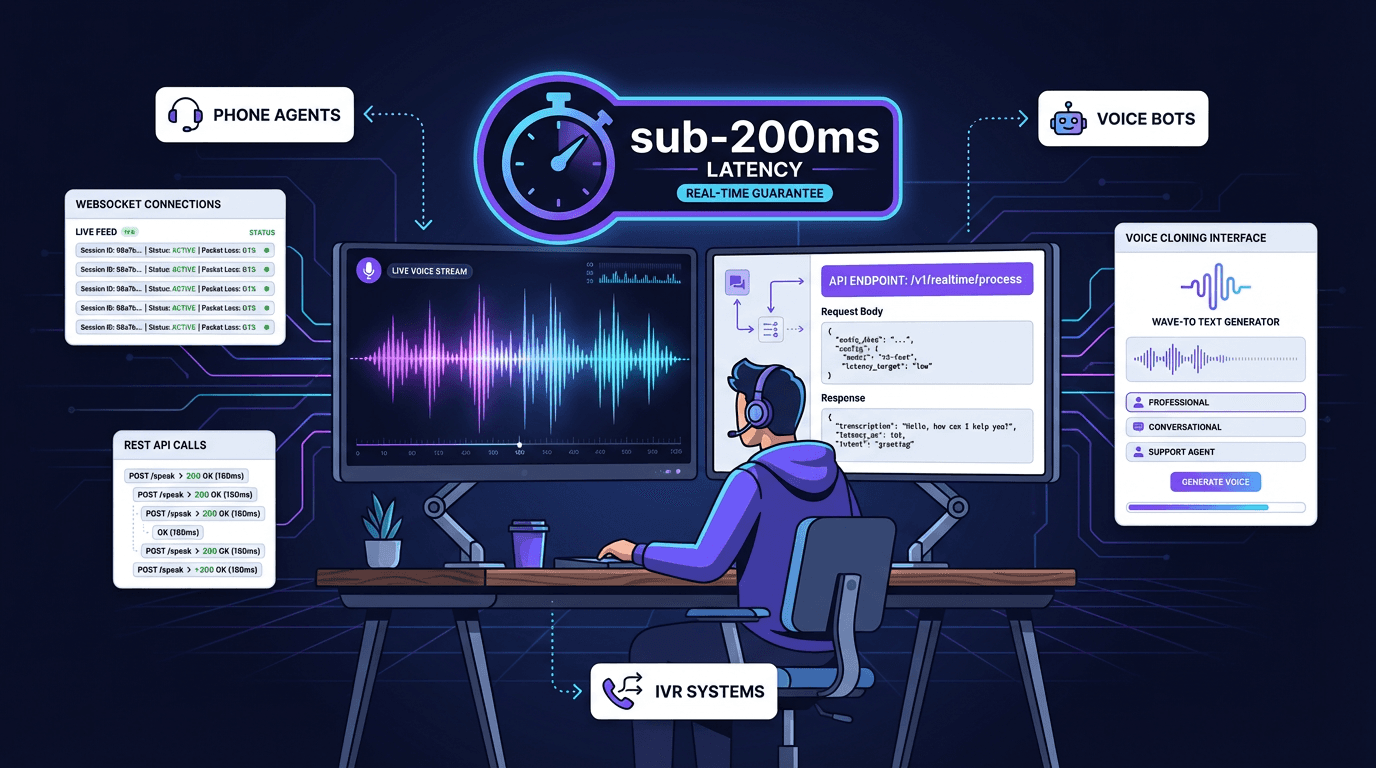
Cartesia is built for developers who need real-time, low-latency voice synthesis at scale.
Cartesia Pricing Plans: The Full Breakdown
Cartesia offers a free tier, a Growth plan starting around $99/month, and enterprise pricing. Included usage is credit-based and tied to character consumption, with exact limits depending on the plan configuration. Because Cartesia's pricing presentation evolves and specific allocations can vary, always check the official pricing page for the current numbers before making any cost estimates.
Plan | Monthly Cost | Included Credits | Voices | Support |
|---|---|---|---|---|
Free | $0 | Credit allocation for prototyping (see cartesia.ai/pricing) | Pre-built voices only | Community |
Growth | ~$99/month | Credit-based character allocation (see cartesia.ai/pricing) | Pre-built + voice cloning | Email support |
Enterprise | Custom | Custom volume | Full feature access | Dedicated support + SLA |
The free tier is genuinely useful for prototyping but hits its ceiling fast. Depending on your plan configuration, the included character credits cover a demo or light integration test, not sustained production traffic. The Growth plan unlocks voice cloning and provides a meaningfully larger credit allocation, making it the practical starting point for most real integrations. Enterprise pricing is negotiated directly and typically includes volume discounts, dedicated infrastructure, and uptime SLAs. For the exact credit figures on each tier, the official pricing page is the authoritative source, since allocations can shift as Cartesia updates its billing structure.
Understanding Cartesia's Credit and Usage Model
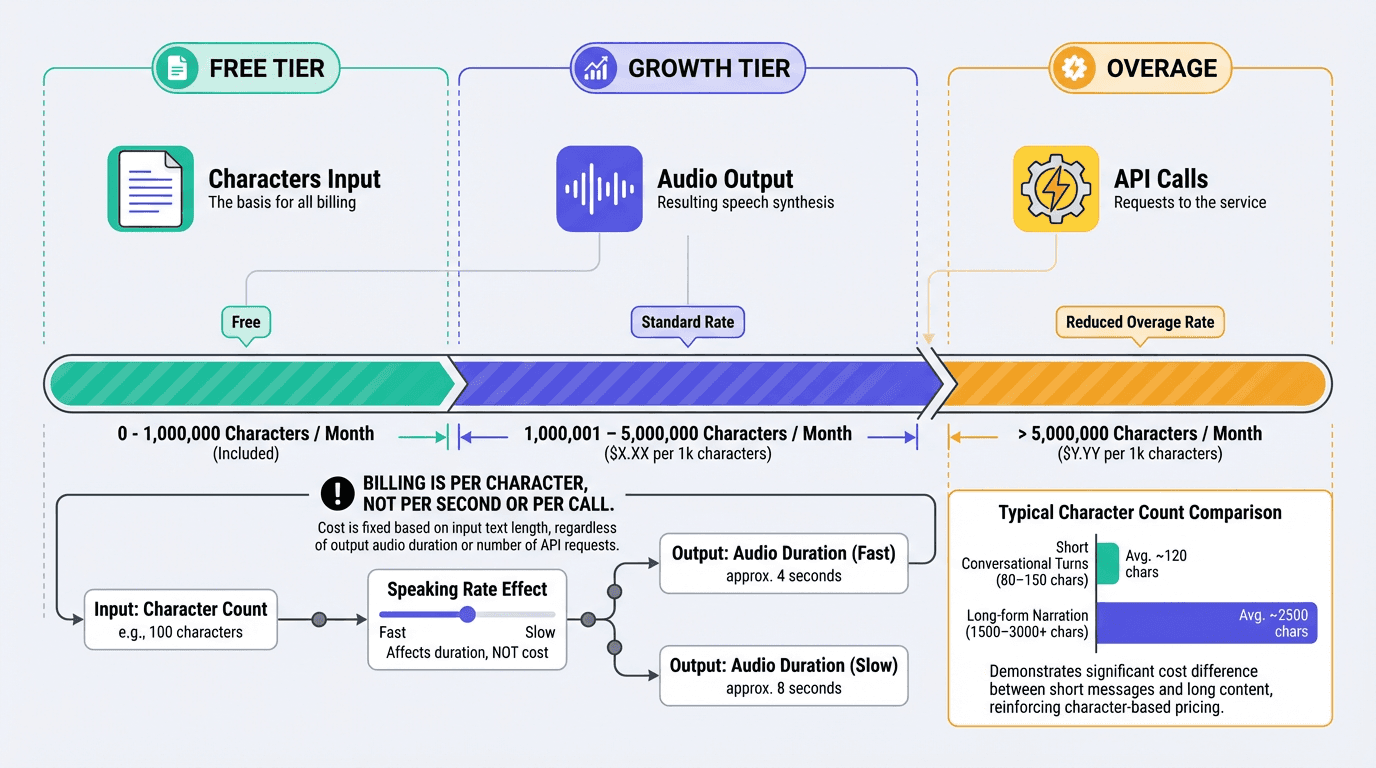
Cartesia bills by characters processed, not by audio seconds or API calls.
Cartesia's billing unit is characters of input text, not audio seconds or API requests. This is worth understanding carefully because it affects how you estimate costs for different use cases. Character usage translates to audio duration depending on speaking rate and voice model, so actual output time varies. A voice agent handling short, punchy responses will consume credits very differently from a system reading long-form content or narrating documents.
For real-time voice agent applications, the average conversational turn tends to fall between 80 and 150 characters. At that rate, even a moderately sized credit allocation can be exhausted quickly once you move from prototyping to production call volumes. For a low-volume internal tool, the Growth plan's allocation is likely sufficient. For a customer-facing phone agent handling hundreds of calls daily, you'll need to model your character consumption carefully and may need to negotiate enterprise rates.
One thing that often catches developers off guard: Cartesia's WebSocket streaming API counts characters the same way as the REST API. There's no discount for streaming versus batch synthesis. If your architecture uses persistent connections for low latency, your credit consumption rate is identical to synchronous calls. For a broader look at how TTS APIs structure their pricing models, the speech-to-text API pricing models explained guide covers the key patterns across the industry.
Voice Cloning: What's Included and What It Costs
Voice cloning is locked behind the Growth plan and above. On the free tier, you're limited to Cartesia's pre-built voice library. The Growth plan includes the ability to create custom voice clones from audio samples, which is a significant feature for branded voice agents or personalized applications.
What to know about Cartesia voice cloning:
Cloning requires a short audio sample, typically a few seconds of clean speech
Cloned voices consume characters from your monthly allocation at the same rate as pre-built voices
The number of stored voice clones you can maintain is subject to plan limits, with enterprise getting higher or unlimited storage
Voice clones are private to your account and not shared across the platform
For most production deployments, voice cloning is the feature that justifies upgrading from free to Growth. If you're building a product where brand voice consistency matters, the entry-level Growth plan is a reasonable starting point. The key question is whether your credit allocation covers your actual volume, or whether overage charges will push the effective monthly cost well above the base rate.
Estimating Your Real Monthly Cost: Practical Scenarios
The base plan price is rarely what you actually pay. Here are three realistic scenarios to calibrate your expectations. Note that cost estimates below are illustrative and based on typical character consumption patterns; your actual bill will depend on Cartesia's current credit allocations and overage rates, which should be confirmed directly with their team.
Use Case | Monthly Characters | Plan Required | Estimated Cost |
|---|---|---|---|
Developer prototype / internal demo | Under 50,000 | Free or Growth | $0 to ~$99 |
Small customer service bot (100 calls/day) | ~600,000 to 900,000 | Growth + potential overage | ~$99 to $200+ |
High-volume phone agent (1,000+ calls/day) | 6M to 15M+ | Enterprise | Custom negotiation |
The middle scenario is where most teams get surprised. A modest customer service bot handling 100 calls per day, with an average call involving 40 to 60 agent turns, will consume somewhere between 600,000 and 900,000 characters monthly. Depending on the Growth plan's current credit allocation, that volume may already push you into overage territory, meaning you're paying the base rate plus additional charges on top. Before committing, ask Cartesia's sales team for the overage rate per 1,000 characters, as this isn't published on the public pricing page.
Enterprise Plan: What You Actually Get
Enterprise pricing at Cartesia is fully custom, which is standard for infrastructure-grade voice AI. What matters is understanding what's actually negotiable and what's included by default at that tier.
Enterprise customers typically receive dedicated infrastructure (meaning your workloads aren't competing with other tenants for compute), uptime SLAs with financial penalties for downtime, custom rate limits for concurrent WebSocket connections, and a dedicated account manager. For regulated industries like healthcare or financial services, enterprise agreements also include data processing addendums and compliance documentation.
One thing worth knowing: Cartesia's latency performance, which is genuinely strong at the model level, can vary under load on shared infrastructure. Enterprise dedicated deployment is where the advertised sub-200ms time-to-first-audio becomes a contractual commitment rather than a benchmark figure. If your product's quality depends on consistent latency, that distinction is not minor.
Cartesia vs. Alternatives: Where the Pricing Lands
Cartesia's Growth plan is competitive at the entry level, but the credit-based model starts to show its limits at scale. Most enterprise-grade voice AI platforms shift to per-second or per-minute audio pricing at higher volumes, which can be more predictable for high-throughput applications. For a thorough look at how the top TTS APIs compare on both latency and cost, the top fastest text-to-speech APIs in 2026 breakdown is worth reading alongside this guide.
The key differentiator Cartesia leans on is latency. Its Sonic model is genuinely fast, and for real-time conversational applications that's a legitimate advantage. But latency alone doesn't justify a pricing structure that becomes opaque at scale. Teams evaluating Cartesia for production should run a proper cost model before signing anything, especially if call volumes are expected to grow significantly in the first year. You can also explore how different voice stacks compare in the 2026 voice agent stack comparison.
See how Smallest.ai's voice models compare on pricing and latency for production deployments.
What Most People Get Wrong About Cartesia Pricing
The most common mistake is treating the Growth plan's included credit allocation as a comfortable buffer. For most real-world applications, it isn't. Developers often prototype with short test strings and underestimate production turn lengths. Real conversational AI responses, especially when the system is reading back structured data, addresses, or confirmation messages, tend to run longer than you'd expect.
A second mistake is ignoring the WebSocket connection limits. Cartesia's lower tiers have restrictions on concurrent connections, which matters for applications that need to handle simultaneous calls. If your architecture spins up a new WebSocket per call and you're handling 20 concurrent calls, you need to verify that your plan supports that concurrency. This is rarely spelled out clearly in the public documentation and usually requires a direct conversation with their team.
Third, and this applies to any character-based TTS pricing: SSML tags and whitespace handling can inflate your character counts if your integration isn't clean. If you're passing raw LLM output directly to the TTS API without stripping formatting artifacts, you may be paying for characters that produce no audio. It's a small optimization but it adds up at scale.
Key Takeaways and Next Steps
What you now know about Cartesia pricing:
Three tiers: Free, Growth (starting around $99/month), and Enterprise (custom). Exact credit allocations are credit-based and should be verified at cartesia.ai/pricing.
Billing is character-based, not per audio second or per API call. Character usage translates to audio duration depending on speaking rate and voice model, so actual output time varies.
Voice cloning is a Growth-and-above feature
Overage rates are not publicly listed and require direct inquiry
Enterprise tier is where latency SLAs and dedicated infrastructure become contractual
Concurrent WebSocket connection limits vary by plan and are not clearly documented publicly
Cartesia is a solid choice for developers who need real-time voice synthesis and are willing to invest time in understanding the cost model before scaling. The free tier is good for prototyping. The Growth plan works for low-to-mid volume applications. Beyond that, you're in enterprise negotiation territory, which is fine if you have the volume to justify it.
If you're still in the evaluation phase and want to see how other providers handle the cost-latency tradeoff, the top 7 best text-to-speech APIs for IVR in 2026 guide covers the competitive landscape in detail. And if you're building a cost-effective voice agent from scratch, the guide to building a cost-effective AI receptionist walks through architecture decisions that directly affect your monthly TTS bill.
The real question isn't whether Cartesia's pricing is good or bad in isolation. It's whether it fits your specific volume, latency requirements, and budget trajectory. Run the numbers for your actual use case, not the best-case scenario, before committing to a plan.
The Problem With Opaque Pricing at Scale
Here's the honest assessment: Cartesia's pricing works well for developers who stay within the Growth plan's credit limits or have the volume to negotiate enterprise terms. The gap in the middle, where you've outgrown the base plan but aren't large enough to command favorable enterprise rates, is genuinely uncomfortable. Overage costs that aren't published, connection limits that require a sales call to understand, and a character-based model that doesn't map cleanly to audio output duration all create friction for teams trying to forecast infrastructure costs accurately.
This is exactly the problem Smallest.ai is built to solve. Smallest.ai's Lightning TTS model delivers sub-100ms latency with transparent, predictable per-second audio pricing, no hidden overage tiers, and a pricing structure designed for teams that need to scale without renegotiating contracts every quarter. If
Smallest.ai offers transparent, predictable pricing for teams that need to scale real-time voice applications without cost ambiguity or constant contract renegotiation. If you’re evaluating providers for production use, Smallest.ai’s pricing is worth reviewing before you finalize your stack.
Compare Smallest.ai's transparent voice AI pricing and start building with sub-100ms TTS today.
Frequently asked questions
Does Cartesia offer a free trial or free tier?
How does Cartesia calculate usage, and what counts as a character?
What happens if I exceed my monthly character limit on the Growth plan?
Is voice cloning available on the free tier?
How does Cartesia's pricing model work for high-volume voice agents?