Top 7 Best Text to Speech APIs for IVR in 2026 (Latency & Cost Compared)

Discover the best text to speech API for IVR systems in 2026. We compare 7 top TTS providers on latency, cost, and voice quality to help you choose.
Choosing the best text-to-speech API for IVR (Interactive Voice Response) systems is a critical decision that directly impacts customer experience and operational efficiency. A great IVR voice can make callers feel heard and understood, while a robotic, high-latency voice leads to frustration and abandoned calls. The global IVR market is projected to grow from USD 5.73 billion in 2025 to USD 10.17 billion by 2035 (Research Nester, 2026), a clear signal that businesses are investing heavily in automated voice solutions. This growth is fueled by AI advancements that make interactions more intelligent and human-like.
But what makes a TTS API suitable for IVR? Unlike streaming audio for a podcast, IVR has unique demands. While ultra-low latency is crucial for conversational AI, IVR systems can often tolerate slightly higher response times, typically between 500ms and 1 second (Fish Audio Blog, 2026). This shifts the focus to other vital factors: reliability, cost-effectiveness at scale, voice quality, and robust SSML (Speech Synthesis Markup Language) support for controlling pronunciation, pacing, and tone. This article compares the top 7 TTS APIs for IVR in 2026, evaluating them on the criteria that matter most for building effective automated voice systems.
Here are the top 7 text-to-speech APIs for IVR we will compare:
Smallest.ai Lightning
ElevenLabs
Deepgram Aura
OpenAI TTS
Cartesia
Resemble AI
WellSaid Labs
Comparison of the Best Text to Speech APIs for IVR
API Provider | Key Feature | Typical Latency | Pricing Model | Best For |
|---|---|---|---|---|
Smallest.ai Lightning | Ultra-low latency with high concurrency | ~150ms | Per character, with enterprise tiers | Performance-critical, scalable IVR systems |
ElevenLabs | High-fidelity voice cloning and emotional range | ~400ms | Per character, with usage tiers | Brand identity and emotionally expressive IVR |
Deepgram Aura | Integrated STT & TTS for conversational AI | ~200ms | Per character, pay-as-you-go | End-to-end conversational IVR platforms |
OpenAI TTS | Ease of integration within OpenAI ecosystem | ~300-500ms | Per character, pay-as-you-go | Developers already using OpenAI APIs |
Cartesia | Self-hostable models for data privacy | Variable (self-hosted) | Free (open source), with enterprise support | Organizations with strict data security needs |
Resemble AI | Real-time voice cloning and speech-to-speech | ~500ms+ | Per character, with platform fees | Dynamic, personalized audio content in IVR |
WellSaid Labs | Studio-quality voices and production workflow tools | ~800ms+ | Seat-based subscriptions | Pre-recorded IVR prompts and corporate narration |
1. Smallest.ai Lightning
Smallest.ai's Lightning model is engineered from the ground up for speed and efficiency, making it an exceptional choice for IVR systems where responsiveness is paramount. While many IVR applications can tolerate up to a second of latency, reducing this delay significantly improves the conversational flow and prevents callers from interrupting the system or becoming impatient.
Lightning consistently delivers audio with latency around the 150ms mark, creating a more natural and immediate response that feels less like a machine and more like a conversation.
This performance is achieved through a highly optimized model architecture that doesn't sacrifice voice quality. The voices are clear, natural, and suitable for professional environments. For developers, the API is straightforward and well-documented, facilitating quick integration. The pricing is character-based, which is ideal for the short, dynamic prompts common in IVR, such as reading back account balances or confirming appointment times. This combination of speed, quality, and a developer-friendly approach makes it a leading contender for any new IVR project or for upgrading a legacy system that suffers from sluggish response times. For those exploring implementation details, this guide on building realistic text-to-speech in Python offers practical steps.
Smallest.ai provides clear documentation and code examples for rapid integration.
2. ElevenLabs
ElevenLabs has earned a formidable reputation for producing some of the most realistic text-to-speech AI voices available. Their primary strength lies in voice cloning and the ability to imbue speech with a wide range of emotions. For IVR, this translates into creating a unique brand voice that sounds genuinely welcoming, empathetic, or urgent as the context requires. Imagine an IVR that can deliver an urgent fraud alert in a serious tone or confirm a successful payment with a cheerful one. This level of expressiveness can transform the customer experience.
However, this high fidelity comes with a latency of around 400ms, which is well within the acceptable range for most IVR use cases but not the fastest on the market. The real value proposition for an IVR developer using ElevenLabs is brand consistency. You can clone the voice of a brand spokesperson or create a custom synthetic voice that becomes synonymous with your company. Their platform offers granular control over voice settings, allowing for fine-tuning of stability and clarity to match the specific needs of a telephony environment. While it might be overkill for a simple 'press one for sales' system, it's a powerful choice for brands looking to build a premium, emotionally resonant automated experience.
ElevenLabs excels at creating custom, emotionally expressive brand voices.
3. Deepgram Aura
Deepgram's Aura TTS is a strong contender, particularly for developers building comprehensive conversational AI systems. Deepgram is well-known for its high-performance speech-to-text (STT) products, and Aura is designed to be the vocal counterpart, creating a tightly integrated, low-latency voice AI loop. With latency around 200ms, Aura is one of the fastest text-to-speech APIs available, making it excellent for responsive IVR.
What makes Deepgram a compelling choice for IVR?
End-to-End Solution: By using Deepgram for both STT and TTS, developers can often simplify their stack, reduce integration points, and potentially achieve better overall performance as the systems are optimized to work together.
Conversational Quality: The stock voices are tuned for conversational interactions, with natural intonation that works well for dynamic IVR scripts.
Developer Focus: Like its STT products, Aura is API-first, with clear documentation and a focus on performance and scalability. The pay-as-you-go pricing model is transparent and scales predictably with usage.
For businesses that already use or are considering Deepgram for transcription and voice analytics, adding Aura for the outbound voice is a logical and efficient choice. It ensures a consistent level of performance across the entire voice interaction workflow.
Deepgram Aura provides a fast TTS solution that integrates tightly with its STT service.
4. OpenAI TTS
OpenAI entered the text-to-speech market with the same polish and developer-centric approach that made its language models ubiquitous. The primary advantage of using OpenAI's TTS for IVR is its seamless integration into an existing OpenAI-powered ecosystem. If your IVR logic is already driven by GPT-4 for understanding user intent and generating responses, using the same provider and API key for audio generation simplifies development and billing significantly.
The voice quality is high, offering a small selection of very natural-sounding male and female voices under names like 'Alloy', 'Echo', and 'Nova'. While it lacks the vast voice library or cloning capabilities of specialists like ElevenLabs, the available voices are professional and pleasant, making them well-suited for most IVR applications. Latency can be more variable, typically ranging from 300ms to 500ms, which is acceptable for IVR but may not feel as instantaneous as more specialized providers. The pricing is competitive and follows the familiar pay-as-you-go model. OpenAI TTS is the path of least resistance for the vast number of developers already building with OpenAI's toolset.
OpenAI's TTS is an easy addition for developers already using its language models.
5. Cartesia
Cartesia offers a unique proposition in the TTS market: high-performance, self-hostable models. This is a critical differentiator for organizations in finance, healthcare, or government that have stringent data privacy and security requirements. By hosting the TTS model on your own infrastructure (on-premise or in a private cloud), you ensure that no sensitive data, such as account numbers or personal information spoken by the IVR, ever leaves your controlled environment.
Their open-source model, Sonic, is designed for speed and can achieve latencies under 100ms on appropriate hardware. While the base model is free, Cartesia provides enterprise support and access to more advanced, higher-quality voices for commercial clients. The trade-off for this control and security is increased operational overhead. Your team is responsible for deploying, scaling, and maintaining the inference servers. This makes Cartesia less of a plug-and-play solution and more of an infrastructure component. For companies with the technical capability and a compelling security need, Cartesia is arguably the best text to speech API for IVR because it offers unparalleled control and privacy.
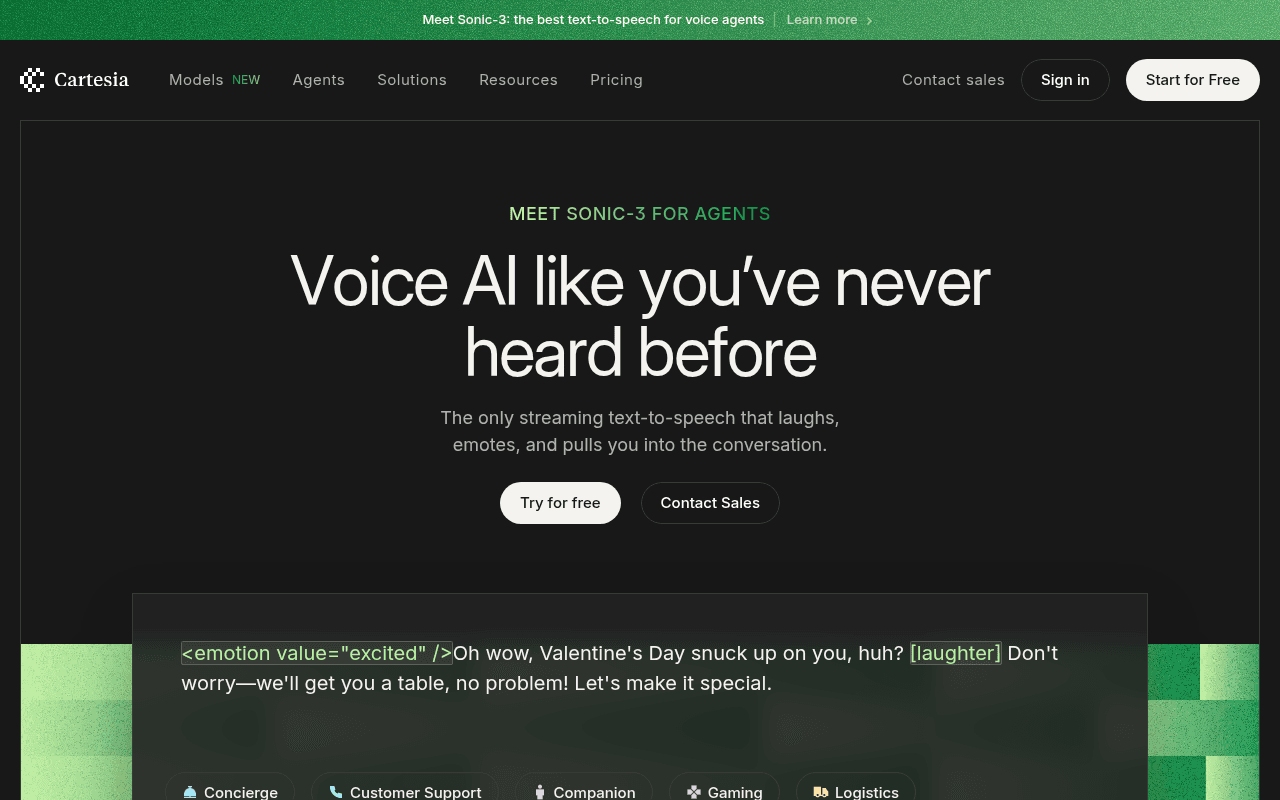
Cartesia's self-hosting option provides maximum data security for sensitive IVR applications.
6. Resemble AI
Resemble AI positions itself as a complete generative voice AI platform, and its capabilities extend beyond standard text-to-speech. One of its standout features for IVR is real-time voice cloning and speech-to-speech (STS) conversion. This allows for incredibly dynamic and personalized interactions. For example, an IVR could use a standard brand voice for prompts but then clone a specific sales agent's voice to leave a personalized voicemail callback message. The STS feature can also be used to standardize the accent or emotional tone of pre-recorded audio snippets on the fly.
These advanced features come at a higher latency, often exceeding 500ms, and a more complex pricing structure that can include platform fees in addition to per-character usage. This makes Resemble AI less suited for simple, high-volume IVR systems where speed and cost are the primary drivers. However, for applications requiring deep personalization, localization (by changing accents), or creating a vast library of audio assets with a consistent voice, Resemble AI provides a powerful and flexible toolkit. It's an excellent choice for creative and marketing-focused IVR campaigns or applications that need to generate highly customized audio content in real time.
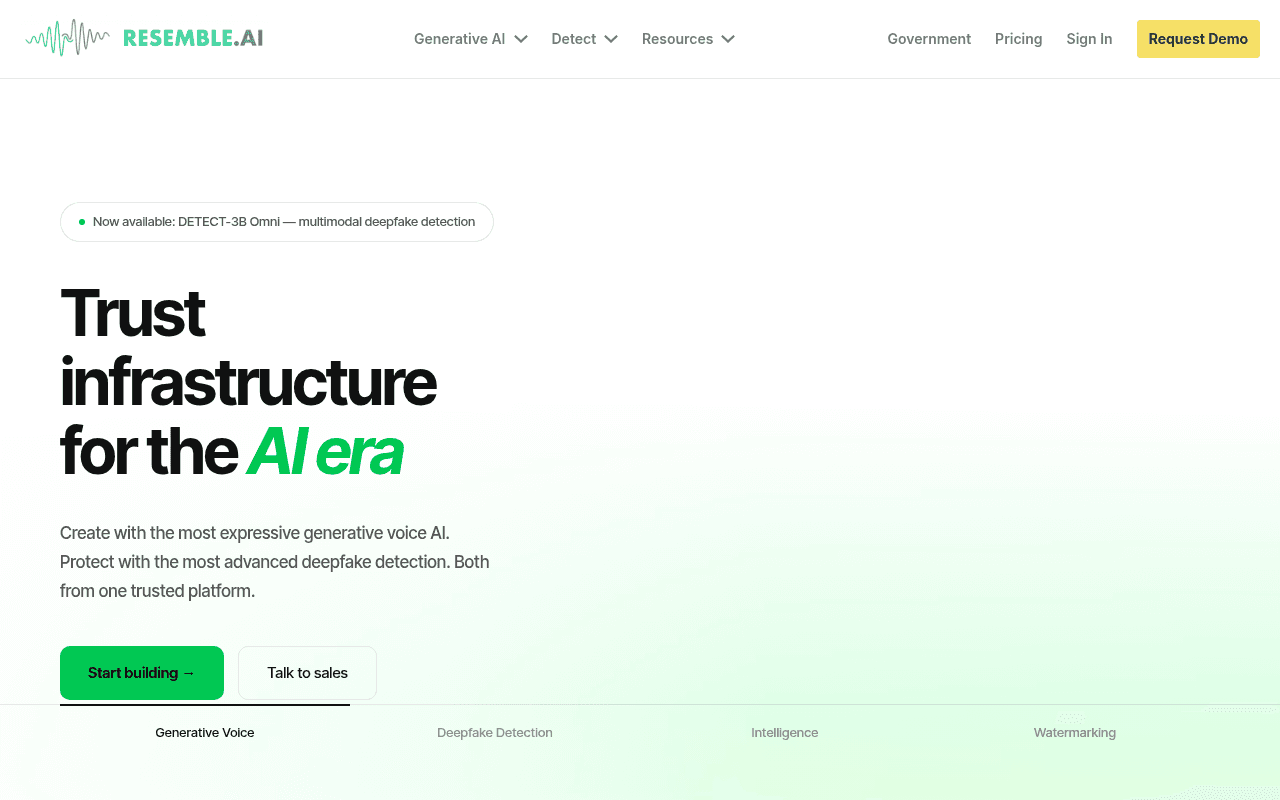
Resemble AI offers advanced tools for creating highly dynamic and personalized IVR audio.
7. WellSaid Labs
WellSaid Labs focuses on producing exceptionally high-quality, studio-grade AI voices, primarily for corporate and media production use cases like e-learning, advertising, and audiobooks. Their platform is built around a collaborative workflow, allowing teams to create, review, and manage voiceover projects. While they offer an API, their core product is a web-based 'Studio' application.
How does this fit into IVR? WellSaid Labs is not optimized for real-time, dynamic text-to-speech. Its API latency is generally higher (often 800ms or more), making it unsuitable for conversational turn-by-turn interactions. However, it is an outstanding tool for creating the static prompts in an IVR system, such as the main welcome message, menu options, and informational recordings. A key benefit cited by users is the ability to make real-time updates to this content without re-hiring a voice actor (WellSaid Labs, 2024). You can generate a new prompt with the exact same professional voice in minutes. Their subscription-based pricing model, which is often seat-based, aligns with this production workflow rather than a high-volume, per-request API model. Use WellSaid Labs to produce your core IVR audio files, and pair it with a lower-latency API for the dynamic parts.
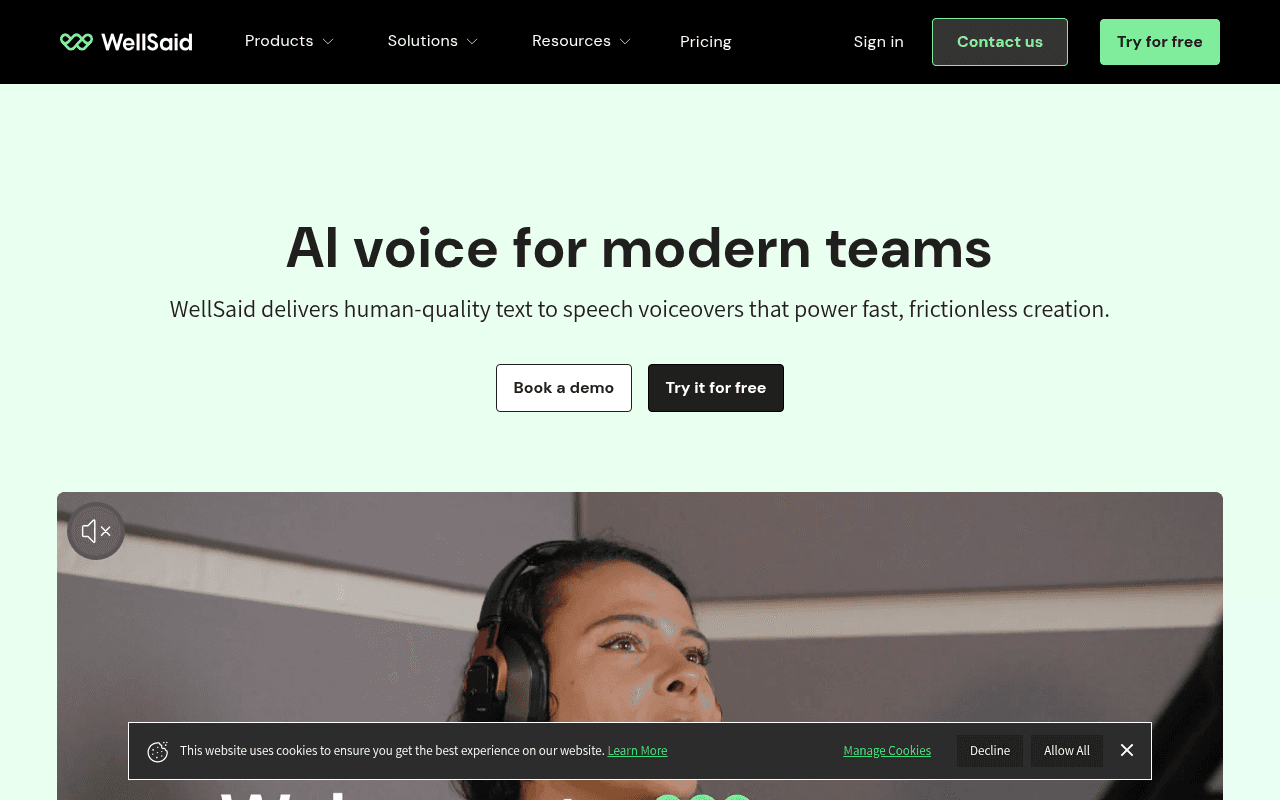
WellSaid Labs is ideal for creating the professional, pre-recorded audio components of an IVR system.
How to Choose the Right TTS API for Your IVR
With about 57% of users preferring to resolve issues via IVR without a live agent (ReAnIn, 2026), the quality of your automated system is non-negotiable. The best text to speech API for IVR depends entirely on your specific priorities.
Here is a verdict based on different needs:
For Maximum Performance and Scalability: Smallest.ai Lightning is the top choice. Its ultra-low latency ensures the most fluid conversational experience, which is crucial for complex, multi-turn IVR interactions.
For Best Brand Identity and Voice Realism: ElevenLabs is unmatched. If creating a unique, emotionally expressive, and consistent brand voice is your main goal, the quality is worth the slightly higher latency.
For an All-in-One Conversational Stack: Deepgram Aura is the most logical option for developers who also need high-performance speech-to-text. The seamless integration simplifies development and optimizes the entire voice AI workflow.
For Strict Data Privacy and Control: Cartesia is the clear winner. The ability to self-host provides an essential security guarantee for industries handling sensitive customer data.
For Pre-recorded Prompts and Narration: WellSaid Labs excels at producing the high-quality, static audio files that form the backbone of any professional IVR menu.
Ultimately, the decision involves balancing speed, quality, cost, and specific features like voice cloning or self-hosting. We recommend testing the top two or three contenders for your use case with a small proof-of-concept to hear the difference and measure the real-world performance within your telephony environment. Understanding the nuances of speech-to-text API pricing models) can also help in forecasting long-term costs.
Frequently asked questions
What is acceptable latency for an IVR TTS system?
What is SSML and why is it important for IVR?
Can I use a custom voice or clone a voice for my IVR?
How much does a text-to-speech API for IVR cost?
What are the benefits of using an AI voice over pre-recorded audio in IVR?