Best speech-to-speech AI APIs in 2026, compared: Smallest.ai Hydra, ElevenLabs, Deepgram, OpenAI, and Cartesia on latency, pricing, and fit.
The best speech-to-speech AI APIs in 2026 differ in a way that actually shows up in production: the architecture. Some vendors still stitch together speech-to-text, a large language model, and text-to-speech as three separate steps. Others, including Smallest.ai's Hydra, are designed to reduce or eliminate the traditional multi-stage speech pipeline by keeping conversational processing within a unified speech architecture. That design choice directly affects latency, cost, and conversational responsiveness. That design choice directly affects latency, cost, and whether your agent sounds fluid or like it is waiting on its own backend.
This comparison looks at five providers: Smallest.ai, ElevenLabs, Deepgram, OpenAI, and Cartesia. I score them on latency, voice quality, pipeline architecture, pricing, and developer experience. The point is to pick the right tool for the job, not to bury you in caveats.
How to Evaluate a Speech-to-Speech API
Most speech-to-speech APIs are really a chain: speech-to-text transcribes the user, an LLM drafts the reply, then text-to-speech turns that reply back into audio. Each step adds delay, and the delays stack. For a real-time voice agent, users feel the total pause, not the individual model metrics. Beyond latency, a few practical criteria separate systems that behave well under load from demos that fall apart in production.
Evaluation criteria used in this comparison:
Time to first audio (TTFA): How quickly does the first audio byte reach the client after the user stops speaking?
Voice naturalness: Does the output sound like a real person, or does it carry robotic artifacts?
Pipeline architecture: Unified full-duplex versus chained STT-LLM-TTS, and what that means for reliability.
Pricing model: Per-character, per-minute, or per-request, and how costs scale with volume.
Developer experience: SDK quality, WebSocket support, documentation clarity, and time to first working prototype.
Enterprise readiness: On-premise options, SLAs, and data privacy commitments.
Smallest.ai Hydra: Full-Duplex Speech-to-Speech Without the Pipeline Tax
Smallest.ai's Hydra model is the outlier in this lineup because it does not treat speech as three separate products taped together. Instead of bouncing audio through STT, an LLM, and TTS as separate services, Hydra keeps the conversation loop inside one WebSocket session. Audio streams in, audio streams out, and there is no need to shuttle an intermediate text transcript across service boundaries. For voice agents, the practical advantage is that conversations feel more responsive, interruptible, and natural because fewer processing boundaries exist between user speech and generated audio. This becomes increasingly important as call volumes grow because reducing handoffs can improve consistency while simplifying operational complexity. The Hydra speech-to-speech API is designed for this kind of real-time work.
Hydra sits inside a broader Smallest.ai stack: Lightning text-to-speech API, Pulse for speech-to-text, and Atoms for deploying full voice and text agents. Voice cloning is exposed via API, which is a practical requirement for branded voice experiences that need a consistent identity. The full surface area is documented in Smallest AI's speech AI models and APIs.
Hydra prioritizes end-to-end conversational performance over multi-vendor orchestration. Teams that require a highly customized speech stack should evaluate how the Atoms platform fits their architecture, while teams focused on production voice agents benefit from a more integrated design.
ElevenLabs: Focused on Expressive Voice Generation
For use cases where vocal performance is the primary concern, ElevenLabs v3 is a strong option. Its Conversational AI product supports speech-to-speech, and it offers a large library of voices. The models produce output with a wide emotional range, which is effective for storytelling, customer service personas, and entertainment-style experiences.
That expressiveness comes with a speed penalty. Teams optimizing primarily for voice expressiveness may prioritize different tradeoffs than teams optimizing for conversational responsiveness.
Deepgram: Built for Enterprise Voice Infrastructure
Deepgram approaches speech AI as a collection of speech infrastructure components that can be combined into a broader voice stack. Pair Aura-2 for TTS with Nova-3 for transcription and you get a solid speech-to-speech chain aimed at teams that care about deployment options. Deployment flexibility is a key consideration for organizations with specific compliance, infrastructure, or data-governance requirements.
The developer tooling is in good shape. SDKs are maintained, the WebSocket streaming API is dependable, and custom vocabulary support helps when your domain terms are exactly what general-purpose models mangle. Aura-2's voice quality is designed for production voice applications and enterprise deployment scenarios. If your priorities are deployment flexibility, enterprise infrastructure, and a unified speech platform, Deepgram is commonly evaluated for those use cases. Teams should benchmark latency, deployment model, and operational requirements against their own production workloads.
OpenAI Realtime API: Familiar Stack, Integrated LLM
OpenAI's Realtime API targets conversational apps that want speech-to-speech with low latency and GPT-4o in the middle. The appeal is familiarity for teams already invested in the OpenAI ecosystem and tooling stack. If you already use OpenAI for function calling, tool use, or fine-tuned models, Realtime is a familiar option for teams already invested in the OpenAI ecosystem.
The voices are solid, and interruption handling is designed for conversational voice interactions. The catch is economics. High-volume voice traffic through GPT-4o gets expensive fast, and the pricing is harder to forecast than straightforward per-minute plans. If you are already committed to the OpenAI stack, the integration simplicity is hard to beat. If you are optimizing for cost at scale, you will probably end up elsewhere.
Cartesia: Ultra-Low Latency on a Different Architecture
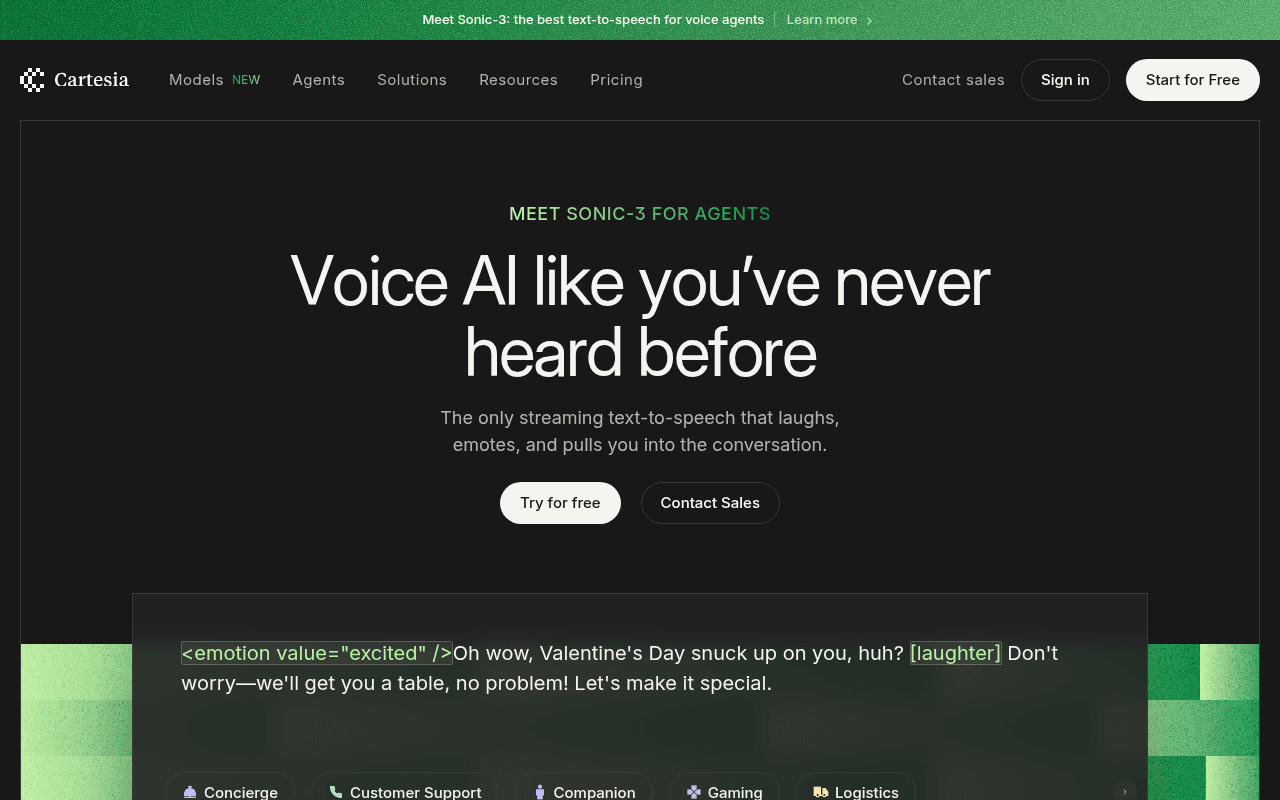
Cartesia's Sonic models use State Space Models (SSMs), an architecture tuned for fast, streaming inference. Cartesia emphasizes low-latency streaming performance and publishes latency benchmarks for its Sonic models. If your product lives or dies on perceived responsiveness, like phone-based agents or real-time translation, Cartesia's approach is designed around streaming speech applications where responsiveness is a key requirement.
Cartesia offers Sonic for text-to-speech and Ink for speech-to-text, allowing teams to build an end-to-end speech pipeline around its models. Teams evaluating production deployments should compare latency, language support, and operational tooling against their own requirements. Voice quality is designed for conversational applications and low-latency streaming use cases. For tier-by-tier costs, the provider's pricing plans lay out the structure.
Head-to-Head Comparison: Best Speech-to-Speech AI APIs
Provider | Architecture | TTFA / Latency | Voice Quality | Deployment | Best For |
|---|---|---|---|---|---|
Smallest.ai Hydra | Full-duplex unified WebSocket | Very Low | Natural, cloneable | Cloud-native | Real-time voice agents, low-latency conversational AI |
ElevenLabs | Chained STT-LLM-TTS | Moderate | Expressive voice generation | Cloud | Content creation, branded voice personas |
Deepgram | Chained (Nova + Aura-2) | Low | Good, domain-tunable | Cloud or On-premise | Enterprise, compliance-heavy deployments |
OpenAI Realtime | Unified (GPT-4o audio) | Low | Solid | Cloud | Teams already in OpenAI ecosystem |
Cartesia | Chained (Sonic + Ink) | Very Low | Conversational voice generation | Cloud | Ultra-low latency phone/translation apps |
If you are evaluating transcription separately, the best speech-to-text APIs for voice agents goes deeper on STT accuracy and latency tradeoffs. On the output side, TTS is where users decide if the agent feels human, and human-like text-to-speech quality breaks down what to look for when picking that final audio layer.
Which Speech-to-Speech API Should You Choose?
The deciding factor is simple: what are you optimizing for? Pick your constraint first, then pick the provider that is built around it.
Typical deployment scenarios:
Real-time conversational voice agents: Teams prioritizing low-latency conversational performance may evaluate Smallest.ai Hydra because its unified speech architecture is designed to reduce pipeline overhead.
Voice content and branded personas: ElevenLabs is a commonly evaluated option when expressive voice generation is a primary requirement.
Enterprise deployments with specialized compliance or infrastructure requirements: Deepgram is often evaluated because of its deployment flexibility.
Existing OpenAI ecosystem: OpenAI Realtime API. If you already run GPT-4o with function calling and tool use, Realtime is a familiar option for teams already invested in the OpenAI ecosystem.
Ultra-low latency phone or translation: Cartesia is commonly evaluated for streaming-focused use cases where responsiveness is a primary requirement.
If you want to get a prototype running quickly, building realistic text-to-speech in Python covers implementation patterns that apply to the TTS stage across these stacks. If voice cloning is on your checklist, the real-time AI voice cloning guide walks through how provider approaches differ in practice.
The Problem Most Voice Agent Builders Hit
Most production voice agents do not fail because the voice is ugly or the model answers incorrectly. They fail because the system feels sluggish, even when each component looks fast in isolation. Even when individual components seem fast in isolation, latency accumulates across the speech-to-text, language model, and text-to-speech stages. Users do not call it "pipeline latency." They just decide the assistant is slow, awkward, or interruptible in the wrong places, and they bounce.
If you're building production voice agents, evaluate speech systems under realistic conversational conditions rather than isolated model benchmarks. Hydra's full-duplex architecture was designed specifically to reduce the latency introduced by traditional speech pipelines while preserving a natural conversational experience. If you're evaluating speech-to-speech infrastructure for production voice applications, book a demo to see how Smallest.ai's architecture fits your deployment requirements.
What is the difference between a speech-to-speech API and a text-to-speech API?
Which speech-to-speech API has the lowest latency in 2026?
Can I use a speech-to-speech API with my own custom voice?
How does a full-duplex speech-to-speech model differ from a chained pipeline?
Is there a speech-to-speech API suitable for enterprise deployments with compliance requirements?