Smart IVR: How AI is Modernizing IVR Systems in 2026

Learn how Smart IVR uses AI, ASR, NLU, and TTS to replace legacy phone trees. A technical guide covering architecture, metrics, and implementation for 2026.
Smart IVR is not a minor upgrade to the phone tree you have been tolerating for years. It is a fundamental rethinking of how automated voice systems handle callers, replacing static menu hierarchies with AI that listens, understands, and responds in natural language. The global conversational AI market is experiencing significant growth, with IVR modernization sitting at the center of that expansion.
This article is written for product managers, contact center architects, and developers who need a clear-eyed view of what smart IVR actually means technically, where the real implementation challenges sit, and how to evaluate the components that make or break the caller experience. You will come away understanding the architecture, the metrics that matter, and the practical decisions that separate a genuinely intelligent voice system from one that merely sounds modern.
What Smart IVR Actually Means (And What It Does Not)
Traditional IVR operates on a decision tree. Press 1 for billing, press 2 for support. The system does not understand language; it recognizes keypad tones or, at best, a narrow set of spoken keywords mapped to fixed branches. The caller adapts to the machine. Smart IVR inverts that relationship entirely.
Using a combination of Automatic Speech Recognition (ASR), Natural Language Understanding (NLU), and text-to-speech synthesis, a smart IVR conducts a real conversation. The caller says 'I was charged twice last month and I need a refund,' and the system parses intent, extracts entities (billing, duplicate charge, refund), authenticates the caller if needed, and either resolves the issue or routes to the right agent with full context already populated. The core components enabling this are machine learning models trained on domain-specific dialogue, not keyword lookup tables.
What smart IVR is not: a chatbot bolted onto a phone line, a voice assistant that reads FAQs aloud, or a legacy IVR with a 'say or press' prompt added. Many vendors market cosmetic upgrades as full conversational AI, so the distinction matters. The test is straightforward: can the system handle an out-of-order, multi-intent utterance on the first try, without asking the caller to restate their request in a different format?
Why Legacy IVR Is Failing at Scale
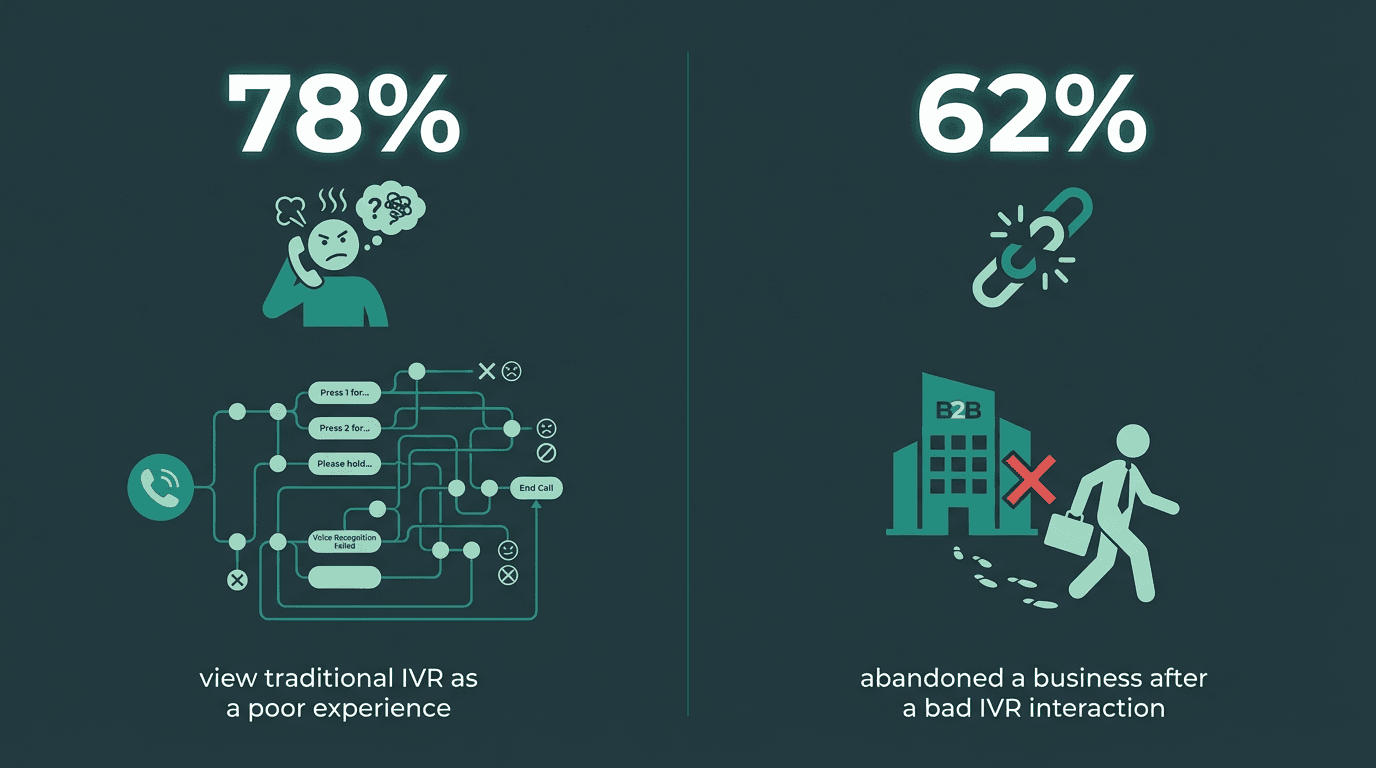
Legacy IVR is not a neutral experience. For most callers, it actively damages brand perception.
A significant share of customers report frustration with legacy IVR, and many enterprises are actively replacing it with conversational AI platforms, specifically because the maintenance burden has become untenable alongside the rising customer experience cost. The structural problems with legacy IVR compound over time. Menus grow as products expand, creating deeper trees that callers cannot navigate. Seasonal volume spikes expose brittle routing logic. Multilingual support requires duplicating entire menu structures. Every change requires developer intervention, making the system slow to adapt to new business realities.
The Technical Architecture of a Smart IVR System
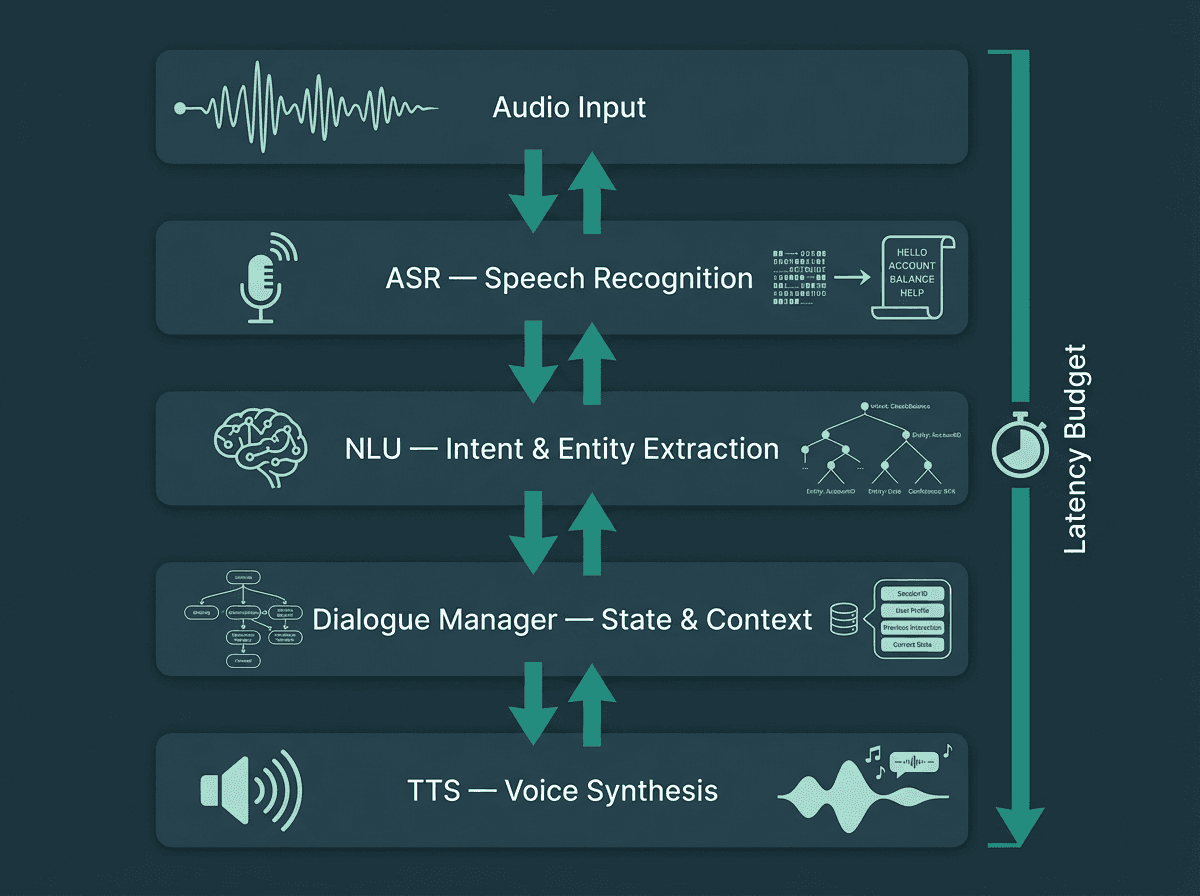
Every millisecond in the latency budget is shared across four layers. Optimizing one without the others produces diminishing returns.
A production-grade smart IVR has four core layers. Understanding how they interact is essential before making any vendor or build decision.
The four layers of a smart IVR stack:
Speech Recognition (ASR): Converts caller audio into text in real time. Accuracy under noisy conditions, telephony-grade audio (8kHz narrowband), and low-latency transcription are the critical requirements. For a proper benchmark of this layer, the guide on how to evaluate Automated Speech Recognition (ASR) covers the right metrics in detail.
Natural Language Understanding (NLU): Parses transcribed text to extract intent and entities. This is where the system determines what the caller actually wants, not just which words they used.
Dialogue Management: Holds conversation state across multiple turns, handles clarification prompts, manages context carryover, and decides when to escalate to a human agent. Stateless NLU implementations fail the moment a caller says 'actually, change that to Tuesday.'
Text-to-Speech (TTS): Converts the system's response back into audio. Voice quality, latency, and prosody naturalness directly affect whether callers trust the system. Choosing the right text-to-speech APIs for IVR is one of the most consequential decisions in the stack.
The interaction between these layers determines end-to-end latency, which is the single most important UX metric in voice. Based on commonly observed UX thresholds, a 400ms delay between a caller finishing a sentence and the system responding feels natural. A 1.2-second delay feels broken, even if the response is correct. Each layer contributes to that budget, and optimizing the stack means understanding where the bottlenecks actually live, not just picking the fastest individual component.
Where Most Smart IVR Deployments Actually Break
Most implementation guides skip this section. The technology works in demos. It breaks in production for reasons that are almost always predictable in advance. Three failure modes account for the majority of real-world problems.
Acoustic mismatch is the most common. ASR models trained on clean studio audio degrade significantly on telephony audio, background noise, accented speech, or callers using speakerphone. The fix is not a better model in isolation; it is a model specifically trained and evaluated on telephony-grade audio. The National Institute of Standards and Technology (NIST) maintains benchmarking standards for speech recognition that are worth understanding when evaluating ASR vendors.
Dialogue state collapse surfaces in multi-turn conversations, where the system needs to remember what was said two exchanges ago. Many NLU implementations are stateless by design, which handles single-turn queries adequately but fails the moment a caller introduces a correction or a compound request. The dialogue manager must hold context across the full session.
TTS voice quality eroding trust is subtler but measurable. A technically accurate response delivered in a flat, robotic voice causes callers to distrust the information even when it is correct. The quality gap between mediocre synthesis and a natural-sounding voice shows up directly in customer satisfaction scores. The comparison of most realistic text-to-speech AI options in 2026 gives a useful benchmark for what the top of the range actually sounds like.
Key Metrics for Evaluating Smart IVR Performance
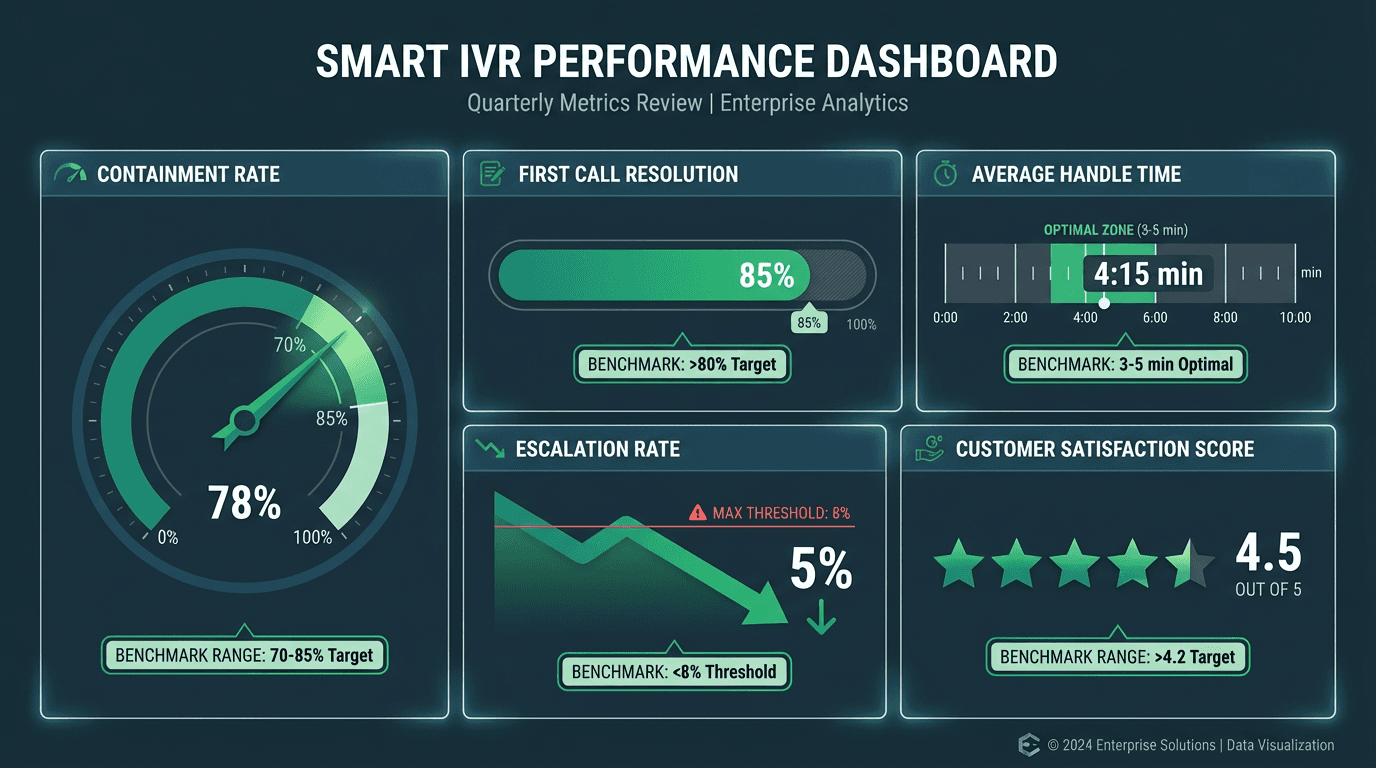
These five metrics collectively tell you whether your smart IVR is solving problems or just deflecting them.
Containment rate is the headline metric: the percentage of calls fully resolved without a human agent. Used in isolation, though, it is misleading. A system that traps callers in dead ends will post a high containment rate while destroying satisfaction scores. Track these five together for an honest picture:
Containment Rate: Percentage of calls resolved end-to-end by the AI. Businesses implementing AI-powered IVR consistently report reductions in live-agent call volume alongside measurable improvements in customer satisfaction scores.
First Call Resolution (FCR): Did the caller's actual problem get solved, not just acknowledged?
Escalation Rate and Quality: When the system transfers to an agent, does it pass full context? A clean handoff with populated data is a success. A cold transfer is a failure, regardless of what the containment rate says.
Word Error Rate (WER) in production: Not in the vendor's benchmark environment, but on your actual call audio. Even a 5% WER difference meaningfully degrades NLU accuracy downstream.
Turn-to-resolution ratio: How many conversational exchanges does the average successful call require? Lower is generally better, but not at the cost of forcing callers to compress complex requests into a single utterance.
Building vs. Buying: What the Decision Actually Involves
The build-vs-buy question in smart IVR is rarely binary. Most production deployments are hybrid: a platform handles telephony infrastructure and dialogue orchestration, while the ASR and TTS layers are sourced from specialized API providers. The reason is specialization. A vendor focused exclusively on low-latency speech synthesis will outperform a general-purpose platform's bundled TTS on the metrics that matter for voice.
For teams evaluating the component approach, the roundup of best speech-to-text APIs available in 2026 is a practical starting point for the ASR layer. For the full picture across providers, the analysis of building a voice agent stack covers latency, cost, and accuracy trade-offs in a way that maps directly to IVR architecture decisions.
The operational overhead of a fully custom build is real. Platform solutions reduce that burden but introduce vendor dependency. The right answer depends on call volume, customization requirements, and internal engineering capacity, and those three variables rarely point in the same direction.
Enterprise and Industry-Specific Considerations
Smart IVR behaves differently across industries, and implementation requirements shift significantly depending on the use case.
Industry-specific constraints that shape the stack:
Financial services: Caller authentication, PCI compliance for payment handling, and regulatory call recording requirements add layers of complexity that a generic deployment does not address. These constraints shape voice AI architecture in banking and insurance, as covered in our solutions for AI voice agents.
Healthcare: HIPAA requirements around data handling and strict limits on what the AI can say without clinical oversight define the boundaries of what is deployable. The compliance layer is not optional and cannot be retrofitted.
Retail and e-commerce: Implementations here prioritize order status, returns, and real-time inventory queries, which require tight CRM and ERP integration. The IVR is only as smart as the data it can access. A well-designed dialogue manager connected to a stale or siloed data source will still produce wrong answers.
For organizations assessing whether their current architecture can scale to enterprise requirements, the evaluation of whether your voice agent is prepared to handle enterprise needs provides a useful framework for identifying gaps before they become production incidents.
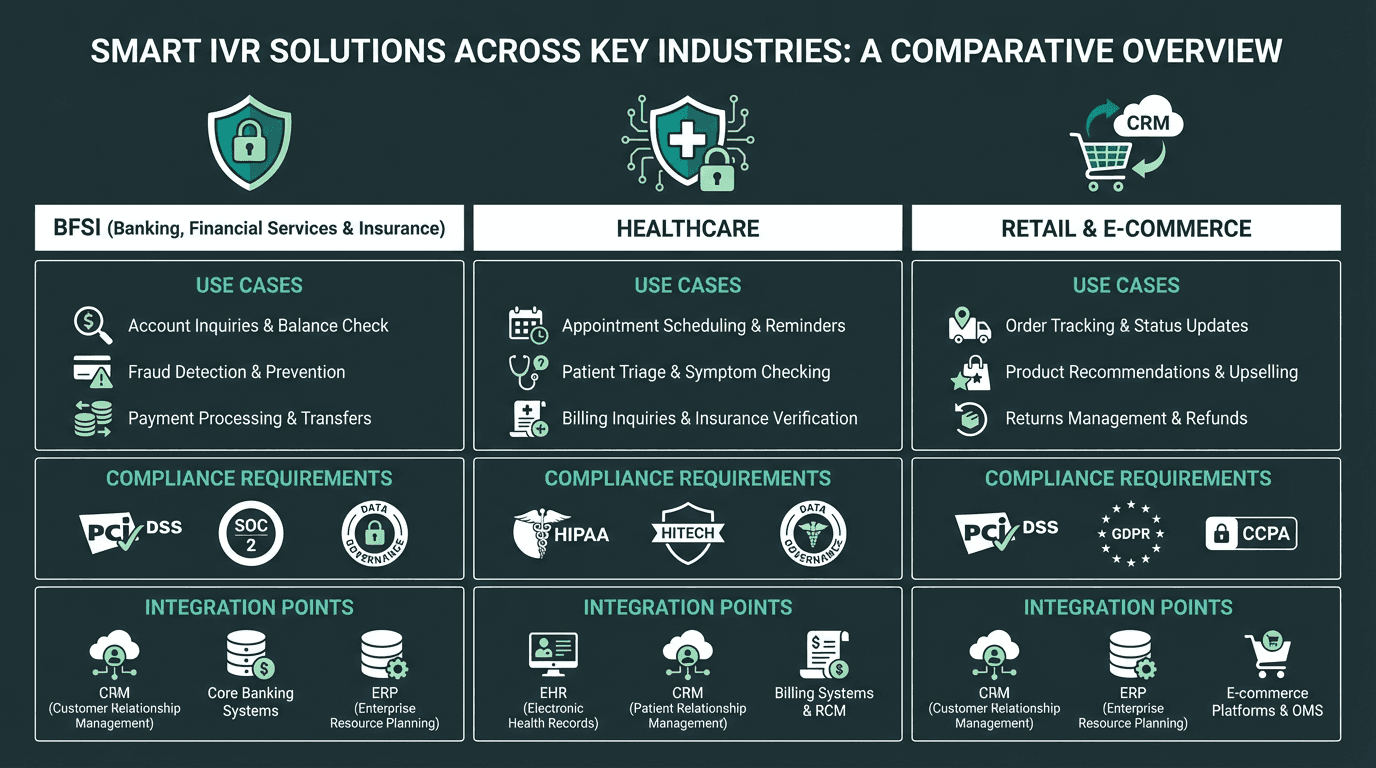
Industry context shapes every layer of the smart IVR stack, from compliance requirements to integration architecture.
Summary and Next Steps
Smart IVR in 2026 is a solvable engineering problem, but only if you treat it as a system design challenge rather than a vendor selection exercise. The core reality is that each layer of the stack (ASR, NLU, dialogue management, TTS) has distinct performance requirements, and the weakest layer determines the caller experience regardless of how strong the others are.
The practical path forward: audit your current IVR against the five metrics above, identify which layer is creating the most friction, and evaluate replacements at that layer specifically before rebuilding the whole stack. For most organizations, the TTS layer is where the experience gap is most immediately audible, and it is also the easiest component to swap without disrupting the rest of the architecture.
Every IVR modernization project starts from the same problem: callers are abandoning interactions because the system cannot understand them, and that abandonment has a direct cost in lost revenue and damaged trust. The answer is not more menu options or a friendlier hold message. It is a voice layer that processes natural language with low latency and responds with audio that callers find credible. Smallest.ai's Lightning TTS model is built specifically for this requirement, delivering sub-100ms latency in optimal conditions on telephony-grade audio with voice quality that holds up across the full range Nof production conditions. If the voice layer is where your IVR is losing callers, that is the right place to start.
Frequently asked questions
What is the difference between smart IVR and a traditional IVR system?
How do I measure whether my smart IVR is actually working?
What causes high latency in smart IVR systems, and how can it be reduced?
Can smart IVR handle multiple languages and accents reliably?
Is smart IVR suitable for small businesses, or is it primarily an enterprise solution?