IVR voice bot demo: How AI voice agents handle calls, routing, and FAQs

IVR voice bot demo breakdown: architecture, AI call routing, FAQ automation, latency targets, and the red flags that separate a demo from production.
An IVR voice bot is an AI-powered phone system that swaps out touch-tone menus for spoken conversation. Callers say what they need in plain language; the system routes the call, answers common questions, and hands off the messy edge cases to the right human agent without forcing anyone through a keypad maze. Where legacy interactive voice response depends on rigid keypress trees, a modern IVR voice bot runs a real-time loop of speech recognition, language understanding, and text-to-speech so the call can move like an actual dialogue, not a script.
If you have watched an IVR voice bot demo and wondered what is really happening behind the curtain, this breaks the system down into its working parts: the architecture, the way routing and FAQs get orchestrated, and the places where the tech shines versus where it still needs guardrails. The keyword "IVR voice bot demo" tends to attract product managers, contact center architects, and developers who are trying to judge the tech before they commit to building it, so the aim is a technically honest view rather than a glossy one.
What an IVR Voice Bot Actually Is (and What It Is Not)
"IVR" comes with decades of baggage. The classic systems that tell you to "press 1 for billing, press 2 for support" are deterministic state machines: every path is prewritten, every branch expects a keypress, and the caller is the one who has to adapt. A voice bot flips that relationship. The caller speaks naturally, and the system is responsible for keeping up.
A modern AI voice bot, whether it sits on top of a legacy IVR stack or replaces it outright, is built around a simple sequence that has to run fast: speech-to-text transcribes what the caller says, a language model interprets intent and produces the next response, and text-to-speech turns that response back into audio. On well-optimized infrastructure, a full turn should have low conversational latency. This is not trivia: as response delays increase, conversations begin to feel less natural and callers become more likely to interrupt, disengage, or assume the system has stopped responding.
What an IVR voice bot is not: a text chatbot with a microphone bolted on. Chat has slack; people can skim, pause, and wait. Phone calls do not. They are synchronous, turn-based, and brutally sensitive to latency spikes. If your architecture is really a chat backend dressed up with audio, callers will feel it. That gap explains why a lot of early deployments disappointed, and why purpose-built voice agents designed for telephony tend to land a noticeably better experience.
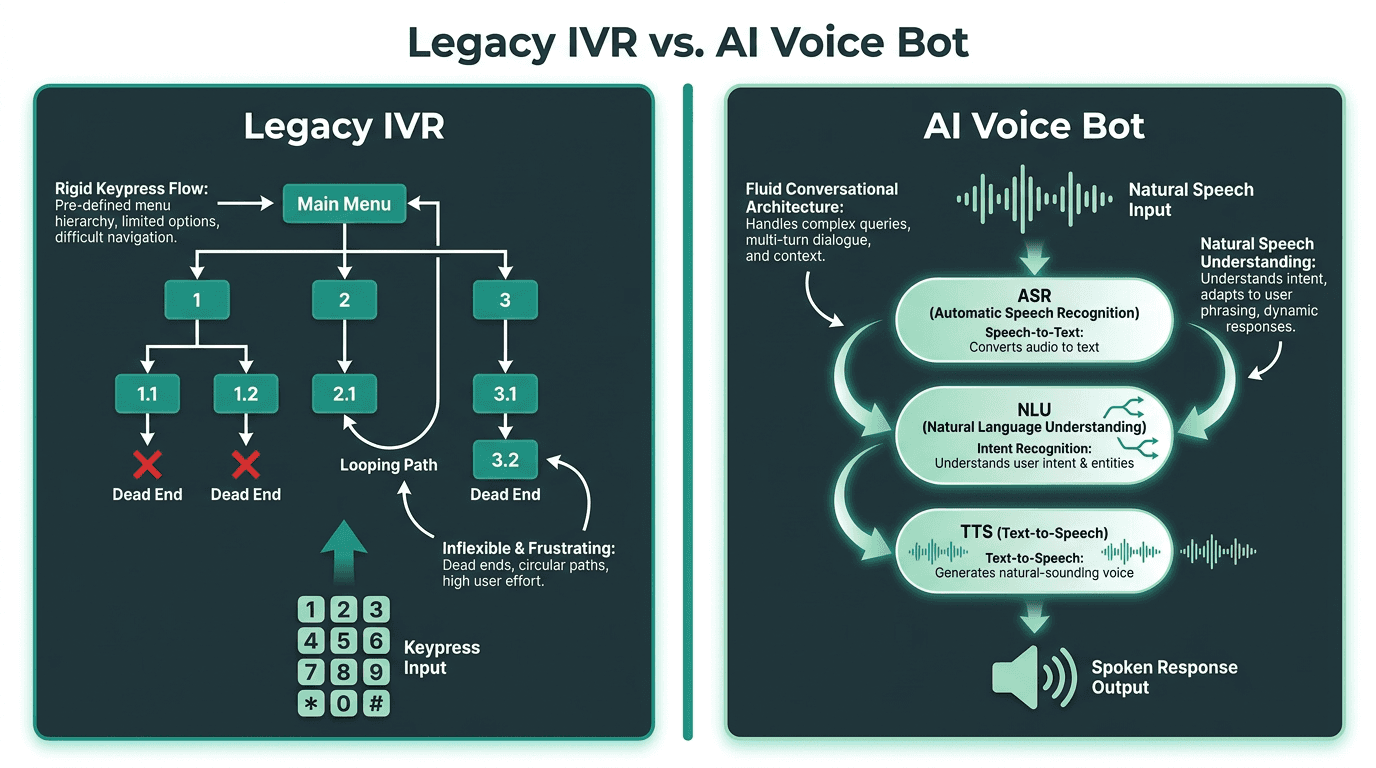
Legacy IVR locks callers into numbered menus; AI voice bots process natural speech through ASR, NLU, and TTS layers.
The Architecture Behind a Voice Bot Demo
A live IVR voice bot demo is really a fast-moving pipeline, with multiple layers cooperating under tight timing constraints. Knowing what those layers are makes it easier to judge the demo on its merits, and to spot what the presenter is quietly papering over. A well-designed system often resembles a conversational AI platform built specifically for voice.
The five functional layers in a production-grade AI voice bot:
Telephony interface: SIP trunking or PSTN integration that receives the inbound call and streams audio to the processing pipeline. This layer handles codec negotiation (G.711, Opus) and jitter buffering.
Speech-to-text (ASR): Converts the caller's audio stream into a text transcript in real time. Accuracy on telephony-grade audio (8 kHz, noisy environments) is a distinct challenge from clean studio audio.
Natural language understanding (NLU) / language model: Classifies intent, extracts entities (account numbers, dates, names), manages conversation state, and decides the next action: answer, route, or escalate.
Text-to-speech (TTS): Synthesizes the bot's response into speech. Latency here is critical. A TTS engine that takes too long to generate the first audio chunk will make the entire conversation feel sluggish.
Orchestration and routing logic: The decision layer that connects intent outputs to downstream actions: transferring to a queue, triggering a CRM lookup, sending an SMS confirmation, or ending the call.
In most demos, the layer that gives the game away is TTS. Plenty of platforms lean on cloud TTS APIs, and the round trip often adds significant delay to every response. Neural TTS latency is a familiar bottleneck in voice systems, and the difference between responsive voice interactions and noticeable lag is not subtle. Callers hear it immediately, even if they cannot name it.
How Call Routing Works in an AI Voice Bot
Routing is where an IVR voice bot stops being a science project and starts paying for itself. In a legacy IVR, routing is basically a decision tree: press a number, get transferred. With an AI voice bot, routing is driven by intent and informed by context.
When a caller says, "I need to dispute a charge on my account from last Tuesday," a capable bot should not just latch onto "billing" and fire a transfer. It can identify the intent (dispute), pull out the entity (a charge), capture the time reference (last Tuesday), and, if the integration exists, match the caller's number to a CRM record before routing. The handoff can include that context payload so the receiving agent does not have to start with, "Can you repeat that?" This ability to pass context is what separates a well-built AI call center agent from a menu system that happens to speak.
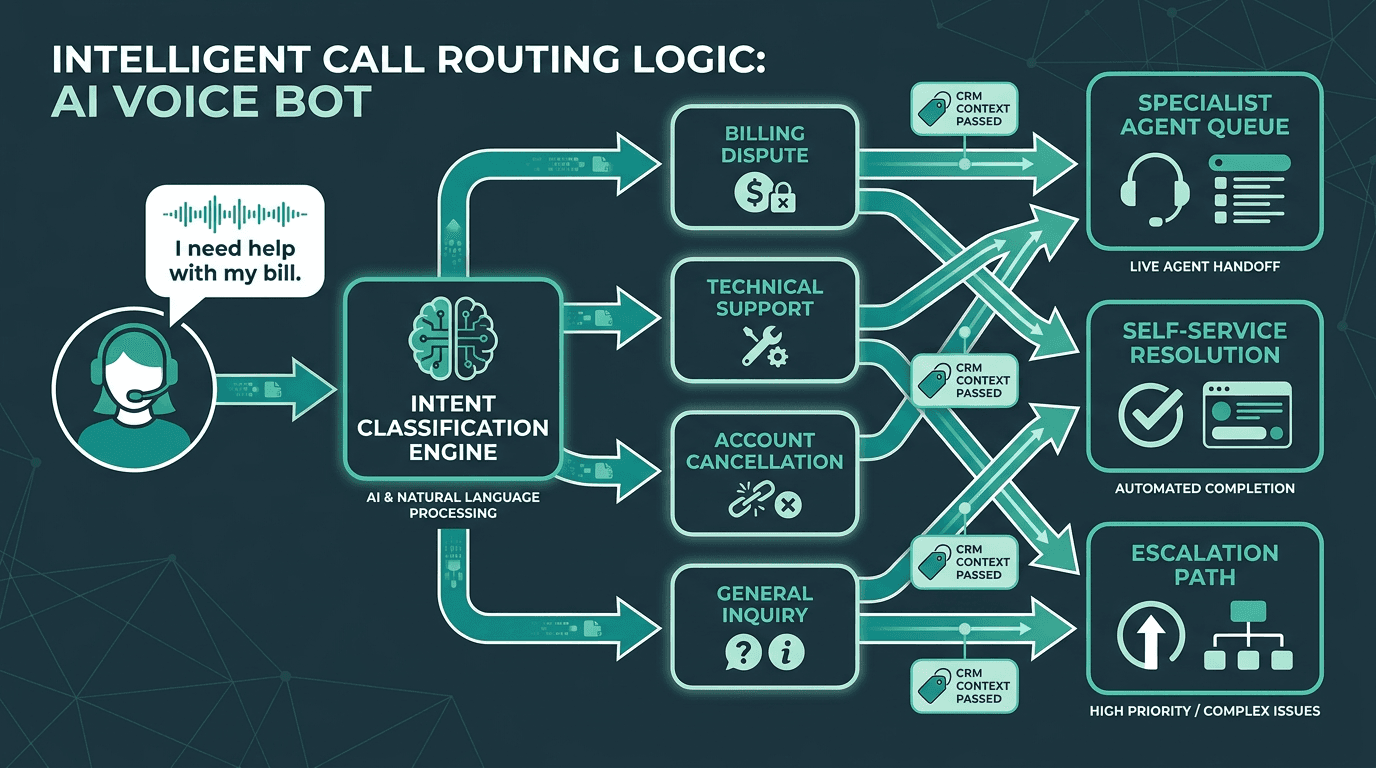
Intent-driven routing delivers context to agents before the call even connects.
How FAQ Handling Works at Scale
FAQs are where most contact centers drown in volume, and where voice bots usually show ROI first. In many contact centers, a large share of inbound volume consists of repetitive questions such as store hours, account status requests, appointment scheduling, and policy inquiries.
To handle that load, a voice bot needs a retrieval layer, either a structured knowledge base or a retrieval-augmented generation (RAG) setup, so the language model can pull the right source material before it speaks. The make-or-break detail is confidence thresholds. When the system is not confident, it should not bluff. The correct behavior is to flag ambiguity and offer a transfer or a follow-up message. Callers are generally fine with, "I want to make sure I get this right for you, let me connect you with someone," and far less forgiving of a smooth, confident answer that is simply wrong.
For teams building AI phone agents that handle inbound calls and FAQs automatically, the FAQ layer is usually the first thing configured and the first thing a demo tries to show off. It is also the place where voice quality has an outsized effect on trust. A robotic-sounding response to a sensitive billing question can make an otherwise correct answer feel dubious.
What a Good IVR Voice Bot Demo Should Show You
Demos vary wildly, and the slickest ones can conceal the exact weaknesses that will hurt you in production. When you are evaluating a bot, you want to push it off the happy path. Here is a practical set of things worth probing while you watch (or run) a demo:
Capability | What to Test | Red Flag |
|---|---|---|
Latency | Time the gap from the end of caller speech to the first audio byte of the reply | Noticeable delays between turns |
Interruption handling (barge-in) | Interrupt the bot mid-sentence and keep talking | The bot talks over you and finishes the whole script |
Ambiguous intent | Say something vague like "I have a problem" | It routes instantly instead of asking a clarifying question |
Noisy audio | Try background noise or a weak mobile connection | Transcription quality degrades significantly |
Context retention | Refer back to something you said two turns earlier | It treats each turn like a fresh start, with no memory |
Graceful escalation | Ask a question outside its knowledge | It loops, hallucinates, or strands the caller |
CRM integration | Ask about your specific account | It cannot pull personalized data |
Common Misconceptions About IVR Voice Bots
"It will replace all our agents immediately"
Voice bots are strong at high-volume, repeatable interactions. Calls that are complex, emotionally charged, or legally sensitive still need human judgment. The realistic operating model is containment: the bot resolves a meaningful portion of repetitive call volume and routes the remaining conversations to human agents with full context. The point is not to erase agents; it is to expand capacity and keep humans focused on work that actually requires a human.
"Accuracy is good enough out of the box"
Telephony audio is a harder environment than a clean microphone. Accents, domain-specific language (medical codes, product SKUs, account numbers), and shaky network conditions all drag ASR performance down. Even a small word error rate becomes a serious problem when the missed words are the account number that drives everything downstream. Word error rate and its impact on voice agent quality is worth understanding before you sign off on any production rollout.
"Any TTS voice will do"
Callers often judge the quality and credibility of a system based on how natural the voice sounds. A flat, robotic voice reads as "cheap automation," which tends to raise hang-up rates and lowers willingness to engage. Picking a voice and tuning naturalness is a product decision with real operational consequences, not a cosmetic afterthought.
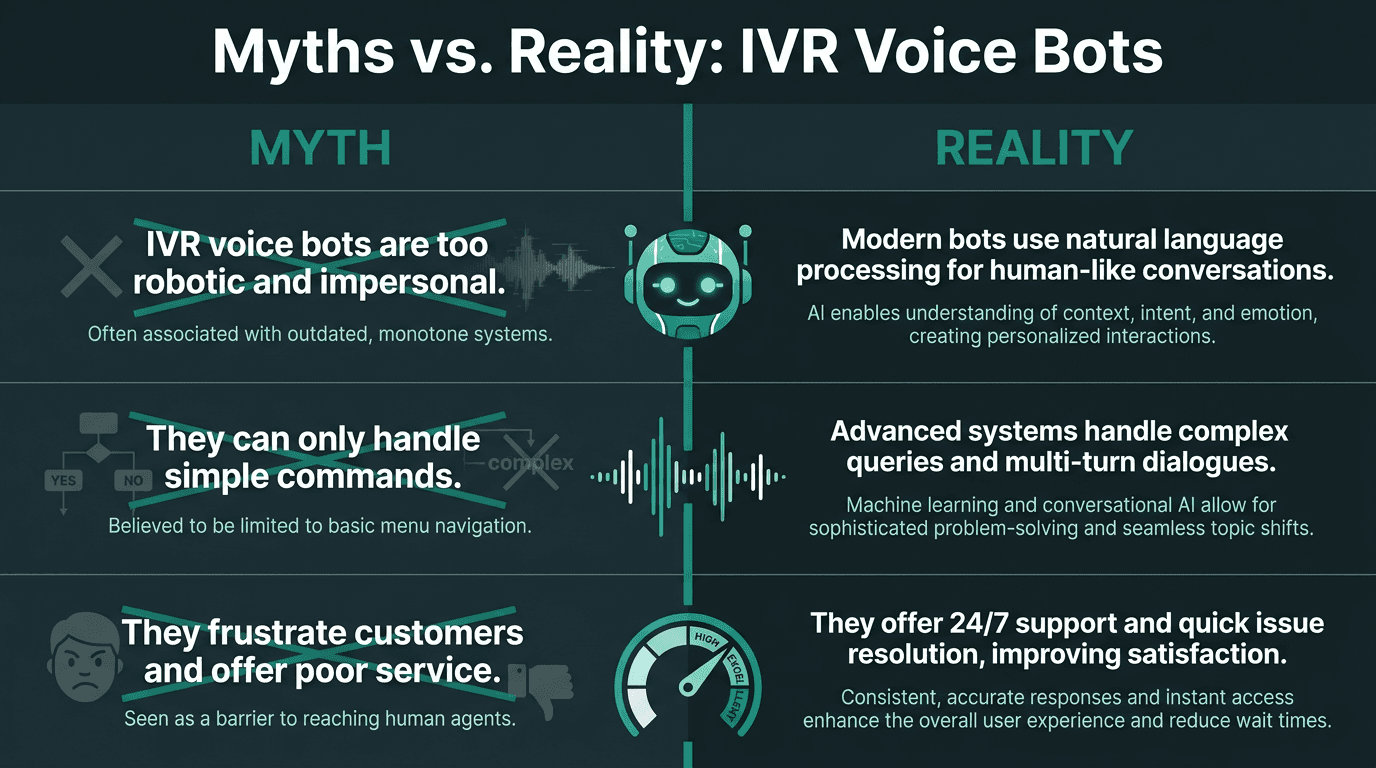
Three common IVR voice bot misconceptions debunked — critical context before any production rollout.
Key Takeaways
What you need to know about IVR voice bots:
An IVR voice bot replaces touch-tone menus with natural-language conversation, running ASR, NLU, and TTS as a real-time pipeline.
Routing in a modern voice bot is intent-driven rather than menu-driven, and it can pass caller context to human agents during transfer.
FAQ automation can reduce repetitive call handling when the knowledge base is accurate and regularly maintained.
Keeping each turn responsive is the rough threshold for a natural experience; TTS first-chunk latency is the most common drag on responsiveness.
A demo should be stress-tested for barge-in, noisy audio, vague intents, and clean escalation paths, not just scripted happy flows.
Voice quality (TTS naturalness) shapes caller trust and willingness to engage; it is a product choice with measurable impact.
Production performance depends on ongoing iteration: conversation analytics, knowledge base updates, and ASR tuning for your caller population.
From Demo to Production: The Problem This Technology Solves
The problem an IVR voice bot solves is bigger than cost cutting. It is the growing mismatch between what callers expect and what legacy phone systems can deliver. By 2026, callers expect to speak normally, be understood quickly, and get to an answer without wandering through menus or sitting on hold just to hear a basic policy. Legacy IVR was designed for a different era, with different constraints. That gap between expectation and experience keeps widening.
Closing that gap takes more than stitching together a handful of APIs. You need a stack built for real-time voice, where each layer is tuned for telephony: ASR that holds up on 8 kHz audio and TTS that can respond with low conversational latency. That is what Smallest.ai's Atoms platform is built to do. Atoms combines the Lightning TTS engine (optimized for low-latency voice output), the Pulse speech-to-text layer, and the Electron conversational model into a unified platform for inbound calls, FAQ resolution, and intelligent routing, without the latency penalties that tend to show up in stitched-together stacks. If you want to move past watching demos and test your own call flows, book a voice agent demo to see what production-grade performance looks like.
Frequently asked questions
What is the difference between a traditional IVR and an AI voice bot?
How does an IVR voice bot handle calls it cannot resolve?
What latency should I expect from a production AI voice bot?
Can an AI voice bot integrate with our existing CRM and telephony systems?
How long does it take to deploy an IVR voice bot for a contact center?