Free ElevenLabs alternatives for 2026: Top Options Compared

Comparing free ElevenLabs alternatives in 2026. Discover which TTS platforms are genuinely free, what restrictions apply, and which tools suit your use case.
The phrase 'free plan' in the text-to-speech world has become almost meaningless without context. Some tools give you a genuinely usable free tier. Others hand you 5,000 words a month, slap on a non-commercial restriction, and call it free. If you are evaluating ElevenLabs alternatives for a real project in 2026, the most important question is not just 'does it have a free tier?' but 'what can I actually do with it?'
This guide cuts through the marketing language. It covers which platforms offer genuinely usable free access, what the hidden restrictions are, how open-source options compare, and where paid tiers become unavoidable. The global text-to-speech market is projected to grow from $4.92 billion in 2025 to $5.83 billion in 2026 (The Business Research Company, 2026), which means more vendors, more pricing tiers, and more fine print to read. This guide is for developers, content creators, and product teams who want clarity before committing.
What 'free' actually means in TTS pricing
Before comparing platforms, it helps to understand the three distinct categories that get lumped under the word 'free' in TTS marketing. The first is a genuine free tier: a permanent, no-credit-card plan with a monthly character or word allowance that resets. The second is a free trial: time-limited or credit-limited access that expires, often requiring a card upfront. The third is open-source: software you can run yourself with no usage fees, but with infrastructure and maintenance costs that are very real.
The distinction matters enormously depending on your use case. A developer building a prototype needs something that will not expire mid-build. A content creator monetizing YouTube videos needs a commercial license, not just character credits. A startup with engineering capacity might find open-source the most cost-effective path. Most comparison articles skip this framing entirely and just list features. That is where they fail the reader.
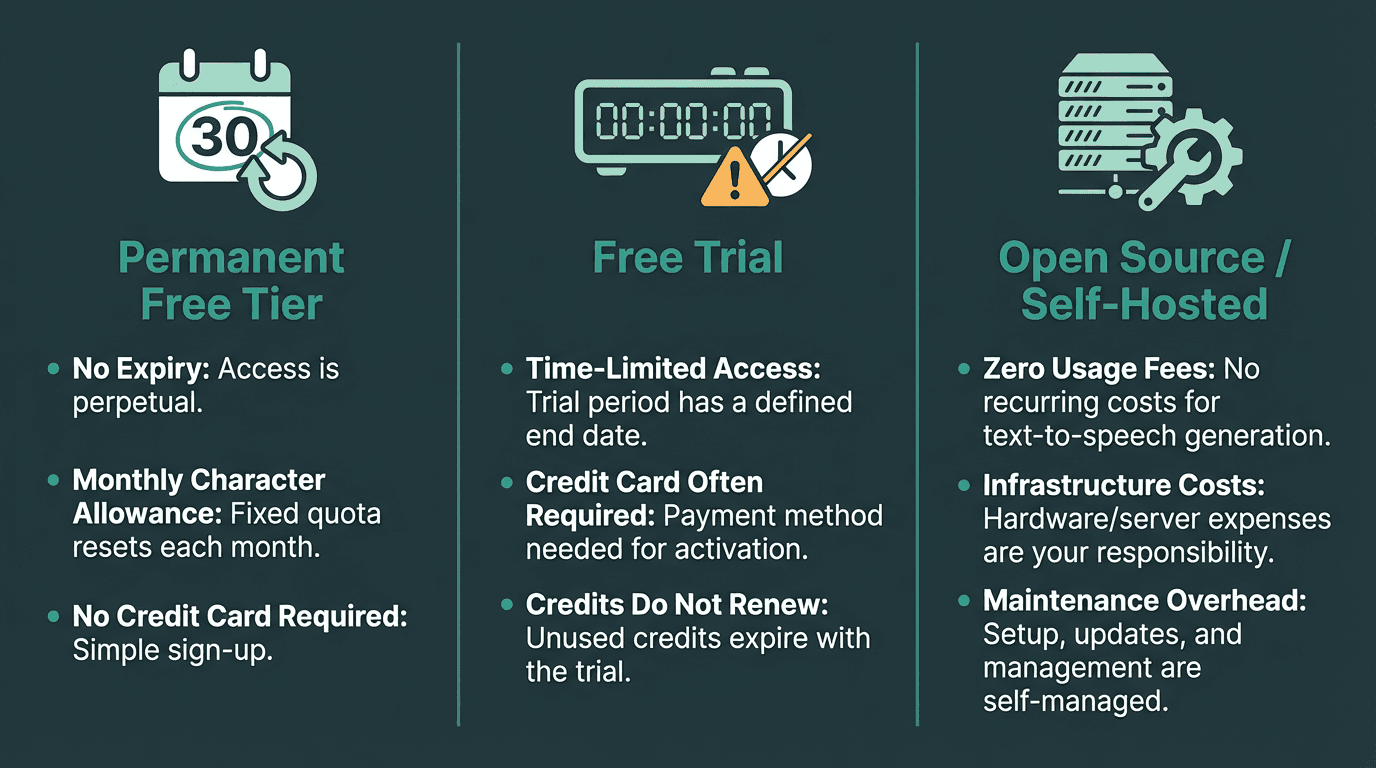
Understanding which category a 'free' plan falls into changes everything about its practical value.
ElevenLabs free plan: What you actually get
ElevenLabs is the benchmark most people use when searching for alternatives, so it is worth being precise about what its free tier includes. The ElevenLabs free plan provides 10k credits per month. That is roughly 1,500 to 1,700 words, depending on average word length. The free tier is meant for personal projects. Commercial usage rights and Instant Voice Cloning require an upgrade. For a hobbyist testing the technology, that is workable. For anyone building a product, publishing content commercially, or needing consistent volume, it runs out fast.
This is not a criticism of ElevenLabs as a product. The voice quality is genuinely strong, and the platform has earned its reputation. But the free tier is designed as a tasting menu, not a working kitchen. Knowing that upfront saves a lot of frustration when you hit the wall mid-project.
The main ElevenLabs alternatives and their actual free access
Platform | Free Allowance | Commercial License | Voice Cloning | Expires? |
|---|---|---|---|---|
ElevenLabs | 10,000 credits/month | No | No | No (permanent tier) |
Smallest.ai | a free tier with credits to test the platform | Yes | Yes | No |
Deepgram | $200 in free credits | Yes | N/A | Yes |
Chatterbox (open-source) | Unlimited (self-hosted) | Check model license | Yes | No |
Deepgram takes a different approach entirely: new users receive $200 in free credits that can be applied across its voice AI services including TTS. That is genuinely useful for a developer building and testing an integration, but teams should still verify the latest credit terms and post-credit pricing before committing. For a broader look at how these platforms stack up beyond just pricing, the most realistic text-to-speech AI comparison for 2026 covers voice quality in detail.
Test Smallest.ai’s Lightning TTS with free credits
Open-source alternatives: Genuinely free but not free of cost
Open-source models like Chatterbox, which has seen significant development, represent a major alternative. It is open-source, which means no per-character fees and no usage caps once deployed. But 'free' here means free of licensing fees, not free of effort. You need infrastructure to run it, engineering time to deploy and maintain it, and the technical capacity to handle updates and scaling.
For a team with strong ML engineering resources, open-source TTS is a compelling path. For a solo developer or a small content team, the operational overhead often outweighs the cost savings compared to a well-priced API. The honest framing is this: open-source is free in the way that a plot of land is free to build on. The land costs nothing; everything else does.
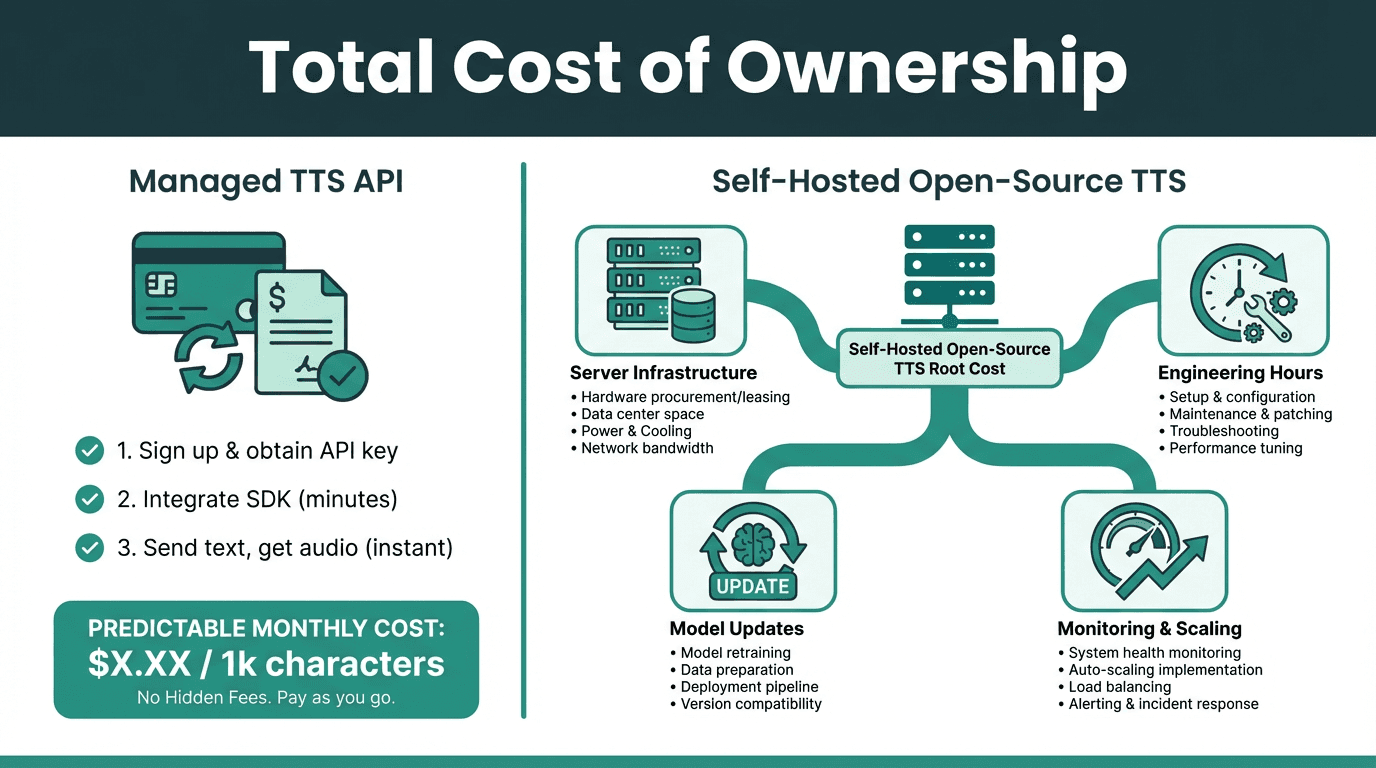
Open-source TTS eliminates licensing fees but introduces infrastructure and maintenance costs that add up.
Commercial use and licensing: The fine print that changes everything
This is the section most comparison guides skip, and it is arguably the most important one. A free tier with a non-commercial restriction is not free for most professional use cases. If you are a content creator monetizing a YouTube channel, a developer building a SaaS product, or a company using TTS in customer-facing applications, you need a commercial license. Several platforms that advertise free tiers either exclude commercial use entirely or require attribution that is impractical in audio contexts.
Before committing to any platform, check three things: whether the free tier includes commercial rights, whether attribution is required, and whether the voice models themselves carry any third-party licensing restrictions. The commercial use and licensing guide for ElevenLabs alternatives walks through exactly what to look for and provides a practical checklist for teams that need to stay compliant.
What most people get wrong about 'free' TTS for developers
Developers evaluating TTS APIs often focus on the free tier allowance and miss the more important question: what does the pricing look like once you scale? A platform that gives you $200 in credits but charges $0.03 per 1,000 characters after that could become expensive quickly in a production environment. Conversely, a platform with a smaller free tier but aggressive volume pricing might be far more cost-effective at scale.
Latency is the other factor that rarely shows up in free tier comparisons but matters enormously for real-time applications. A TTS API with generous free credits but 800ms response times is not viable for conversational AI or live voice interfaces. If you are building anything that requires low-latency speech synthesis, the free text-to-speech API guide for developers in 2026 covers the technical benchmarks worth checking before you integrate.
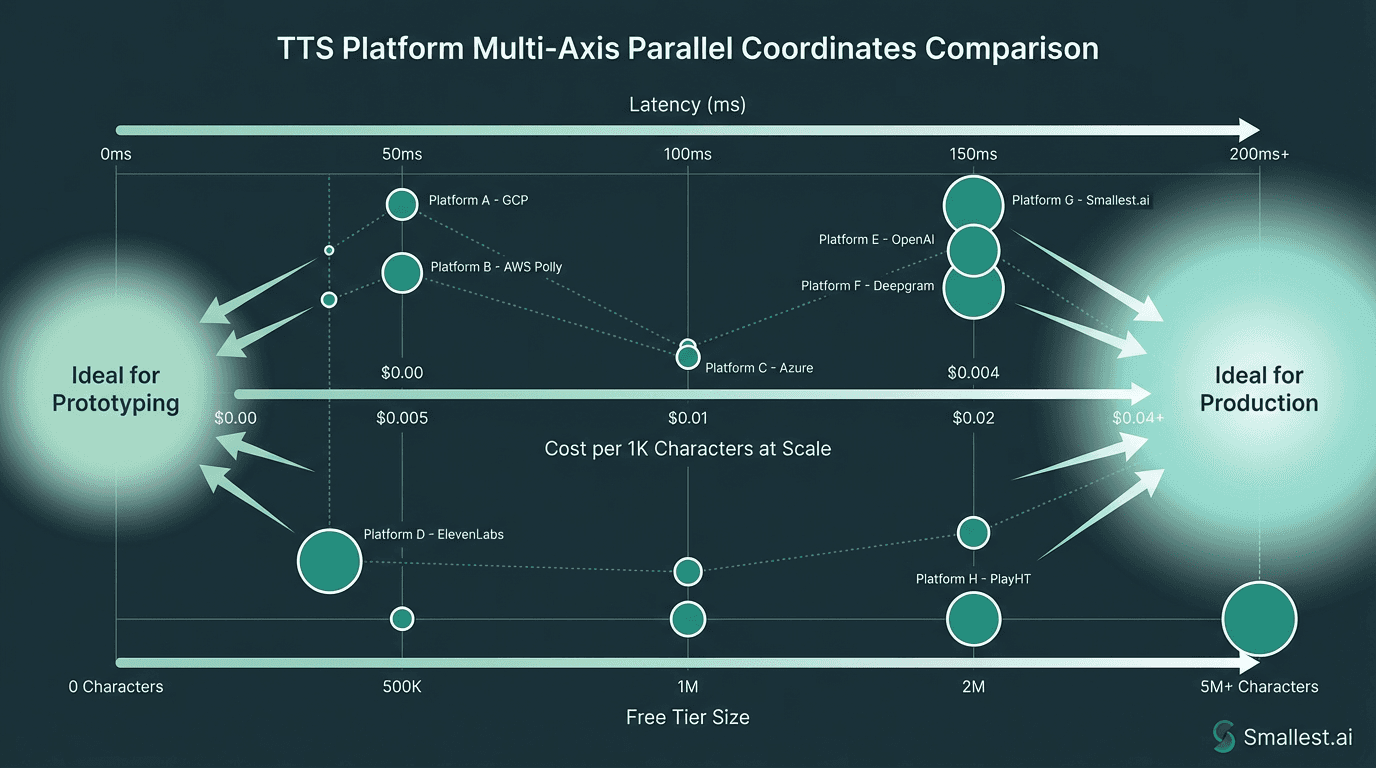
For production deployments, latency and per-character pricing at scale matter more than free tier size.
Practical guidance: Matching the right tool to your actual use case
The right free alternative depends entirely on what you are building or creating. Here is a direct breakdown without the usual hedging.
Use case matching guide:
Prototyping or personal projects: A platform's free tier or another's starter credits both work well. Neither requires a card for initial testing, and both give you enough volume to validate an idea.
Content creators (commercial): Skip any platform that restricts commercial use on the free tier. You will need a paid plan or a platform whose free tier explicitly includes commercial rights. Check the terms, not just the marketing page.
Developers building production APIs: Prioritize latency benchmarks and per-character pricing at scale over free tier size. A credit model like Deepgram's gives you real production testing before you commit.
Teams needing voice cloning: Free tiers almost universally exclude this. Budget for a paid plan or evaluate open-source options if you have the engineering capacity. Smallest.ai is a notable exception, offering instant voice cloning on its free credit tier.
High-volume content pipelines: Open-source self-hosted models become economically attractive above a certain volume threshold, but only if you have the infrastructure team to support them.
For content creators specifically, the top text-to-speech tools for content creators in 2026 covers the full landscape including platforms optimized for voiceover workflows rather than API integrations.
Advanced consideration: Voice quality at the free tier
One pattern worth flagging: some platforms deliberately limit voice quality on free tiers, reserving their best models for paid plans. This is not always disclosed clearly. You might test a platform on the free tier, find the quality acceptable, upgrade to paid expecting the same quality at higher volume, and discover the premium voices were never available to you during evaluation.
Always test the specific voice and model you intend to use in production, not just the default demo voice. If a platform gates its best models behind a paid tier, that is a legitimate business decision, but it changes the evaluation calculus significantly. The free text-to-speech alternatives comparison covers which platforms maintain consistent quality across tiers and which ones reserve premium output for paying customers.
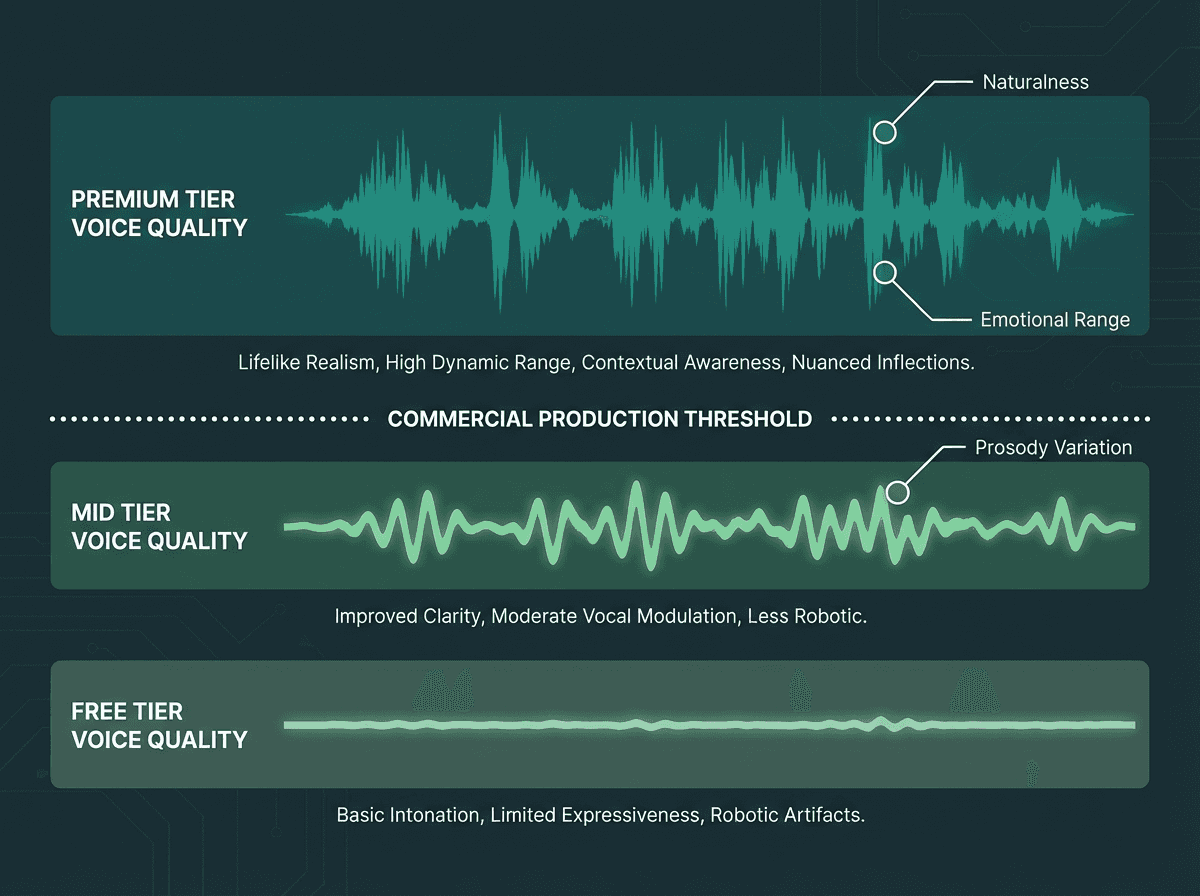
Some platforms gate their highest-quality models behind paid plans. Always test the production model, not the demo.
Key takeaways and next steps
The honest summary: genuinely free TTS with commercial rights and meaningful volume is rare. ElevenLabs' free tier is limited to 10,000 characters with no commercial license. Open-source options like Chatterbox offer unlimited usage but require self-hosting infrastructure. For most teams, the question is not which platform is free, but which platform's paid tier offers the best value once you have outgrown the free limits.
For developers and product teams prioritizing low latency and production-grade performance, Smallest.ai's Lightning model is one of the strongest options available.Smallest.ai offers $10 in free credits to test the platform, including Lightning TTS and instant voice cloning. The Lightning speech model delivers first-chunk audio in under 100ms and is built specifically for production-grade, real-time voice applications where latency and naturalness both matter. It is designed for teams that have moved past the prototype stage and need a TTS foundation that scales without surprises. Explore the top alternatives to ElevenLabs to see where Smallest.ai fits in the broader landscape, or go directly to the platform to test the Lightning model against your own content.
Frequently asked questions
Is it actually free to use a popular TTS tool?
Which TTS alternative has the most generous free tier?
Can I use free TTS tools for commercial projects?
Are open-source TTS models a viable free alternative?
What should developers prioritize when evaluating free TTS APIs?